
Why Do Hoodie Cuffs and Ribbing Have Different Colors From the Body Fabric?
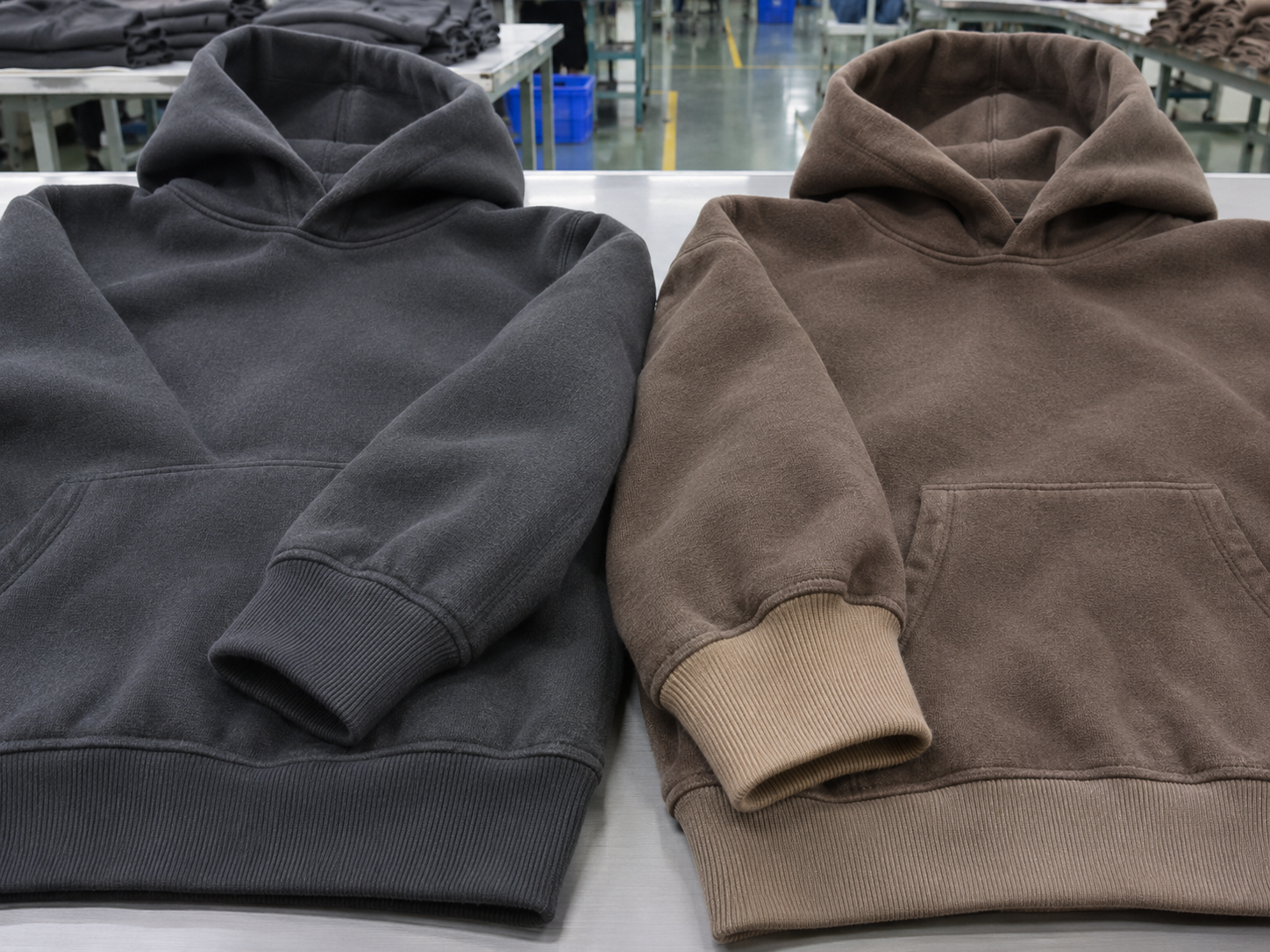
You receive the first sample of your new heavyweight hoodie.
The fit looks right. The fabric feels good, and the embroidery is exactly where you wanted it.
Then you look at the sleeves.
The cuffs are slightly different in color from the body fabric.
Not dramatically different. Just enough that you notice it whenever you look at the hoodie.
You send the factory a photo and ask why the colors don't match.
The factory replies that the body fabric and ribbing are different materials.
That explanation is technically correct, but it doesn't solve the problem.
Color differences between hoodie ribbing and body fabric are common in custom clothing manufacturing. However, that doesn't mean brands should automatically accept them.
At Dongguan Decheng Textile & Garment Co., Ltd., we work with custom hoodies, sweatshirts, joggers, and other knitted garments made from cotton, polyester blends, French terry, and fleece.
When developing these garments, we pay attention to how the main fabric and ribbing look together.
They may use different yarns, knitting structures, dyeing processes, and production batches. Each difference can influence the finished shade.
A color variation that looks minor on a small fabric swatch can become much more obvious when the two materials are sewn together.
For a clothing brand developing a premium hoodie, this small detail can affect the appearance of the entire product.
In this guide, we'll explain why hoodie ribbing colors don't always match, how manufacturers can improve color consistency, and what brands should approve before bulk production.
Why Do Hoodie Ribbing and Body Fabric Have Different Colors?
Quick Answer:
Hoodie ribbing and body fabric may have different shades because they often use different fiber compositions, knitting structures, yarns, dyeing methods, or production lots. Even when both materials are developed toward the same Pantone color, differences in texture and light reflection can make them look different. Manufacturers can reduce mismatches by comparing physical fabric samples, coordinating dyeing, evaluating materials under consistent lighting, and approving the finished hoodie before bulk production.
The important point is that matching a color reference is not always the same as matching the final appearance.
For example, a black fleece fabric and a black rib fabric may look almost identical when viewed separately.
Place them next to each other, and the ribbing might appear warmer, lighter, or less saturated.
Sometimes the problem comes from dyeing. Other times, the difference is caused by the material's surface structure.
Before trying to correct the color, the manufacturer needs to identify the likely cause.
Table of Contents
- What Is Ribbing on a Hoodie?
- Why Does the Same Color Look Different on Rib Fabric?
- Does Fabric Composition Affect Color Matching?
- Can You Use the Same Dye Formula for Fleece and Ribbing?
- Why Do Stock Rib Fabrics Often Have Color Differences?
- How Do Manufacturers Match Hoodie Ribbing Colors?
- What Happens to Ribbing After Garment Washing?
- How Do You Check Ribbing Quality Beyond Color?
- Should You Choose Stock or Custom-Dyed Ribbing?
- What Should Clothing Brands Confirm Before Production?
- Frequently Asked Questions
- Conclusion
What Is Ribbing on a Hoodie?
Ribbing is a knitted fabric commonly used around the sleeve cuffs, bottom waistband, and sometimes the neckline of a garment.
On a typical pullover hoodie, ribbing is usually attached at the sleeve openings and bottom hem.
Unlike regular single jersey, rib fabric is constructed with alternating knit and purl stitches, creating its recognizable raised vertical lines.
This construction allows the material to stretch and recover.
That matters because a hoodie cuff needs to expand when someone puts their hand through it, then return toward its original shape.
The waistband also helps control the shape and fit of the garment.
What Types of Ribbing Are Used for Hoodies?
Two common structures are 1×1 rib and 2×2 rib.
A 1×1 rib alternates one knit wale with one purl wale, while a 2×2 rib uses groups of two.
The choice affects the texture, stretch behavior, appearance, and structure of the cuff.
However, rib performance also depends on fiber composition, yarn, knitting tension, finishing, and whether elastane is included.
Is Hoodie Ribbing the Same Fabric as the Body?
Usually not.
For example, a heavyweight hoodie might use the following combination:
| Specification | Main Body Fabric | Ribbing |
|---|---|---|
| Fabric Type | French terry | Rib knit |
| Fabric Weight | 400 GSM | 280 GSM |
| Composition | 100% cotton | Cotton with elastane |
| Surface | Relatively smooth exterior | Raised rib structure |
| Primary Function | Body shape and drape | Stretch and recovery |
These specifications are examples rather than mandatory manufacturing standards.
The body fabric provides most of the garment's weight, drape, and structure. The ribbing helps control the wrist openings and bottom hem.
Because the materials serve different purposes, their construction and finished appearance may differ.
Does Ribbing Need the Same GSM as the Hoodie?
No.
A 400 GSM fleece hoodie does not necessarily require 400 GSM ribbing.
A lighter rib may provide better stretch and recovery, while a heavier rib may produce a firmer cuff.
What matters is whether the rib works with the intended garment design.
A thick oversized hoodie with very weak ribbing may look unbalanced. An excessively tight rib may cause the sleeve fabric to gather too heavily around the wrist.
We prefer evaluating ribbing on the actual garment rather than choosing it based only on GSM.
For more information, read our Fabric GSM Guide for T-Shirts and Hoodies.
Why Does the Same Color Look Different on Rib Fabric?
Imagine a clothing brand orders a dark brown hoodie.
The body fabric and ribbing are both developed toward the same color reference.
When the materials arrive, the fleece looks deep brown, but the ribbing appears slightly warmer.
The customer may assume the supplier used the wrong dye.
That is one possibility, but there are other reasons.
1. Different Knitting Structures Reflect Light Differently
French terry and rib fabric have different surface structures.
French terry generally has a smoother outer surface, while ribbing has raised ridges and recessed channels.
These raised and recessed areas create highlights and shadows.
Even if two fabrics have similar measured colors, their textures can make them appear different under the same lighting.
The effect may be particularly noticeable on black, charcoal, brown, navy, cream, and pastel shades.
It can also change when ribbing is stretched.
A flat rib swatch may look close to the body fabric, but once it is attached to the sleeve and stretched around the wrist, the difference can become more visible.
This is why evaluating the materials only when laid flat may not be enough.
2. Different Yarns Can Affect Appearance
Two fabrics can both be described as 100% cotton and still look different.
Their yarn counts, twist levels, spinning methods, and finishing treatments may vary.
These factors influence the fabric's surface and behavior during dyeing.
The rib may also contain a small amount of elastane for improved stretch recovery.
Elastane does not automatically create a color mismatch, but the overall yarn construction can affect how the finished material looks.
3. Fabric Finishing Changes the Surface
The hoodie body may be brushed, softened, compacted, or treated during finishing.
The ribbing may receive a different process.
For example, brushed fleece has a different surface appearance from a smooth cotton rib.
Even when their dyed shades are close, their final appearance can differ.
The manufacturer should therefore compare the actual finished materials rather than relying only on how they looked immediately after dyeing.
Does Fabric Composition Affect Color Matching?
Yes.
Fiber composition can have a significant influence on how fabrics respond to coloration and finishing.
Suppose a customer orders a hoodie made from 80% cotton and 20% polyester fleece.
The approved body color is dark charcoal.
The rib supplier offers two options:
- Option A: 100% cotton rib
- Option B: Cotton-polyester rib with elastane
Both may be described as charcoal, but neither is guaranteed to match the body fabric perfectly.
Why Do Cotton and Polyester Dye Differently?
Cotton is a cellulosic fiber, while polyester is a synthetic fiber.
They generally require different dye classes and processing conditions.
The technical resources from CottonWorks on textile dyeing[^1] explain the importance of dye selection, preparation, processing, and color consistency in textile production.
When dyeing cotton-polyester blends, the textile supplier may need to account for how both fiber components are colored.
A dyeing process suitable for a cotton rib may not produce the same appearance on a cotton-polyester fleece.
This is why matching two fabrics often requires more than copying a single dye formula.
Does Elastane Affect Ribbing Color?
Elastane is commonly used in rib fabrics to improve stretch and recovery.
Its response to dyeing and finishing differs from cotton and polyester.
However, the final appearance depends on the full yarn construction, fiber coverage, dye system, and finishing process.
A small elastane percentage does not necessarily cause a noticeable mismatch.
The important point is to verify the finished fabric rather than assuming that two materials will look identical because they are described using the same color name.
Fabric Composition and Color Matching
| Body Fabric | Rib Fabric | Main Concern |
|---|---|---|
| 100% cotton French terry | 100% cotton rib | Knit structure and dye-lot differences |
| 100% cotton fleece | Cotton/elastane rib | Shade, stretch, and texture |
| 80/20 cotton-poly fleece | 100% cotton rib | Different coloration behavior |
| 80/20 cotton-poly fleece | Cotton-poly/elastane rib | Dyeing and recovery performance |
| Pigment-finished cotton | Separately dyed rib | Appearance after washing |
The objective is not necessarily to use identical fiber compositions.
It is to achieve an approved combination of color, appearance, comfort, and performance.
Can You Use the Same Dye Formula for Fleece and Ribbing?
Not automatically.
Even when two materials share the same fiber composition, their yarn construction, fabric density, pretreatment, dyeing equipment, and finishing conditions can affect the final shade.
For custom-colored hoodies, textile suppliers may need separate dye adjustments for the body and rib fabric.
What Is a Lab Dip?
A lab dip is a small textile sample developed to represent a proposed dyed shade before bulk production.
It helps the buyer and manufacturer assess whether the color is sufficiently close to the target.
For a hoodie using two different fabrics, it may be necessary to evaluate the main fabric and ribbing together.
Approving a body-fabric lab dip does not automatically approve the rib.
Is a Pantone Number Enough for Color Matching?
Pantone references are useful tools for communicating color.
For apparel and textile applications, the Pantone Fashion, Home + Interiors system[^2] includes physical textile color standards.
Pantone TCX references are particularly relevant for textile color communication.
However, the reference establishes a target color.
It does not guarantee that fleece and ribbing will look identical after dyeing, finishing, stretching, or garment washing.
We therefore recommend comparing the actual materials alongside the agreed physical standard.
Why Shouldn't Brands Approve Colors From Phone Screenshots?
Digital images are affected by lighting, camera white balance, screen brightness, display settings, image processing, and compression.
A brown fabric may look warmer on one device and cooler on another.
Photographs are useful during development, but they should not be the only approval method for color-sensitive orders.
Physical swatches, finished samples, or an agreed color-evaluation procedure provide a more reliable basis for production.
Why Do Stock Rib Fabrics Often Have Color Differences?
Stock fabrics are practical for small-batch clothing production.
At Decheng, our standard MOQ for many custom garments starts from 50 pieces per color, depending on the materials and design requirements.
At this quantity, buying available ribbing may be more practical than arranging an individual custom dyeing program.
However, stock rib fabrics bring their own challenges.
Stock Black Is Not Always the Same Black
A rib supplier might offer three different black fabrics.
One may have a relatively neutral appearance. Another may have a blue undertone. The third may look slightly warmer.
All three are sold as black.
But only one may work well with the hoodie body.
The same situation can occur with heather gray, cream, wine red, navy, brown, and washed charcoal.
A color name is not a confirmed shade match.
Different Suppliers May Use Different Dye Lots
The body fabric may come from one textile mill and the ribbing from another.
Their yarns, dye systems, production batches, and finishing processes may differ.
Even when both suppliers work toward the same color standard, the finished materials may show visible variation.
For small orders, the practical challenge is often finding a suitable existing rib.
For custom-dyed orders, the challenge becomes coordinating the development and approval of the materials.
When Is a Small Color Difference Acceptable?
That depends on the design.
Some streetwear brands intentionally use tonal contrasts.
A dark brown hoodie with slightly lighter cuffs may be part of the intended aesthetic.
Other brands want the garment to appear as uniform as possible.
Neither approach is automatically wrong.
The important distinction is whether the buyer approved the difference.
If the brand expects a uniform color, the factory should not assume that an unapproved tonal variation is acceptable.
Any foreseeable limitations should be discussed during sampling, before bulk production.
How Do Manufacturers Match Hoodie Ribbing Colors?
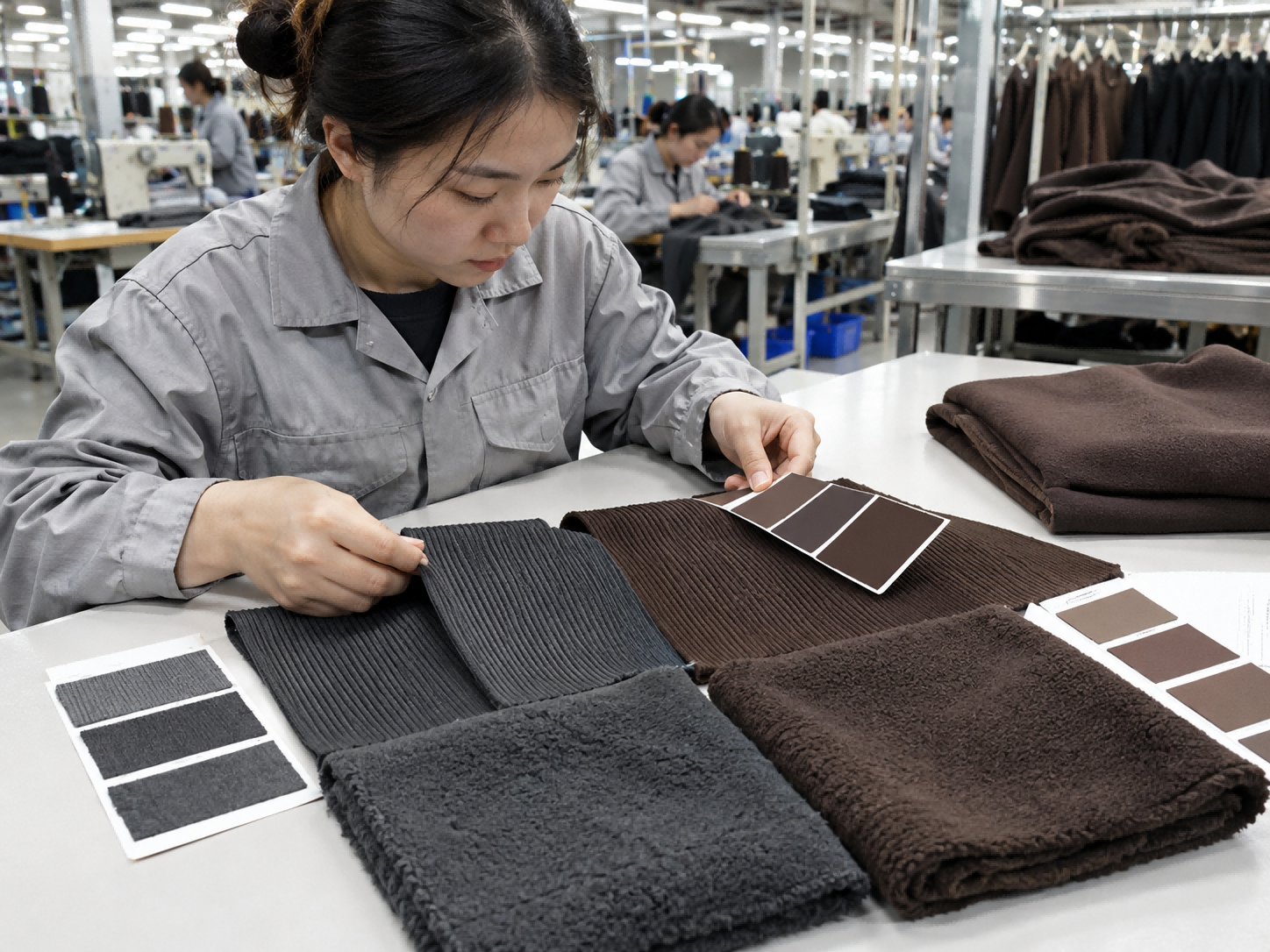
From a manufacturing perspective, we can break the color-matching process into five practical steps.
Step 1: Confirm the Main Fabric
The main fabric usually accounts for most of the hoodie's visible surface.
For this reason, approving the body fabric first is often practical.
The specification should include fiber composition, fabric structure, GSM, usable width, color reference, and required finishing.
Once the main fabric is approved, the ribbing can be selected or developed against it.
Step 2: Compare Multiple Rib Options
If stock ribbing is being used, we recommend checking several possible shade matches where available.
A supplier's color card may help narrow the choices, but the actual fabric should be compared directly with the main material.
A close match in a small swatch does not always remain visually convincing when sewn into a finished hoodie.
Step 3: Evaluate the Fabrics Under Consistent Lighting
Lighting can affect color perception.
A difference may be obvious under one light source and less noticeable under another.
The AATCC EP9 visual assessment procedure[^3] provides a recognized reference for evaluating textile color differences.
For instrumental color-difference calculations, ISO 105-J03:2009[^4] describes an approach for comparing specimens of the same material under the same measurement conditions.
There is an important limitation when dealing with hoodie production.
Fleece and rib fabric have different textures, which can complicate visual and instrumental comparisons.
A single numerical color-difference tolerance should not automatically be applied to two different fabric structures without a suitable, agreed evaluation method.
The buyer and manufacturer should define the acceptance standard for the intended garment.
Step 4: Sew a Sample Using the Actual Ribbing
A fabric swatch cannot show how every part of a garment will look.
Once ribbing is attached to the cuff, it stretches and the raised knit structure becomes more visible.
A slight difference may then become more noticeable.
We recommend evaluating the actual sample hoodie both laid flat and when worn.
Pay particular attention to the sleeve-to-cuff seam and the waistband-to-body seam.
Step 5: Keep an Approved Material Reference
Once the buyer approves the combination, the factory should retain or clearly identify an approved reference.
It can be used to compare incoming production materials and finished garments.
Relevant fabric and rib dye-lot information should also be recorded.
If the supplier or production lot changes, the color combination should be checked again.
An approved first sample does not guarantee that future rolls will automatically look identical.
What Happens to Ribbing After Garment Washing?
This is particularly important for vintage-washed and sun-faded hoodies.
A hoodie may look closely matched before washing.
After finishing, the body fabric may fade more than the ribbing, creating a noticeable difference.
Why Does the Body Fabric Sometimes Fade More?
The result depends on composition, dye system, fabric construction, and the washing process.
For example, a pigment-treated cotton-rich body and a separately dyed cotton-polyester rib may respond differently to the same finishing treatment.
The fleece surface and rib structure may also experience different mechanical abrasion.
Consequently, the original shade relationship can change after washing.
Should the Ribbing Be Dyed Darker Before Washing?
Sometimes a manufacturer may test a different starting shade to achieve the desired final appearance.
However, ribbing should not automatically be dyed darker.
If the body and rib react differently during finishing, increasing the initial darkness may not solve the problem.
The appropriate adjustment must be tested.
In some cases, the finishing process or rib material may need to change.
Why Should the Complete Hoodie Be Washed During Sampling?
For vintage-washed garments, the approved sample should represent the final product.
That includes the main fabric, rib cuffs, rib waistband, drawcords where used, embroidery, and printed artwork.
These components may respond differently to washing.
Approving unwashed materials alone can create unexpected problems later.
A good pre-wash sample does not necessarily mean the finished hoodie will meet the customer's expectations.
For more background, explore our clothing manufacturing articles about garment finishing and quality control.
How Do You Check Ribbing Quality Beyond Color?
Color matching is only part of ribbing quality.
A perfectly matched cuff is not useful if it loses its shape after a few wears or washes.
When developing custom hoodies, manufacturers should also evaluate stretch, recovery, cuff tightness, dimensions, and washing performance.
Stretch and Recovery
A cuff should stretch comfortably when the customer puts on the hoodie and recover after the force is removed.
If it stays stretched out, the sleeve opening may become loose.
The recovery behavior depends on the rib structure, yarn, fiber composition, elastane content where applicable, and finishing.
Cuff Tightness
Not every oversized hoodie requires a tight cuff.
Some brands prefer sleeves that gather strongly around the wrist. Others want a more relaxed opening.
The finished circumference and attachment ratio should reflect the intended fit.
Using tighter ribbing is not always an improvement.
Cuff Height
Cuff height affects the proportions of a hoodie.
For example, a 7 cm cuff can create a different appearance from a 9 cm cuff, even when the main body measurements remain unchanged.
The finished cuff height should be specified in the tech pack.
The same applies to the bottom waistband.
Shrinkage After Washing
The main body and ribbing may have different dimensional-change behavior.
If the rib shrinks significantly more than the body, the cuff or bottom hem may become too tight or distorted.
If the rib loses recovery during finishing, the garment may also lose its intended shape.
The AATCC TM150 garment dimensional-change test[^5] provides a recognized method for evaluating changes after home laundering.
This standard does not determine the correct cuff dimensions for a hoodie. Those dimensions still need to be established during product development.
Appearance After Laundering
The finished rib should be checked for:
- Twisting and waviness
- Uneven gathering
- Loss of elasticity
- Distorted seams
- Pilling
- Noticeable shade changes
For premium hoodies, the objective is to maintain the intended fit and appearance through normal care conditions.
Should You Choose Stock or Custom-Dyed Ribbing?
There is no single answer for every clothing order.
The best option depends on quantity, color requirements, available materials, budget, and development time.
When Does Stock Ribbing Make Sense?
Stock ribbing is often suitable for small production runs, common colors, early samples, and projects with some flexibility in shade matching.
For example, when a customer orders 50 black hoodies, evaluating available black rib fabrics may be the most practical starting point.
If a suitable material is available and performs correctly, a custom dyeing run may not be necessary.
However, the selected shade still needs buyer approval.
When Is Custom-Dyed Ribbing Worth Considering?
Custom dyeing may be appropriate when the hoodie uses a special color, stock shades are unacceptable, or the brand requires tight appearance control.
It can also be useful when planning repeat production around a specific color standard.
However, custom dyeing may involve additional sampling, setup costs, and a separate fabric mill MOQ.
A garment factory's minimum sewing quantity is not necessarily the same as the textile mill's dyeing minimum.
This distinction is important for smaller clothing brands.
Stock vs. Custom-Dyed Ribbing
| Factor | Stock Ribbing | Custom-Dyed Ribbing |
|---|---|---|
| Availability | Depends on existing inventory | Requires development |
| Color Selection | Limited to available shades | Developed toward target |
| Small Orders | Often more practical | Subject to dyeing MOQ |
| Shade Control | Depends on existing options | Greater adjustment flexibility |
| Repeat Orders | Stock lots may change | New dye lots still require checking |
| Upfront Cost | Usually lower setup commitment | May involve dyeing and development charges |
| Lead Time | Often shorter when available | Usually requires additional time |
Custom dyeing offers more flexibility, but it does not guarantee an exact match without testing and approval.
The final decision should account for both color and rib performance.
What Should Clothing Brands Confirm Before Production?
Before approving a custom hoodie for bulk production, we recommend confirming the main fabric and ribbing as one material combination.
Hoodie Ribbing Approval Checklist
| Item | What to Confirm |
|---|---|
| Body Fabric | Composition, GSM, construction, approved shade |
| Rib Composition | Cotton, polyester, elastane percentages |
| Rib Structure | 1×1, 2×2, or specified construction |
| Rib Weight | Approved GSM or equivalent requirement |
| Rib Color | Physical comparison against body fabric |
| Cuff Dimensions | Finished height and opening width |
| Waistband | Finished height and width |
| Stretch Performance | Suitable stretch and recovery |
| Washing | Appearance after required finishing |
| Final Sample | Actual approved body and rib materials |
| Production Lots | Dye-lot records and shade checking |
Why Shouldn't You Approve the Rib Separately?
One mistake is approving the body fabric and ribbing independently.
The body fabric receives approval on Monday.
The ribbing is approved on Wednesday.
But nobody places the materials side by side.
Both approvals may seem correct individually, yet the finished hoodie can still look wrong.
For that reason, the final evaluation should consider the complete garment.
What If the Factory Cannot Achieve an Acceptable Color Match?
The manufacturer should explain the available options rather than promising a result that has not been tested.
Possible solutions include sourcing another stock rib, developing a custom-dyed shade, adjusting the rib composition, changing the finishing process, or agreeing on an intentional tonal difference.
Each option affects cost, performance, or lead time.
Choosing a visually matching rib with poor stretch recovery is not a good solution.
Neither is selecting an excellent rib that visibly clashes with the body when the brand requested a uniform-color garment.
The goal is to achieve an approved balance before bulk production begins.
Frequently Asked Questions
Why Are My Hoodie Cuffs Lighter Than the Main Fabric?
The ribbing may have a different fiber composition, dye lot, knitting structure, or finish. The raised rib surface also reflects light differently from fleece or French terry. Comparing the actual finished materials helps identify the cause.
Can Hoodie Ribbing Match the Body Fabric Perfectly?
A very close visual match is often possible, but identical appearance under every lighting condition cannot be guaranteed across different fabric structures. Physical approval samples and agreed acceptance criteria help control the result.
Is Cotton Ribbing Better Than Polyester Ribbing?
Neither is automatically better. Cotton-rich ribbing offers a familiar natural-fiber feel, while synthetic fibers and elastane may be used to adjust recovery and durability. The right choice depends on the garment's design and performance requirements.
Can I Use 280 GSM Ribbing on a 400 GSM Hoodie?
Yes, provided the ribbing has suitable stretch, recovery, structure, and finished appearance. Ribbing does not need to match the body fabric's GSM.
Why Does Ribbing Change Color After Washing?
The body and ribbing may have different dye systems, compositions, or surface structures. As a result, they can respond differently to washing and garment-finishing treatments.
Can a Factory Custom Dye Ribbing for Only 50 Hoodies?
It depends on the fabric supplier and dyeing requirements. A garment MOQ of 50 pieces per color does not guarantee that custom rib dyeing is available at that quantity.
How Should I Specify Ribbing in a Hoodie Tech Pack?
Include composition, knit structure, GSM, color standard, finished cuff height, opening width, waistband dimensions, stretch requirements, and any washing or finishing specifications. A physical approved sample is also valuable.
Does Ribbing Need to Match on Vintage-Washed Hoodies?
That depends on the desired appearance. Some brands intentionally use tonal variations, while others want a closely matched finish. The final washed combination should be approved before bulk production.
Conclusion
A hoodie is rarely made from just one material.
The body fabric, cuffs, waistband, drawcords, labels, and decorations all need to work together.
When a brand wants one consistent color, the manufacturer has to consider how those materials look together, not simply whether each supplier calls them the same shade.
Ribbing color differences may come from fiber composition, knitting structure, dyeing, finishing, or production-lot variation.
Sometimes selecting a better stock rib solves the problem. Sometimes custom dyeing is needed. In other cases, the mismatch only becomes obvious after garment washing.
The important thing is to identify the cause before bulk production.
At Dongguan Decheng Textile & Garment Co., Ltd., we support OEM and ODM clothing brands developing custom hoodies, sweatshirts, joggers, T-shirts, and other knitted apparel.
Our development discussions cover fabric selection, pattern making, ribbing, decoration, sizing, and production requirements.
If you're developing a custom hoodie, send us your design, fabric specifications, color references, and expected order quantity.
We can review the material combination and discuss practical development options before production.
Contact Decheng Garment About Your Custom Hoodie Project
Footnotes & References
[^1]: CottonWorks™ — Dyeing Basics. Technical information covering textile dyeing, preparation, dye selection, shade consistency, and color performance. https://cottonworks.com/learning-hub/dyeing/dyeing-basics/
[^2]: Pantone — Fashion, Home + Interiors. Official color system used in apparel, textile, and soft-goods design, including physical cotton TCX color references. https://www.pantone.com/na/en-us/fashion-home-interiors
[^3]: AATCC — EP9: Visual Assessment of Color Difference of Textiles. Official evaluation procedure for visual assessment of textile color differences. https://members.aatcc.org/store/ep9/466/
[^4]: International Organization for Standardization (ISO) — ISO 105-J03:2009, Textiles — Tests for Colour Fastness — Part J03: Calculation of Colour Differences. Official standard describing calculated color differences for specimens of the same material measured under the same conditions. https://www.iso.org/standard/51385.html
[^5]: AATCC — TM150-2025: Dimensional Changes of Garments after Home Laundering. Official test method for evaluating dimensional changes in garments following specified laundering procedures. https://members.aatcc.org/store/tm150/556/