

How Can Clothing Manufacturers Prevent Fabric Shrinkage Before Bulk Cutting?
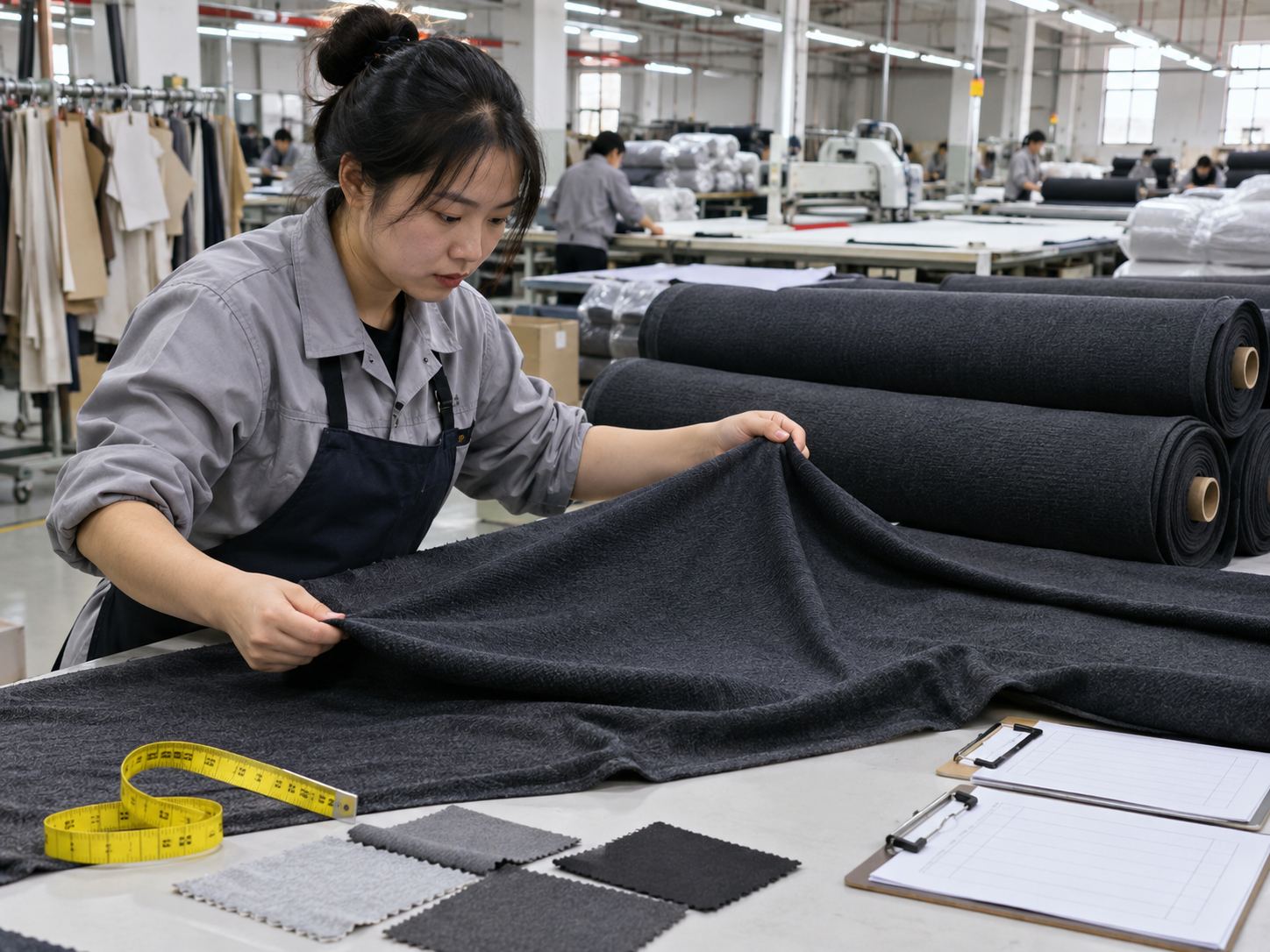
A clothing brand approves a T-shirt sample with a 72 cm body length.
The sample fits well. The shoulder width is correct, the fabric feels good, and the brand is ready to place its bulk order.
The factory cuts 500 pieces using the approved pattern.
After production, the brand washes one of the finished T-shirts.
The body length is now 69 cm.
That's a 3 cm reduction from the original measurement.
The customer contacts the manufacturer and asks why the factory didn't follow the approved size chart.
But the problem may not be the cutting pattern at all.
The fabric may have changed dimensions during laundering.
And if that possibility wasn't properly considered before bulk cutting, correcting the finished garments can be difficult or even impossible.
This is one of the reasons fabric dimensional stability matters so much in clothing manufacturing.
At Dongguan Decheng Textile & Garment Co., Ltd., we develop and manufacture custom T-shirts, hoodies, sweatshirts, joggers, and other knitted garments for clothing brands.
Our production involves different fabric constructions, including cotton jersey, French terry, fleece, and cotton-polyester blends.
A correct pattern is important, but it doesn't automatically guarantee a dimensionally stable garment.
Before cutting, we need to understand how the fabric behaves.
That means checking its usable width, GSM, shrinkage, relaxation characteristics, and compatibility with the approved garment specifications.
Finding a problem while the material is still in rolls is much easier than dealing with hundreds of incorrectly sized finished garments.
How Do Manufacturers Control Fabric Shrinkage Before Cutting?
Quick Answer:
Clothing manufacturers control fabric shrinkage before bulk cutting by checking dimensional stability, verifying fabric finishing, allowing knitted materials to relax when necessary, and developing patterns based on measured shrinkage behavior. They should also inspect usable fabric width, GSM, skewing, and consistency between production lots. Finished garments must then be tested to confirm that their dimensions meet the agreed specifications after the required laundering procedures.
The solution is not simply washing every roll before production.
That would be impractical or unnecessary for many manufacturing programs.
Instead, the factory needs to determine how much dimensional change is likely under the agreed conditions and whether the material meets the customer's requirements.
If the fabric is suitable, production can proceed according to the approved cutting and pattern plan.
If the fabric fails the agreed dimensional-stability requirements, the factory needs to address the issue before cutting.
Possible solutions may include additional finishing at the textile mill, changing the material, or revising the product development plan.
Pattern adjustments can compensate for some predictable dimensional changes. They cannot make an unsuitable or unstable material acceptable for every application.
Table of Contents
- Why Does Fabric Shrink After Washing?
- Which Fabrics Are Most Likely to Have Shrinkage Problems?
- What Should a Factory Check Before Bulk Cutting?
- How Is Fabric Shrinkage Tested?
- What Is Fabric Relaxation Before Cutting?
- Should Fabrics Be Pre-Shrunk Before Manufacturing?
- How Do Manufacturers Calculate Shrinkage Allowances?
- Why Can Fabric Shrinkage Affect Production Cost?
- How Can Factories Control Shrinkage Across Different Fabric Lots?
- What Should Brands Approve Before Bulk Cutting?
- Frequently Asked Questions
- Conclusion
Why Does Fabric Shrink After Washing?
When people hear that cotton shrinks, they sometimes imagine the individual fibers simply becoming shorter when exposed to hot water.
The actual process is more complicated.
During spinning, knitting, dyeing, finishing, and fabric handling, tension can be introduced into the textile structure.
When the material is later exposed to moisture, mechanical movement, and drying, some of those stresses may be released.
The fabric structure can change as a result.
Knitted fabrics are particularly sensitive because their yarns form interconnected loops.
Those loops can change shape as the fabric relaxes.
Technical educational resources from CottonWorks on shrinking and skewing[^1] discuss the factors that influence textile dimensional stability.
The important lesson for garment production is that shrinkage depends on more than fiber composition.
Two fabrics labeled 100% cotton may behave differently.
Even two knitted fabrics with the same weight can have different shrinkage results because of their yarn, stitch construction, finishing, and handling.
Is Shrinkage Always a Reduction in Size?
No.
Textile dimensional change can include either shrinkage or growth.
A knitted fabric may become shorter in length while becoming wider.
For example, after laundering, a particular fabric might show:
- Length change: −4%
- Width change: +1%
This is a hypothetical example of different dimensional behavior in two directions.
If the pattern maker assumes that the material shrinks equally in length and width, the finished garment could have unexpected proportions.
For this reason, dimensional changes need to be evaluated separately in the lengthwise and widthwise directions.
Why Does Shrinkage Matter for Oversized Clothing?
Oversized garments rely heavily on proportions.
Consider a boxy T-shirt with a wide chest, dropped shoulders, shorter body length, and broad sleeves.
If the body length shrinks but the chest width changes very little, the T-shirt may become noticeably shorter and boxier.
The garment might still fit across the chest, but its silhouette is no longer what the customer approved.
This matters in streetwear manufacturing because buyers are not purchasing measurements alone.
They are purchasing a particular fit and appearance.
A change of several centimeters can alter how the finished product looks when worn.
Which Fabrics Are Most Likely to Have Shrinkage Problems?
Different fabrics respond differently to laundering and finishing.
There is no reliable universal shrinkage percentage that applies to every cotton, fleece, or French terry fabric.
At our factory, common knitwear developments involve cotton jersey, French terry, brushed fleece, cotton-polyester blends, waffle fabrics, and rib knits.
Each material needs to be evaluated according to its actual construction and finishing history.
100% Cotton Single Jersey
Cotton single jersey is widely used for T-shirts.
For custom streetwear, we commonly evaluate fabric weights such as 220 GSM, 240 GSM, and 270 GSM, depending on the requested design.
Single jersey is a weft-knitted construction.
Its dimensional stability can be influenced by knitting tension, stitch length, yarn characteristics, and finishing.
A 270 GSM jersey is not automatically more dimensionally stable than a 220 GSM jersey.
A heavier weight may help create a more structured garment, but the fabric still needs to meet the required shrinkage specifications.
For oversized T-shirts, we also pay attention to side-seam twisting after laundering.
French Terry
French terry is commonly selected for hoodies, sweatshirts, and casual shorts.
It typically has a smoother outer surface and looped interior.
A 400 GSM French terry can create a substantial heavyweight hoodie, but that weight does not eliminate the possibility of shrinkage.
When reviewing French terry, the manufacturer should consider usable width, fabric weight, shrinkage, loop construction, and finished appearance.
A brand may approve the fabric's hand feel and drape, but dimensional stability still needs to be checked.
Brushed Fleece
Brushed fleece is frequently used for hoodies, sweatshirts, and sweatpants.
Products may use 300–320 GSM fleece or heavier fabrics, depending on the customer's specifications.
The brushed interior creates a softer, warmer feel.
However, brushing is a surface-finishing process. It does not automatically guarantee that the fabric will remain dimensionally stable.
The knit construction, fiber composition, and mill finishing process still matter.
Cotton-Polyester Blends
Cotton-polyester fabrics are widely used in casualwear and streetwear.
Brands may choose these blends to balance hand feel, cost, strength, comfort, and other performance requirements.
But adding polyester does not automatically guarantee negligible shrinkage.
For example, an 80% cotton / 20% polyester fleece still needs to be evaluated under the required washing and drying conditions.
The fabric's actual construction and finishing are more useful than assuming a shrinkage percentage based only on composition.
Fabric Shrinkage Comparison
| Fabric | Example Development Specification | Main Dimensional Concern |
|---|---|---|
| 100% Cotton Jersey | 220–270 GSM T-shirts | Length and width change, twisting |
| French Terry | 350–400 GSM hoodies | Loop relaxation and garment dimensions |
| Brushed Fleece | 300–400 GSM sweatshirts | Dimensional change after laundering |
| Cotton-Polyester Jersey | T-shirts and casualwear | Stability after finishing |
| Cotton-Polyester Waffle | Tops and shorts | Textured knit dimensional behavior |
| Rib Knit | Cuffs and waistbands | Stretch recovery and differential shrinkage |
These examples describe fabric applications, not guaranteed shrinkage rates.
When selecting a material, we prefer reviewing its actual performance rather than relying on general assumptions about fiber type or GSM.
What Should a Factory Check Before Bulk Cutting?
Fabric inspection should involve more than checking whether the material matches the approved color.
Before bulk cutting, the factory needs to confirm that the supplied material meets the requirements used during pattern development and costing.
Several details deserve particular attention.
1. Finished Fabric Width
Usable fabric width directly affects marker planning and material consumption.
Suppose a T-shirt pattern was originally calculated using fabric with a usable width of 180 cm.
The bulk fabric arrives with a usable width of 175 cm.
That difference may change the cutting arrangement.
Some pattern pieces may no longer fit the original marker efficiently, and the factory could require additional fabric for the same quantity of garments.
This is why we check usable fabric width before confirming the final cutting plan.
The width shown on a fabric supplier's quotation should not automatically be treated as the exact usable width of every delivered roll.
2. Fabric GSM
GSM stands for grams per square meter.
If a customer approves 320 GSM fleece, the incoming material should be checked against the agreed weight and tolerance.
Fabric weight affects hand feel, drape, garment weight, material consumption, and handling during cutting and sewing.
However, fabric GSM is also related to its dimensional condition.
A knitted fabric under tension may have a different measured weight per square meter from the same material after relaxation.
For this reason, we consider fabric weight, width, and dimensional behavior together.
3. Length and Width Shrinkage
The factory should test dimensional change under the agreed laundering conditions.
The lengthwise and widthwise results must be recorded separately.
For example, 4% shrinkage in length and 2% shrinkage in width have different implications for pattern development.
The buyer and factory should agree on acceptable limits before production.
4. Fabric Skewing and Spirality
Shrinkage is not the only dimensional concern.
Knitted fabrics can also develop skewing or spirality.
A familiar example is a T-shirt whose side seam twists toward the front after washing.
The body length may still be acceptable, and the chest width may remain within tolerance.
Yet the garment no longer hangs correctly.
This can relate to yarn twist, knitting, processing, and fabric relaxation.
For cotton single jersey, it is worth evaluating before the fabric is released for bulk cutting.
5. Surface and Material Defects
Fabric inspection should also identify holes, stains, knitting defects, uneven dyeing, unwanted creases, damaged areas, and significant shade differences.
Cutting defective material can create unnecessary replacement work later.
The objective is to identify material problems while the affected rolls can still be separated, investigated, or returned to the supplier.
How Is Fabric Shrinkage Tested?
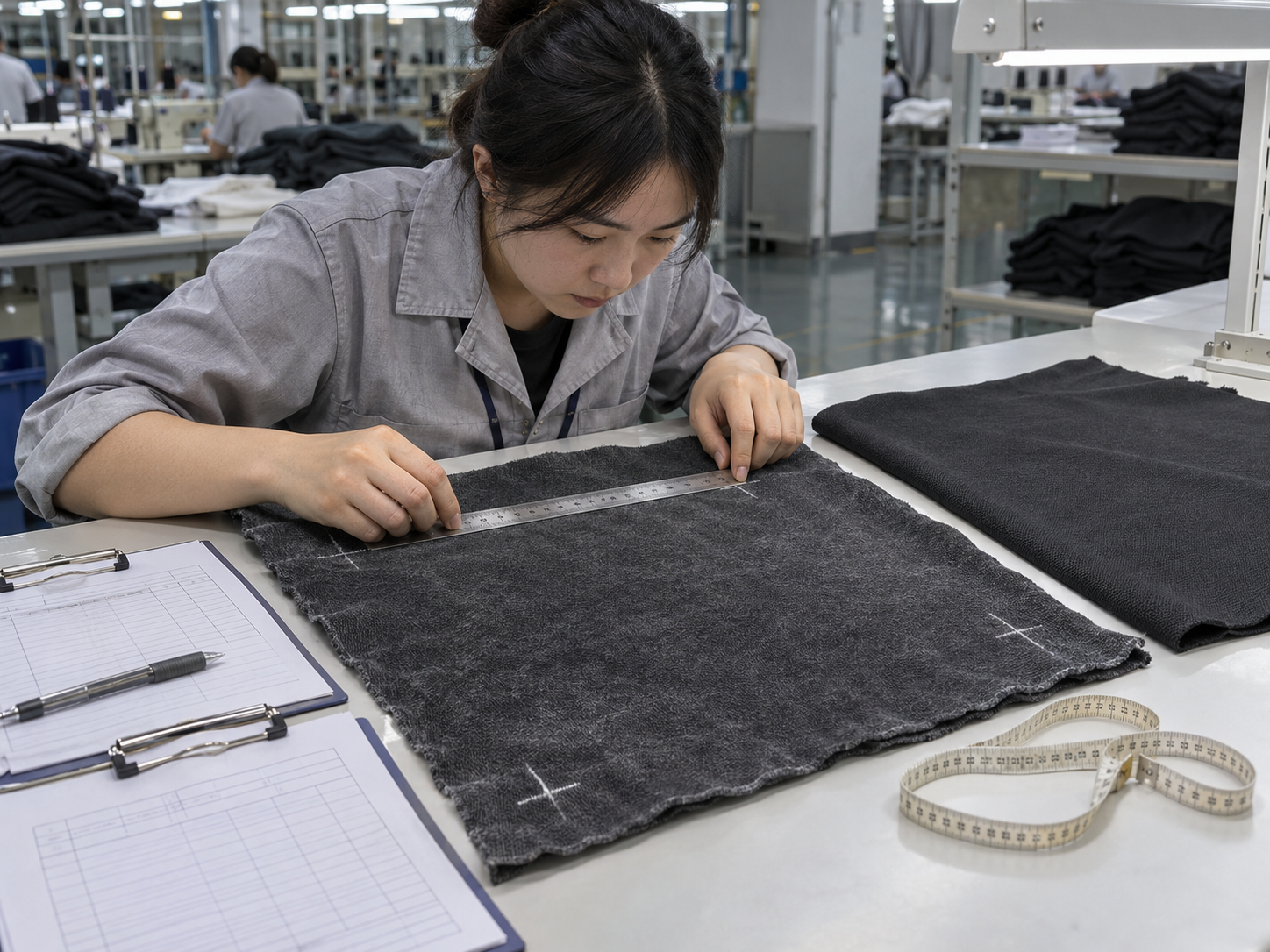
A fabric shrinkage test compares material dimensions before and after a specified treatment.
However, a reliable test requires more than simply washing a fabric sample and measuring it afterward.
The test procedure needs to be controlled so that results can be compared.
Which Fabric Shrinkage Testing Standards Are Used?
Two widely recognized AATCC methods are:
- AATCC TM135 — Dimensional Changes of Fabrics after Home Laundering[^2]
- AATCC TM150 — Dimensional Changes of Garments after Home Laundering[^3]
TM135 is intended to evaluate dimensional changes in fabrics.
TM150 evaluates dimensional changes in finished garments under specified home-laundering conditions.
The distinction matters.
Fabric testing provides information that can support material approval and pattern development.
Garment testing helps verify the behavior of the complete sewn product. TM150 may not be applicable to some garments made from certain stretch fabrics, so the appropriate method should be checked for each product.
Another relevant reference is ISO 5077:2007[^4], which specifies a method for determining textile dimensional changes after defined washing and drying procedures.
The selected test conditions should reflect the buyer's requirements and intended garment care.
How Do You Calculate Fabric Shrinkage?
A practical formula is:
Shrinkage (%) = (Original Dimension − Dimension After Washing) ÷ Original Dimension × 100
For example, consider a hypothetical cotton fabric test.
| Measurement | Before Washing | After Washing | Dimensional Change |
|---|---|---|---|
| Length | 50.0 cm | 48.0 cm | −4.0% |
| Width | 50.0 cm | 49.0 cm | −2.0% |
The results indicate:
- Length shrinkage: 4%
- Width shrinkage: 2%
These are illustrative figures rather than actual test results from a Decheng production order.
The calculation demonstrates why both directions need to be considered separately.
Does One Washing Cycle Tell You Everything?
Not necessarily.
Some materials continue to change dimensions during additional laundering cycles.
The test conditions and number of cycles should follow the selected method and agreed performance requirements.
If a brand is developing premium heavyweight T-shirts expected to maintain their shape through repeated home laundering, the testing program should reflect that requirement.
It is also important to record the fabric lot tested.
Without suitable lot identification, a passing result may be difficult to connect to the material actually used in bulk production.
What Is Fabric Relaxation Before Cutting?
Fabric relaxation means allowing a material to release some of the tension introduced during manufacturing, finishing, winding, transport, or handling.
It is especially relevant to knitted fabrics.
When fabric is tightly wound on a roll or pulled during spreading, its dimensions may not represent the condition it will reach after the tension is removed.
If the fabric is cut while excessively stretched, the cut panels may change dimensions afterward.
That can affect sewing accuracy and finished garment measurements.
Why Shouldn't Knitted Fabric Always Be Cut Immediately After Unrolling?
Consider a cotton jersey fabric that has been tightly wound.
If it is pulled across the cutting table under tension, the fabric may remain stretched while the marker is prepared.
After cutting, the panels can relax and recover some of their dimensions.
The resulting pieces may differ from the intended pattern dimensions.
This can create inconsistent measurements during sewing.
The appropriate preparation method depends on the material's actual behavior.
Does Every Fabric Need 24 Hours of Relaxation?
No.
There is no universal requirement that every knitted fabric must rest for exactly 24 hours before cutting.
The appropriate period depends on fabric construction, processing history, storage conditions, and the relaxation procedure.
Some fabrics require additional preparation, while others may be suitable for cutting sooner.
The factory should establish the process based on the actual material and production requirements instead of applying one fixed time to every roll.
Is Fabric Relaxation the Same as Pre-Shrinking?
No.
Fabric relaxation addresses some of the tension present in the supplied material.
Pre-shrinking or dimensional stabilization is intended to reduce the changes that may occur during later treatments or laundering.
A fabric can be relaxed before cutting and still shrink during washing.
Similarly, fabric that has received compacting treatment at the textile mill may still require suitable handling in the cutting room.
The processes are related, but they serve different purposes.
Should Fabrics Be Pre-Shrunk Before Manufacturing?
For many knitted garments, textile mill finishing has an important influence on dimensional stability.
However, pre-shrinking does not always mean washing entire fabric rolls in the same way that consumers wash garments.
Textile mills may use mechanical or other finishing methods to improve stability.
The appropriate approach depends on the material and required performance.
What Is Fabric Compacting?
Compacting is a mechanical finishing process used to improve dimensional stability in certain knitted fabrics.
The process compresses the textile structure, helping reduce some of the dimensional change that might otherwise occur during later laundering.
CottonWorks' technical guidance on mechanical finishing[^5] explains processes such as relaxation drying and compaction.
These treatments can help control residual shrinkage.
However, they do not necessarily eliminate all dimensional changes.
Can Compacted Fabric Still Shrink?
Yes.
The result depends on the fabric construction, processing conditions, and laundering procedure.
A supplier may describe a fabric as pre-shrunk or compacted, but that statement alone is not sufficient to confirm compliance with a buyer's dimensional-stability requirements.
The material should still be tested against the agreed specification.
Should a Factory Wash Every Fabric Roll Before Cutting?
Not as a standard practice for every order.
Washing entire fabric rolls can be unnecessary, expensive, or unsuitable for certain materials.
It may introduce additional handling, drying, creasing, and quality risks.
A more practical approach is to evaluate the mill's finishing information and test the supplied material.
If the fabric does not meet the required performance, the factory should discuss appropriate corrective actions with the supplier and buyer.
That may involve additional mill finishing, replacement material, or an approved garment-treatment process.
The final result must still be verified.
How Do Manufacturers Calculate Shrinkage Allowances?
This is one of the most practical parts of garment development.
Suppose a clothing brand wants a T-shirt with a finished body length of 72 cm after the specified washing process.
The actual fabric is tested, and the measured length shrinkage is 4%.
How should the pattern maker approach the dimensions?
Example: Calculating a Body Length Allowance
Assume that the finished garment will change by the same percentage observed in the relevant test.
The theoretical calculation is:
Required pre-wash length = Target finished length ÷ (1 − Shrinkage rate)
For a target length of 72 cm and 4% shrinkage:
72 ÷ 0.96 = 75.00 cm
The theoretical pre-wash length would be 75 cm.
This does not automatically mean the cutting pattern should be changed to exactly 75 cm.
It provides a starting point for development and validation.
What About Chest Width?
Suppose the brand wants a finished half-chest width of 60 cm.
The relevant widthwise shrinkage is 2%.
The calculation becomes:
60 ÷ 0.98 = 61.22 cm
The theoretical pre-wash half-chest target would be approximately 61.22 cm.
Example Garment Shrinkage Compensation Table
| Measurement | Finished Target | Assumed Shrinkage | Theoretical Pre-Wash Target |
|---|---|---|---|
| Body Length | 72.0 cm | 4% | 75.00 cm |
| Half Chest | 60.0 cm | 2% | 61.22 cm |
| Sleeve Length | 62.0 cm | 4% | 64.58 cm |
| Half Hem Width | 58.0 cm | 2% | 59.18 cm |
These are mathematical examples, not approved cutting measurements.
Why Can't a Factory Simply Apply These Calculated Dimensions?
Because fabric shrinkage and garment shrinkage are not necessarily the same.
A finished garment includes seams, stitching, ribbing, different fabric directions, trims, and possibly several materials.
Sewing, finishing, and laundering can affect the final dimensions.
A fabric test provides useful information for pattern development, but it does not replace garment testing.
The pattern maker must also consider grain direction, seam allowances, construction, and the approved measurement procedure.
We also need to avoid double compensation.
If the approved pattern already accounts for the fabric's actual behavior, adding another shrinkage allowance can make the finished garment too large.
How Should the Final Pattern Be Approved?
A practical development process is:
- Test the actual production fabric.
- Develop or adjust the pattern using the relevant results.
- Cut and sew a representative sample.
- Apply the intended washing or finishing process.
- Measure the finished garment against the approved specifications.
- Revise the pattern when necessary before bulk cutting.
The final decision should be based on the approved finished garment, not the formula alone.
Why Can Fabric Shrinkage Affect Production Cost?
Shrinkage is not only a quality-control issue.
It can also affect fabric consumption, production planning, and the total cost of an order.
For heavyweight knitwear and garments using large pattern pieces, changes in usable fabric width and marker efficiency can be particularly important.
Fabric Width Affects Cutting Efficiency
Suppose the original costing calculation uses a fabric width of 185 cm.
After the material is received and prepared, the usable width is found to be smaller.
The marker may need to be rearranged.
That can increase the amount of material required.
Even a small change in consumption per garment becomes significant over a larger order.
Example: How Much Additional Fabric Could Be Needed?
Assume:
- Original fabric consumption: 1.40 meters per garment
- Revised fabric consumption: 1.45 meters per garment
- Order quantity: 1,000 garments
The additional fabric required would be:
(1.45 − 1.40) × 1,000 = 50 meters
This is a hypothetical example, but it shows why accurate fabric width and dimensional-stability information matter during costing.
If the factory discovers the difference only after cutting begins, the purchasing and production plans may need to change.
Do Shrinkage Allowances Increase Fabric Consumption?
They can.
If a garment needs additional length or width to meet the approved final measurements, the marker may require more material.
However, adding 4% to a body-length measurement does not automatically increase total fabric consumption by 4%.
The actual effect depends on the complete pattern layout.
Sleeves, hoods, pockets, fabric width, and size distribution can all influence marker efficiency.
The consumption calculation needs to be revised using the updated pattern.
Why Is Recutting More Expensive Than Testing?
Imagine a factory has already cut 800 T-shirts.
Then it discovers that the fabric cannot meet the approved finished measurements.
The production team may need to investigate the material, check the patterns, replace cut panels, source additional fabric, and revise the schedule.
Some pieces may not be recoverable.
Identifying dimensional issues before cutting is therefore important for both quality and cost control.
For brands comparing quotations, it is worth understanding whether the manufacturer has properly evaluated fabric consumption and shrinkage.
A lower initial price is not necessarily a saving if the garment cannot meet the required specifications.
How Can Factories Control Shrinkage Across Different Fabric Lots?
One passing fabric sample does not necessarily represent every roll in a bulk order.
Material may arrive from different production lots.
Even when the fabric has the same composition, GSM, and color, there may be differences in finishing and dimensional behavior.
Keep Fabric Lot Identification
A factory should maintain sufficient information to trace the material used in production.
Relevant records may include the supplier, fabric specification, color, lot number, roll identification, and inspection results.
If a problem appears later, these records can help identify which fabric was used.
Avoid Mixing Unverified Lots
Suppose the first fabric lot meets the approved shrinkage requirement.
A second lot arrives with different dimensional behavior.
If the factory combines the two lots without verification, finished garments may vary even when they are cut using the same pattern.
That is not simply a pattern-making issue.
It is a material-control issue.
The additional lot should be checked before release for production.
Check Width, GSM, and Shrinkage Together
Fabric weight, usable width, and dimensional stability are related to construction and finishing.
A material may meet the weight specification but have an unexpected width.
Another may have an acceptable width but fail the agreed shrinkage requirement.
Reviewing these specifications together provides a better understanding of whether the material is suitable for bulk cutting.
Verify the Finished Garment
Fabric testing helps identify risks before cutting.
Finished-garment testing evaluates whether the complete product performs as intended.
Both are important.
For example, a T-shirt may include rib neck binding with different dimensional behavior from its main fabric.
Joggers may include waistband elastic, rib cuffs, and multiple fabric panels.
The finished garment therefore needs to be evaluated as a complete product.
For more information about production inspection, read our clothing quality control guide.
What Should Brands Approve Before Bulk Cutting?
Before a clothing factory releases the bulk cutting plan, the buyer and manufacturer should have a clear understanding of the approved materials, pattern, specifications, and performance requirements.
Pre-Bulk Cutting Approval Checklist
| Item | What Needs Approval |
|---|---|
| Main Fabric | Composition, construction, GSM, color |
| Fabric Width | Approved usable width |
| Shrinkage | Lengthwise and widthwise results and limits |
| Fabric Finish | Approved finishing condition |
| Pattern | Final version developed for the production fabric |
| Size Chart | Finished garment dimensions |
| Measurement Tolerances | Acceptable size variation |
| Ribbing | Composition and dimensional performance |
| Washing | Intended treatment and care conditions |
| Pre-Production Sample | Representative finished garment |
| Fabric Lots | Material consistency and traceability |
| Cutting Authorization | Final release before bulk production |
What If the Sample Fabric and Bulk Fabric Are Different?
This can happen during product development.
A first sample may be made using available fabric because the final bulk material has not yet arrived.
That can be useful for evaluating the design and general fit.
However, the sample fabric's dimensional behavior may not represent the actual production material.
If the material changes, the factory should reassess the relevant specifications.
Depending on the differences, another sample using the production fabric may be necessary.
Why Is a Pre-Production Sample Important?
A pre-production sample helps establish the production-ready version of the garment.
Ideally, it should represent the approved pattern, production fabric, construction, decoration, finishing, and finished measurements.
It provides a physical reference for the production team.
However, an approved sample does not eliminate the need for incoming-material checks and ongoing quality control.
For a broader overview, see our clothing production process guide.
Frequently Asked Questions
Should Clothing Factories Wash Fabric Before Cutting?
Not always. Many fabrics are supplied after appropriate mill finishing and can be evaluated through testing. Additional pre-shrinking or treatment depends on the material, performance requirements, and results.
How Much Does 100% Cotton Shrink?
There is no universal percentage. Shrinkage depends on yarn, fabric construction, finishing, and washing conditions. The actual fabric should be tested before a shrinkage allowance is selected.
Does 400 GSM Cotton Fleece Shrink Less Than 300 GSM Fleece?
Not necessarily. Heavier fabric does not automatically have better dimensional stability. Construction and finishing are important.
How Long Should Knitted Fabric Relax Before Cutting?
There is no single correct relaxation time for every fabric. The factory should establish the preparation procedure according to the material and its behavior.
Can a Pattern Maker Compensate for Fabric Shrinkage?
Yes, if the dimensional changes are sufficiently predictable. The pattern can be adjusted, but the finished garment must still be tested and approved.
What Is the Difference Between Fabric Shrinkage and Garment Shrinkage?
Fabric shrinkage measures dimensional changes in the textile material. Garment shrinkage measures changes in the complete sewn garment, where seams, ribbing, construction, and finishing can also influence the result.
Is Pre-Shrunk Fabric Guaranteed Not to Shrink?
No. Pre-shrunk material has generally received treatment intended to reduce dimensional changes. Residual shrinkage should still be checked against the agreed specification.
What Happens If Shrinkage Is Discovered After Bulk Cutting?
The factory should investigate the affected fabric lots, patterns, and finished dimensions. Depending on the problem, corrective action may involve replacing panels, sourcing additional fabric, or adjusting production. Some defects cannot be fully corrected after cutting.
Does Fabric Shrinkage Affect Printing and Embroidery Placement?
It can. If garment panels or finished garments change dimensions, decoration placement may also be affected. Artwork positioning should be approved according to the actual production and finishing sequence.
What Documents Should a Clothing Brand Provide?
A useful tech pack should include finished measurements, tolerances, fabric specifications, washing instructions, artwork placement, construction details, and relevant performance requirements. Physical reference garments can also help when available.
Conclusion
Fabric shrinkage is much easier to address before cutting than after production.
But proper shrinkage control involves more than asking the fabric supplier for pre-shrunk material.
The factory needs to understand the supplied fabric, verify its dimensional behavior, prepare it appropriately, and develop the pattern using reliable information.
The finished garment then needs to be tested under the agreed conditions.
For custom T-shirts, hoodies, sweatshirts, and joggers, these checks are particularly important because knitted fabrics may change dimensions during production and laundering.
A garment can be sewn using the correct pattern and still fail the customer's expectations if the fabric behaves differently from what was anticipated.
At Dongguan Decheng Textile & Garment Co., Ltd., we work with B2B clothing brands on OEM and ODM garment development.
Our manufacturing discussions cover fabric sourcing, technical specifications, sampling, pattern development, cutting, sewing, decoration, and quality inspection.
If you're preparing a new clothing collection, we recommend discussing dimensional stability during development rather than waiting until bulk production begins.
Share your tech pack, fabric requirements, finished size chart, and order quantity with our team.
We can review the project and discuss suitable materials, development requirements, and production planning.
Contact Decheng Garment About Your Custom Clothing Project
Footnotes & References
[^1]: CottonWorks™ — Shrinking and Skewing. Technical educational resource discussing dimensional stability and fabric distortion in textile production. https://cottonworks.com/learning-hub/quality-assurance/shrinking-and-skewing/
[^2]: AATCC — TM135-2025: Dimensional Changes of Fabrics after Home Laundering. Official fabric dimensional-change test method. https://members.aatcc.org/store/tm135/543/
[^3]: AATCC — TM150-2025: Dimensional Changes of Garments after Home Laundering. Official dimensional-change test method for finished garments. https://members.aatcc.org/store/tm150/556/
[^4]: International Organization for Standardization (ISO) — ISO 5077:2007: Textiles — Determination of Dimensional Change in Washing and Drying. Official international standard describing dimensional-change determination after specified laundering procedures. https://www.iso.org/standard/41877.html
[^5]: CottonWorks™ — Mechanical Finishing. Technical guidance covering relaxation drying, fabric compaction, and other mechanical finishing processes. https://cottonworks.com/learning-hub/finishing/mechanical-finishing/