

How Do You Get Consistent Vintage Wash Results in Bulk Clothing Production?
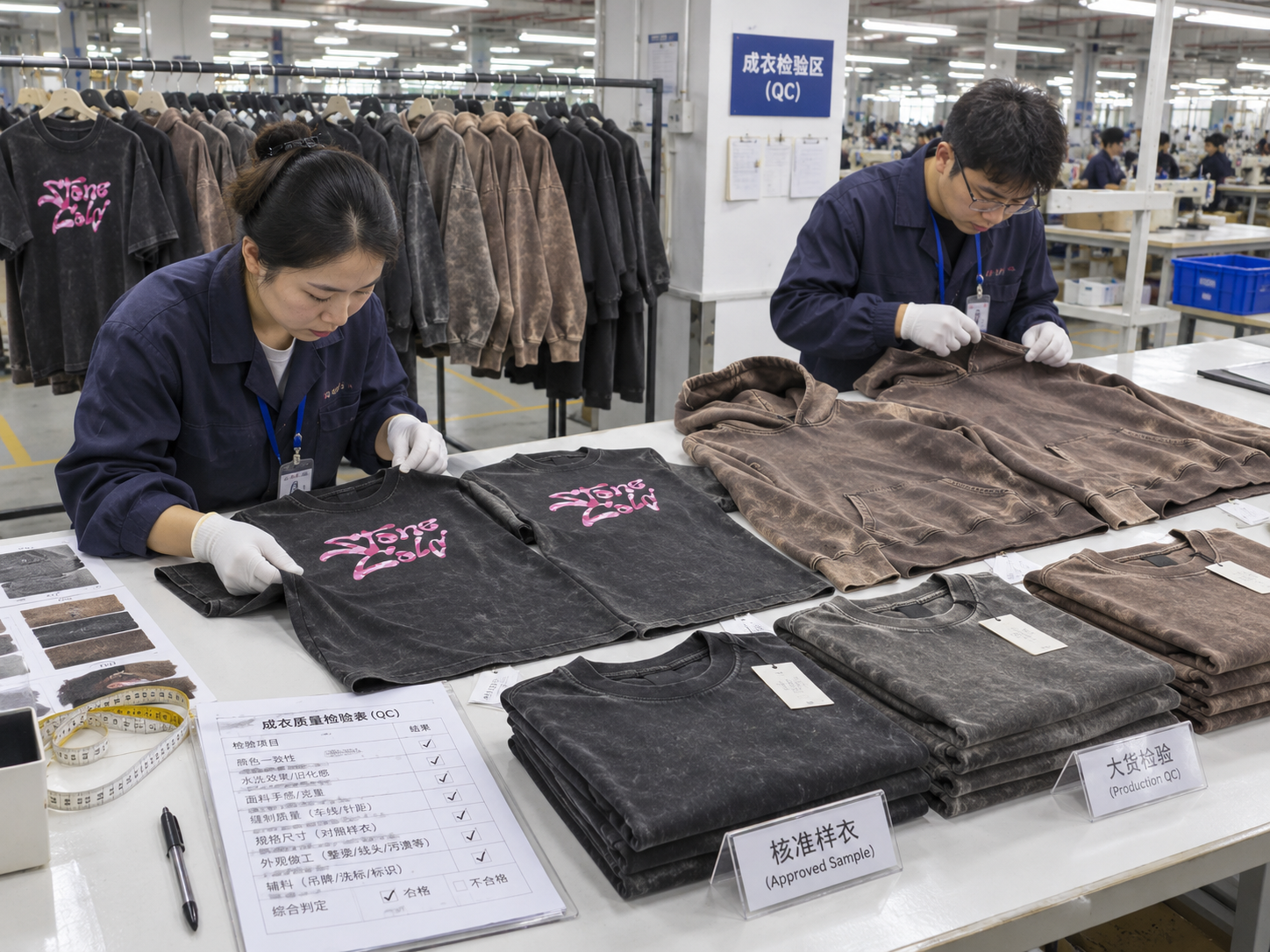
Your vintage-washed hoodie sample looks exactly how you imagined.
The black has faded into a soft charcoal. The seams have a slightly worn appearance, and the fabric feels broken-in without looking damaged.
You approve the sample and place an order for 500 pieces.
Then the bulk production photos arrive.
Some hoodies are darker. Others have stronger fading around the seams. A few look almost gray.
The factory explains that these differences are normal because of the washing process.
But how much variation is acceptable? And how do you prevent the finished garments from looking as though they came from three different collections?
These are questions every clothing brand should discuss before approving a vintage wash order.
At Dongguan Decheng Textile & Garment Co., Ltd., we work with custom streetwear products involving different fabrics, printing techniques, embroidery, and garment finishing requirements.
When developing vintage-washed or sun-faded clothing, the final color is only part of the discussion. Fabric composition, dyeing method, garment construction, washing conditions, decoration, and finished measurements all influence the result.
Making one attractive sample is important. Making that appearance repeatable across a production order is the real challenge.
What Is the Best Way to Control Vintage Wash Results in Bulk Production?
Quick Answer:
To achieve consistent vintage wash results in bulk clothing production, manufacturers should approve a physical washed garment, confirm the base fabric and dyeing method, establish acceptable color variation limits, evaluate shrinkage and colorfastness, and conduct a controlled production trial before finishing the entire order. Final inspection should compare bulk garments against the approved washed reference rather than relying only on photographs or unwashed fabric swatches.
The important point is that vintage washing is not one universal manufacturing process.
Two suppliers can both describe their service as "vintage wash" while producing very different results.
Before deciding how to control the process, we need to understand exactly what the brand wants the finished garment to look and feel like.
Table of Contents
- What Does Vintage Wash Mean in Clothing Manufacturing?
- Why Do Vintage-Washed Garments Have Different Colors?
- Which Fabrics Work Best for Vintage Wash Clothing?
- How Is Sun-Faded Washing Different From Vintage Washing?
- Should Printing and Embroidery Be Done Before or After Washing?
- How Do You Approve Vintage Wash Colors Before Bulk Production?
- How Does Vintage Washing Affect Garment Measurements?
- What Quality Tests Should Be Done on Washed Clothing?
- How Can Brands Control Vintage Wash Production Costs?
- What Should You Send a Vintage Wash Clothing Manufacturer?
- Frequently Asked Questions
- Conclusion
What Does Vintage Wash Mean in Clothing Manufacturing?
Vintage wash is a general term for garment finishing processes that create an aged, softened, faded, or worn-in appearance.
It is commonly used on oversized T-shirts, heavyweight hoodies, sweatshirts, joggers, streetwear shorts, and matching clothing sets.
However, the term does not tell a manufacturer exactly how the finished clothing should look.
One brand may want a slightly faded black T-shirt. Another may want a heavily washed hoodie with visible fading around the seams. A third may prefer a warm, washed-brown appearance with very little abrasion.
All three may call their design "vintage washed."
From a manufacturing perspective, they require different finishing decisions.
The actual process may involve garment washing, enzyme treatment, pigment coloration, controlled abrasion, or a combination of techniques, depending on the fabric and intended result.
What Are the Common Types of Vintage Clothing Finishes?
| Finishing Type | Typical Appearance | Main Production Concern |
|---|---|---|
| Standard Garment Wash | Softer, more relaxed garment | Shrinkage and hand feel |
| Vintage Wash | Aged or faded appearance | Shade consistency |
| Enzyme Wash | Softened or mildly worn surface | Surface change and fiber strength |
| Pigment Wash | Washed-down pigment appearance | Rubbing colorfastness |
| Acid-Style Wash | Irregular, high-contrast fading | Repeatability and surface damage |
| Sun-Faded Effect | Appearance of gradual light exposure | Fading placement and intensity |
These descriptions are not interchangeable technical instructions.
For instance, a vintage finish on a 220 GSM cotton T-shirt may require a different approach from a pronounced faded effect on a 400 GSM cotton-polyester fleece hoodie.
A supplier should not automatically use the same processing conditions for both materials.
For clothing brands, the most practical approach is to approve a physical finished garment rather than approving a finishing name alone.
Why Do Vintage-Washed Garments Have Different Colors?
Color variation is one of the biggest challenges in washed clothing production.
Some variation is intentional. It may be part of the product's design.
Other variation comes from differences in fabric lots, washing conditions, garment construction, or finishing.
The challenge is distinguishing acceptable vintage character from avoidable quality problems.
1. The Base Fabric Comes From Different Dye Lots
Imagine a production order of black oversized hoodies.
The factory sources fabric from two dye lots. Both appear black before washing, but the colors may have been produced with slightly different dye concentrations or processing conditions.
After the same vintage wash treatment, one lot fades toward charcoal while the other develops a warmer tone.
A difference that was barely visible before washing can become obvious afterward.
Where possible, we prefer using the same approved fabric specification and compatible dye lots for a production color.
When multiple dye lots are unavoidable, the manufacturer should assess their response to the intended finishing process before combining them.
2. Fiber Composition Changes the Washing Result
Two fabrics can have the same GSM but behave differently during washing.
Consider these examples:
- Fabric A: 100% cotton fleece, 400 GSM
- Fabric B: 80% cotton / 20% polyester fleece, 400 GSM
Although both materials weigh 400 grams per square meter, the fibers and dye systems may respond differently.
A treatment that changes the appearance of cotton fibers may leave polyester fibers relatively unchanged.
That can influence the final color, fading contrast, and surface appearance.
This is why we do not recommend replacing one fabric with another based only on fabric weight.
If a customer wants to change fabric composition to reduce costs, the replacement material needs to be checked against the approved washing effect.
3. Washing Conditions Vary Between Batches
Several operating conditions influence garment washing:
- Processing time and water temperature
- Machine loading and liquor ratio
- Mechanical action
- Chemical concentration
- Fabric construction
- Drying method
A small sample load and a larger production load may not create identical results without process adjustment.
Even when the same recipe is used, the garment-to-machine interaction can change with loading conditions.
For that reason, a successful sample wash should be followed by an appropriate bulk-process trial.
4. Garment Construction Influences Fading
A finished hoodie contains many areas that respond differently to mechanical washing.
Hood seams, rib cuffs, waistbands, pockets, shoulder seams, double-layer sections, and folded edges do not all receive the same level of abrasion.
Raised seams may become lighter than flat fabric panels.
That may be desirable for a strongly vintage appearance.
However, if the pocket or sleeve area becomes dramatically lighter than the approved reference, the result may no longer match the customer's expectations.
The factory should evaluate the washed garment as a complete product, not merely as a piece of fabric.
5. Lighting Changes How Washed Colors Appear
A washed-black hoodie photographed under warm indoor lighting may look brown.
The same hoodie may look charcoal under neutral daylight and considerably lighter under strong studio lighting.
This makes approving washed colors through messaging-app photographs risky.
Photos are helpful for checking general fading patterns and construction, but physical reference garments are more reliable for final color decisions.
For color-sensitive projects, comparison should be made under agreed and consistent viewing conditions.
Which Fabrics Work Best for Vintage Wash Clothing?
There is no single best fabric for all vintage wash designs.
The right choice depends on the intended appearance, garment shape, finishing process, and target customer.
At Decheng, our custom streetwear developments commonly involve cotton jersey, French terry, brushed fleece, cotton-polyester blends, and other knitted materials.
Cotton Jersey for Vintage T-Shirts
Cotton jersey is commonly used for vintage-washed T-shirts.
For streetwear development, weights such as 220 GSM, 240 GSM, and 270 GSM can be useful starting points.
A lighter jersey may create a softer, more relaxed silhouette. A heavier jersey can help an oversized T-shirt maintain a boxier shape.
However, GSM alone does not determine the final washed effect.
Yarn selection, knitting structure, dyeing, and finishing all influence the result.
We also pay attention to potential shrinkage, side-seam twisting, and changes in the neckline after washing.
French Terry for Vintage-Washed Hoodies
French terry has a generally smooth outer surface and looped inner construction.
It is often suitable for heavyweight casualwear and streetwear.
For custom hoodie projects, specifications around 350–400 GSM are common development options, subject to material availability.
A 400 GSM French terry hoodie can provide a substantial appearance while maintaining a different hand feel from brushed fleece.
But heavier fabric may also create bulk around seams and folded areas.
After washing, the garment should be evaluated for shape, softness, surface appearance, and dimensional changes.
Brushed Fleece for Vintage Sweatshirts
Brushed fleece is commonly used for hoodies, sweatshirts, and joggers.
Its brushed interior creates a soft and warm hand feel.
For sun-faded or vintage-washed garments, the manufacturer needs to check the outer surface response as well as the performance of the brushed interior.
Potential concerns include unwanted pilling, distortion, surface damage, and changes in garment dimensions.
For example, when a customer specifies 300–320 GSM brushed fleece, it should not automatically be replaced with ordinary French terry.
The two materials have different structures and may behave differently during finishing.
Cotton-Polyester Waffle Fabric
Waffle fabric is another option for matching tops and shorts.
A customer may request 200–220 GSM cotton-polyester waffle fabric with a vintage finish.
The textured surface can create an attractive casual appearance, but the knitting structure and fiber blend need to be considered.
A washing process developed for smooth cotton jersey may not produce the same result on waffle fabric.
Vintage Wash Fabric Comparison
| Fabric | Example GSM | Common Products | Important Checks |
|---|---|---|---|
| Cotton Jersey | 220–270 | Oversized T-shirts | Shrinkage, fading, twisting |
| Cotton French Terry | 350–400 | Hoodies, sweatshirts | Surface fading, hand feel |
| Cotton-Polyester Fleece | 300–400 | Hoodies, joggers | Fiber-dependent color response |
| Cotton-Polyester Waffle | 200–220 | T-shirts, shorts | Texture and finishing compatibility |
| Heavyweight Cotton Fleece | 400–500 | Premium streetwear | Abrasion, seam bulk, drying |
These figures represent possible development specifications, not guaranteed stock availability or universal fabric requirements.
If a brand has a physical fabric reference, we prefer examining it before recommending a replacement.
Sometimes an existing material will work. Sometimes another available fabric can achieve a similar result. In other cases, changing the fabric means developing the wash again.
That decision affects both sampling costs and the production schedule.
How Is Sun-Faded Washing Different From Vintage Washing?
Vintage wash and sun-faded are frequently used together in streetwear descriptions.
They can look similar, but they are not necessarily the same finish.
Vintage washing generally refers to an aged or worn-in appearance, often involving an overall change in color and hand feel.
A sun-faded effect aims to resemble the color loss associated with prolonged light exposure.
The fading may be even or concentrated in selected areas, depending on the design.
For example, one brand may want a black fleece hoodie with brown-gray fading across the shoulders, sleeves, and upper body.
Another may prefer an evenly washed charcoal hoodie without pronounced local contrast.
These should be treated as different finishing specifications.
Does Sun-Faded Clothing Have to Be Exposed to Sunlight?
No.
In clothing manufacturing, "sun-faded" may describe the desired appearance rather than the literal method.
The look can sometimes be developed through controlled coloration, washing, or other finishing methods.
The exact production process should be agreed upon during development.
Natural sunlight exposure is difficult to control consistently, especially across large orders. A controlled industrial process may be more suitable for repeatable production.
Can Every Fabric Achieve the Same Sun-Faded Effect?
Not necessarily.
The final appearance depends on fiber composition, dye system, fabric structure, original color, finishing treatment, and fading intensity.
Cotton-rich fleece and polyester-rich fleece may respond differently to the same treatment.
When customers provide reference photos, we try to identify what matters most: the exact shade, where the fading appears, or the overall worn-in character.
Those requirements are related, but they are not identical.
Should Printing and Embroidery Be Done Before or After Washing?
This is an important decision for brands developing decorated vintage streetwear.
There is no universal rule.
The best sequence depends on the fabric, decoration method, finishing process, and intended appearance.
Screen Printing Before Washing
Printing before garment washing may be suitable when the brand wants the graphic to look aged together with the garment.
For example, a screen-printed design may be intended to develop a slightly worn appearance after finishing.
However, the ink system must be compatible with the wash.
Water-based and plastisol inks can respond differently to mechanical and chemical treatment.
The manufacturer should check whether washing causes unwanted cracking, peeling, poor adhesion, excessive fading, or loss of detail.
Intentional distressing should not be confused with defective printing.
The actual ink, curing conditions, fabric, and wash process need to be tested together.
Printing After Washing
Printing after washing may be a better choice when the brand wants a faded garment with a clean, sharp graphic.
For example, a charcoal vintage-washed hoodie with a bright white chest logo may benefit from printing after finishing.
However, the washed fabric must still be suitable for printing.
Surface treatments, residual chemicals, or softeners may affect ink adhesion and transfer performance.
For DTF and other transfer methods, adhesion and wash durability should be checked on the actual finished fabric.
What About Embroidery?
Embroidery introduces different concerns.
If the garment is embroidered before washing, the process may affect the thread, backing, surrounding fabric, and stitch appearance.
If embroidery is completed after washing, the decoration can be applied to the finished garment, but positioning and handling may require additional care.
For large embroidery, appliqué, and chenille designs, we consider fabric stability, stitch density, backing, thread compatibility, finished measurements, and placement.
A large embroidered area may also affect how the garment hangs.
Printing and Washing Sequence Comparison
| Desired Appearance | Possible Production Sequence | What to Verify |
|---|---|---|
| Aged graphic | Print before washing | Ink durability and final appearance |
| Clean graphic on faded fabric | Print after washing | Adhesion and wash resistance |
| Distressed embroidery | Develop and test sequence | Thread, backing, distortion |
| Clean embroidery on washed hoodie | Embroider after washing where feasible | Placement and puckering |
| Matching vintage-washed set | Coordinate finishing and decoration | Color and appearance consistency |
A manufacturer should not guarantee a particular sequence without checking the artwork, fabric, and finishing requirements.
For more information, explore our custom clothing manufacturing services and available printing and embroidery options.
How Do You Approve Vintage Wash Colors Before Bulk Production?
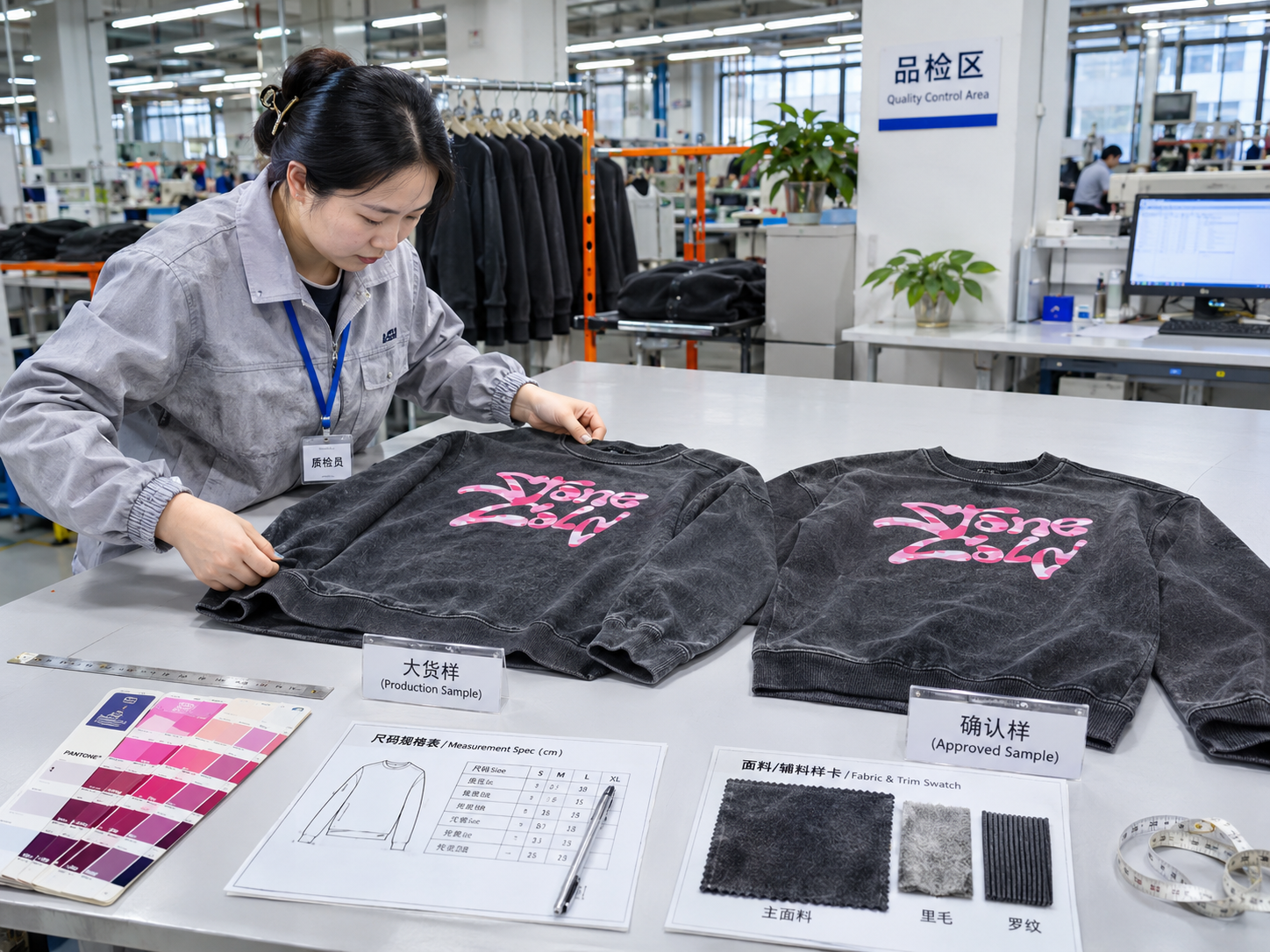
This is one of the stages where clothing brands should spend more time.
A customer may send a photograph and say, "I want exactly this faded black."
That is a useful starting point, but a photograph cannot communicate every aspect of a washed finish.
A physical approval standard makes production and inspection more reliable.
Step 1: Approve the Base Color
If fabric is custom dyed, the starting color should be agreed upon using an appropriate physical reference.
The Pantone Fashion, Home + Interiors system[^1] is designed for applications including apparel and textiles.
Pantone TCX references are used for textile color communication.
However, a Pantone number alone cannot fully specify a vintage-washed appearance.
The fabric, finishing conditions, and desired fading distribution must also be established.
Step 2: Approve a Finished Washed Garment
The approved reference should represent the garment in its intended final condition.
That means confirming the fabric, color, washing effect, construction, and decoration where applicable.
If the final product will be washed after sewing, approving an unwashed sample is not sufficient.
The buyer should evaluate the garment after the full finishing sequence.
Step 3: Establish Acceptable Variation Limits
Vintage-washed products may have intentional differences between pieces.
The important question is which differences are acceptable.
For example, the buyer may accept minor variation around raised seams but reject an overall shade that is noticeably darker than the approved sample.
Instead of stating "some variation is okay," the approval should identify:
- The target washed garment
- The lightest acceptable appearance
- The darkest acceptable appearance
- Areas where uneven fading is allowed
- Areas where visible marks are unacceptable
When practical, physical light and dark limit samples can support bulk inspection.
Step 4: Validate the Bulk Washing Process
A successful sample does not automatically mean the same result will be achieved in a larger washing load.
The production team should conduct an appropriate trial using representative materials and garment construction.
The trial should consider color, surface appearance, shrinkage, hand feel, decoration, and possible damage.
If the initial bulk trial differs significantly from the approved reference, the process should be reviewed before the complete production order is finished.
Step 5: Inspect Against the Approved Sample
Bulk garments should be checked against the approved physical reference under consistent viewing conditions.
Photographs remain useful for communication, but they should not replace physical color approval in color-sensitive orders.
Pantone's explanation of color systems[^2] also highlights how material influences color appearance.
This helps explain why the same target color may look different on various fibers and finished surfaces.
For projects with strict shade requirements, the buyer and manufacturer may also agree on suitable instrumental or controlled visual assessment methods.
How Does Vintage Washing Affect Garment Measurements?
Vintage washing can change the finished dimensions of a garment.
The effect depends on the fabric, knit construction, dyeing, washing, and drying conditions.
For example, a customer may approve an oversized hoodie with a body length of 70 cm.
If the garment becomes shorter during finishing, the final silhouette may no longer match the approved design.
The same issue can affect chest width, shoulder width, sleeve length, hem width, waist measurements, and trouser length.
Should the Pattern Be Adjusted Before Washing?
Sometimes.
If the development team establishes repeatable dimensional changes under the approved process, the pattern can be adjusted to account for them.
However, the allowance should be based on actual testing.
Consider a theoretical example:
- Required finished body length: 70 cm
- Expected length reduction during washing: 4%
The calculated pre-wash target would be:
70 ÷ (1 − 0.04) = 72.92 cm
This suggests an initial pre-wash development target of approximately 72.9 cm.
It is only a mathematical example.
Real garments may shrink differently in length and width. Ribbing, seams, fabric construction, and finishing can also affect the measurements.
A manufacturer should not simply add the same percentage to every part of a pattern.
Why Should You Measure the Garment After Washing?
For washed clothing orders, the final measurement specification should clearly identify whether dimensions apply before or after finishing.
In most cases, the buyer needs the finished garment to match the approved size chart.
The AATCC TM150 method[^3] covers dimensional changes of garments after home laundering, while AATCC TM135[^4] addresses fabric dimensional changes after home laundering.
These are established testing references. They do not replace validation of the factory's specific industrial vintage washing process.
The required testing conditions and measurement tolerances must be agreed upon.
What About Vintage-Washed Matching Sets?
Matching hoodies and sweatpants need additional attention.
If the top and trousers use different fabric constructions, they may respond differently to washing.
The finished shades may not match perfectly, and their shrinkage behavior may also differ.
For this reason, a vintage-washed matching set should be developed as a coordinated product.
Both garments need approval for appearance, fit, and performance.
What Quality Tests Should Be Done on Washed Clothing?
A vintage-washed garment can look excellent but still have quality problems.
For example, a dark washed hoodie may transfer color onto a white T-shirt, or a garment may shrink further after its first home wash.
Visual approval alone is not enough.
1. Colorfastness to Rubbing
Rubbing colorfastness evaluates whether color transfers from a textile surface onto another material.
This can be especially relevant for certain dark, pigment-finished, or heavily treated garments.
AATCC TM8[^5] provides a method for evaluating color transfer through rubbing using dry and wet test cloths.
A vintage appearance does not automatically justify excessive color transfer during normal use.
2. Colorfastness to Laundering
A garment should also be evaluated for unwanted color changes during subsequent washing.
The AATCC standard test methods catalog[^6] includes TM61, which addresses accelerated colorfastness to laundering.
The appropriate method and acceptance level depend on the garment, buyer's quality requirements, and intended care conditions.
The manufacturer should distinguish between controlled fading during the initial finishing process and unwanted color loss during consumer use.
3. Shrinkage and Dimensional Stability
The garment should maintain an acceptable fit after care according to its intended instructions.
Fabric-level and finished-garment testing may both be relevant.
The factory should also confirm that the approved size chart applies to the correct stage of production.
4. Surface and Fabric Damage
After finishing, the quality-control team should inspect for holes, excessive abrasion, broken yarns, weak seams, unwanted pilling, distorted pockets, and damaged ribbing.
Some distressing may be intentional.
However, the intended effect should be identified clearly during sample approval.
Structural damage should not automatically be accepted as part of a vintage finish.
5. Printing and Embroidery Durability
When a garment includes printing or embroidery, the decoration should be checked after the intended finishing and relevant care testing.
Potential issues include cracking, peeling, thread damage, puckering, color change, and poor adhesion.
If a garment includes both embroidery and screen printing, the production sequence may require separate evaluation.
6. Finished Appearance Consistency
Inspection should consider multiple garments from different parts of the production order.
The approved variation range should be used to decide whether differences are acceptable.
A deliberately irregular vintage finish does not need to be visually identical on every garment.
However, the factory should not treat every unexpected difference as acceptable simply because the product is described as vintage washed.
How Can Brands Control Vintage Wash Production Costs?
Vintage washing adds another manufacturing stage.
Depending on the process, it may require additional development, handling, material testing, production trials, and quality inspection.
This is why a vintage-washed hoodie may cost more than an otherwise similar unwashed garment.
Start With a Suitable Base Fabric
A brand does not always need a specially developed fabric.
Some available fabrics can produce the desired washed effect, while others may require custom dyeing or material development.
We prefer reviewing suitable stock options before recommending a more complicated sourcing process.
However, any material substitution needs to be checked for wash compatibility.
A cheaper fabric that cannot achieve the approved finish may create more cost through repeated sampling.
Use Clear Washing References
Unclear references often lead to unnecessary revisions.
The first sample may be too dark. The second may appear too gray. The third may have excessive seam fading.
Each additional development round can involve material, labor, washing, transportation, and scheduling costs.
Clear physical references cannot eliminate every adjustment, but they can reduce uncertainty.
Avoid Changing Fabrics After Wash Approval
Suppose a customer approves a vintage finish on 100% cotton fleece.
Later, the customer switches to an 80/20 cotton-polyester blend to reduce costs.
The new material may not reproduce the original appearance under the same processing conditions.
Another washing trial may be required.
That can reduce or eliminate the expected savings.
Understand Sample and Bulk Costs
Sample development can involve pattern making, fabric sourcing, cutting, sewing, washing trials, decoration setup, and inspection.
Bulk production distributes some setup costs over more garments.
However, garment washing may involve its own minimum processing charges and batch requirements.
Small orders containing several colors or wash effects may require more complex production planning.
At Decheng, our standard garment MOQ can start from 50 pieces per color, depending on style and material requirements.
This does not mean every custom fabric or special washing process can be produced economically at that quantity.
Fabric mills and specialized finishing partners may have separate minimums.
Confirm What the Quotation Includes
A complete quotation should clarify whether the price includes:
- Fabric and accessories
- Cutting and sewing
- Washing and finishing
- Printing and embroidery
- Main and care labels
- Packaging
- Testing, if required
- Agreed order quantity and trade terms
An unwashed blank hoodie quotation should not be compared directly with the price of a fully customized vintage-washed hoodie.
For a more detailed explanation, read our guide to custom clothing manufacturing costs.
What Should You Send a Vintage Wash Clothing Manufacturer?
When a clothing brand contacts us about vintage-washed streetwear, the most useful information is a clear combination of product specifications and reference images.
A long description is not always necessary if the technical requirements are well organized.
Vintage Wash Manufacturing Inquiry Checklist
| Item | Information to Provide |
|---|---|
| Product | Hoodie, T-shirt, sweatshirt, joggers, shorts |
| Fabric | Composition, construction, GSM |
| Base Color | Physical swatch or Pantone TCX reference |
| Wash Effect | Vintage, sun-faded, pigment-style, etc. |
| Visual Reference | Clear photographs or physical garments |
| Order Quantity | Total pieces and quantity per color |
| Size Range | XS–XXL or custom sizing |
| Measurements | Finished garment size chart |
| Decoration | Artwork, positions, sizes, methods |
| Labels | Main label, size label, care label |
| Packaging | Individual and carton requirements |
| Quality Requirements | Color variation, shrinkage, colorfastness |
Can You Start With Reference Photos?
Yes.
Reference photographs help the manufacturer understand the intended appearance.
We can review the garment design, recommend possible materials, and discuss which finishing methods may be suitable.
However, an initial quotation may remain preliminary until the fabric and washing requirements are sufficiently defined.
We prefer identifying what needs to be tested rather than promising an exact wash result based on one photograph.
Can the Factory Help Develop the Fabric and Washing Effect?
Yes. Custom clothing manufacturers may coordinate fabric sourcing, sample development, garment construction, decoration, and specialist finishing.
Feasibility depends on the chosen fabric, wash effect, order quantity, and available production processes.
Some effects require additional trials. Others may not be suitable for the selected material.
Our role is to identify those concerns before the brand commits to bulk production.
You can also read our custom clothing production process guide for more information about developing a garment from technical specifications through production.
Frequently Asked Questions
Can Vintage-Washed Hoodies Be Exactly the Same Color?
Manufacturers can work toward consistent overall shades, but deliberately irregular vintage effects may vary between garments. Brands should establish acceptable appearance limits using approved physical samples.
Is 100% Cotton Better Than Cotton-Polyester for Vintage Washing?
Not always. Both can be suitable depending on the desired effect. Fiber composition, dyeing system, fabric construction, and finishing method determine the result. The fabric should be tested before bulk production.
Does Vintage Washing Make Hoodies Shrink?
It can. Washing and drying may change garment dimensions. The amount depends on the fabric and process, so final measurements should be approved after finishing.
Can You Print a Logo on a Vintage-Washed Hoodie?
Yes. Screen printing, embroidery, DTF, and other decoration methods may be suitable. The production sequence should be tested to confirm appearance, adhesion, and durability.
What Is the Difference Between Acid Wash and Vintage Wash?
Vintage wash is a broad commercial term for aged or worn-in appearances. Acid wash commonly refers to a stronger, uneven, or high-contrast distressed effect. Actual production methods vary, so physical references and process requirements should be agreed upon.
Can I Order 50 Pieces of Custom Vintage-Washed Clothing?
Some small-batch projects are possible when suitable fabric and finishing capacity are available. Decheng's standard garment MOQ can start at 50 pieces per color, but custom dyeing and special washing may involve separate minimums.
How Long Does Vintage Wash Clothing Production Take?
Our standard custom garment programs commonly use approximately 5–7 days for sampling and 20–25 days for bulk production under suitable conditions. Special washing, fabric development, and additional approval rounds may require more time, so the schedule should be confirmed for each project.
How Do I Prevent Washed Black Clothing From Staining Other Garments?
Appropriate finishing control and colorfastness testing are important. Brands should specify relevant washing and rubbing colorfastness requirements, particularly for dark or pigment-finished garments.
Conclusion
Vintage-washed clothing is not challenging simply because it is supposed to look old.
The challenge is reproducing a deliberately worn-in appearance while maintaining acceptable consistency across a commercial production order.
Customers may want fading, irregular surface effects, or a garment that looks as though it has been worn for years.
They still expect the correct size, reliable construction, acceptable color variation, and suitable performance.
That requires more than choosing a washing name.
The fabric needs to be suitable, the base color needs to be controlled, the washed appearance needs to be approved, and finished measurements need to be checked.
Most importantly, the production team needs a clear physical reference before processing the full order.
For brands developing their first vintage-washed collection, we recommend starting with one or two styles, confirming the fabric, developing the finish, and testing the completed garment before scaling production.
At Dongguan Decheng Textile & Garment Co., Ltd., we support B2B clothing brands with OEM and ODM development for hoodies, sweatshirts, T-shirts, joggers, and custom streetwear.
If you are planning a vintage-washed collection, share your reference images, fabric specifications, quantities, and technical requirements with our team.
We can review the design, discuss material and finishing feasibility, and help determine the next steps for sample development.
Contact Dechoreal to Discuss Your Custom Clothing Project
Footnotes & References
[^1]: Pantone — Fashion, Home + Interiors. Official color system for apparel, textiles, and related design applications, including TCX textile references. https://www.pantone.com/na/en-us/fashion-home-interiors
[^2]: Pantone — Pantone Color Systems Explained. Information about standardized color communication and differences in color appearance across materials. https://www.pantone.com/color-systems/pantone-color-systems-explained
[^3]: AATCC — TM150-2025: Dimensional Changes of Garments after Home Laundering. Official test method covering garment dimensional changes following specified home laundering procedures. https://members.aatcc.org/store/tm150/556/
[^4]: AATCC — TM135-2025: Dimensional Changes of Fabrics after Home Laundering. Official test method for evaluating fabric dimensional changes. https://members.aatcc.org/store/tm135/543/
[^5]: AATCC — TM8: Colorfastness to Crocking — Crockmeter. Official test method for evaluating dry and wet rubbing color transfer. https://members.aatcc.org/store/tm8/481/
[^6]: AATCC — Standard Test Methods and Procedures. Official catalog covering textile evaluation methods, including colorfastness and laundering tests. https://www.aatcc.org/testing/standards