
Clothing Quality Control: How Do You Make Sure Your Bulk Order Matches the Sample?
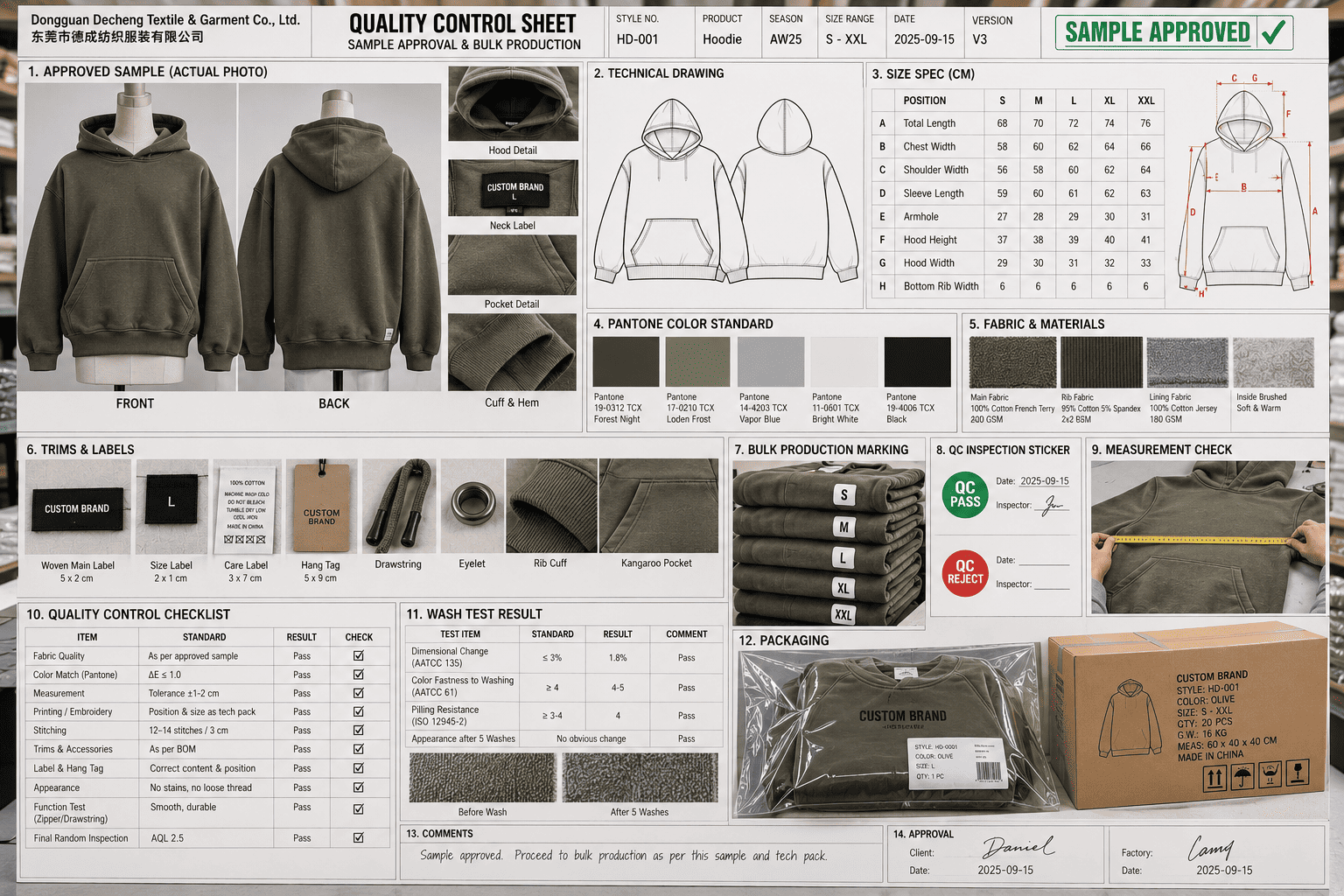
Your sample was perfect.
Then the bulk order arrives.
The sleeves feel shorter.
One black looks slightly grey.
The embroidery has moved.
A few garments have loose seams.
The size M does not measure like the approved M.
At that point, saying:
The sample was correct.
does not solve the problem.
Clothing quality control is the system used to compare materials, measurements, construction, decoration, finishing, labels, and packing against approved requirements throughout production. Good QC does not wait until the last day. It checks the product while problems can still be corrected before they spread across the whole order.
I work with custom garment production in Dongguan, and one thing I always want buyers to understand is:
QC does not create quality at the end of production.
If 500 garments have already been cut from the wrong shade of fabric, final inspection is too late.
If the first 30 hoodies have the pocket sewn 2 cm too low, inline inspection can still stop that problem.
That is why good quality control starts before bulk sewing.
Table of Contents
- What Is Clothing Quality Control?
- What Is the Difference Between Quality Control and Quality Assurance?
- What Should Bulk Production Be Checked Against?
- Which QC Stages Should a Garment Factory Use?
- Why Is Fabric Inspection Important?
- What Happens Before Bulk Cutting?
- Why Is Inline Inspection So Important?
- What Should End-of-Line QC Check?
- What Is AQL?
- What Does AQL 2.5 Actually Mean?
- Are AQL 2.5 and 4.0 Universal Apparel Rules?
- What Are Critical, Major, and Minor Defects?
- Which Garment Defects Should QC Look For?
- How Should Measurements Be Inspected?
- How Should Color and Shade Be Controlled?
- How Should Printing and Embroidery Be Inspected?
- Should Garments Be Wash Tested?
- What Should Final Inspection Check?
- Should You Use Third-Party Inspection?
- What Happens If Final Inspection Fails?
- How Do You Choose a Factory With Real Quality Control?
- Conclusion
- Footnotes & References
What Is Clothing Quality Control?
Quality control means checking the actual product against an agreed standard.
For custom apparel, that can include:
- Fabric
- Color
- Measurements
- Sewing
- Construction
- Printing
- Embroidery
- Trims
- Labels
- Packing
The important word is:
agreed.
A QC inspector cannot objectively say:
This hoodie is too short.
unless the specification says what the correct length should be.
That is why QC begins with good product documentation.
What Is the Difference Between Quality Control and Quality Assurance?
These terms are related, but they are not identical.
Quality Assurance
Quality assurance focuses more on the system that prevents problems.
For example:
- Approved suppliers
- Controlled tech-pack versions
- Fabric approval
- PP sample
- Standard operating procedures
- Staff training
Quality Control
Quality control focuses on checking the product.
For example:
- Measuring garments
- Checking sewing
- Comparing color
- Inspecting prints
- Checking labels
A strong factory needs both.
If you only inspect defects but never improve the process causing them, the same problems keep returning.
What Should Bulk Production Be Checked Against?
Before bulk production begins, I want clear reference standards.
Approved Sample
This helps define:
- Overall appearance
- Fit
- Hand feel
- Construction
Tech Pack
This defines:
- Measurements
- POMs
- Tolerances
- Fabric
- Trims
- Artwork
- Construction
Approved Color Standard
For textile products, Pantone Fashion, Home + Interiors[^1] identifies TCX for soft surfaces such as textiles and apparel.
Pantone also warns that digital screen simulations should not replace physical Pantone standards for visual approval.
Artwork Approval
This should define:
- Artwork file
- Size
- Position
- Color
- Technique
Packing Instructions
These may define:
- Folding
- Polybag
- Size sticker
- Hangtag
- Carton assortment
- Carton marks
Without these references, QC becomes subjective.
Which QC Stages Should a Garment Factory Use?
I prefer thinking about QC as several checkpoints rather than one final inspection.
A typical workflow may include:
| Stage | Main Purpose |
|---|---|
| Incoming material check | Catch fabric and trim problems |
| Pre-production review | Confirm everything before cutting |
| Cutting control | Check pattern, grain, shade and quantity |
| Inline QC | Catch sewing problems while production is running |
| End-of-line QC | Check completed garments |
| Final inspection | Evaluate finished order before shipment |
| Packing check | Verify labels, assortment and cartons |
Different factories organize these stages differently.
The important thing is that inspection happens early enough to prevent repeated defects.
Why Is Fabric Inspection Important?
A large percentage of the finished garment comes from one material:
the fabric.
If the fabric is wrong, sewing it perfectly does not solve the problem.
Incoming inspection may check:
- Holes
- Stains
- Knitting/weaving defects
- Shade variation
- Width
- Weight
- Surface appearance
Shade Variation
Dark colors can be especially sensitive.
For example:
Black fabric from Roll A
may appear slightly different from:
Black fabric from Roll B.
For matching sets, this becomes even more important.
A hoodie and joggers should not accidentally come from visibly different shade groups.
Fabric Approval Before Cutting
Once hundreds of panels are cut, replacing the fabric becomes much more expensive.
That is why material problems should be caught before cutting.
What Happens Before Bulk Cutting?
Before the cutting room starts, I want a pre-production review.
This may confirm:
- Latest tech pack
- Approved pattern
- Fabric
- Shrinkage
- Color
- Trims
- Labels
- Artwork
- Quantity
- Size ratio
This is also where version control matters.
If Sample V3 is approved but the cutting room receives Pattern V2, QC cannot fix that afterward.
Pre-Production Sample
For projects that require one, the PP sample should represent bulk production as closely as practical.
That gives production and QC a physical reference.
Why Is Inline Inspection So Important?
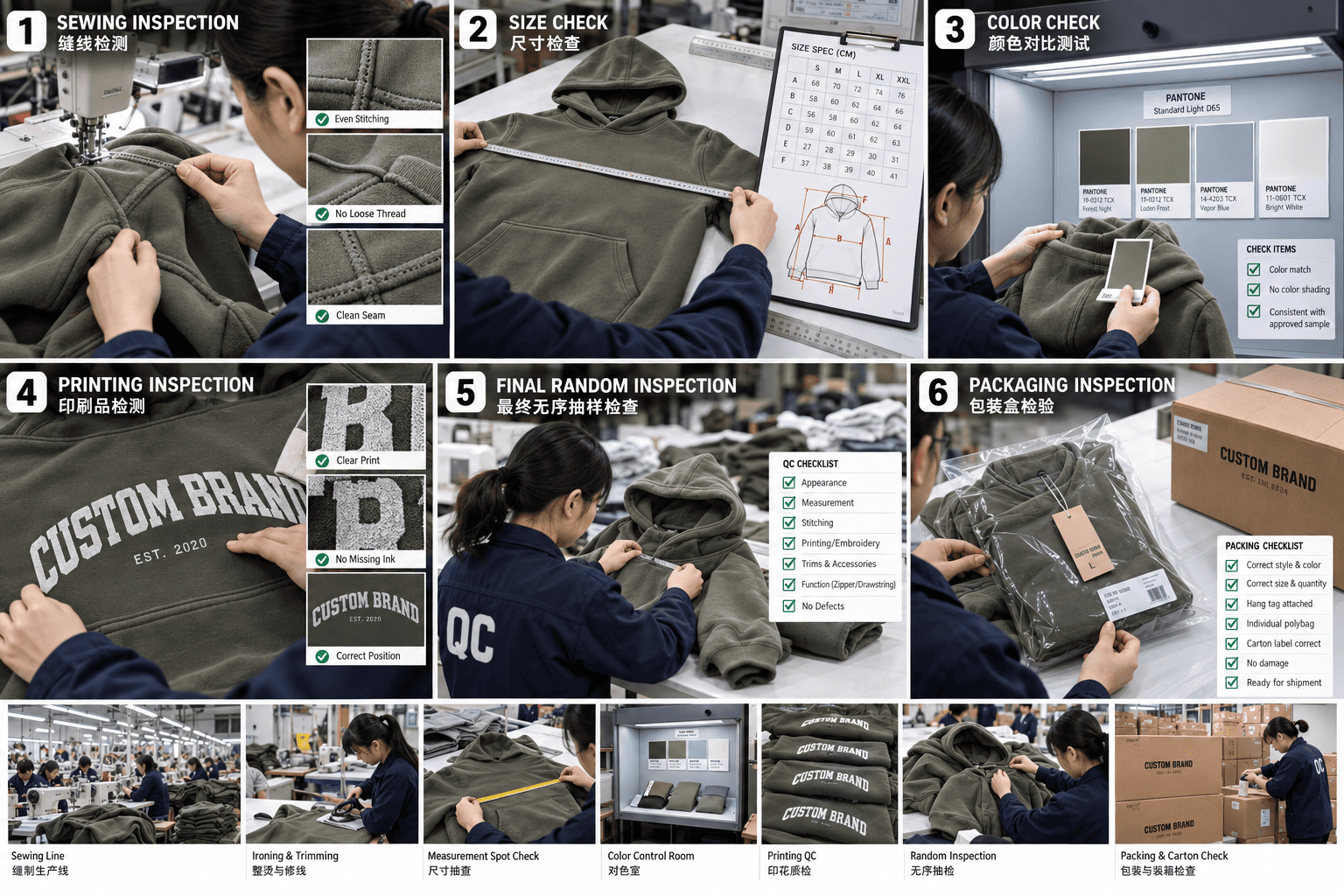
Inline QC happens while garments are still being produced.
This is one of the most valuable stages.
Imagine the approved cargo pocket should sit:
21 cm below the waistband.
The first 20 pants come off the line at:
24 cm.
If inline QC catches it immediately, production can stop and correct the operation.
If nobody checks until 500 pants are complete, the same mistake may appear 500 times.
Inline QC Can Check
- Seam type
- Stitching
- Pocket position
- Zipper installation
- Collar/hood construction
- Decoration
- Measurements
The purpose is not simply to find bad garments.
It is to find a process drifting away from the approved standard.
What Should End-of-Line QC Check?
Once a garment is completed, end-of-line QC may review:
- Overall workmanship
- Loose threads
- Open seams
- Stitching
- Measurements
- Decoration
- Stains
- Labels
Some defects can still be repaired at this stage.
For example:
- Loose thread
- Missed trimming
- Some sewing defects
Others may require major rework.
That is why earlier QC remains preferable.
What Is AQL?
AQL stands for:
Acceptance Quality Limit
The current ISO 2859-1:2026[^2] defines an acceptance-sampling system using single, double, and multiple sampling plans for inspection by attributes.
In simple terms:
Instead of inspecting every garment in a large order under one statistical acceptance plan, an inspector selects a sample according to an agreed sampling scheme.
The result is then used to make a decision about the lot.
AQL Is an Acceptance-Sampling Tool
It does not mean:
The factory is allowed to deliberately make 2.5% defective garments.
That is a common misunderstanding.
And it does not mean:
AQL 2.5 = exactly 2.5% defects in every shipment.
AQL is part of a statistical sampling system.
What Does AQL 2.5 Actually Mean?
When buyers say:
We inspect at AQL 2.5.
there is still missing information.
To build an actual inspection plan, you may also need to know:
- Lot size
- Inspection level
- Sampling scheme
- Defect classification
- AQL value
Under ISO 2859-1, the inspection setup determines the sample size and the corresponding acceptance/rejection criteria.[^2]
So I would not treat one internet AQL chart as universally applicable to every order.
Example Workflow
A buyer may specify:
General Inspection Level II
Major defects: AQL 2.5
Minor defects: AQL 4.0
The inspector then uses the applicable sampling plan.
That is very different from saying:
Every 500-piece garment order automatically has the same sample and acceptance numbers.
Are AQL 2.5 and 4.0 Universal Apparel Rules?
No.
They are commonly seen in garment inspection, but they are buyer-defined quality requirements—not laws saying every apparel brand must use exactly those numbers.
A stricter buyer may use different requirements.
Another buyer may use:
- Different inspection level
- Different AQL
- Additional 100% checks for certain points
The right requirement depends on:
- Product
- Risk
- Customer
- Market
- Contract
Agree Before Production
Do not wait until final inspection to decide what counts as acceptable.
Put the inspection requirements in writing before bulk begins.
What Are Critical, Major, and Minor Defects?
Factories and inspection companies often classify defects by severity.
Critical Defect
A defect involving serious:
- Safety
- Regulatory
- Hazard
concerns.
Examples may include:
- Sharp object
- Broken needle fragment
- Serious safety violation
Many buyers specify zero acceptance for critical defects.
Major Defect
A defect likely to make the product:
- Unsellable
- Functionally unacceptable
- Significantly different from specification
Examples can include:
- Hole
- Wrong size
- Open seam
- Large measurement failure
- Wrong artwork
Minor Defect
A smaller workmanship issue that may not substantially affect function or saleability.
For example:
- Small removable loose thread
But classification is not universal.
A defect one buyer considers minor may be major for another.
Build a Defect List
For important programs, define examples before inspection.
That reduces arguments later.
Which Garment Defects Should QC Look For?
Common areas include:
Fabric
- Hole
- Stain
- Shade difference
- Surface defect
Sewing
- Open seam
- Skipped stitch
- Uneven stitching
- Puckering
Measurements
- Chest out of tolerance
- Body length wrong
- Sleeve length inconsistent
Decoration
- Wrong placement
- Wrong color
- Embroidery puckering
- Print damage
Trims
- Bad zipper
- Loose snap
- Wrong drawcord
Labels
- Wrong size label
- Wrong care label
- Missing label
Packing
- Wrong size assortment
- Missing hangtag
- Wrong carton quantity
A good QC checklist reflects the actual style.
Inspecting a simple T-shirt and a waterproof jacket with exactly the same checklist makes little sense.
How Should Measurements Be Inspected?
Measurements should be checked against the approved spec sheet.
The spec should define:
- POM
- Measurement method
- Target
- Tolerance
For example:
Chest width: 60 cm ±1 cm
Measurement Method Matters
The buyer and factory need to measure the garment the same way.
Otherwise one side may get:
60 cm
while the other gets:
61 cm
from the exact same garment.
Do Not Measure Only One Piece
QC usually checks a selection across:
- Sizes
- Colors
- Production lots
because consistency matters.
A perfect size M does not prove XL is correctly graded.
How Should Color and Shade Be Controlled?
Color should be checked against an approved reference.
For textiles, a physical Pantone FHI[^1] standard can be useful.
But shade control also requires comparing the actual production.
Check Garment-to-Garment Variation
For example:
Five black hoodies
should not look like:
- Blue black
- Neutral black
- Faded black
when laid together.
Matching Sets Need Extra Control
For:
Hoodie + joggers
check the two pieces together.
Do not approve them separately without ever comparing the finished set.
Lighting Matters
Color appearance changes under different lighting.
For important color programs, factories may use controlled light sources or light boxes rather than relying only on random factory lighting.
How Should Printing and Embroidery Be Inspected?
Decoration QC should check more than:
Logo exists.
Embroidery
Check:
- Position
- Dimensions
- Thread color
- Density
- Edge quality
- Puckering
- Loose threads
Screen Printing
Check:
- Position
- Dimensions
- Color
- Coverage
- Registration
- Surface
- Curing result
Rhinestones / Transfers
Check:
- Position
- Missing components
- Adhesion
- Appearance
The approved artwork and physical sample should be available during QC.
Should Garments Be Wash Tested?
For many products, yes.
Especially where the product may be affected by:
- Shrinkage
- Twist
- Printing
- Heat transfer
- Garment wash
- Stretch
AATCC TM150[^3] provides standardized procedures for determining dimensional changes in garments after home laundering.
It offers defined washing and drying conditions so results can be evaluated more consistently.
Measure Before and After
For a hoodie:
- Chest
- Length
- Sleeve
- Bottom width
For pants:
- Waist
- Rise
- Inseam
- Outseam
Then also inspect:
- Surface
- Embroidery
- Rib
- Seam twisting
A garment can pass final measurements before washing and still perform badly afterward.
What Should Final Inspection Check?
Final inspection should confirm the finished order against the agreed requirements.
Typical areas include:
- Quantity
- Workmanship
- Measurements
- Color
- Decoration
- Labels
- Packing
- Carton assortment
AQL Sampling Can Be Used Here
SGS states that its final selective textile inspections can use ANSI/ASQ Z1.4 / ISO 2859-1 criteria for AQL-based sampling.[^4]
This is a good example of how acceptance sampling is used in actual inspection practice.
Final Inspection Is Not a Replacement for Inline QC
If final inspection discovers:
Every pocket is positioned incorrectly.
inspection has identified the problem.
It has not made the problem inexpensive to fix.
That is why QC needs multiple stages.
Should You Use Third-Party Inspection?
Third-party inspection can be useful when you want an independent inspection company working for the buyer.
SGS Product Inspection[^4] describes inspection services designed to identify non-conformities before consignments are completed or shipped.
Common inspection timing can include:
During Production
Useful for:
- Large orders
- Complex styles
- New suppliers
Pre-Shipment Inspection
Useful when the order is substantially complete and you want an independent check before shipment approval.
Loading Check
Useful when you also want verification of:
- Cartons
- Quantity
- Loading
Product Testing Is Different
A third-party visual inspection is not the same as laboratory testing.
For example:
- Fiber testing
- Chemical testing
- Children's product testing
- Colorfastness testing
may require laboratory methods rather than an inspector visually checking the garment.
What Should a Third-Party Inspector Receive?
Give them the same approved information the factory uses:
- Tech pack
- Approved measurements
- Tolerances
- Approved sample
- Artwork
- Color standard
- Defect classification
- AQL requirements
- Packing instructions
Otherwise the inspector is forced to guess.
Inspection Cannot Fix a Vague Specification
If the tech pack says:
Oversized fit
but gives no measurement chart, an inspector cannot objectively determine whether the garment is:
2 cm too narrow.
Good inspection depends on good specifications.
What Happens If Final Inspection Fails?
This is an important question to discuss before ordering.
A failed inspection does not automatically mean:
Throw away the whole order.
The next step depends on the failure.
Possible actions include:
- Sort defective garments
- Repair/rework
- Replace incorrect labels
- Repack
- Re-measure
- Re-inspect
Find the Root Cause
If ten garments have the same stitching problem, ask:
Why?
Was it:
- One machine?
- One operator?
- One production batch?
Correcting the source matters more than fixing the ten samples that happened to be inspected.
Re-Inspection
After rework, another inspection may be required.
Agree beforehand who pays for additional inspection when defects cause a re-inspection.
That avoids another argument later.
How Do You Choose a Factory With Real Quality Control?
Every factory says:
Our quality is very good.
That tells you almost nothing.
Ask how the quality system actually works.
Ask:
When do you inspect fabric?
Do you run inline QC?
How do you control measurements?
How do you check shade?
What happens when inline QC finds a repeated defect?
Do you accept third-party inspection?
Specific answers are much more useful than general promises.
Ask for Records
A factory may be able to show examples of:
- Measurement reports
- QC checklists
- Inspection photos
- Corrective-action records
Sensitive customer information can be removed.
What you want to know is whether a real process exists.
Quality Control and Social Compliance Are Different
This distinction matters.
Sedex describes SMETA[^5] as a social-audit methodology covering areas such as:
- Labour standards
- Health and safety
- Environmental performance
- Business ethics
Sedex explicitly states that SMETA is a continuous-improvement methodology rather than a certification.[^5]
SMETA does not tell you:
- Whether chest measurement is correct
- Whether a print will crack
- Whether embroidery is centered
Those questions require product QC.
Care Compliance Is Another Separate Topic
For U.S. textile apparel, the FTC Care Labeling Rule[^6] requires covered garments to carry appropriate regular-care instructions.
So final QC may also need to verify that the approved care label is:
- Present
- Correct
- Attached to the correct product
Quality control is where documentation and the physical garment meet.
Green Flags and Red Flags
| Green Flag | Red Flag |
|---|---|
| Checks fabric before cutting | Only checks finished cartons |
| Runs inline inspection | Waits until production is complete |
| Measures against a tech pack | Judges fit by eye |
| Uses agreed tolerances | No measurement tolerance |
| Explains its AQL setup | Says only “AQL 2.5” with no context |
| Has defect classifications | Every defect is treated the same |
| Controls dye-lot/shade issues | Mixes fabric lots without checking |
| Supports third-party inspection | Refuses outside inspection |
| Keeps inspection records | No reports or records |
| Explains SMETA correctly | Uses social audit as product-quality proof |
A good factory does not promise:
Zero defects forever.
It explains:
How defects are prevented, detected, corrected, and prevented from repeating.
That is a much more useful answer.
Conclusion
Clothing quality control is not one inspector standing beside packed cartons.
It is a system.
The strongest QC process begins with:
- Clear tech pack
- Approved sample
- Defined measurements
- Agreed tolerances
- Approved materials
- Color references
- Artwork approval
Then production needs checkpoints:
- Incoming material inspection
- Pre-production review
- Inline QC
- End-of-line QC
- Final inspection
- Packing verification
And when AQL is used, understand what it means.
AQL 2.5 is not permission to make 2.5% defective garments.
It is not a universal law requiring every clothing order to use the same sampling table.
The inspection plan depends on the agreed sampling system, inspection level, AQL values, and defect classifications.
Also remember:
Final inspection does not replace inline quality control.
A SMETA audit does not prove product workmanship.
A beautiful approved sample does not guarantee bulk consistency unless production has clear references and controls.
Before bulk production, agree on the rules.
During production, check whether the process is following them.
Before shipment, verify the finished order against them.
That is how quality becomes something measurable rather than:
Don't worry, our quality is very good.
For me, the best garment QC system is not the one that finds the largest number of defects at final inspection.
It is the one that finds problems early enough that the customer never sees them repeated across the bulk order.
Footnotes & References
[^1]: Pantone — Fashion, Home + Interiors (FHI). Pantone identifies TCX for soft textile surfaces such as fabrics and apparel and recommends physical Pantone standards for reliable visual evaluation rather than depending on digital simulations.
https://www.pantone.com/na/en-us/fashion-home-interiors
[^2]: International Organization for Standardization — ISO 2859-1:2026. ISO 2859-1:2026 defines an acceptance-sampling system using single, double, and multiple sampling plans for inspection by attributes and provides sampling schemes indexed by Acceptance Quality Limit (AQL).
https://www.iso.org/standard/2859-1
[^3]: AATCC — TM150, Dimensional Changes of Garments After Home Laundering. AATCC TM150 provides standardized procedures for determining length and width changes of finished garments after defined home-laundering conditions.
https://members.aatcc.org/store/tm150/556/
[^4]: SGS — Product Inspection / Final Selective Inspection of Textiles. SGS provides product-inspection services for identifying non-conformities before shipment and states that its final selective textile inspections may use ANSI/ASQ Z1.4 / ISO 2859-1 criteria for AQL-based sampling.
https://www.sgs.com/en-us/industry/consumer-products-and-retail/product-inspection
https://www.sgs.com/en-kz/news/2023/11/sgs-offers-final-selective-inspections-of-textile-products
[^5]: Sedex — SMETA Audit. Sedex describes SMETA as a social-audit and continuous-improvement methodology covering labour standards, health and safety, environmental performance, and business ethics rather than as a product-quality certification.
https://www.sedex.com/solutions/smeta-audit/
[^6]: U.S. Federal Trade Commission — Care Labeling Rule. FTC rules require covered textile apparel to carry appropriate regular-care instructions, making correct label verification part of the finished-garment compliance process for applicable U.S. products.
https://www.ftc.gov/legal-library/browse/rules/care-labeling-textile-wearing-apparel-certain-piece-goods