
Stock Fabric vs Custom Fabric: Which Should You Choose for Clothing Production?
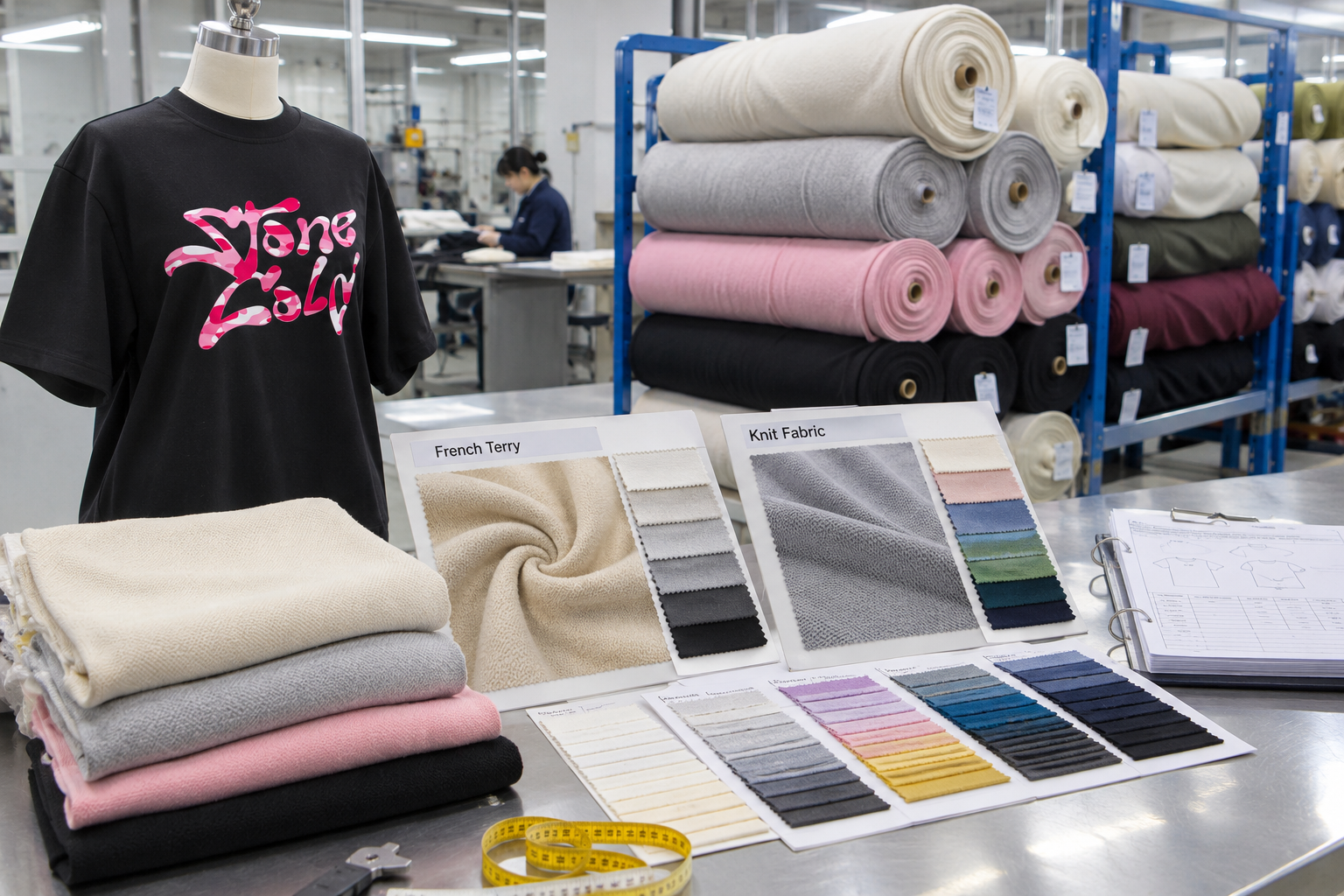
You found the perfect fabric on a competitor's hoodie.
The weight felt right, the surface was smooth, and the fabric had exactly the structure you wanted for your new streetwear collection.
You sent a photograph to your clothing manufacturer and asked for the same material.
Then came the response: custom knitting, a 300 kg fabric minimum, and several additional weeks for production.
Your first clothing order was only 100 pieces.
Suddenly, a fabric decision became the biggest obstacle to launching your collection.
We see situations like this when new clothing brands begin developing custom garments. Many buyers focus on garment design, printing, embroidery, and fit without realizing how much fabric sourcing affects the final price, minimum order quantity, and production schedule.
Quick Answer: What Is the Difference Between Stock Fabric and Custom Fabric?
Stock fabric is material already available from textile mills or fabric suppliers in existing compositions, weights, colors, and finishes. Custom fabric is developed or produced according to a buyer's specific requirements, such as yarn composition, knit structure, GSM, color, or finishing treatment.
Stock fabric is usually more practical for small clothing orders and faster development. Custom fabric offers greater control over product specifications but often requires higher fabric minimums, additional testing, and longer lead times.
At Decheng, we source and use different types of knitted fabrics for hoodies, sweatshirts, T-shirts, joggers, and other custom garments.
Our experience has taught us something important: choosing custom fabric does not automatically make a garment better.
The right material is the one that supports your product, customers, order quantity, and budget.
In this guide, we'll explain the practical differences between stock and custom fabric, how fabric rolls affect pricing, and when a clothing brand should consider investing in custom material development.
Table of Contents
- What Is the Difference Between Stock Fabric and Custom Fabric?
- When Should You Use Stock Fabric for Clothing Production?
- When Is Custom Fabric Worth the Investment?
- How Do Fabric Rolls and Colors Affect Manufacturing Costs?
- How Do You Choose and Approve Fabric Before Sampling?
- What Fabric Minimums and Lead Times Should You Expect?
- How Do You Choose Between Stock and Custom Fabric?
- Frequently Asked Questions
- Conclusion
What Is the Difference Between Stock Fabric and Custom Fabric?
Both stock and custom fabric can produce high-quality clothing.
The difference is how the fabric is sourced, how much control the buyer has over its specifications, and how much material must be ordered.
Stock fabric uses an existing fabric quality that a supplier already offers. Custom fabric involves producing or modifying fabric to meet requirements that existing materials cannot satisfy.
For example, if you need a 380 GSM cotton French terry in an available color, your manufacturer may be able to source it directly from an existing supplier.
However, if you require a particular yarn count, a special knitted structure, a precise fabric weight, and a specific finishing treatment, the mill may need to produce a new fabric according to your specifications.
Stock Fabric vs Custom Fabric Comparison
| Factor | Stock Fabric | Custom Fabric |
|---|---|---|
| Availability | Existing supplier inventory or standard quality | Produced to agreed specifications |
| Development Time | Usually faster | Additional development time |
| Fabric MOQ | Often available by the roll or smaller cut | Typically requires a larger production quantity |
| Material Cost | Usually lower sourcing commitment | May include development and setup costs |
| Fabric Weight | Limited to available GSM options | Can target a specified GSM |
| Color Options | Available stock colors | Custom dyeing or yarn-dyed colors |
| Composition | Existing fiber blends | Can specify a required blend |
| Fabric Structure | Standard knit or weave | Custom knit or weave construction |
| Finishing | Existing finishes | Selected or specially developed finishes |
| Performance Testing | Existing quality may have historical test data | New specification needs validation |
| Best For | Startups, small orders, faster launches | Established products and larger programs |
One important distinction is that custom fabric does not always mean custom knitting.
Sometimes the base fabric already exists, but the customer wants a custom color.
In that situation, the supplier may use an existing fabric construction and arrange dyeing according to the approved color standard.
This is different from developing an entirely new yarn, knitting structure, or fabric weight.
The cost and MOQ depend on which part of the fabric is being customized.
Does Stock Fabric Mean Lower Quality?
No.
Stock fabric describes availability, not quality.
A good-quality stock French terry can perform better than a poorly developed custom fabric.
In fact, an established stock fabric may have an advantage because the supplier has already produced it repeatedly and understands its shrinkage, color consistency, and handling characteristics.
However, previous production experience does not replace inspection of the actual fabric lot.
At our factory, we prefer reviewing an existing fabric quality before recommending custom development.
If the fabric already meets the customer's requirements, producing a new material may add unnecessary cost and complexity.
Our fabric GSM guide and French terry vs fleece guide explain how fabric weight and construction influence garment performance.
When Should You Use Stock Fabric for Clothing Production?
For many new clothing brands, stock fabric is the more practical starting point.
It allows brands to develop samples, evaluate customer response, and launch their collections without committing to large amounts of material.
Stock fabric is particularly suitable for first orders, smaller production quantities, time-sensitive launches, and basic garments such as hoodies, T-shirts, sweatpants, and matching sets.
What Stock Fabrics Are Commonly Used in Streetwear?
Our knit fabric sourcing options include several weights and compositions commonly used for casualwear and streetwear.
| Fabric | Weight | Common Applications |
|---|---|---|
| 100% Cotton French Terry | 280 GSM | Lightweight hoodies and casual sets |
| 100% Cotton French Terry | 340 GSM | Midweight hoodies and sweatpants |
| 100% Cotton French Terry | 380 GSM | Heavyweight streetwear hoodies |
| 85/15 Brushed Fleece | 375 GSM | Warm hoodies and sweatpants |
| 100% Cotton Brushed Fleece | Heavyweight | Premium winter garments |
| 100% Cotton Jersey | 330 GSM | Heavyweight oversized T-shirts |
| Bamboo Blends | Varies | Soft casualwear and loungewear |
| Modal Blends | Varies | Comfortable everyday garments |
Availability depends on the fabric supplier's current inventory, color selection, and production schedule. The weights above are sourcing examples rather than a guarantee that every composition and color is always in stock.
Why Is Stock Fabric Better for Small Clothing Orders?
Imagine you are launching a streetwear brand with three hoodie designs.
Each style uses the same fabric composition and weight but has different artwork and colors.
If you choose an available fabric quality, your manufacturer may be able to source the necessary material without arranging a new knitting program.
That reduces the upfront material commitment.
You can spend more of your development budget on garment fit, sampling, printing, embroidery, and product presentation.
For small brands, those elements may have a greater immediate impact on the finished product than developing an exclusive fabric.
Stock fabric also makes it easier to compare several options before choosing one.
Can Stock Fabric Still Be Customized?
Yes.
Using stock fabric does not mean producing generic clothing.
Brands can still customize:
- Garment patterns and measurements
- Oversized, relaxed, or regular fits
- Available fabric weights and colors
- Printing and embroidery
- Ribbing and cuffs
- Drawcords, zippers, and other trims
- Woven labels and care labels
- Packaging and branding
For example, two brands may use the same 380 GSM French terry but produce completely different hoodies because of their patterns, washes, decoration, and construction details.
The fabric is only one part of the finished garment.
Our lightweight hoodie and heavyweight T-shirt guides provide additional examples of how fabric weight affects product development.
When Is Custom Fabric Worth the Investment?
Custom fabric becomes valuable when an existing material cannot meet an important product requirement.
This may involve a specific texture, yarn blend, weight, color, knitted structure, or finishing process.
Custom fabric is worth considering when the fabric itself provides a meaningful product advantage and the production quantity is large enough to justify the minimum fabric order.
What Can You Customize in Fabric Manufacturing?
| Customization | Examples | Main Consideration |
|---|---|---|
| Fiber Composition | Cotton/polyester, cotton/spandex, other blends | Yarn availability and sourcing |
| Fabric Weight | Specific GSM target | Knit structure and production tolerance |
| Yarn Specification | Yarn count, twist, yarn type | Minimum yarn and fabric quantities |
| Knit Construction | French terry, fleece, interlock, jersey | Machine setup and fabric performance |
| Custom Color | Approved lab dip or color standard | Dyeing MOQ and colorfastness |
| Yarn-Dyed Design | Stripes and multicolor patterns | Larger yarn and fabric minimums |
| Surface Finishing | Brushing, peach finish, special hand feel | Processing compatibility |
| Functional Finish | Performance treatments | Testing, durability, and cost |
Why Does Custom Knitting Require a Higher MOQ?
Knitting mills need enough material to justify machine setup, yarn preparation, and production scheduling.
For the type of custom knit development discussed in our original fabric sourcing program, matching a specific yarn and knit construction may require approximately 300 kg of fabric.
The actual minimum depends on the mill and the requested material.
A 300 kg order can represent several hundred heavyweight garments, depending on fabric consumption, usable width, cutting efficiency, and garment size distribution.
For this reason, a brand ordering only 100 hoodies may find it difficult to justify a completely new knitted fabric.
When Does Custom Fabric Make Sense?
| Situation | Recommended Approach |
|---|---|
| First order of 100 garments | Usually start with stock fabric |
| Small test collection | Stock fabric |
| Proven bestseller with larger reorders | Consider custom fabric |
| Exact fabric weight unavailable in stock | Evaluate custom knitting |
| Special texture or hand feel | Custom development may be suitable |
| Exclusive yarn-dyed stripe pattern | Consider custom yarn dyeing |
| Special finishing requirement | Confirm custom processing feasibility |
| Certified organic or recycled content | Verify suitable stock or made-to-order options |
Can a Brand Copy a Fabric From a Reference Garment?
A reference garment is useful, but matching a fabric exactly can be difficult.
Two fabrics may have the same GSM and fiber composition while feeling different.
That difference can come from yarn count, knitting tension, finishing, brushing, washing, or other production variables.
For example, two 380 GSM cotton French terry fabrics may have noticeably different surface textures and drape.
A physical reference sample allows the manufacturer to examine construction, weight, stretch, thickness, and finishing more accurately than a photograph.
However, a physical sample does not guarantee an identical reproduction.
If a brand needs a highly specific match, additional development and testing may be required.
What About Organic Cotton and Recycled Fabrics?
Organic cotton and recycled polyester blends may be available as stock materials from certain suppliers, while other specifications require made-to-order production.
Availability should be checked rather than assuming every sustainable material requires custom knitting.
The Textile Exchange Materials Market Report 2025[^1] provides industry context on global fiber production and recycled material availability.
When sourcing these materials, brands should also check relevant documentation, certification scope, and traceability requirements.
For many brands, a sensible strategy is to begin with an existing fabric quality and invest in exclusive fabric development after the product has demonstrated repeat demand.
How Do Fabric Rolls and Colors Affect Manufacturing Costs?
Fabric purchasing is one of the most misunderstood parts of small-batch clothing production.
A brand may assume that ordering 100 hoodies is the same regardless of whether they choose one color or five colors.
From a fabric sourcing perspective, those orders can be very different.
Fabric is commonly supplied in rolls, with each roll representing a particular fabric quality and color. Buying full rolls may provide a lower unit material price than purchasing small, loose-cut quantities.
Why Is Full-Roll Fabric Usually More Economical?
A fabric supplier may price material differently according to the quantity purchased.
When a manufacturer buys a full roll, the fabric supplier can usually supply it with less handling than a small cut from an opened roll.
Small quantities may involve additional cutting, inventory management, and sourcing costs.
In our original sourcing example, loose-cut fabric can cost approximately twice the full-roll price.
This is not a universal market rule. The difference depends on the fabric, supplier, available inventory, and order quantity.
How Do Color Choices Affect Fabric Cost?
Consider a clothing brand planning 100 hoodies.
| Order Plan | Fabric Sourcing Situation | Possible Cost Effect |
|---|---|---|
| 100 pcs, 1 color | May consume full rolls | More efficient material purchasing |
| 100 pcs, 2 colors | May combine full-roll and smaller quantities | Depends on material consumption |
| 100 pcs, 5 colors | More individual color quantities | Higher risk of loose-cut pricing |
| Hoodie and sweatpants in same fabric/color | Shared fabric sourcing | Better purchasing efficiency |
| Custom knitted material | Separate production minimum | Higher upfront commitment |
A single-color order is not automatically large enough to consume a full roll. The result depends on fabric consumption per garment and the weight or length of each roll.
Likewise, a multi-color order does not always cost more if suitable stock fabric is readily available.
The factory needs to calculate the actual material requirement.
Can Hoodies and Sweatpants Share Fabric Rolls?
Yes, if both garments use the same approved fabric quality and color.
For example, a hoodie and sweatpants set may use 340 GSM French terry from the same sourcing batch.
Combining the material requirement can improve purchasing efficiency.
However, the manufacturer still needs to account for cutting losses, fabric direction, shrinkage, and garment construction.
A hoodie may require matching ribbing, while sweatpants may use different waistband and cuff materials.
Sharing the main fabric does not automatically eliminate all additional material requirements.
For our hoodie and set production programs, the original order guideline is 50 pieces per style per color.
That quantity should be understood as a garment MOQ, not the knitting mill's fabric MOQ.
Why Do Fabric Prices Change?
Cotton prices, yarn prices, processing charges, labor, energy, and supplier availability can all influence fabric quotations.
For example, Procurement Resource's November 2026 cotton market report[^2] reported that ICE December cotton futures settled at 78.50 US cents per pound on October 29, 2026.
This is a commodity futures reference, not the direct price of fabric purchased by a clothing factory.
Finished fabric costs also include spinning, knitting or weaving, dyeing, finishing, and other supplier expenses.
The CottonWorks October 2026 Monthly Economic Letter[^3] provides additional context on changes in cotton market benchmarks.
For buyers, the practical lesson is to confirm fabric pricing for each production order rather than relying indefinitely on an earlier quotation.
How Do You Choose and Approve Fabric Before Sampling?
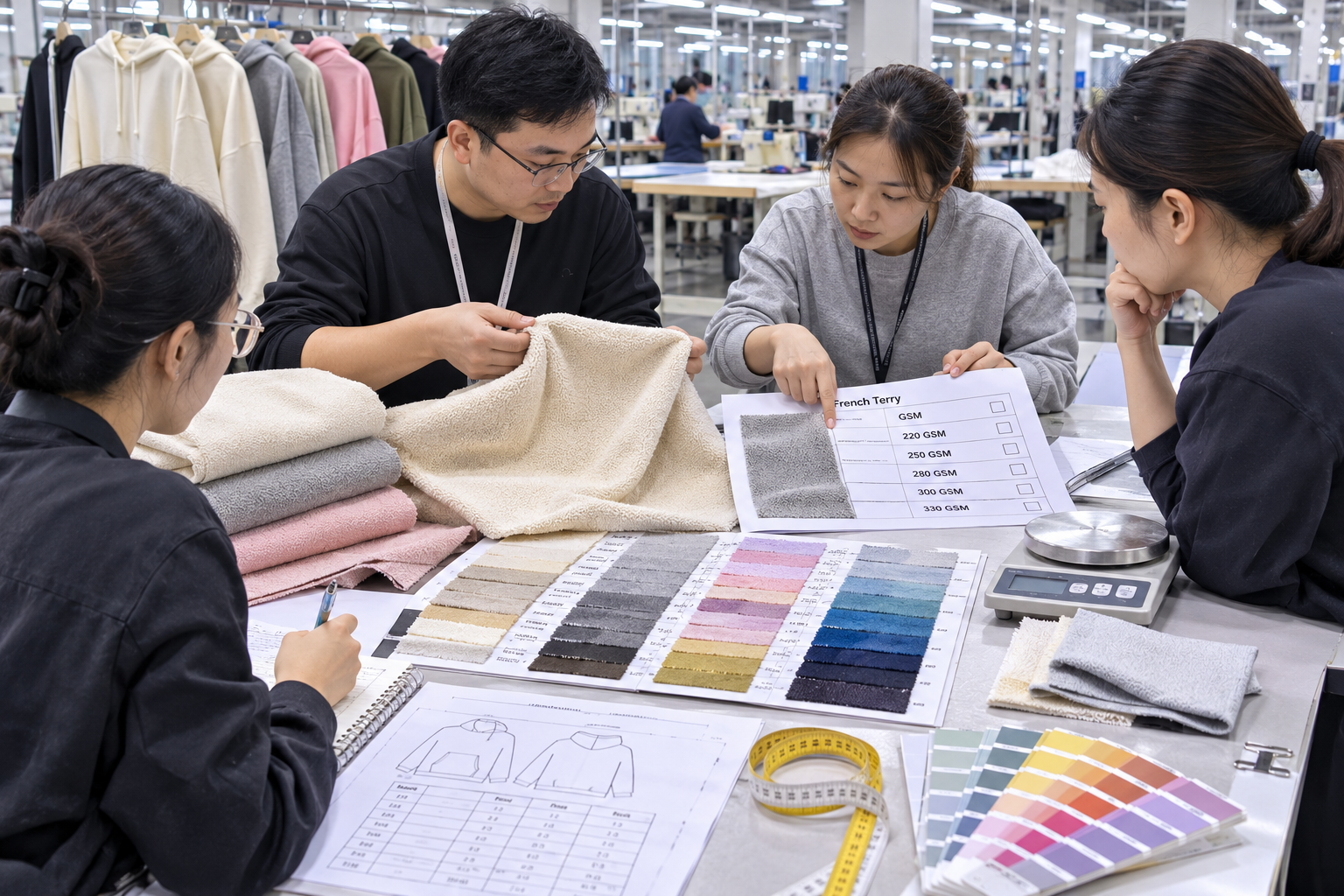
Choosing fabric from photographs alone creates unnecessary risks.
A photograph can show color and surface appearance, but it cannot reliably communicate fabric weight, hand feel, stretch recovery, thickness, or shrinkage.
For important development projects, we recommend reviewing physical fabric swatches or an actual reference garment whenever possible.
Fabric approval should cover composition, GSM, construction, hand feel, color, shrinkage, and any special performance requirements before bulk materials are committed.
Fabric Approval Checklist
| Item | What to Confirm |
|---|---|
| Composition | Fiber types and percentages |
| Fabric Weight | GSM and allowed tolerance |
| Width | Usable fabric width |
| Knit or Weave | French terry, fleece, jersey, twill, etc. |
| Hand Feel | Softness, firmness, brushing, surface texture |
| Color | Approved swatch or color standard |
| Shrinkage | Dimensional change after specified washing |
| Colorfastness | Relevant washing and rubbing performance |
| Stretch | Required stretch and recovery behavior |
| Opacity | Suitability for light-colored or stretch garments |
| Dye Lot | Identification and shade consistency |
| Finishing | Brushing, washing, or other treatment |
Why Should You Check GSM and Fabric Width Together?
Fabric GSM tells you the weight per square meter, but it does not tell you how much a roll will yield for garment production.
Fabric width also affects cutting efficiency.
For example, two fabrics with the same GSM may have different usable widths.
The wider material may allow a different pattern layout, potentially changing consumption and cutting loss.
However, a wider fabric is not automatically cheaper. The price per kilogram, usable width, shrinkage, and cutting arrangement must all be considered.
When calculating fabric consumption, we review the fabric's actual usable width rather than relying only on its nominal width.
This is particularly important for oversized hoodies, wide-leg trousers, and other garments with large pattern pieces.
Why Is Fabric Shrinkage Testing Important?
Shrinkage can affect finished garment dimensions.
If a hoodie meets its measurements before washing but changes significantly afterward, the customer may experience problems with fit.
For cotton-rich knitted fabrics, dimensional stability should be considered during development.
ISO 5077:2007[^4] provides a method for determining dimensional change after specified washing and drying procedures.
The appropriate testing conditions and acceptable shrinkage limits should be agreed upon according to the product and buyer's requirements.
Testing can also help the pattern maker account for expected material behavior.
How Do You Check Fabric Colorfastness?
Colorfastness matters because customers expect their clothing to retain color during normal use and care.
Depending on the fabric and intended application, testing may consider washing, rubbing, perspiration, and other conditions.
The AATCC textile test methods[^5] include established procedures for evaluating textile properties, including colorfastness.
For dark and heavily dyed fabrics, rubbing performance may deserve particular attention.
Before bulk production, the manufacturer and buyer should agree on which tests are required and what acceptance criteria apply.
Why Should You Keep Approved Fabric Swatches?
An approved swatch becomes a useful reference during production.
It allows the production and sourcing teams to compare delivered material against the agreed appearance and hand feel.
If different dye lots are used, retaining samples from each lot helps identify possible shade variations.
However, a reference swatch alone does not guarantee perfect consistency.
The incoming fabric should still be checked according to the agreed specifications.
What If You Only Have a Reference Photo?
A photograph is a useful starting point, but physical samples provide more reliable information.
If a particular garment is essential to the design, sending the actual sample allows the factory to examine its fabric construction and behavior.
Otherwise, the manufacturer can recommend available fabric options based on your reference images, requested weight, composition, and intended use.
Our color matching and clothing shrinkage guides provide more details about these development considerations.
What Fabric Minimums and Lead Times Should You Expect?
Fabric sourcing can determine when garment production begins.
Even when a factory has available sewing capacity, production cannot proceed as planned if the approved material is unavailable.
Stock fabrics generally offer shorter sourcing schedules, while custom knitting, special dyeing, or yarn-dyed fabric development can add additional weeks.
Fabric MOQ and Lead Time Comparison
| Fabric Type | Indicative Minimum | Production Consideration |
|---|---|---|
| Stock Fabric | Often available by full roll | Faster sourcing if inventory is available |
| Loose-Cut Stock Fabric | Smaller than one full roll | Possible price premium |
| Custom-Knit Fabric | Approximately 300 kg in the original sourcing program | Additional knitting and preparation |
| Custom Yarn-Dyed Stripes | Supplier-dependent larger minimum | Yarn dyeing and knitting time |
| Special Finishing | Depends on process and mill | Additional finishing and testing |
| Organic or Recycled Blends | Stock or made-to-order depending on supply | Availability and documentation checks |
How Long Does Fabric Sampling Take?
The original development program for this article lists approximately 10–14 days for garment samples.
When fabric color cards need to be mailed and approved first, the overall development process may take approximately 20 days.
These are planning estimates, not fixed commitments.
The actual schedule depends on whether suitable fabric is available, the sample complexity, decoration requirements, shipping arrangements, and customer approval time.
How Does Custom Fabric Affect Bulk Production?
The original production estimate is approximately 23–28 days after sample approval and deposit for programs using available materials.
Custom fabric development adds a separate sourcing stage.
If yarn or fabric must be produced, dyed, finished, and tested, the order schedule needs to accommodate those operations before cutting.
Brands should avoid assuming that garment production and fabric production can always happen simultaneously.
How Does Chinese New Year Affect Fabric Sourcing?
Chinese New Year is an important scheduling consideration for clothing production in China.
The holiday can affect textile mills, dyeing facilities, fabric suppliers, garment factories, and logistics operations.
Factories and suppliers may operate on different holiday and restart schedules.
For orders targeting spring 2027, brands should confirm fabric purchasing deadlines and production arrangements early.
This is particularly important for custom fabrics, because a delay at the knitting or dyeing stage can affect the entire garment delivery schedule.
What Are the Typical Payment Terms?
For the production arrangements described in the original article, new clients generally pay a 50% deposit before production, with the balance settled before shipment.
Exact payment terms should be confirmed in the quotation or sales agreement.
For a more complete overview of garment manufacturing, visit Dechoreal to learn about our OEM and ODM clothing production services.
How Do You Choose Between Stock and Custom Fabric?
The best decision depends on your stage of business.
A new brand launching its first collection has different priorities from an established label ordering thousands of garments per season.
A Practical Decision Guide
| Your Situation | Suggested Fabric Strategy |
|---|---|
| Launching your first clothing collection | Start with stock fabric |
| Testing a new design | Use suitable available fabric |
| Ordering small quantities | Prioritize fabric availability |
| Need a fast launch | Choose approved stock options |
| Have a proven bestselling product | Compare stock and custom alternatives |
| Need a specific fabric construction | Investigate custom development |
| Require exclusive colors or stripes | Evaluate custom dyeing or yarn dyeing |
| Planning regular large-volume orders | Consider dedicated fabric production |
What Are the Green Flags of a Reliable Fabric Sourcing Partner?
A reliable manufacturer should explain both the opportunities and limitations of available materials.
| Green Flag | Red Flag |
|---|---|
| Provides actual available fabric specifications | Claims every GSM is always in stock |
| Explains full-roll and loose-cut pricing | Gives unclear fabric purchasing terms |
| Confirms fabric MOQ before development | Promises custom knitting without checking mill requirements |
| Discusses shrinkage and testing | Ignores fabric performance |
| Provides physical swatches when appropriate | Relies entirely on photographs |
| Identifies color and dye-lot limitations | Guarantees exact color matching without approval |
| Suggests suitable stock options for small orders | Pushes unnecessary custom development |
| Explains realistic sourcing schedules | Promises delivery without checking material availability |
From our manufacturing perspective, one of the most valuable things a supplier can do is tell a customer when custom development is unnecessary.
If an existing fabric works, there may be little reason to create additional cost.
If the product depends on a unique fabric specification, custom development may be worth the investment.
The decision should come from the garment's requirements, not simply the label attached to the fabric.
Frequently Asked Questions
Is Stock Fabric Cheaper Than Custom Fabric?
Stock fabric often requires a lower upfront purchasing commitment because the supplier already offers that material.
However, custom fabric can become economically competitive when production volumes increase.
The final comparison depends on material specifications, quantity, supplier pricing, and processing requirements.
Can I Order Custom Fabric for Only 50 Hoodies?
It depends on the fabric supplier and the customization required.
A small quantity may be possible with existing stock fabric and available colors.
Developing an entirely new knitted fabric may require a much larger minimum, such as the approximately 300 kg example discussed in this guide.
Can Stock Fabric Be Used for Premium Streetwear?
Yes.
Premium clothing depends on material quality, fit, construction, finishing, and consistency.
A suitable stock fabric can be used to manufacture high-quality streetwear without requiring exclusive fabric development.
Can I Request an Exact Custom GSM?
You can specify a target GSM for custom development.
However, the manufacturer and fabric mill should confirm feasibility, production tolerances, and the effect on fabric performance.
A specified number does not automatically guarantee identical results across all production batches.
Does Custom Fabric Always Require Custom Dyeing?
No.
Custom fabric may involve changes to yarn, construction, weight, or finishing.
Custom dyeing may be a separate process, and standard fabric qualities can sometimes be dyed in a customer's requested color without changing the underlying structure.
What Is the Difference Between Fabric MOQ and Clothing MOQ?
Fabric MOQ is the minimum quantity required by the fabric supplier or mill.
Clothing MOQ is the minimum garment quantity required for a production order.
They are related, but they are not the same.
A factory may accept a relatively small garment order using stock fabric even when producing a new fabric would require a much larger material commitment.
Should I Approve Fabric Before Making a Garment Sample?
Ideally, you should confirm the intended fabric quality before making the approval sample.
If a substitute fabric is used for an early fit sample, that should be clearly documented.
The final approved garment sample should reflect the agreed production fabric wherever possible.
Can Organic Cotton or Recycled Fabric Be Purchased From Stock?
Sometimes.
Availability depends on the supplier's existing inventory, composition, certification requirements, color, and quantity.
Brands should request appropriate supporting documentation rather than assuming all available organic or recycled fabrics carry valid certification for the intended product.
For example, OEKO-TEX® STANDARD 100[^6] addresses testing for harmful substances; it does not, by itself, establish that fabric is organic or recycled.
Conclusion
Choosing between stock fabric and custom fabric is not simply a question of quality or price.
It is a decision about how your clothing brand wants to manage development, product differentiation, material investment, and production risk.
For a first collection or smaller production run, stock fabric is often the most practical choice.
It allows you to focus on fit, construction, branding, and customer feedback without committing to large quantities of specially developed material.
For established products with consistent demand, custom fabric can provide greater control over composition, construction, color, and finishing.
At Decheng, our approach is to review the garment's requirements before deciding how the fabric should be sourced.
If an existing fabric can achieve the intended result, we prefer to explain that option clearly.
If a custom material is necessary, we help the customer understand its technical requirements, minimum quantities, and production implications.
Planning a custom hoodie, T-shirt, sweatpant, or streetwear collection?
Visit Dechoreal.com to learn more about our clothing manufacturing services and discuss available fabrics, garment development, and OEM/ODM production options.
Footnotes & References
[^1]: Textile Exchange — Materials Market Report 2025. Industry research covering global fiber production, recycled materials, and textile sourcing trends. https://textileexchange.org/app/uploads/2025/09/Materials-Market-Report-2025.pdf
[^2]: Procurement Resource — Cotton Market Firms in Early November as India Extends Duty Relief and ICE Futures Hold Above 78 Cents. Published November 6, 2026. Provides cotton futures information, including the October 29 settlement. https://www.procurementresource.com/news-and-articles/cotton-market-firms-in-early-november
[^3]: CottonWorks™ — Monthly Economic Letter: October 2026. Industry reference discussing cotton prices, futures contracts, and sourcing market conditions. https://cottonworks.com/news/monthly-economic-letter-october-2026/
[^4]: International Organization for Standardization (ISO) — ISO 5077:2007 — Textiles: Determination of Dimensional Change in Washing and Drying. Official standard for measuring dimensional changes following specified washing and drying procedures. https://www.iso.org/standard/41877.html
[^5]: American Association of Textile Chemists and Colorists (AATCC) — Standard Test Methods and Procedures. Official textile testing reference covering colorfastness and other fabric performance evaluations. https://www.aatcc.org/testing/standards
[^6]: OEKO-TEX® — STANDARD 100. Official information about textile testing for harmful substances and certification scope. https://www.oeko-tex.com/en/our-standards/oeko-tex-standard-100