

Scaling Clothing Production: How Do You Reorder and Grow from Small Batch to Bulk?
Your first hoodie drop sells out in two weeks.
That sounds like good news.
Then customers start asking:
“When will it be back?”
You contact your factory.
The answer is:
Fabric needs to be ordered again. Production needs several weeks. Then you still need shipping.
By the time the reorder arrives, the excitement around the original launch may already have cooled.
Selling out is good.
Staying sold out for too long is not.
Scaling clothing production means turning successful small-batch products into repeatable production programs. The goal is not simply to order more pieces. It is to reorder early enough, keep fit and color consistent, improve unit economics as volume grows, and build a production system that can repeat your best-selling styles reliably.
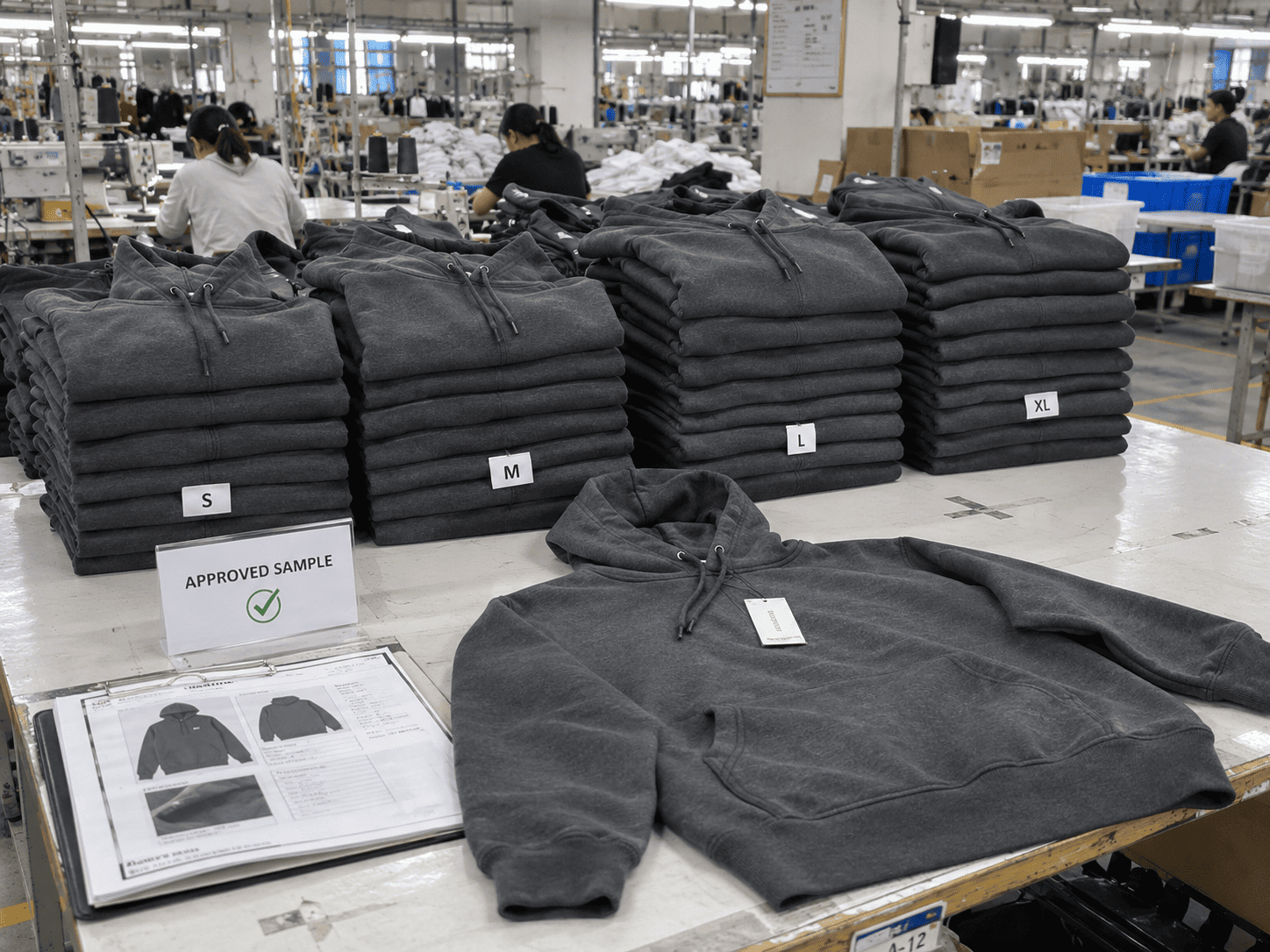
Inventory planning matters because both extremes cost money.
According to IHL Group's 2025 inventory-distortion research[^1], global retailers lose approximately USD 1.73 trillion every year to the combined impact of out-of-stocks and overstocks.
IHL estimates that inventory distortion represents around 6.5% of global retail sales.[^1]
A growing clothing brand faces exactly the same problem on a smaller scale.
Order too little:
you lose sales.
Order too much:
your cash sits in unsold inventory.
The goal is not maximum stock.
The goal is better timing.
Table of Contents
- When Should You Place a Reorder?
- Why Is a Reorder Faster Than a First Order?
- How Do You Keep a Reorder Consistent With the First?
- How Does Your Unit Price Change as You Scale?
- What Changes in Terms and Planning as You Grow?
- Which Reorder Mistakes Cost Brands the Most?
- Conclusion
When Should You Place a Reorder?
The biggest reorder mistake is simple:
waiting until inventory reaches zero.
By then, you are usually too late.
A clothing brand should consider reordering when its remaining sellable inventory is approaching the quantity it expects to sell during the factory lead time, shipping time, and an additional safety buffer. Reorder planning should also be done by size and color, not only by total style quantity.
Think in Total Replenishment Time
Your reorder is not only:
factory sewing time.
It may include:
- Order confirmation
- Fabric availability
- Fabric purchase or dyeing
- Trims
- Cutting
- Printing or embroidery
- Sewing
- Finishing
- Inspection
- Packing
- Freight
- Customs and delivery
If bulk production requires around 20–30 days, and sea freight takes several more weeks, waiting until only two weeks of inventory remain is clearly too late.
A Simple Reorder-Point Example
Suppose your hoodie sells:
50 pieces per week
and your estimated replenishment time is:
7 weeks
Production + shipping demand during that time:
50 × 7 = 350 pieces
If you also want a two-week safety buffer:
50 × 2 = 100 pieces
A practical planning trigger could therefore appear around:
450 pieces remaining
rather than waiting until zero.
This is only a planning example.
Real demand changes.
But the principle is useful:
inventory left should be compared with how much you expect to sell before the new production can physically arrive.
Track Sizes Separately
This matters a lot in clothing.
Imagine you technically still have:
120 hoodies.
But the stock looks like this:
| Size | Inventory |
|---|---|
| S | 40 |
| M | 3 |
| L | 2 |
| XL | 15 |
| XXL | 60 |
Your warehouse says:
120 pieces available.
Your customer sees:
M and L sold out.
Commercially, your style is already partly out of stock.
So track:
- Sell-through by size
- Sell-through by color
- Weekly sales velocity
- Returns
- Available stock
not only total quantity.
Separate Core Styles From Experimental Styles
Not every product deserves the same inventory strategy.
A new graphic tee might remain:
small test run.
Your proven black hoodie may become:
carry-over core stock.
That distinction matters.
For new products:
- Lower quantity
- More cautious reorder
- Faster feedback
For proven styles:
- Deeper inventory
- Earlier fabric booking
- Forecasted repeat production
Scaling should put more money behind evidence.
Not behind every idea equally.
Watch Factory Holidays
Reorder lead time changes during busy periods.
For China production, Chinese New Year is especially important because the slowdown is not limited to the garment factory.
It can affect:
- Fabric mills
- Dye houses
- Label suppliers
- Zipper suppliers
- Printing workshops
- Trucking
So if your stock will run low around February, reorder planning needs to begin much earlier.
The same principle applies to:
- National holidays
- Peak shipping seasons
- Major launch periods
Why Is a Reorder Faster Than a First Order?
A first order requires decisions.
A true reorder should reuse those decisions.
A repeat clothing order can be faster because the approved pattern, measurements, grading, fabric specification, artwork, trims, labels, and packing requirements already exist. But a reorder should only skip development stages when the specification really has not changed.
First Order vs Reorder
| Stage | First order | Exact repeat order |
|---|---|---|
| Pattern | Developed | Reuse approved pattern |
| Grading | Developed | Reuse approved grading |
| Fabric | Sourced and approved | Source same specification |
| Color | Developed | Match approved standard |
| Sample | Required | May not require full redevelopment |
| Artwork | Approved | Reuse final file |
| Embroidery | Developed | Reuse approved specification |
| Labels | Developed | Reorder existing artwork |
| Packing | Defined | Repeat approved method |
| Bulk | Starts after approval | Can move faster |
But Do Not Automatically Skip Every Sample
This is important.
A reorder may still need a confirmation sample if something significant changes.
For example:
- New fabric supplier
- New color
- New wash
- Different zipper
- New embroidery size
- Pattern adjustment
- Different GSM
- Different factory process
If you change three things and call the order:
“repeat order”
it is not really a repeat order anymore.
Use Version Control
One of the easiest ways to create a production mistake is:
Original tech pack: V1
Then the buyer says in WhatsApp:
“Please make sleeve 2 cm longer next time.”
Three months later, the factory opens V1.
Nobody remembers whether that chat message was final.
The correct system is:
Tech Pack V2 — sleeve +2 cm
Every production change should have:
- Date
- Version number
- Description
- Approval
Then the reorder is repeatable.
Leftover Trims Can Help
Some custom items have supplier minimums.
For example:
- Woven labels
- Hangtags
- Jacquard elastic
- Custom packaging
- Certain hardware
If the first production ordered more trims than the garment quantity required, usable leftover stock can sometimes carry into the reorder.
That can reduce:
- Development time
- Setup
- Waste
But the quantity should be recorded.
Do not assume:
“We probably have labels left.”
Know exactly what remains.
How Do You Keep a Reorder Consistent With the First?
This is where brands start noticing the difference between:
a supplier who can make one good order
and:
a supplier who can support growth.
Customers expect the same style to stay recognizable.
Repeat-order consistency comes from keeping the approved pattern, fabric specification, physical color reference, artwork, trims, wash standard, labels, and measurement tolerances on file. A new production lot should be compared against the approved standard rather than recreated from memory.
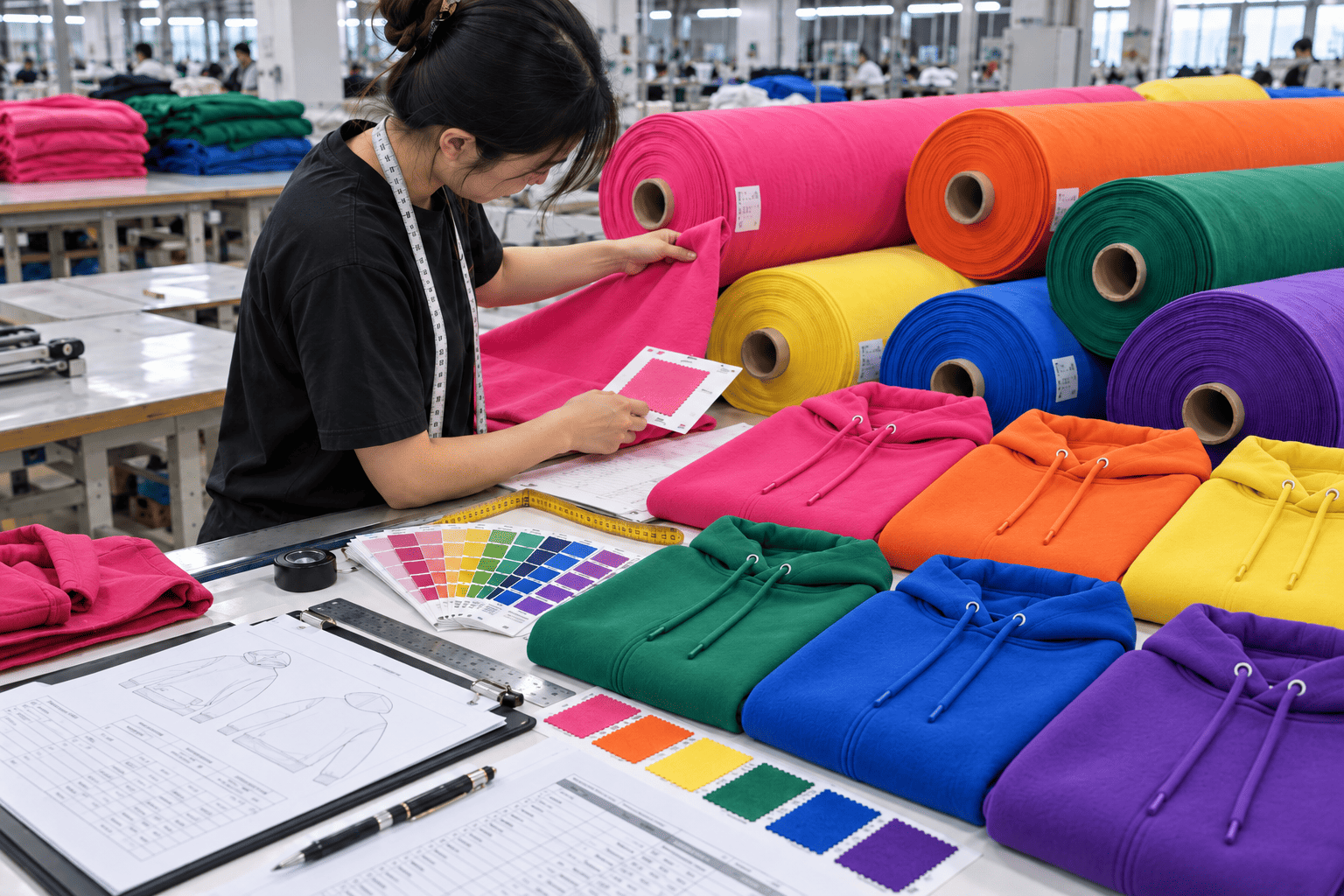
Fabric Color Is One of the Hardest Things to Repeat
Fabric is normally dyed in production lots.
A new order six months later usually means:
new dye lot.
Even when using:
- Same mill
- Same fabric
- Same color formula
a small visual difference can occur.
That is why:
“same black as last time”
is not a technical color specification.
Keep Physical Color References
For textile development, Pantone Fashion, Home + Interiors[^2] is designed for fashion and textile applications.
Pantone identifies TCX as the format intended for soft textile surfaces.[^2]
For production, we prefer to combine the brand color reference with the actual approved fabric.
Keep:
- Pantone reference
- Approved lab dip if applicable
- Bulk swatch
- Finished garment sample
Pantone itself notes that screen representations may not exactly match physical color standards.
So do not approve a reorder from:
an iPhone photo of the old hoodie.
Match New Fabric Against the Previous Standard
When the new fabric arrives:
Old approved reference
vs.
New bulk fabric
should be compared under consistent viewing conditions.
The goal is not to claim that independent dye lots will always be physically identical.
The goal is:
keep the new production within the agreed visual tolerance.
Shrinkage Can Change Too
Even if the fabric name remains the same, a new lot may behave differently enough that checking dimensional behavior is sensible.
ISO 5077[^3] provides a standardized method for determining dimensional change in textile fabrics and garments after washing and drying.
This is particularly useful when consistency matters across repeated:
- T-shirts
- Hoodies
- Sweatpants
- Garment-washed products
The factory should not assume:
“Last year's fabric shrank 3%, so this year's definitely will too.”
Verify where the risk justifies it.
Decoration Should Be Locked Too
Keep exact details for:
- Embroidery width
- Embroidery height
- Thread reference
- Print dimensions
- Position from seam
- Print ink
- Puff height where relevant
- Patch
- Template
For example:
Left chest logo 8 cm wide
is repeatable.
Same logo as last time
depends on memory.
Fit Should Come From the Approved Pattern
The same applies to:
- Chest
- Length
- Shoulder
- Sleeve
- Waist
- Rise
- Inseam
Reorders should reference the same approved pattern and measurement sheet unless the buyer intentionally approves a change.
Final Inspection Helps Catch Drift
At larger quantities, statistical sampling can be part of the inspection plan.
The current ISO 2859-1:2026[^4] defines acceptance-sampling schemes indexed by Acceptance Quality Limit (AQL) for lot-by-lot inspection.
The 2026 edition replaced the previous 1999 edition and its amendments.[^4]
AQL should not be understood as:
“2.5% defective products are okay.”
It is part of a statistical sampling and lot-acceptance system.
For repeat orders, inspection should still compare finished goods against:
- Approved sample
- Measurement chart
- Artwork
- Packing requirement
A reorder should not receive less QC simply because the style is familiar.
How Does Your Unit Price Change as You Scale?
Most brands assume:
100 pieces = one price
1,000 pieces = exactly 10% cheaper
5,000 pieces = another fixed percentage cheaper
Manufacturing rarely works that smoothly.
Clothing unit prices usually decrease in steps as quantity improves fabric purchasing, spreads fixed setup costs across more garments, and allows longer production runs. The actual price breaks depend on the style, fabric, decoration, color split, trims, and supplier minimums.
Why Larger Orders Can Cost Less Per Piece
Three major reasons are:
1. Fabric Purchasing
At very small quantities, a factory may need:
- Cut yardage
- Partial rolls
- Small-lot sourcing
At larger quantities:
- Full rolls
- Larger dye lots
- Mill-level pricing
may become possible.
2. Setup Cost
Some costs happen once per design.
Examples:
- Embroidery digitizing
- Print screen
- Appliqué template
- Rhinestone template
- Custom mold
If a $50 setup supports:
50 garments:
$1 per garment
If the same setup supports:
500 garments:
$0.10 per garment
The setup itself did not become cheaper.
It was simply spread across more units.
3. Production Efficiency
A sewing line becomes more efficient when operators repeat the same construction for longer runs.
Changing constantly between:
- Style
- Fabric
- Thread
- Machine setup
reduces efficiency.
So:
1,000 pieces of one proven style
can be more efficient than:
10 styles × 100 pieces
even though both total 1,000 pieces.
There Is No Universal Clothing Price-Break Table
The original draft used fixed breaks such as:
- 200
- 1,000
- 3,000
- 5,000 pieces
Those may appear in individual quotations.
But they should not be presented as universal industry rules.
A hoodie and a polo may reach cost efficiencies at different quantities.
The actual break depends on:
- Fabric MOQ
- Dye MOQ
- Size ratio
- Color split
- Decoration
- Hardware
- Sewing complexity
So when scaling, ask the factory:
“What quantity changes the cost meaningfully for this exact style?”
That is much more useful.
Depth Usually Improves Economics Better Than Width
Suppose you have USD 20,000 to invest.
Option A:
20 styles × small quantity
Option B:
5 proven styles × deeper quantity
The second option may give:
- Better material buying
- Lower setup per unit
- Better size availability
- Easier reordering
That does not mean stop developing new products.
It means use:
small batches to test
and:
larger quantities to scale winners.
Color Depth Matters Too
500 pieces divided into:
250 black
250 grey
can be easier to source than:
50 pieces × 10 colors
even though total volume is identical.
Why?
Because each color may have its own:
- Dye lot
- Fabric minimum
- Rib
- Thread
- Decoration
- Cutting batch
Total quantity does not tell the full story.
Quantity per color matters.
What Changes in Terms and Planning as You Grow?
When a brand becomes repeat business, the relationship with the factory changes.
But that does not mean every commercial term automatically becomes more favorable.
As order volume becomes predictable, brands and manufacturers can plan material, production capacity, inspections, and shipping earlier. Payment terms may also be reviewed case by case, but they should never be assumed simply because order quantity increased.
Early-Stage Relationship
At the beginning, the factory knows very little about:
- Payment reliability
- Forecast accuracy
- Revision habits
- Order consistency
So production is generally managed order by order.
Our normal bulk structure is typically:
50% before production + 50% before shipment
unless a different arrangement is specifically agreed.
Do Not Promise Automatic 30/70 Terms
The original article said that established clients could move automatically from:
50/50
to:
30/70.
That is too definite.
Commercial terms can depend on:
- Order history
- Credit
- Quantity
- Material commitment
- Customer relationship
- Risk
Some long-term clients may negotiate different arrangements.
Others remain at the same terms.
So the safer message is:
terms can be reviewed as the relationship develops.
Not:
every repeat buyer receives 30/70.
Forecasting Becomes More Valuable Than Negotiating Deposit Percentages
If a brand tells the factory:
“We might need 500 black hoodies sometime soon.”
the factory cannot plan much.
If the brand says:
November: ~500 black hoodies
January: ~800
March: ~1,000
that information helps the factory think about:
- Fabric
- Capacity
- Trim inventory
- Holiday timing
A forecast is not a purchase order.
It is planning information.
Core Products Should Become Production Programs
A successful brand often develops:
- Core tee
- Core hoodie
- Core sweatpant
that remain in the range.
Those products are ideal for repeat manufacturing because:
- Pattern is stable
- Fabric is known
- Decoration is known
- Customer demand is known
New colors can then be introduced more carefully without rebuilding the entire garment.
Shipping Strategy Can Change With Scale
When an order becomes larger, freight planning becomes more important.
For example:
Urgent sizes → air
Main quantity → sea
may sometimes make more sense than sending the whole order by expensive air freight.
But the commercial terms need to be clear.
The International Chamber of Commerce Incoterms® 2020 rules[^5] clarify obligations between buyer and seller, including the allocation of tasks, costs, delivery responsibilities, and risk.[^5]
Terms such as:
- EXW
- FOB
- CIF
- DAP
- DDP
should not be treated as another way of saying:
“shipping included.”
Different Incoterms® rules allocate responsibilities differently.
For a growing brand, understanding this becomes increasingly important as shipments get larger.
Book Capacity Earlier
A 100-piece sample order can sometimes fit into small gaps.
A 5,000-piece order needs production planning.
If you know a launch is coming:
share the approximate requirement early.
This is particularly important before:
- Chinese New Year
- Peak season
- Major promotional periods
Large quantities require planning, not simply faster sewing.
Which Reorder Mistakes Cost Brands the Most?
Most reorder problems do not come from highly technical manufacturing failures.
They come from poor communication.
The most expensive reorder mistakes include ordering too late, failing to document changes, assuming the new fabric will automatically match the old batch, ignoring size-level sales, changing too many variables, and failing to plan production capacity.
1. Reordering Only After Sell-Out
Problem:
Sales disappear while waiting for production.
Fix:
Track expected inventory against replenishment time.
2. Making "Small" Changes in Chat
Problem:
One person thinks:
same order.
Another person remembers:
sleeve +2 cm.
Fix:
Update the official specification.
3. Approving Color From Memory
Problem:
New batch slowly drifts away from the original.
Fix:
Keep physical standards.
4. Ignoring Size Sell-Through
Problem:
Warehouse has inventory, but useful sizes are unavailable.
Fix:
Forecast by size.
5. Changing Fabric and Expecting the Same Fit
A fabric change can affect:
- Stretch
- Weight
- Shrinkage
- Drape
So the same pattern may no longer produce the same garment.
If fabric changes materially, test again.
6. Adding Too Many Colors Too Early
Problem:
Volume gets fragmented.
Fabric purchasing becomes less efficient.
Fix:
Scale strong colors first.
7. Treating Reorders as Guaranteed Identical
A new manufacturing batch can have small variations.
The professional goal is not:
absolute physical identity forever.
The goal is:
controlled consistency within approved tolerances.
8. Skipping QC Because "We've Made It Before"
Repeat style does not mean:
zero inspection.
Machines change.
Fabric lots change.
Operators change.
Decoration runs change.
The approved reference still needs to be checked.
Reorder Checklist
Before confirming a repeat order, verify:
| Item | Confirm |
|---|---|
| Style | Same style number |
| Tech pack | Latest version |
| Pattern | Approved version |
| Fabric | Same specification |
| Color | Approved reference |
| GSM | Same target |
| Size chart | Same measurements |
| Decoration | Same file / size / position |
| Labels | Same artwork |
| Packing | Same requirements |
| Quantity | New size breakdown |
| Freight | Required arrival date |
Green Flags and Red Flags
| Green flag | Red flag |
|---|---|
| Keeps approved patterns on file | Rebuilds fit every order |
| Keeps physical fabric references | Uses old WhatsApp photos |
| Tracks trim stock | Does not know what remains |
| Uses version-controlled specs | Production changes exist only in chat |
| Explains cost breaks by actual style | Gives generic volume discounts |
| Rechecks new material lots | Assumes every batch is identical |
| Supports final inspection | Skips QC because it is a repeat |
| Plans capacity from forecasts | Only reacts when PO arrives |
Conclusion
Scaling clothing production is not about ordering the largest quantity you can afford.
It is about making your successful products easier to repeat.
Start with sales data.
Know:
- Which styles sell
- Which colors sell
- Which sizes sell
- How quickly they sell
Then compare remaining inventory with:
- Factory lead time
- Shipping time
- Safety margin
and place the reorder before stock reaches zero.
For repeat production, preserve the approved standard.
Keep:
- Pattern
- Tech pack
- Measurements
- Fabric specification
- Physical color reference
- Artwork
- Trims
- Labels
- Packing
on file.
When a new fabric lot arrives, compare it to the previous approved standard.
Do not rely on memory.
As quantity grows, unit cost can improve because:
- Fabric purchasing becomes more efficient
- Setup costs spread across more pieces
- Production runs become longer
But price breaks are not universal.
Ask where the real economies appear for your specific garment.
As your brand grows, forecast earlier.
Share likely demand with the factory.
Plan around:
- Materials
- Factory capacity
- Holidays
- Freight
And keep every intentional change documented.
The best production relationship is not one where the factory simply makes each purchase order.
It is one where both sides know which products are becoming core products and can plan the next run before the previous one disappears.
Your first order proves that the product can sell.
Your reorder proves that the business can scale.
And those are two very different things.
Footnotes & References
[^1]: IHL Group — Retail Inventory Crisis Persists Despite $172 Billion in Improvements. IHL Group reported in September 2025 that global retail inventory distortion—the combined impact of out-of-stocks and overstocks—costs the industry approximately USD 1.73 trillion annually, representing about 6.5% of global retail sales.
https://www.ihlservices.com/news/analyst-corner/2025/09/retail-inventory-crisis-persists-despite-172-billion-in-improvements/
[^2]: Pantone — Fashion, Home + Interiors (FHI). Pantone's FHI system is designed for fashion, apparel, fabrics, and other soft goods. Pantone identifies TCX as the system suited to textile and apparel surfaces and recommends physical Pantone references rather than relying solely on digital screen simulations when evaluating production color.
https://www.pantone.com/na/en-us/fashion-home-interiors
https://www.pantone.com/na/en-us/products/fashion-home-interiors/cotton-swatch-card
[^3]: International Organization for Standardization — ISO 5077:2007, Textiles — Determination of Dimensional Change in Washing and Drying. Specifies a method for determining dimensional change in textile fabrics, garments, and other textile articles after specified washing and drying procedures. The standard was reviewed and confirmed in 2022 and remains current.
https://www.iso.org/standard/41877.html
[^4]: International Organization for Standardization — ISO 2859-1:2026, Sampling Procedures for Inspection by Attributes. The 2026 edition defines acceptance-sampling schemes indexed by Acceptance Quality Limit (AQL) for lot-by-lot inspection and replaced the previous 1999 edition and its amendments. AQL is part of a statistical acceptance-sampling system rather than a direct allowable-defect percentage or factory certification.
https://www.iso.org/standard/85464.html
[^5]: International Chamber of Commerce — Incoterms® 2020. ICC's Incoterms® rules define common trade terms used in contracts for the delivery of goods and clarify the allocation of seller and buyer obligations, costs, delivery responsibilities, and risk. Incoterms® 2020 remains the latest edition of the ICC rules.
https://iccwbo.org/business-solutions/incoterms-rules/
https://iccwbo.org/business-solutions/incoterms-rules/incoterms-2020/