
Branded Merchandise Apparel Manufacturer: How Do Companies Get Consistent, On-Brand Merch?
Your company ordered branded hoodies for an event.
The garments look good.
But the logo sits slightly too low.
Your brand red looks orange.
Then six months later, you reorder the same hoodie and the new batch arrives in a different shade.
For a fashion product, that may be an inconvenience.
For a corporate brand, it is a brand-control problem.
A branded merchandise apparel manufacturer produces custom clothing for companies, teams, organizations, events, and branded retail programs. The priorities are not only garment quality, but also accurate brand colors, correct logo reproduction, documented approvals, predictable reorders, and a supplier that can pass procurement checks.
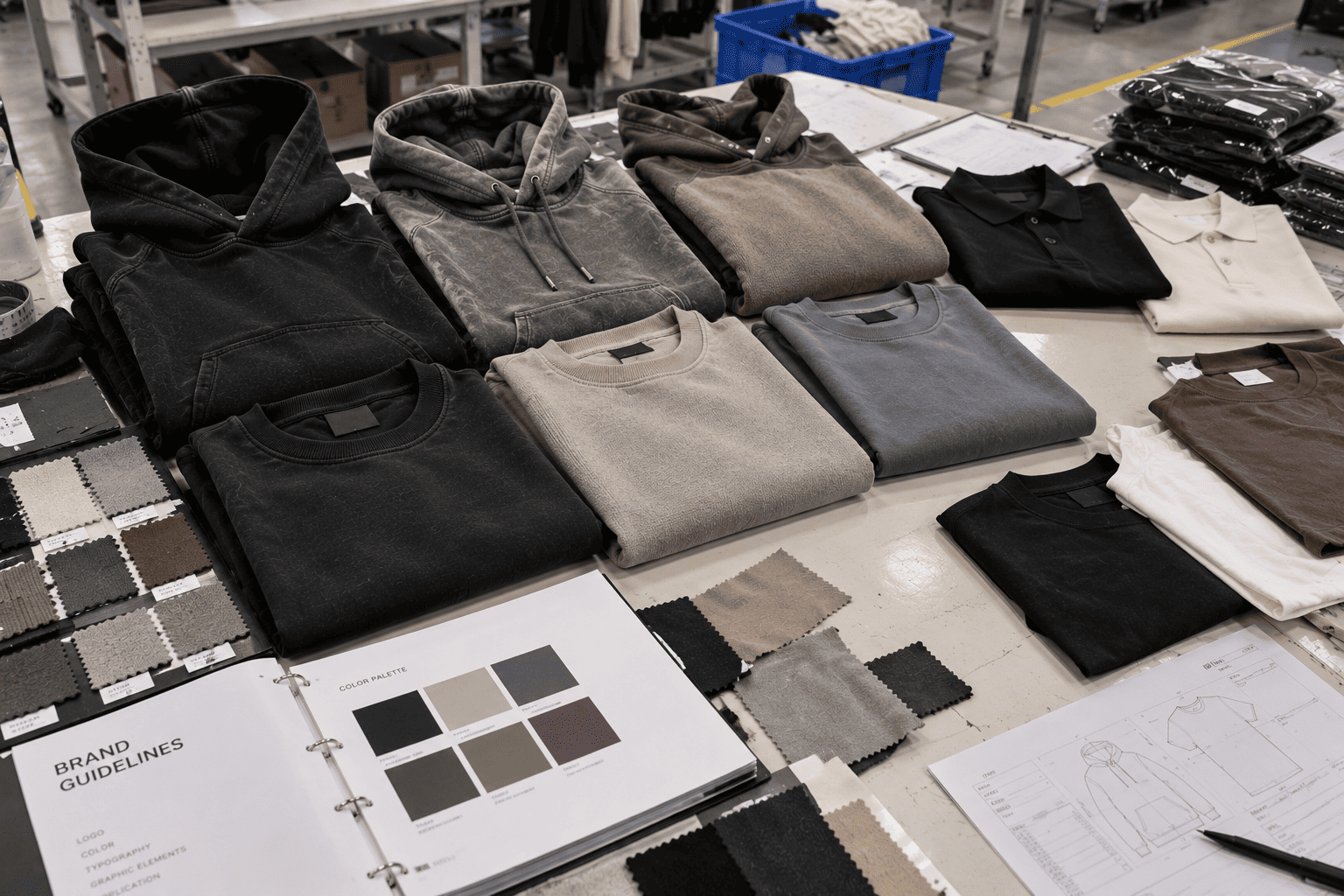
The market behind corporate merchandise is substantial.
According to the Promotional Products Association International[^1], U.S. promotional-products distributor sales reached approximately USD 27.1 billion in 2025, the first time the industry's estimate exceeded USD 27 billion.
PPAI reported approximately 1.3% year-over-year growth despite pressure from tariffs, freight, compliance costs, and tighter customer budgets.[^1]
Apparel is especially useful in branded merchandise because it does something a desk item cannot.
People wear it.
But corporate merchandise should not be managed exactly like a seasonal fashion collection.
Table of Contents
- What Makes Branded Merchandise Different from Fashion Apparel?
- Which Apparel Works Best for Company Merchandise?
- How Do You Keep Brand Colors Consistent?
- How Do You Protect Your Logo in Production?
- What Should a Vendor Qualification Process Check?
- What MOQ, Timing, and Reorders Should You Plan For?
- Conclusion
What Makes Branded Merchandise Different from Fashion Apparel?
A fashion brand is selling the garment itself.
A company may be using the garment to represent something larger:
- Corporate identity
- Event
- Staff team
- Campaign
- Sponsor
- Community
- University
- Non-profit organization
- Internal culture
That changes the priorities.
Branded merchandise is usually judged more heavily on consistency, logo accuracy, color control, repeatability, and procurement compliance than trend-driven fashion apparel.
Fashion Apparel vs Branded Merchandise
| Priority | Fashion apparel | Company merchandise |
|---|---|---|
| Main goal | Sell the garment | Represent the organization |
| Logo | Part of design language | Must follow brand standards |
| Color | Can change by collection | Often fixed to corporate identity |
| Reorders | New drop may replace old one | Same style may need repeating |
| Approval | Often founder/design team | Marketing, brand, procurement and management |
| Documentation | Depends on brand | Often formal vendor process |
| Confidentiality | Varies | Often important |
| Delivery | Collection calendar | Frequently tied to fixed event dates |
The Approval Process Is Usually Longer
For a small fashion brand, one founder may approve:
"Looks good. Start bulk."
Corporate merchandise can involve:
- Designer
- Marketing manager
- Brand manager
- Procurement
- Event team
- Compliance
- Finance
A factory cannot control how quickly the customer approves internally.
But it can make approval easier by providing clear documentation.
For example:
- Fabric swatch
- Color approval
- Embroidery sample
- Print sample
- Size chart
- Mockup
- Packing specification
- Signed-off production sample
The clearer the approval trail is, the lower the chance that someone says:
"That isn't what our brand team approved."
after bulk production has already started.
Consistency Matters More Than Novelty
A fashion company may intentionally change black between collections.
A corporate team may want the exact same navy hoodie for:
- New York office
- London office
- Dubai office
- New employee onboarding
- Next year's conference
That means the manufacturer needs to think about the product as a repeatable specification, not only a one-time order.
If your company is developing a broader merchandise line, our private-label clothing guide explains how labels, packaging, trims, and product identity work together beyond the visible logo.
Which Apparel Works Best for Company Merchandise?
The correct garment depends on who will wear it and why.
T-shirts, hoodies, crewneck sweatshirts, polos, jackets, matching sets, and caps are all common branded-merchandise products, but the best choice depends on whether the garment is for an event, staff uniform, client gift, community program, or retail merchandise collection.
Branded Apparel by Use
| Product | Best suited to | Main consideration |
|---|---|---|
| T-shirt | Events, campaigns, giveaways | Budget, climate, print |
| Hoodie | Staff, teams, premium gifts | Fabric weight and fit |
| Crewneck sweatshirt | Teams and corporate casualwear | Simple premium presentation |
| Polo shirt | Front-line staff and client-facing teams | Collar, embroidery, fit |
| Jacket | Field staff and outdoor use | Weather protection |
| Matching set | Premium merchandise / retail | Color and fabric consistency |
| Cap | Events and teamwear | Separate specialist construction |
Event T-Shirt vs Staff Hoodie
These are very different buying decisions.
An event T-shirt may be:
- Lower-cost
- Light
- Printed
- Worn occasionally
A staff hoodie may be worn:
once or twice every week for a year.
That hoodie represents the company much more frequently.
In that case, better investment in:
- Fabric
- Rib
- Sewing
- Embroidery
- Shrinkage control
can make sense.
Match the Product to the Climate
A company buying merchandise for Saudi Arabia may not want the same fleece specification as a company in Northern Europe.
Likewise, a 450 GSM hoodie may feel premium in a product sample but may be too heavy for employees wearing it indoors all day.
Think about actual use.
For warmer markets, options may include:
- T-shirts
- Polos
- Lightweight French terry
- Light jackets
For cooler markets:
- Heavy hoodies
- Brushed fleece
- Crewnecks
- Outerwear
may work better.
Caps Need Specialist Production
Caps use different:
- Machines
- Blocks
- Panels
- Visors
- Reinforcement
- Embroidery setup
from knit garments.
We therefore work with a specialist long-term cap partner when customers want caps alongside their clothing program.
The important thing is to state that clearly rather than pretending every product is made on the same production line.
Our strongest categories remain knit apparel such as:
- T-shirts
- Hoodies
- Sweatshirts
- Sweatpants
- Shorts
- Matching sets
For product-specific development, our polo shirt guide and low MOQ hoodie guide go deeper into those categories.
How Do You Keep Brand Colors Consistent?
This is one of the most important parts of corporate merchandise.
A normal consumer may accept a small shade difference.
A brand manager may recognize it immediately.
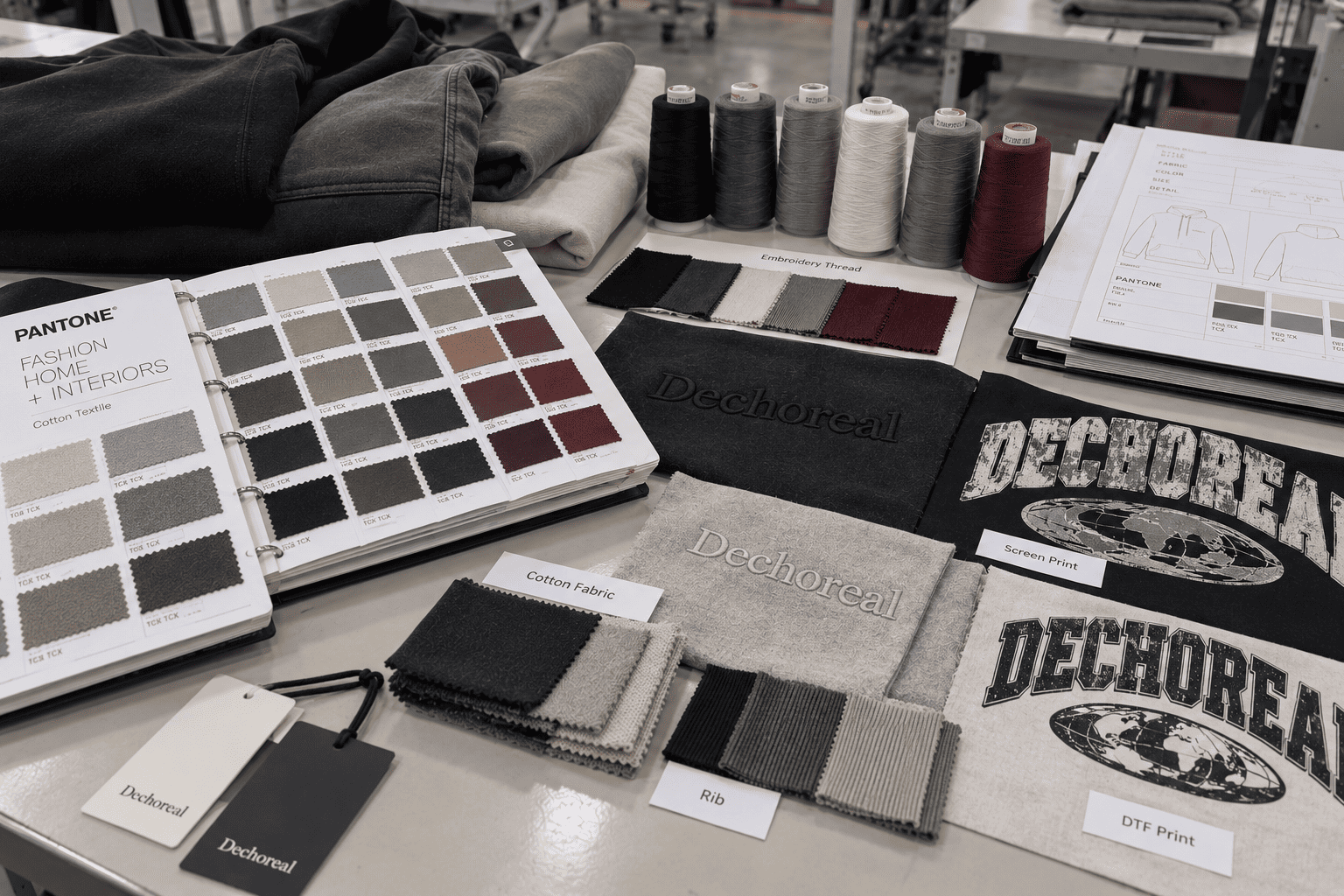
The best way to control corporate colors is to use a defined physical color reference, approve the actual fabric and decoration colors before bulk, document the approved result, and retain production references for future reorders.
Use the Correct Color System
Pantone provides different color systems for different materials.
For apparel and textile applications, Pantone Fashion, Home + Interiors[^2] is specifically designed for products such as:
- Apparel
- Textiles
- Fabrics
- Soft goods
Pantone identifies TCX as the preferred textile format for soft surfaces such as fabrics and apparel.[^2]
That matters.
A corporate brand guide may provide a graphics/PMS color originally created for:
- Packaging
- Website
- Printed paper
But your hoodie is cotton fabric.
The factory may need to identify the closest practical textile target rather than blindly assuming a graphics standard will reproduce identically on cotton.
Why One Brand Red Can Look Different
Imagine you use the same brand red on:
- Cotton hoodie
- Polyester polo
- Nylon jacket
- Embroidery thread
- Screen-print ink
- Rubber patch
They are different materials.
Pantone itself explains that color appearance changes according to material and surface.[^2]
So "exactly the same Pantone" does not always mean the human eye will see an identical result across every material.
The correct process is to approve the final appearance by product.
Color Control Process
| Step | What to control |
|---|---|
| Brand standard | Pantone / physical corporate reference |
| Fabric | Approve lab dip or actual swatch |
| Rib | Compare against body fabric |
| Embroidery | Approve thread against brand standard |
| Approve strike-off / print sample | |
| Bulk fabric | Compare with approved sample |
| Reorder | Use stored approved references |
Do Not Rely Only on a Screen
A PDF brand guideline is useful.
A phone screenshot is not a production color standard.
Screens vary according to:
- Brightness
- Calibration
- Display technology
- Viewing environment
When color is important, approve something physical.
Keep:
- Approved swatch
- Lab dip
- Embroidery sample
- Print sample
as the reference.
What About Reorders?
This is where a merch supplier proves its value.
Six months later, you may need another 300 hoodies.
The new fabric may come from a new dye lot.
It will not literally be the previous roll of fabric.
So the goal should be:
match the approved brand standard within the agreed tolerance
rather than promising every dye lot will be mathematically identical forever.
Keep previous production records such as:
- Fabric specification
- Pantone reference
- Approved physical swatch
- Decoration file
- Thread reference
- Measurements
- Wash
- Label artwork
That makes a reorder much more repeatable.
How Do You Protect Your Logo in Production?
For branded merchandise, the logo is not decoration in the ordinary sense.
It is intellectual property.
To protect logo accuracy, provide the final production artwork, define the physical size and placement, approve a stitched or printed sample before bulk, and restrict logo use to the authorized order.
Logo Production Checklist
| Item | What to define |
|---|---|
| Artwork | Final vector file |
| Logo width | Exact physical size |
| Placement | Distance from fixed garment point |
| Colors | Approved thread / ink reference |
| Embroidery | Stitched sample approval |
| Strike-off / sample approval | |
| Size scaling | Same size or different size groups |
| Authorized use | Only approved merchandise |
Use Vector Artwork Where Possible
For company logos, files such as:
- AI
- EPS
- SVG
- Production-quality PDF
are much easier to work with than a small JPG taken from a website.
Vector files help preserve:
- Curves
- Letter shapes
- Logo proportions
when artwork is resized.
Embroidery Can Change Small Details
A logo that looks perfect on a monitor may not embroider perfectly at 25 mm wide.
Very thin lines can become thicker.
Tiny negative spaces can close.
Small lettering can become difficult to read.
So for embroidery, the process should include an actual stitched approval sample.
Do not approve only from a digital mockup.
Logo Placement Should Use Measurements
Do not specify:
"around the left chest."
Instead, define the location from stable reference points.
For example:
- X cm from center front
- X cm below shoulder seam
- X cm from pocket edge
That makes production repeatable.
Trademark Authorization
If the merchandise carries your own company mark, that is straightforward.
But some corporate projects contain:
- Sponsor logos
- Partner logos
- Sports-team marks
- Licensed characters
- Co-branded campaigns
Those may require permission from another rights holder.
The World Intellectual Property Organization[^3] explains that trademarks distinguish the goods and services of an enterprise and that registered trademark owners generally receive the exclusive right to use the mark or license another party to use it.
So if a customer asks us to reproduce a third party's protected logo or licensed artwork, written authorization may be required.
This protects both sides.
Confidentiality
Corporate development files can include:
- Unreleased products
- New logos
- Campaign artwork
- Event dates
- Partner branding
We do not use customer artwork for unrelated orders or publicize customer projects without permission.
When a buyer requires a formal NDA, that can also be handled as part of vendor onboarding.
Printing and embroidery are completed through long-term specialist workshops we manage directly where appropriate, and logo samples are approved before bulk.
What Should a Vendor Qualification Process Check?
Larger organizations often qualify a manufacturer before issuing a purchase order.
This can look complicated the first time.
Usually, the buyer is trying to answer a few basic questions:
Is this a real supplier?
Can it produce the product?
Can it meet our compliance requirements?
Can it protect our brand?
Can it repeat the order?
Vendor Qualification Checklist
| Area | What to verify |
|---|---|
| Legal identity | Business registration / company name |
| Factory capability | Relevant machinery and product experience |
| Social compliance | Current audit information |
| Quality control | Inspection process and defect criteria |
| Capacity | Can supplier meet volume and dates? |
| Confidentiality | NDA / customer-data handling |
| IP | Policy on unauthorized logos |
| Financial terms | Deposit / balance / currency |
| Incoterms | EXW, FOB or agreed shipping basis |
| Third-party inspection | Whether buyer inspection is accepted |
| Partner processes | Which processes happen off-site |
Check the Legal Company Name
For us, the legal manufacturing entity used for Dechoreal.com is:
Dongguan Decheng Textile & Garment Co., Ltd.
Procurement teams should make sure:
- Quotation
- Contract
- Bank details
- Business documents
refer to the correct legal entity.
Do not qualify one company name and send money to an unexplained unrelated entity.
Understand Social Audits Correctly
Sedex's SMETA audit methodology[^4] evaluates supplier sites in areas including:
- Labour standards
- Health and safety
and, under the wider 4-Pillar scope:
- Environment
- Business ethics
Sedex states clearly that SMETA is a continuous-improvement audit methodology, not a certification or simple pass/fail badge.[^4]
SMETA audits are carried out by auditors from Sedex-approved independent Affiliate Audit Companies.[^4]
This distinction is important.
A supplier should provide the actual:
- Audit scope
- Audit date
- Site
- Report information
rather than simply putting a vague "Sedex certified" logo on its website.
Audit Scope Matters
An audit applies to a particular site.
It does not automatically mean every subcontractor or specialist workshop has the same audit.
For example, our core garment production is handled through our garment manufacturing operation.
Certain specialist processes may be managed through long-term partners, including depending on the order:
- Embroidery
- Printing
- Garment washing
- Caps
A buyer should know which site or supplier performs which process.
That is much more transparent than saying:
"Everything is in-house."
How Should AQL Be Described?
AQL is another term that is often oversimplified in sourcing.
The current ISO 2859-1:2026[^5] defines sampling schemes indexed by Acceptance Quality Limit (AQL) for lot-by-lot inspection.
The new 2026 edition replaced ISO 2859-1:1999 and includes updated sampling guidance.[^5]
AQL therefore belongs to a sampling and acceptance system.
It is not a factory certification.
For an apparel inspection, the buyer and inspector may agree on criteria such as:
- Inspection level
- Sample size
- Critical defect limit
- Major defect limit
- Minor defect limit
AQL 2.5 is commonly discussed in garment QC, but it should be written as part of the agreed inspection plan rather than advertised as if:
"AQL 2.5 = certified high quality."
Third-Party Inspection
We accept third-party pre-shipment inspection.
A buyer may use:
- Their own QC
- Sourcing agent
- Independent inspection company
to check goods before shipment.
That inspection can cover:
- Quantity
- Measurements
- Workmanship
- Logo
- Color
- Labels
- Packing
- Carton marks
For larger corporate orders, documenting the inspection standard before production prevents arguments at the end.
What MOQ, Timing, and Reorders Should You Plan For?
Corporate merchandise often has a deadline that cannot move.
A trade show starts on a specific date.
An employee event starts on a specific date.
A product launch starts on a specific date.
The garment cannot arrive a week afterward.
Plan branded merchandise backwards from the date the goods must physically be in your warehouse or event location, not from the date you want production to finish.
Typical Starting MOQs
For our standard programs, typical starting quantities are approximately:
| Product | Typical starting MOQ |
|---|---|
| Hoodies | 50 pcs / style |
| Crewneck sweatshirts | 50 pcs / style |
| Matching sets | 50 sets / style |
| T-shirts | 100 pcs / style |
| Polo shirts | Around 100 pcs / style depending on specification |
| Shorts | 100 pcs / style |
| Caps | Partner-factory MOQ confirmed separately |
These quantities can change if the order requires:
- Custom fabric
- Custom dye
- Custom jacquard
- Special hardware
- Special packaging
because material suppliers can have their own minimums.
Build the Approval Time Into the Schedule
Production is not always the longest delay.
Suppose we send a sample on Monday.
Then:
- Marketing reviews Wednesday
- Procurement reviews Friday
- Brand team asks for change Monday
- Management signs off Thursday
More than a week has passed without any factory production.
That time needs to be included in the project plan.
Example Merch Timeline
A program may include:
- Artwork and specification
- Fabric confirmation
- Sample
- Internal approval
- Revision if needed
- Bulk deposit
- Material preparation
- Bulk production
- Decoration
- Final inspection
- Packing
- Freight
- Customs
- Final delivery
If the order is tied to an event, add buffer.
Do not plan:
Delivery Friday → Event Saturday.
Reorders Should Be Easier Than First Orders
A good merch program creates a "golden reference" for the next run.
Keep:
- Approved garment sample
- Tech pack
- Size chart
- Fabric specification
- Color standard
- Decoration file
- Decoration size
- Thread colors
- Label artwork
- Packaging
- Carton specification
Then when a department says:
"We need 500 more of the same hoodie."
the factory is not developing a new hoodie.
It is repeating an approved specification.
Reorder Does Not Mean Zero Variation
Fabric may come from a new production lot.
Dye may be processed months later.
Therefore, a manufacturer should aim to match:
the approved standard within the agreed tolerance.
It should not promise something physically unrealistic such as:
"The new dye lot will be absolutely identical under every light source."
That is why retaining a physical reference is so important.
Green Flags and Red Flags
| Green flag | Red flag |
|---|---|
| Requests official brand artwork | Copies logo from website |
| Uses physical color approvals | Approves colors from phone photos |
| Keeps documented specifications | Relies on memory |
| Provides current audit information | Uses vague certification claims |
| Accepts buyer inspection | Does not allow pre-shipment checks |
| Explains partner processes | Claims everything is in-house |
| Protects customer artwork | Shows confidential customer designs freely |
| Plans reorders from approved references | Treats every reorder as a new guess |
Conclusion
Branded merchandise is not only about putting a logo on a hoodie.
It is about protecting the brand from one production run to the next.
Start with accurate files.
Define:
- Logo
- Size
- Placement
- Color
- Fabric
- Fit
- Label
- Packaging
Approve physical samples.
For corporate colors, use an appropriate textile color reference and approve the actual fabric, embroidery thread, or print rather than trusting only what appears on a screen.
For logos, use production-quality artwork and approve a real stitched or printed sample.
For vendor qualification, check the legal company, factory capability, audit scope, quality-control process, partner processes, and inspection terms.
And for reorders, keep the approved specifications.
The goal is not to recreate the product from memory six months later.
The goal is to repeat an approved standard.
That is what makes company merchandise look professional.
When employees in different offices wear the same hoodie, the logo should feel like the same logo.
The navy should feel like the same navy.
And the second order should feel like it belongs beside the first.
That consistency is the real product.
Footnotes & References
[^1]: Promotional Products Association International (PPAI) — 2025 U.S. Distributor Sales Volume Estimate. PPAI reported that U.S. promotional-products distributor sales reached approximately USD 27.1 billion in 2025, the industry's first year above USD 27 billion, representing approximately 1.3% year-over-year growth.
https://www.ppai.org/media-hub/ppai-sales-volume-estimate-promo-reaches-new-height-but-hampered-by-external-volatility/
[^2]: Pantone — Fashion, Home + Interiors (FHI). Pantone's official color system for fashion, textiles, apparel, and other soft goods. Pantone identifies TCX as the appropriate FHI format for textiles and apparel and notes that color appearance varies across different materials and surfaces.
https://www.pantone.com/na/en-us/fashion-home-interiors
https://www.pantone.com/na/en-us/color-systems/pantone-color-systems-explained
[^3]: World Intellectual Property Organization (WIPO) — Trademarks. WIPO explains that trademarks distinguish the goods or services of one enterprise and that trademark registration generally gives the owner exclusive use rights or the ability to license the mark to another party.
https://www.wipo.int/en/web/trademarks/
[^4]: Sedex — SMETA Audit. Official Sedex information on the SMETA social-audit methodology. SMETA assesses labour standards and health and safety, with 4-Pillar audits also covering environment and business ethics. Sedex states that SMETA is a continuous-improvement methodology rather than a certification and that audits are carried out by approved independent Affiliate Audit Companies.
https://www.sedex.com/solutions/smeta-audit/
[^5]: International Organization for Standardization — ISO 2859-1:2026. The current international standard for sampling procedures for inspection by attributes and sampling schemes indexed by Acceptance Quality Limit (AQL) for lot-by-lot inspection. The third edition was published in January 2026 and replaced the 1999 edition and its amendments.
https://www.iso.org/standard/2859-1