

Oversized T-Shirt Manufacturer: How Do You Make a Boxy Tee That Fits Right?
You asked for an "oversized tee."
The sample arrives, and it looks like a normal T-shirt two sizes too big.
The sleeves hang too low.
The body is too long.
The neck opening looks stretched.
That is not the oversized fit you wanted.
A true oversized T-shirt is built from its own pattern, with a wider body, dropped shoulder, controlled body length, wider sleeves, and a neckline that still sits cleanly around the neck. It is not simply a regular T-shirt graded up two sizes.
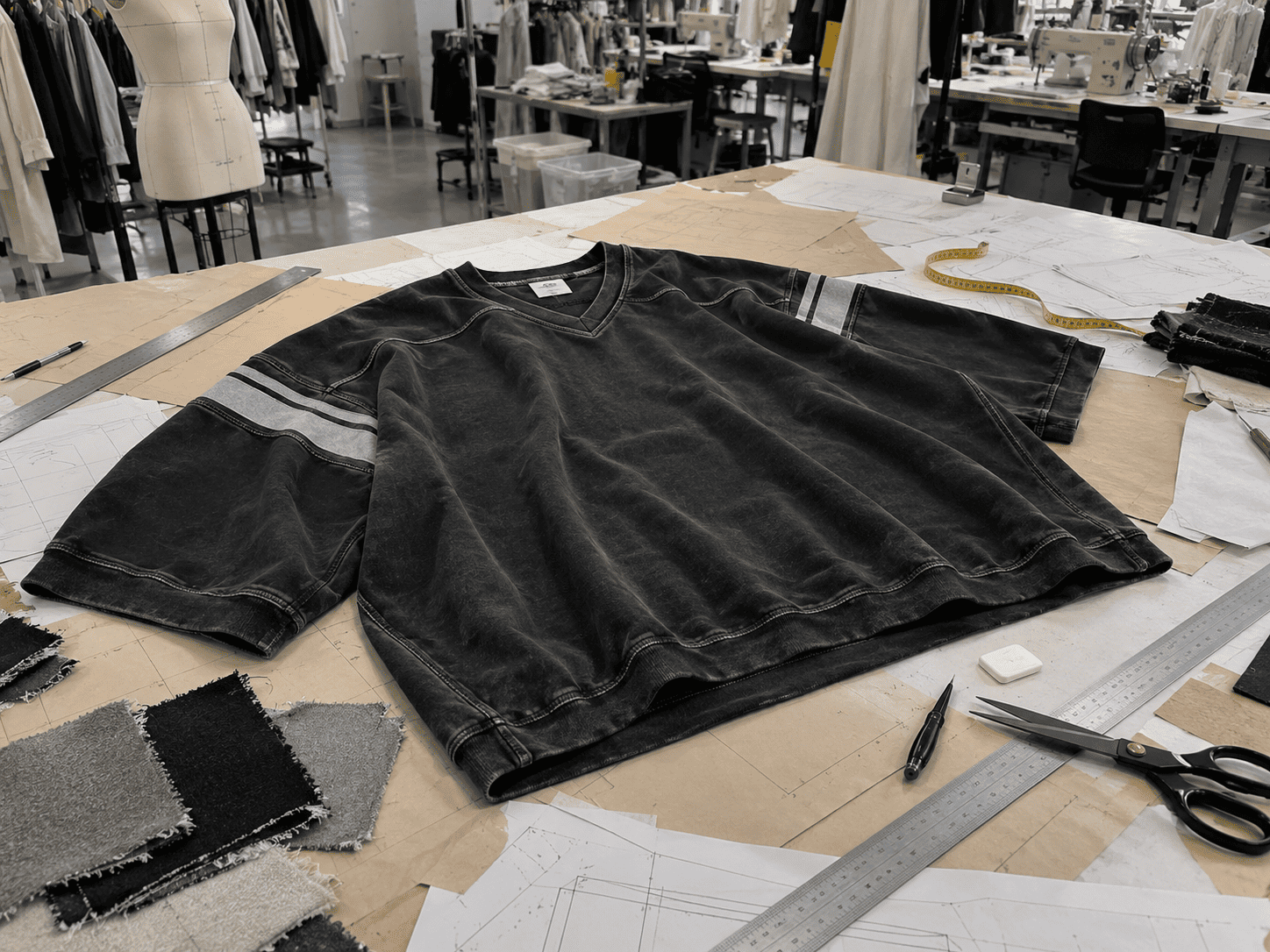
The oversized silhouette is now a standard part of streetwear and premium casualwear.
But "oversized" is not a technical measurement.
Two brands can both request an oversized T-shirt and mean completely different shapes.
One wants:
- Wide body
- Short length
- Dropped shoulder
- Heavy 300 GSM fabric
Another wants:
- Long body
- Loose sleeves
- Lightweight jersey
- Relaxed drape
That is why the pattern matters more than the word.
Table of Contents
- What Makes an Oversized Tee Different from a Bigger Size?
- Which Measurements Define the Oversized Fit?
- Which Fabric and Weight Should You Choose?
- Why Does the Collar Make or Break an Oversized Tee?
- How Do Print Size and Placement Work Across Sizes?
- What MOQ and Cost Should You Expect?
- Conclusion
What Makes an Oversized Tee Different from a Bigger Size?
This is one of the most common development mistakes.
A brand says:
"Make it oversized."
The factory takes a normal T-shirt pattern and simply makes everything larger.
That creates the wrong proportions.
A true oversized tee has a purpose-built pattern. The body becomes wider, the shoulder seam moves onto the upper arm, the sleeve gets wider, and the body length is controlled so the garment looks intentional rather than simply too large.
Sized-Up Regular Tee vs True Oversized Tee
| Feature | Regular tee sized up | True oversized tee |
|---|---|---|
| Shoulder | Moves slightly outward | Deliberately dropped |
| Chest | Wider | Much wider and boxier |
| Body length | Becomes much longer | Controlled |
| Sleeve | Longer but often narrow | Wider and proportioned to dropped shoulder |
| Neck opening | Often becomes too wide | Kept controlled |
| Overall look | Looks too big | Looks intentionally oversized |
The neckline is one of the easiest places to see the difference.
A good oversized T-shirt can have:
- Very wide chest
- Very dropped shoulder
- Large sleeve
while still keeping a relatively clean, close neckline.
That contrast helps the garment look designed rather than stretched.
Pattern First, Size Second
Do not brief a factory by saying:
"Use XXL measurements for size M."
That is not the same thing as making a proper oversized pattern.
Instead, send:
- Reference garment
- Front and back photos
- Measurement chart
- Desired body length
- Desired chest width
- Shoulder width
- Sleeve opening
Then build the pattern from those proportions.
Our tech pack guide explains how to turn a reference garment into measurable specifications.
Which Measurements Define the Oversized Fit?
"Oversized" becomes much easier to control once you stop describing it with adjectives.
Chest width, shoulder width, body length, sleeve length, sleeve opening, and neckline measurements determine whether a T-shirt feels boxy, long, relaxed, or simply oversized.
Two T-shirts may have the same chest width and still look completely different.
Why?
Because one may be:
wide + short
while the other is:
wide + long
That ratio changes the whole silhouette.
Key Measurements
| Point of measure | What it controls |
|---|---|
| Chest width | Body volume |
| Shoulder width | Amount of shoulder drop |
| Body length | Boxy vs long silhouette |
| Sleeve length | Where sleeve finishes |
| Sleeve opening | Slim vs wide sleeve |
| Neck width | How open the neckline feels |
| Collar rib height | Visual weight of the neckline |
Two Common Oversized Shapes
| Shape | Width | Length | Character |
|---|---|---|---|
| Boxy oversized | Very wide | Controlled / shorter | Structured streetwear |
| Long oversized | Wide | Longer | Relaxed, layered |
Neither is wrong.
They serve different brands.
Grading Matters
One good size M does not guarantee a good size range.
The proportions need to work from:
- XS
- S
- M
- L
- XL
- XXL
and beyond.
If every measurement increases too aggressively, the larger sizes can become excessively long.
If the chest grows but the sleeve and shoulder do not grow correctly, the shape changes between sizes.
For more sensitive oversized fits, it is useful to check at least:
- Base size
- Smallest size
- Largest size
before bulk production.
Shrinkage Can Change the Fit
Cotton T-shirts can lose length or width after washing.
That matters especially for a boxy pattern.
Imagine a tee designed with a deliberately controlled short body.
If it loses several centimeters in length after laundering, it may become much more cropped than intended.
ISO 5077[^1] specifies a method for determining dimensional changes in fabrics and garments after defined washing and drying procedures.
So after the sample is finished:
- Measure it.
- Wash it.
- Dry it according to the intended care method.
- Measure it again.
Do not approve the fit only in the unwashed state.
Which Fabric and Weight Should You Choose?
Pattern creates the silhouette.
Fabric decides whether that silhouette stays visible.
For structured oversized streetwear T-shirts, medium-to-heavy cotton jersey is often a strong choice because it holds the body away from the wearer. Lighter fabrics create more drape and movement.
There is no rule saying an oversized tee must be 280 GSM or heavier.
But the heavier the fabric becomes, the more structure it can provide.
Practical Fabric Weight Guide
| Fabric weight | Character | Typical use |
|---|---|---|
| Around 180 GSM | Light, soft, drapey | Summer oversized tees |
| Around 220–240 GSM | Substantial | Everyday premium oversized tees |
| 250–280 GSM | Heavy, structured | Streetwear |
| 300–330 GSM | Very heavy | Boxy premium statement tees |
| 350 GSM+ | Ultra-heavy | Niche heavyweight products |
These are practical sourcing ranges, not official quality grades.
Verify GSM Rather Than Trusting the Label
A supplier can write:
"300 GSM"
on a fabric card.
That does not prove the fabric is actually 300 GSM.
ASTM D3776/D3776M[^2] covers standardized methods for measuring fabric mass per unit area.
For development, you can also use a GSM cutter and precision scale to check a representative fabric sample.
So if heavyweight construction is part of your product identity, verify it.
Yarn Matters Too
GSM is only one part of the fabric.
Yarn structure changes:
- Hand feel
- Surface
- Strength
- Stability
- Cost
CottonWorks[^3] explains that ring spinning and rotor/open-end spinning produce different yarn structures.
CottonWorks notes that ring-spun yarn is widely used where fine counts and soft fabric hand are important, while rotor spinning offers much higher production efficiency.
So do not ask only:
"Is this 280 GSM?"
Also ask:
"What yarn is it?"
Combed Cotton
Combing removes more short fibers from cotton before spinning.
That can contribute to:
- Cleaner yarn
- Smoother surface
- Softer hand
- More even yarn structure
For premium oversized tees, this can matter just as much as adding another 20 GSM.
What About Double-Yarn Fabric?
Some heavyweight jersey is described as:
- Double yarn
- Two-ply yarn
- Double-ply
Be careful with terminology.
A fabric should not automatically be called "more stable" simply because someone says double yarn.
The final result still depends on:
- Yarn count
- Twist
- Knit density
- Finishing
- Construction
So ask for a physical swatch and wash test instead of buying the terminology.
Why Does the Collar Make or Break an Oversized Tee?
A weak collar can ruin an expensive heavyweight T-shirt.
A good oversized tee collar needs enough structure and recovery to stay close to the neck while the rest of the garment remains loose.
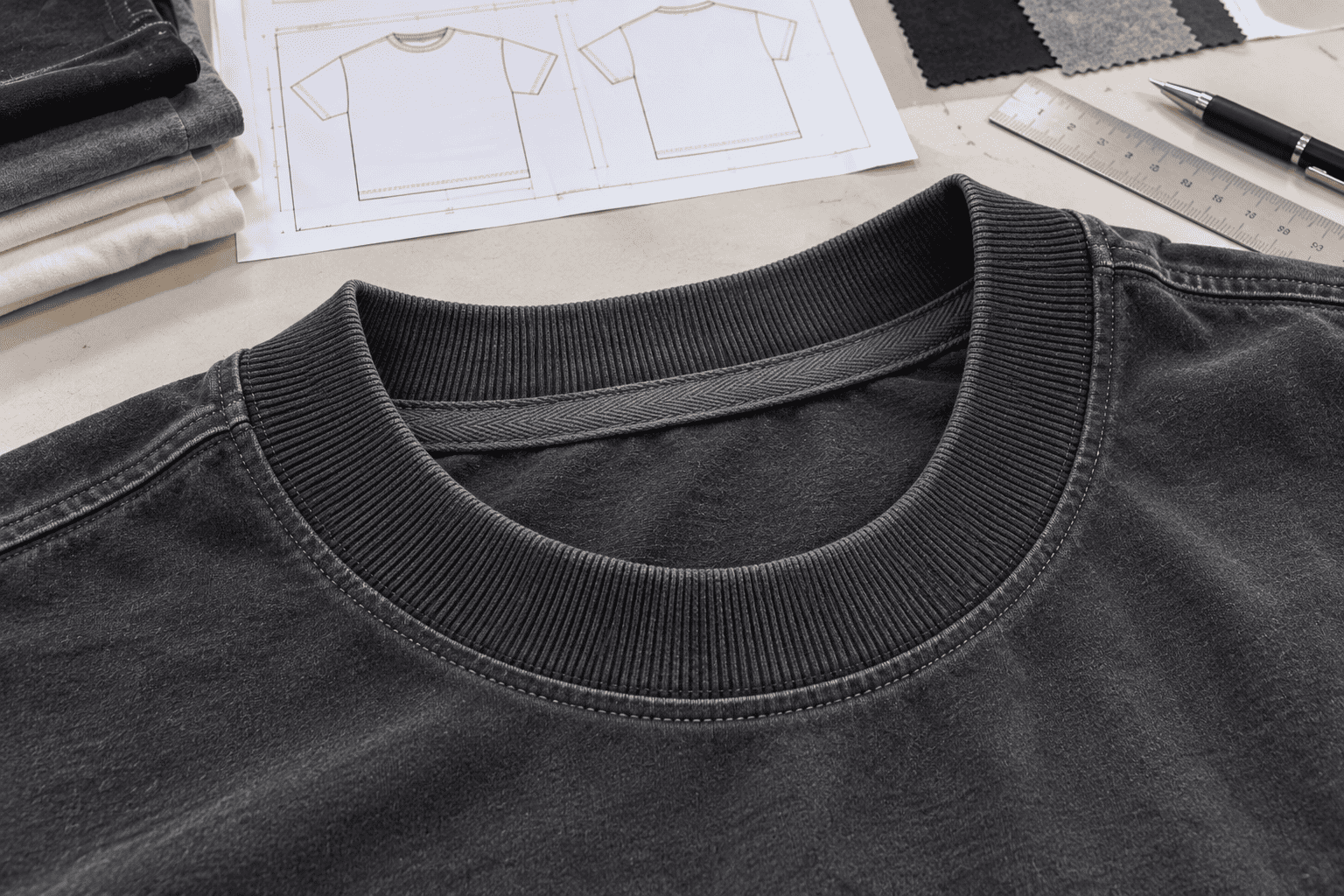
On a normal fitted tee, a weak collar already looks bad.
On an oversized tee, it looks worse because the neckline becomes one of the main visual anchors.
Collar Details to Specify
| Detail | What it changes |
|---|---|
| Rib height | Narrow vs bold neckline |
| Rib composition | Recovery and hand feel |
| Rib density | Structure |
| Neck width | Opening size |
| Stitching | Strength and visual finish |
| Neck tape | Back-neck comfort and stability |
| Shoulder reinforcement | Helps control heavy fabric |
Why Does a Collar Become Wavy?
A wavy neckline can come from:
- Rib with poor recovery
- Neckline stretched during sewing
- Incorrect rib length
- Uneven feeding
- Excessive shrinkage difference
- Weak rib construction
People sometimes call this "bacon neck."
The solution is not always simply adding more spandex.
The rib length and sewing ratio also matter.
Test Recovery
During sample review:
- Stretch the neckline normally.
- Put the garment on and remove it several times.
- Wash it.
- Lay it flat.
The rib should recover cleanly without permanent waviness.
Shoulder Stability
Oversized T-shirts can use much more fabric than fitted tees.
With:
- Heavy jersey
- Dropped shoulders
- Wider sleeves
there is more garment weight acting on the upper body.
Shoulder tape or other appropriate reinforcement can help stabilize the seam depending on the design.
But it should be treated as a construction choice, not a universal requirement.
How Do Print Size and Placement Work Across Sizes?
Oversized T-shirts often carry large graphics.
That creates another production decision.
With traditional screen printing, each physical print size requires its own production setup. Using one print dimension across all garment sizes is usually the simplest and most economical solution.
Adobe's current screen-print artwork preparation guidance[^4] recommends preparing artwork carefully for color separation and converting text and strokes into stable vector shapes before output.
That matters especially for large graphics.
Same Print Size Across Sizes
Suppose the back print is:
30 cm wide
On size S, it may visually fill most of the back.
On XXL, the exact same 30 cm print looks smaller relative to the garment.
That is normal.
Three Common Approaches
| Option | Result | Cost impact |
|---|---|---|
| One print size | Same artwork dimension on every size | Lowest |
| Two print sizes | One for smaller sizes, one for larger | Higher |
| Separate print size by garment size | Proportion stays more consistent | Highest |
Most low-to-medium quantity brands choose:
one print size for all sizes
or occasionally:
two grouped print sizes
For example:
S–M = smaller print
L–XXL = larger print
Why Extra Sizes Cost More
Screen printing works by separating artwork colors into screens.
Changing the physical artwork dimension usually requires a different screen setup.
If the design has:
- 5 colors
- 3 print sizes
the setup can multiply quickly.
That is why this decision should be made before the printing supplier quotes.
Artwork Should Be Production Ready
For large graphics, provide:
- Vector artwork where possible
- Outlined fonts
- Correct dimensions
- Color separations
- Placement
- Pantone references where relevant
Do not send only a small screenshot.
Print Hand Feel Matters
A very large back graphic can dramatically affect the feel of the T-shirt.
Depending on the ink system, a large print may feel:
- Thick
- Rubbery
- Soft
- Breathable
Ask for a test print when the design covers a large area.
We sew the garments in our own factory and manage printing through long-term specialist partners.
That allows us to test:
- Graphic size
- Placement
- Fabric
- Ink result
before bulk production.
What MOQ and Cost Should You Expect?
An oversized T-shirt normally costs more than a regular fitted tee using the same fabric.
The biggest reason is fabric consumption.
Our standard MOQ for custom T-shirts starts around 100 pieces per style. Oversized patterns typically use more fabric per garment, and heavyweight fabrics add further cost.
What Drives the Cost?
| Cost driver | Effect |
|---|---|
| Fabric GSM | Heavier fabric increases consumption cost |
| Pattern width | Wider body uses more fabric |
| Body length | Longer oversized styles use more material |
| Sleeve width | Adds consumption |
| Yarn quality | Can increase fabric price |
| Decoration | Large prints / embroidery add cost |
| Garment wash | Adds processing |
| Number of colors | Can affect fabric purchasing |
Oversized Does Not Mean One Fixed Fabric Consumption
Two oversized tees can use very different amounts of fabric.
Example A:
- Very wide
- Cropped
- Short sleeve
Example B:
- Wide
- Long body
- Elbow-length sleeve
Both are oversized.
The fabric consumption is different.
That is why we need the pattern or measurements before giving a final quote.
Color Splits Matter Too
Suppose you order:
100 pieces total.
Option A:
100 black
Option B:
25 black
25 cream
25 grey
25 brown
Those orders may have different fabric costs.
The fabric supplier may price:
- Full rolls
- Stock yardage
- Small cuts
differently.
So low MOQ does not automatically mean unlimited colors at the same price.
U.S. Fiber Labeling
If your product is sold in the United States, fiber claims need to match the actual material.
The FTC Textile Fiber Rule[^5] requires covered textiles to disclose the generic names and percentages by weight of constituent fibers, as well as other required information.
So if your tee is:
100% cotton
say 100% cotton.
If it is:
90% cotton / 10% polyester
do not market it as pure cotton.
Care Instructions Should Match the Finished Garment
Heavyweight cotton, garment dye, large prints, and special washes can all affect care.
The FTC Care Labeling Rule[^6] requires covered manufacturers and importers in the U.S. to provide regular-care instructions.
That is another reason we recommend testing the final finished garment rather than assuming care instructions from the fabric alone.
Green Flags and Red Flags
| Green flag | Red flag |
|---|---|
| Builds a dedicated oversized pattern | Simply sizes up a regular tee |
| Requests measurements or reference sample | Works from "oversized" only |
| States exact GSM and composition | Uses only words like "premium heavyweight" |
| Wash tests the sample | Approves only before washing |
| Explains print size by garment size | Never discusses print scaling |
| Shows relevant production examples | Uses only stock catalog images |
| Can explain compliance and audits | Makes vague certification claims |
Factory Verification
Factory compliance is useful, but it should remain separate from product quality.
For example, Sedex's SMETA methodology[^7] evaluates supplier sites in areas including labour standards and health and safety, with the broader 4-Pillar format also covering environment and business ethics.
That does not tell you whether your size M is boxy enough.
Product quality still needs:
- Pattern approval
- Fabric approval
- Fit sample
- Wash test
- Print approval
- Bulk QC
Both matter for a long-term supplier relationship.
Conclusion
An oversized T-shirt is a pattern.
It is not a bigger size.
Start with the silhouette.
Define:
- Chest width
- Shoulder width
- Body length
- Sleeve length
- Sleeve opening
- Neck width
Then choose a fabric that supports that shape.
Heavy fabric can create structure.
But GSM alone does not guarantee quality.
Check:
- Yarn
- Knit
- Composition
- Surface
- Shrinkage
- Recovery
Pay special attention to the collar.
A good oversized tee can be extremely wide while still keeping a clean, stable neckline.
Then decide the print strategy.
If you want one graphic size across every garment size, confirm it before bulk.
If you want the artwork scaled by size, budget for the extra setup.
Finally, wash the sample.
Measure it again.
Wear it.
Then approve it.
A good oversized tee looks effortless.
But that look only happens when the proportions are intentional.
Footnotes & References
[^1]: International Organization for Standardization — ISO 5077:2007, Textiles — Determination of Dimensional Change in Washing and Drying. Specifies a method for determining dimensional changes in fabrics, garments, and textile articles after defined washing and drying procedures. The standard remains current after ISO review.
https://www.iso.org/standard/41877.html
[^2]: ASTM International — ASTM D3776/D3776M, Standard Test Methods for Mass Per Unit Area (Weight) of Fabric. Covers standardized measurement of fabric mass per unit area, including full-width samples and small fabric swatches.
https://store.astm.org/standards/d3776/d3776m.htm
[^3]: CottonWorks / Cotton Incorporated — Yarn Spinning. Technical guidance explaining ring, rotor/open-end, and other yarn spinning systems and how different yarn structures influence the finished fabric.
https://cottonworks.com/learning-hub/yarn-manufacturing/yarn-spinning/
[^4]: Adobe — Prepare Artwork for Screen Printing. Adobe's official Illustrator guidance on preparing artwork for screen printing, including outlining text and strokes and organizing artwork for color separation.
https://www.adobe.com/learn/illustrator/web/prepare-artwork-for-screen-printing
[^5]: U.S. Federal Trade Commission — Textile Fiber Rule. Requires covered textile products sold in the United States to disclose fiber names and percentages by weight, along with other required labeling information.
https://www.ftc.gov/legal-library/browse/rules/textile-fiber-rule
[^6]: U.S. Federal Trade Commission — Care Labeling Rule. Requires covered textile apparel manufacturers and importers to provide appropriate regular-care instructions for consumers.
https://www.ftc.gov/legal-library/browse/rules/care-labeling-textile-wearing-apparel-certain-piece-goods
[^7]: Sedex — SMETA Audit. Official information on SMETA, a supplier social-audit methodology covering labour standards, health and safety, environmental performance, and business ethics depending on audit scope.
https://www.sedex.com/solutions/smeta-audit/