
How to Get an Accurate Clothing Manufacturing Quote: What Should You Send a Factory?
You send the same message to five clothing factories:
“How much for 200 hoodies?”
One replies:
USD 9.50.
Another says:
USD 22.00.
Three factories ask you another fifteen questions.
Now you are wondering:
Why is there such a huge difference?
Which supplier is expensive?
Which supplier is cheap?
And which number is actually real?
The problem is usually not the quote.
The problem is that:
“200 hoodies” is not a complete product specification.
A 280 GSM polyester-blend basic hoodie and a 500 GSM custom oversized cotton hoodie with a double-layer hood, embroidery, custom labels, garment wash, and branded packaging may both be called:
hoodie.
They are not the same product.
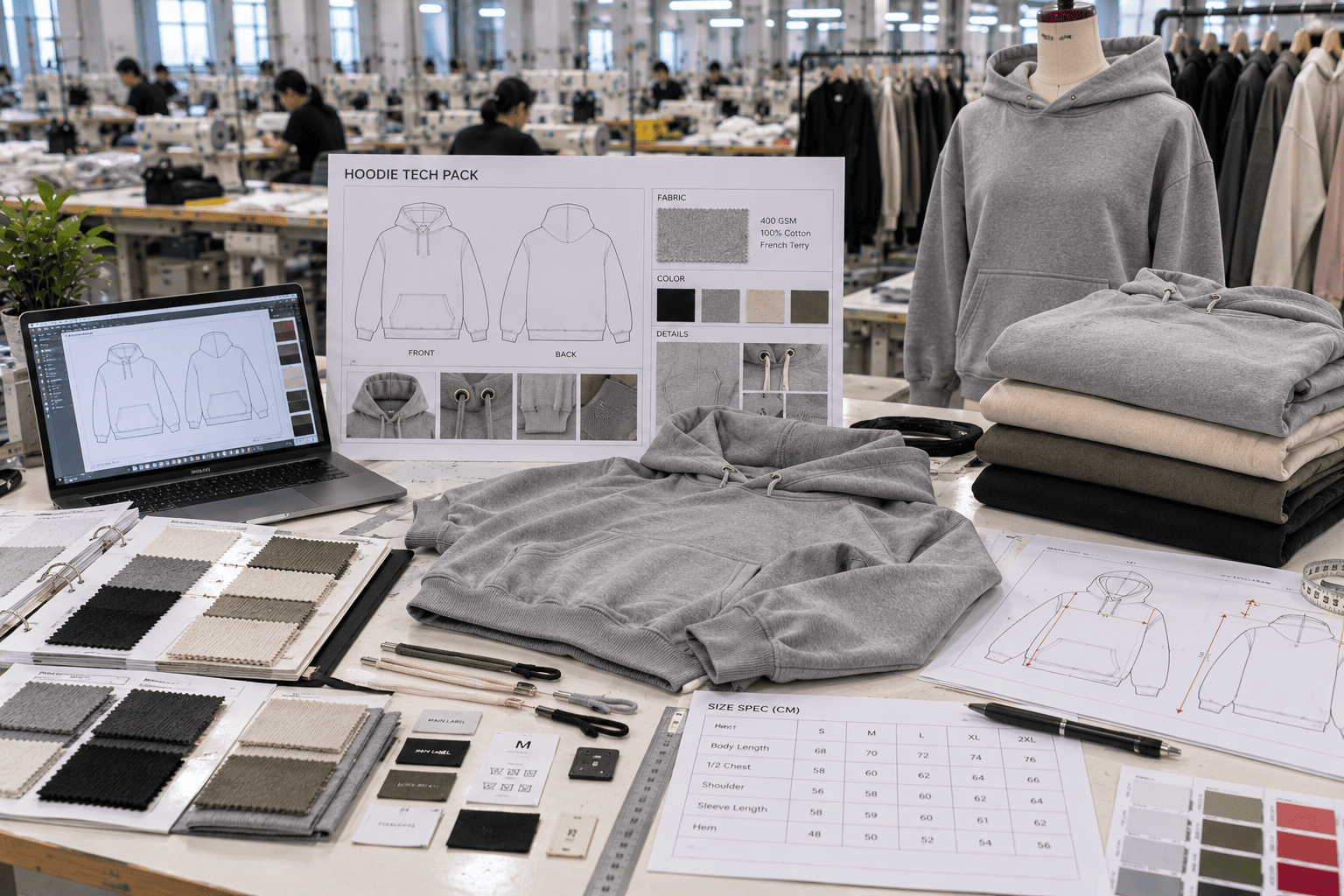
An accurate clothing manufacturing quote needs enough information for the factory to calculate the actual garment: design, measurements or fit reference, fabric composition and weight, quantity by style and color, size range, decoration artwork and dimensions, trims, labels, packaging, trade term, and delivery requirements. The clearer your brief is, the less the factory has to guess.
A useful quote is not simply:
$12.50/pc.
It should tell you:
$12.50 for what?
That is what makes quotations comparable.
Table of Contents
- Why Do Clothing Quotes Vary So Much?
- What Information Does a Factory Need to Quote?
- How Is a Garment Price Actually Built?
- How Do Quantity and Colors Change Your Quote?
- What Should a Good Quote Include?
- Which Mistakes Slow Down or Distort a Quote?
- Conclusion
Why Do Clothing Quotes Vary So Much?
When information is missing, every supplier has to make assumptions.
That is why two factories can answer the same inquiry with completely different prices.
The fewer technical details you provide, the more assumptions go into the quotation. Differences in fabric, GSM, fit, construction, trims, decoration, quantities, color split, and packaging can change the unit price significantly even when the finished products are all described by the same basic name.
“Hoodie” Is Not a Specification
Compare these two products.
Hoodie A
- 280 GSM
- Cotton/poly blend
- Standard fit
- Single-layer hood
- No print
- Standard labels
- 1,000 pcs
- One color
Hoodie B
- 500 GSM
- 100% cotton
- Oversized pattern
- Double-layer hood
- Large embroidery
- Custom woven label
- Custom drawcord tips
- 100 pcs
- Four colors
Both are hoodies.
But almost every cost input is different.
What Changes Behind the Product Name?
| Element | Lower-cost direction | Higher-cost direction |
|---|---|---|
| Fabric | Lighter / simpler material | Heavy or specialty fabric |
| GSM | Lower consumption | Higher consumption |
| Fit | Existing basic block | Custom oversized development |
| Construction | Simple | Double layers / extra panels |
| Decoration | None / small | Large or complex |
| Trims | Stock | Custom |
| Wash | None | Garment wash |
| Quantity | Large run | Small run |
| Colors | One or two | Many small color splits |
The point is not that one version is better.
The point is:
they cannot be compared as the same product.
A Very Low Quote Can Be Based on a Different Assumption
Sometimes a factory sees:
“heavyweight oversized hoodie”
and assumes:
350 GSM.
You mean:
500 GSM.
The first quote looks very attractive.
Then the fabric is confirmed and the price changes.
That does not always mean the factory was dishonest.
It may simply mean the original request was incomplete.
Make Every Factory Quote the Same Product
If you want to compare three factories fairly, send all three:
- Same mockup
- Same measurements
- Same fabric specification
- Same artwork
- Same quantity
- Same color split
- Same packaging requirement
- Same trade term
Then the quotations begin to mean something.
What Information Does a Factory Need to Quote?
A factory does not necessarily need a perfect 30-page tech pack before giving you an initial estimate.
But it does need enough information to understand the product.
For an accurate clothing quote, send front and back designs, measurements or a reference garment, fabric composition and weight, quantities by style and color, size range, decoration artwork with dimensions, trims, labels, packaging requirements, destination, and required timeline.
1. Product Design
At minimum, send:
- Front view
- Back view
If there are important details, add:
- Side view
- Detail close-ups
The factory needs to see things such as:
- Hood
- Pockets
- Panels
- Seams
- Zippers
- Rib
- Hem shape
A logo by itself is not enough.
2. Size Chart or Reference Garment
The pattern affects fabric consumption.
A fitted M hoodie and an oversized M hoodie may use very different amounts of material.
If you have a tech pack, send:
- Finished garment measurements
- Fit notes
- Size range
If you do not have one yet, a physical reference garment can be very useful.
ISO 18890:2018[^1] provides standardized methods for finished-garment measurement and also allows additional measurement points to be agreed between the parties.
That reflects an important factory principle:
measurements need a defined method, not only a number.
3. Fabric Composition
Tell the factory whether you want:
- 100% cotton
- 80% cotton / 20% polyester
- Nylon / elastane
- Polyester / elastane
- French terry
- Brushed fleece
- Jersey
- Rib
If you do not know the exact composition, tell us what you want the fabric to:
- Feel like
- Look like
- Do
and provide a reference if possible.
4. Fabric Weight
If GSM matters, specify it.
For example:
100% cotton French terry, 400 GSM
is much more useful than:
heavy cotton fabric.
GSM is fabric mass per unit area.
The active ASTM D3776/D3776M-20(2025)[^2] covers methods for determining the mass per unit area of fabric.
But GSM should still be understood correctly.
Higher GSM does not automatically mean:
- Better quality
- Better durability
- More premium
It mainly tells us something about fabric mass.
5. Colors
Tell us:
- Number of colors
- Color references
For textile color communication, Pantone Fashion, Home + Interiors[^3] identifies TCX for textile and apparel soft surfaces.
A physical textile standard is more reliable than sending:
a blue screenshot from Instagram.
Pantone itself warns that digital color simulations may not exactly match physical Pantone standards.[^3]
6. Quantity per Style
Do not send only:
Total quantity: 500 pcs.
Tell us:
Style A — 300 pcs
Style B — 200 pcs
because each style may require:
- Separate patterns
- Separate setup
- Different materials
7. Quantity per Color
This matters just as much.
For example:
500 pcs total:
Option A:
- Black 500
Option B:
- Black 100
- Grey 100
- Navy 100
- Cream 100
- Pink 100
Those two orders can have different fabric costs and production efficiency.
8. Size Range
Tell us:
- XS–XL
- S–2XL
- S–4XL
or whatever your range is.
A rough size breakdown is even better.
Larger sizes can change:
- Fabric consumption
- Marker efficiency
especially when the range is wide.
9. Decoration
For printing, provide:
- Artwork
- Placement
- Finished size
- Number of colors
- Technique if known
For embroidery, provide:
- Artwork
- Finished width / height
- Placement
- Thread colors
Embroidery pricing can depend heavily on:
- Size
- Stitch count
- Technique
So:
“small embroidery”
is not precise enough.
10. Trims
Tell us about:
- Zippers
- Buttons
- Snaps
- Elastic
- Drawcords
- Custom pullers
- Woven labels
- Care labels
- Hangtags
Custom accessories often have their own:
- MOQ
- Mold charge
- Lead time
11. Packaging
Standard packaging and custom packaging are not the same cost.
Tell us if you need:
- Standard polybag
- Custom printed bag
- Box
- Tissue
- Sticker
- Barcode
- Retail packaging
12. Destination
This becomes essential if you want anything beyond an ex-factory product price.
For example:
Los Angeles, USA
is more useful than:
USA.
For DDP or shipping estimates, the factory may eventually need:
- Postal code
- Carton count
- Gross weight
- Final packed volume
Those may not be available until later.
13. Timeline
Tell the factory if you have:
- Launch date
- Event date
- Delivery deadline
There is a big difference between:
“whenever ready”
and:
“must arrive before 15 March.”
How Is a Garment Price Actually Built?
A garment quotation is not normally one mysterious number.
It comes from several cost groups.
Garment cost is built from materials, consumption, cutting and sewing, decoration, trims, labels, packaging, finishing, development, quality control, overhead, and commercial requirements. Fabric is often one of the largest cost components, but its share varies by product.
Fabric Cost
A simplified fabric calculation is:
Fabric consumption per garment × fabric price
But consumption is not simply:
garment weight.
It also considers:
- Fabric width
- Pattern shape
- Marker efficiency
- Cutting loss
- Size ratio
For example, an oversized hoodie may consume substantially more fabric than a fitted hoodie in the same GSM.
Pattern Shape Changes Consumption
Compare:
Standard tee
vs.
Oversized drop-shoulder tee.
The oversized style may have:
- Wider body
- Wider sleeves
- Longer sleeve pieces
So even when both use:
260 GSM cotton jersey
their fabric cost can differ.
Sewing / CMT
Construction affects labor.
A basic tee may have relatively few operations.
A technical cargo pant can include:
- Fly
- Waistband
- Belt loops
- Multiple pockets
- Flaps
- Bartacks
- Snaps
- Drawcord hem
That takes more time.
Decoration
Decoration can include:
- Screen print
- DTF
- DTG
- Embroidery
- Appliqué
- Chenille
- Puff print
- Silicone
Pricing depends on the method.
Do not assume:
embroidery always costs more than printing
or:
screen printing is always cheaper.
The artwork and quantity matter.
Trims
Examples:
- Zipper
- Rib
- Drawcord
- Metal tip
- Button
- Snap
- Elastic
Stock items are often easier.
Custom hardware may require:
- Tooling
- MOQ
Labels
Possible labels include:
- Main label
- Size label
- Care/content label
- Hangtag
For U.S. textile products, the FTC Textile Fiber Rule[^4] requires covered products to disclose information including generic fiber names and percentages, manufacturer or marketer identity, and country of processing or manufacture.
So labels are not always only decoration.
They can also contain required product information.
Packaging
Basic:
- Individual polybag
- Shipping carton
Custom:
- Branded bag
- Box
- Tissue
- Sticker
- Barcode
should be quoted separately when applicable.
Quality Control
QC is also part of production cost.
For bulk orders, inspection may involve:
- Material checking
- Inline QC
- Final inspection
The current ISO 2859-1:2026[^5] defines AQL-indexed acceptance-sampling schemes for lot-by-lot inspection.
AQL is a statistical inspection framework.
It is not:
“2.5% defects are allowed.”
And it is not a factory certification.
Development
Depending on the project, development can include:
- Pattern
- Grading
- Sample making
- Artwork setup
Your quotation should make clear which development items are:
- Included
- Charged separately
rather than leaving the buyer to assume.
How Do Quantity and Colors Change Your Quote?
Quantity affects cost.
But it does not follow one universal price-break formula.
Higher quantities can lower unit cost because material purchasing, setup charges, development, cutting, and sewing become more efficient. But the exact price breaks depend on the garment, fabric, color split, decoration, trims, and supplier minimums.
Do Not Publish Universal Price Breaks
The original draft used:
- 200
- 1,000
- 3,000
- 5,000
as fixed price-break levels.
Those can be useful quotation scenarios.
They are not universal.
A basic tee may reach efficient production much sooner than:
a multi-pocket jacket.
Ask for Several Quantities
A better approach is to ask:
100 pcs
300 pcs
1,000 pcs
or whatever ranges actually matter to your business.
Then compare.
This shows you where the real project becomes more efficient.
Colors Can Matter as Much as Total Quantity
Suppose you want:
200 hoodies.
Order A
200 black
Order B
50 black
50 cream
50 pink
50 green
Same total quantity.
Different material purchasing situation.
Each color may require:
- Separate fabric
- Separate rib
- Separate thread
- Separate cutting
- Separate QC
Full Roll vs Cut Quantity
Some suppliers sell:
- Full rolls
- Cut yardage
- Stock remnants
Small quantities may have a higher unit fabric price.
But do not publish:
“loose-cut fabric always costs twice as much.”
That is supplier-specific.
Sometimes it is significantly more.
Sometimes stock material is easy to purchase.
The quotation should use the real fabric price available for that order.
Custom Dyeing Changes MOQ Again
If you want a custom Pantone color, a mill may have a minimum such as:
- Kg per color
- Rolls per color
That textile MOQ may become more important than the sewing MOQ.
Size Range Also Affects Consumption
Imagine:
100 pcs in S–XL
vs.
100 pcs in XL–4XL.
Those orders do not necessarily consume the same amount of fabric.
So if you need an accurate final quote, give a size ratio.
Decoration Setup
Screen printing may involve:
- Screens
- Color separation
- Setup
Embroidery may involve:
- Digitizing
- Stitch count
Custom hardware may involve:
- Mold
Larger quantities spread those costs over more garments.
That is one reason unit price can fall.
What Should a Good Quote Include?
A quote should answer enough questions that you can understand exactly what you are buying.
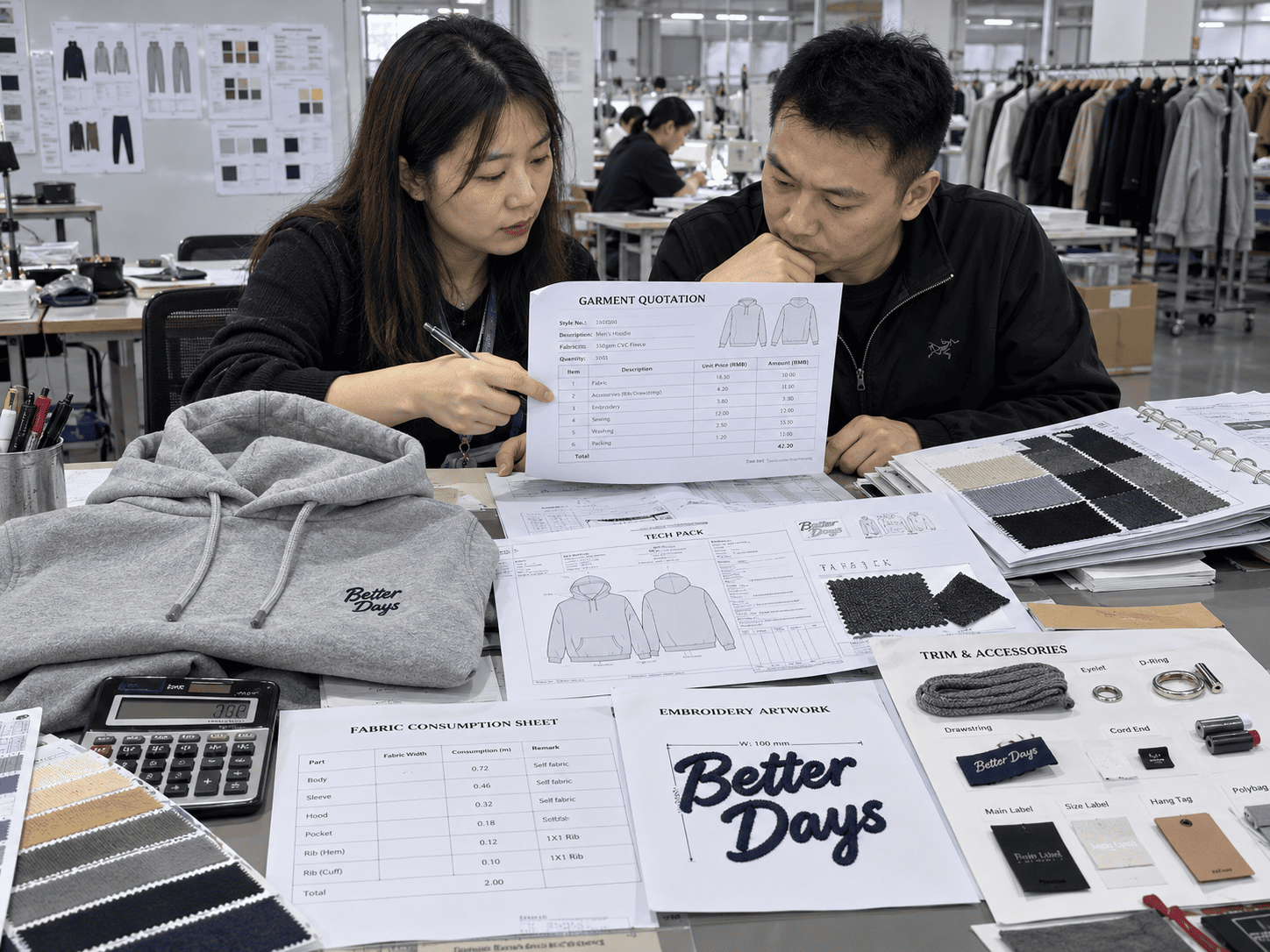
A good clothing quotation should identify the product specification, quantity, unit price, currency, trade term and named place, inclusions, exclusions, sample cost, sample timing, bulk lead time, payment structure, and quotation validity.
1. Style Information
For example:
Style No.: DC-H001
Product:
Oversized Pullover Hoodie
2. Fabric
For example:
100% cotton French terry, 400 GSM
Do not simply write:
Cotton hoodie.
3. Decoration
For example:
Front:
Small embroidery, 8 × 3 cm
Back:
Screen print, 32 × 38 cm
Now the price has a technical basis.
4. Quantity
Specify:
- Total
- Per color where relevant
5. Currency
Write clearly:
USD
not simply:
12.50
6. Unit Price
For example:
USD 18.60/pc
7. Trade Term
This is particularly important.
The International Chamber of Commerce's Incoterms® 2020 rules[^6] clarify the allocation of:
- Tasks
- Costs
- Risks
between buyer and seller for delivery of goods.
ICC confirms that Incoterms® 2020 remains the current edition.[^6]
So instead of writing:
FOB price
write something like:
FOB Shenzhen, Incoterms® 2020
where appropriate.
ICC itself recommends identifying the chosen rule together with the named place.[^6]
EXW and FOB Are Not Just Different Freight Prices
This is important.
An Incoterms® rule defines:
- Obligations
- Cost allocation
- Risk transfer
It does not simply answer:
“Who pays freight?”
Also, FOB is one of the rules intended for sea or inland-waterway transport.
So international buyers should make sure the chosen term actually fits the shipment.
8. Inclusions
A quote should state what is included.
For example:
- Pattern
- Grading
- Standard care label
- Standard size label
- Standard packaging
- QC
if those are actually included in that quotation.
Do not assume.
9. Exclusions
Examples:
- International freight
- Import duty
- Custom packaging
- Third-party lab testing
- Special certification
- Custom hardware tooling
10. Sample Fee
Sample pricing depends on:
- Fabric
- Construction
- Decoration
- Development
Avoid publishing one universal range for every product.
A simple T-shirt sample and a complicated washed jacket should not be expected to cost the same.
11. Sample Timing
For many of our standard custom garment programs, sampling commonly falls around:
5–14 days
depending on:
- Fabric availability
- Construction
- Decoration
- Custom trims
12. Bulk Lead Time
For standard programs, bulk production commonly falls around:
20–30 days after final sample approval and deposit.
Custom fabric, washing, hardware, or large programs can require more time.
13. Payment
For our new bulk orders, the normal structure is:
50% before bulk production + 50% before shipment.
Sample orders are paid before sample development.
Any different commercial arrangement should be confirmed for that specific order.
14. Quotation Validity
This is important because:
- Fabric price can change
- Exchange rates can change
- Freight can change
- Trim supplier prices can change
So a quote may say:
Valid for 15 days
or:
Valid for 30 days
depending on the supplier.
There is no need for an evergreen garment price.
Should You Ask for EXW, FOB, or DDP?
That depends on what you are comparing.
EXW
Useful when you want to understand the factory-side commercial price and you or your logistics partner will handle the later transport arrangements.
But remember:
the exact obligations come from the applicable Incoterms® rule, not from a one-line internet definition.
FOB
Often requested by experienced importers for relevant sea-freight transactions.
Use the correct:
named port
and Incoterms® version.
DDP
DDP can be useful when a buyer wants a more complete delivered estimate.
But a DDP estimate needs more logistics information.
The factory may need:
- Final carton count
- Weight
- Volume
- Destination
So early development-stage DDP can only be an estimate.
Compare Like With Like
Do not compare:
Factory A: EXW
Factory B: FOB
Factory C: DDP
and conclude:
Factory C is expensive.
Those prices cover different responsibilities.
First normalize the commercial basis.
Which Mistakes Slow Down or Distort a Quote?
Most slow quotations have the same root cause:
the factory does not have enough information.
Mistake 1: Sending Only a Logo
Message:
“I want this logo on hoodies. Price?”
Missing:
- Hoodie design
- Fabric
- GSM
- Print/embroidery
- Quantity
- Size
- Color
The factory cannot accurately quote the garment.
Mistake 2: No Quantity
A factory cannot price:
“How much is this?”
without knowing whether you need:
- 50
- 500
- 5,000
pieces.
Mistake 3: No Fabric Specification
If you tell one factory:
“premium hoodie”
it may quote:
350 GSM 80/20 fleece.
Another quotes:
500 GSM 100% cotton.
Now you are comparing two completely different products.
Mistake 4: Sending a Fabric Composition but No Weight
100% cotton
is not enough.
A 180 GSM cotton jersey and a 500 GSM cotton fleece are completely different products.
Mistake 5: Too Many Colors With No Quantity Breakdown
“5 colors, 100 pcs.”
Does that mean:
100 per color?
or:
100 total?
That changes everything.
Mistake 6: No Artwork Size
A front logo might be:
5 cm
or:
40 cm.
That changes decoration cost.
Mistake 7: Changing Specification After Quoting
First quote:
350 GSM
Then:
400 GSM
Then:
add embroidery
Then:
add garment wash
The price should change.
That is not necessarily a bait-and-switch.
The product changed.
Mistake 8: Comparing Different Trade Terms
One supplier quotes:
EXW.
Another:
FOB.
Another includes shipping.
Those are not immediately comparable numbers.
Mistake 9: Asking for Final DDP Too Early
Before the garment is even sampled, nobody knows the exact:
- Carton count
- Gross weight
- Volume
So an early DDP quote should be treated as:
estimated shipping
not an eternal fixed logistics price.
Mistake 10: Choosing the Lowest Number Before Confirming the Specification
The cheapest quote is only useful if it is for the product you actually want.
Green Flags and Red Flags in a Clothing Quote
| Green flag | Red flag |
|---|---|
| Asks for design details | Quotes from “hoodie” alone |
| Confirms fabric and GSM | Says “premium fabric” only |
| Confirms quantities by color | Same price for any color split |
| Asks for artwork dimensions | Prices unknown embroidery size |
| States what is included | Vague “all included” |
| Uses clear currency | Number with no currency |
| States Incoterms® rule and place | Writes only “FOB price” |
| Explains sample charge | Hidden development costs later |
| Gives quote validity | Claims price never changes |
| Separates product and shipping | One unclear total |
| Explains assumptions | Pretends everything is confirmed |
A Simple Quote Request Template
When you contact a clothing factory, you can send something like this:
Product: Oversized pullover hoodie
Fabric: 100% cotton French terry
Weight: 400 GSM
Quantity: 200 pcs
Colors: Black 100 / Grey 100
Sizes: S–XL
Decoration: Front embroidery 8 × 3 cm, back screen print 30 × 35 cm
Labels: Custom woven main label + care label
Packaging: Standard individual polybag
Destination: Los Angeles, USA
Target delivery: March 2027
Quote requested: EXW and FOB Shenzhen
Then attach:
- Front mockup
- Back mockup
- Size chart
- Artwork
That message is much easier to quote than:
“How much for 200 hoodies?”
Conclusion
An accurate clothing quote begins before the factory calculates a number.
It begins with:
a clear product definition.
Send:
- Front and back design
- Measurements
- Fabric
- GSM
- Colors
- Quantities
- Size range
- Artwork
- Trims
- Labels
- Packaging
Then tell the factory:
- Where the goods are going
- When you need them
- Which commercial basis you want quoted
Do not compare quotations that are based on different fabrics.
Do not compare:
EXW
with:
DDP
as if they cover the same thing.
Do not assume that:
larger quantity always follows one fixed discount ladder.
And do not assume:
five colors cost the same as one color
simply because the total piece count is identical.
For the factory, the best quote is not the quote produced fastest.
It is the one with the fewest hidden assumptions.
Because the goal is not to receive:
the lowest number today.
The goal is to receive a number that is still close to the real production price after:
- Fabric is confirmed
- Sample is approved
- Decoration is finalized
- Quantities are locked
That is what makes a clothing manufacturing quotation useful.
Footnotes & References
[^1]: International Organization for Standardization — ISO 18890:2018, Clothing — Standard Method of Garment Measurement. Defines major garment measurement points and standardized methods for measuring finished garments while allowing additional measurement points to be agreed between interested parties. The standard was reviewed and confirmed in 2024 and remains current.
https://www.iso.org/standard/63693.html
[^2]: ASTM International — ASTM D3776/D3776M-20(2025), Standard Test Methods for Mass Per Unit Area (Weight) of Fabric. The active standard covers measurement of fabric mass per unit area and provides several methods for full pieces, full-width samples, small swatches, and narrow fabrics.
https://store.astm.org/d3776_d3776m-20r25.html
[^3]: Pantone — Fashion, Home + Interiors (FHI). Pantone identifies TCX as the FHI color format for soft surfaces such as textiles and apparel and recommends physical standards for visual evaluation because digital simulations may not exactly reproduce physical Pantone colors.
https://www.pantone.com/na/en-us/fashion-home-interiors
[^4]: U.S. Federal Trade Commission — Textile Fiber Rule, 16 CFR Part 303. Requires covered textile products sold in the United States to disclose generic fiber names and percentages by weight, manufacturer or marketer identity, and country of processing or manufacture.
https://www.ftc.gov/legal-library/browse/rules/textile-fiber-rule
[^5]: International Organization for Standardization — ISO 2859-1:2026, Sampling Procedures for Inspection by Attributes — Part 1. The current 2026 edition defines AQL-indexed single, double, and multiple acceptance-sampling schemes for lot-by-lot inspection. AQL is a statistical inspection framework rather than a product certification or garment measurement tolerance.
https://www.iso.org/standard/2859-1
[^6]: International Chamber of Commerce — Incoterms® 2020 Rules. ICC's Incoterms® rules clarify tasks, costs, obligations, delivery responsibilities, and risk between buyers and sellers. Incoterms® 2020 remains the latest edition, and ICC recommends referencing the chosen rule together with the named place in the sales contract.
https://iccwbo.org/business-solutions/incoterms-rules/
https://iccwbo.org/business-solutions/incoterms-rules/incoterms-2020/