Bamboo and Modal Clothing Manufacturer: How Do You Make Soft Clothing That Lasts and Is Labeled Right?
Your bamboo lounge set feels incredible when the sample arrives.
Soft.
Cool.
Drapey.
The customer loves it.
Then the problems begin.
After the first wash, the pants become shorter.
The knees start to bag.
The fabric pills where the thighs rub.
And someone points out that your label says:
“100% Bamboo”
even though the fabric is actually viscose made from bamboo.
Now you have two different problems:
product performance
and:
product claims.
A bamboo and modal clothing manufacturer develops soft garments from regenerated cellulose fabrics such as viscose made from bamboo and modal. Good production depends on choosing the right fabric construction and blend, testing shrinkage and pilling, controlling recovery, and labeling the actual fiber correctly.
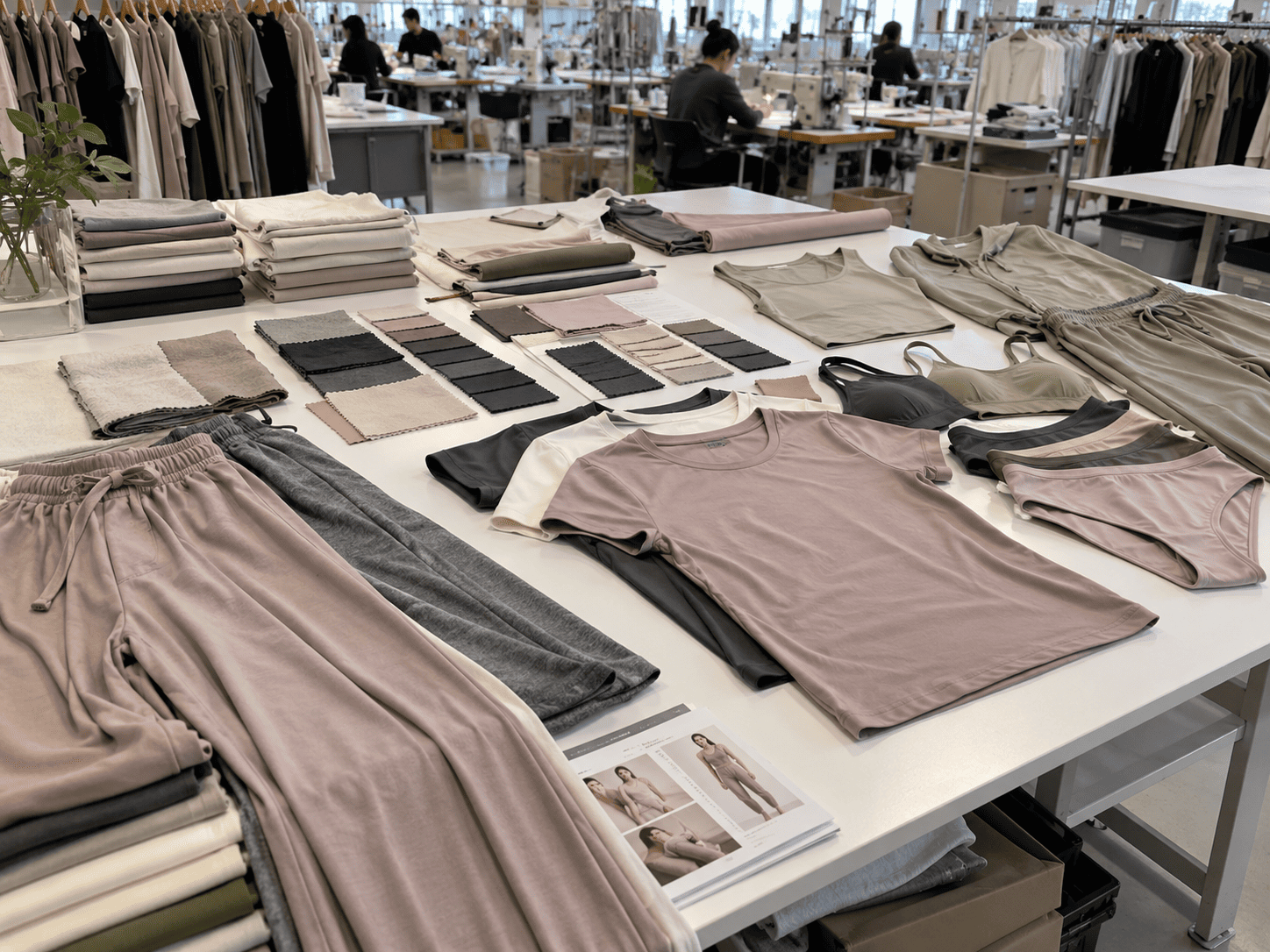
This category looks simple because the main selling point is softness.
But softness alone is not enough.
A fabric can feel amazing during sampling and still perform poorly after:
- Washing
- Wearing
- Hanging
- Repeated friction
And the wording used on:
- Care labels
- Hangtags
- Product pages
- Advertising
also matters.
The U.S. Federal Trade Commission's bamboo-textile guidance[^1] is very clear: textiles made by creating rayon or viscose from bamboo as a plant source should generally be identified using the actual manufactured fiber name, such as “rayon made from bamboo” or “viscose made from bamboo,” rather than simply “bamboo.”[^1]
That is a very important distinction for brands selling into the United States.
Table of Contents
- What Are Bamboo and Modal Fabrics, Really?
- How Should Bamboo Clothing Be Labeled?
- Which Products Work Best in Bamboo and Modal?
- Which Blends Should You Choose?
- How Do You Stop Shrinking, Pilling, and Losing Shape?
- What MOQ, Cost, and Timing Should You Expect?
- Conclusion
What Are Bamboo and Modal Fabrics, Really?
This is where many product descriptions become confusing.
A fabric can be marketed using the name of the plant source even though the finished textile fiber is something different.
Most soft “bamboo” apparel on the market is not mechanically processed bamboo fiber. It is usually a regenerated cellulose fiber such as rayon or viscose made using bamboo as the cellulose source. Modal is also a regenerated cellulose fiber, but the exact raw-material source should be confirmed rather than assumed from the fiber name alone.
What Does “Viscose Made From Bamboo” Mean?
Bamboo can be used as a cellulose source.
That cellulose is processed and regenerated into a manufactured fiber.
The resulting fiber is:
viscose / rayon
rather than a mechanically separated bamboo bast fiber.
FTC guidance makes this distinction directly.[^1]
That is why a soft jersey sold as:
“bamboo fabric”
may technically be:
95% viscose made from bamboo / 5% elastane
on the fiber label.
Real Bamboo Fiber Is Different
FTC guidance states that textiles can only simply be called bamboo if they are actually made directly from bamboo fiber and the claim can be substantiated.[^1]
Mechanically processed bamboo fiber is a very different material from the soft viscose fabrics commonly found in:
- Underwear
- Pajamas
- Lounge sets
- T-shirts
So brands should not use:
“100% bamboo”
as shorthand for any fabric whose cellulose originally came from bamboo.
What Is Modal?
Modal is also part of the regenerated-cellulose family.
It is often associated commercially with wood pulp.
But do not automatically write:
“Modal = beechwood fiber”
unless your supplier documentation actually supports that raw-material claim.
The fiber name itself tells you:
modal
not necessarily the exact tree source used for every mill's product.
That keeps the product description accurate.
Bamboo Viscose, Modal, and Cotton
| Property | Viscose made from bamboo | Modal | Cotton |
|---|---|---|---|
| Fiber family | Regenerated cellulose | Regenerated cellulose | Natural cellulose |
| Typical hand | Soft, fluid | Soft, smooth | Varies widely |
| Drape | Usually high | Usually high | Depends on construction |
| Stretch | Depends on knit / blend | Depends on knit / blend | Depends on knit |
| Recovery | Depends strongly on construction / elastane | Depends strongly on construction / elastane | Depends on construction |
| Shrinkage | Must be tested | Must be tested | Must be tested |
| Pilling | Depends on yarn / fabric / friction | Depends on yarn / fabric / friction | Depends on yarn / fabric / friction |
This table is deliberately cautious.
Statements such as:
“modal always has better wet strength than viscose”
or:
“modal pills less than bamboo”
may sometimes be directionally true for particular materials, but they should not be treated as universal garment-performance guarantees without the actual fabric specification and test data.
Fabric Construction Still Matters
Two fabrics can both be:
95% viscose / 5% elastane
and feel completely different.
Why?
Because performance also depends on:
- Yarn count
- Yarn quality
- Knit structure
- GSM
- Finishing
- Dyeing
- Compacting
- Elastane quality
Composition is important.
It is not the whole specification.
How Should Bamboo Clothing Be Labeled?
This is probably the most important section of the article for a U.S. buyer.
In the United States, textile labels and advertising should identify the actual generic fiber. If bamboo is only the cellulose source used to manufacture rayon or viscose, wording such as “rayon made from bamboo” or “viscose made from bamboo” is appropriate; simply describing the finished textile as “bamboo” can be misleading.
FTC Bamboo Guidance
The FTC's official Bamboo Textiles guidance[^1] says that textiles can only be called bamboo if they are made directly from actual bamboo fiber.
For manufactured rayon or viscose where bamboo is the source plant, the FTC allows descriptions such as:
rayon made from bamboo
or:
viscose made from bamboo.
Why This Matters
In 2022, the FTC pursued enforcement actions against Kohl's and Walmart over rayon textiles that were marketed as bamboo.
The FTC announced penalties of:
- USD 2.5 million for Kohl's
- USD 3 million for Walmart
for a combined USD 5.5 million.[^2]
The cases also involved environmental claims that the FTC alleged were misleading.
This is a useful warning for smaller brands too.
Product naming is not just branding.
It can be a compliance issue.
Examples
| Actual composition | Better U.S. wording | Avoid |
|---|---|---|
| 100% viscose sourced from bamboo | 100% viscose made from bamboo | 100% bamboo |
| 95% viscose from bamboo / 5% elastane | 95% viscose made from bamboo, 5% elastane | Bamboo stretch |
| 50% modal / 50% cotton | 50% modal, 50% cotton | Beech cotton |
| 70% viscose from bamboo / 30% cotton | 70% viscose made from bamboo, 30% cotton | Bamboo cotton |
| 92% modal / 8% elastane | 92% modal, 8% elastane | Modal fabric without percentages where disclosure is required |
The Textile Fiber Rule
The FTC Textile Fiber Rule[^3] requires covered textile products sold in the United States to disclose:
- Generic fiber names
- Percentages by weight
- Manufacturer or marketer identity
- Country where the product was processed or manufactured
So the label should match the actual supported fabric composition.
Do Not Copy the Supplier's Marketing Name Blindly
A fabric mill may tell you:
“Bamboo Jersey 220 GSM.”
That can be useful internally.
But before printing:
- Garment label
- Hangtag
- Website description
ask for the actual composition.
For example:
95% viscose / 5% elastane
and ask whether there is documentation supporting the bamboo-source wording.
Environmental Claims Need Evidence Too
This is another common mistake.
Brands often move from:
“made from bamboo”
to:
“eco-friendly, chemical-free, naturally antibacterial, better for the planet.”
That leap is risky.
FTC consumer guidance states that chemically processed bamboo rayon should not automatically be assumed to retain natural bamboo properties such as antibacterial performance, and environmental claims require reliable evidence.[^4]
So avoid automatic claims such as:
- Naturally antibacterial
- Chemical-free
- Non-toxic production
- Eco-friendly because it is bamboo
- Biodegradable in all conditions
unless you have appropriate substantiation for the specific claim.
Keep Website, Hangtag, and Label Consistent
Do not use:
Care label:
95% viscose / 5% elastane
Website:
100% premium bamboo
Hangtag:
natural bamboo fiber
These statements tell three different stories.
Your:
- Product page
- Label
- Hangtag
- Sales sheet
should all describe the material consistently.
Which Products Work Best in Bamboo and Modal?
Regenerated-cellulose knits are especially useful where softness and drape matter.
Viscose-from-bamboo and modal fabrics work particularly well for loungewear, pajamas, T-shirts, tanks, underwear, women's basics, and other close-to-skin products. Whether they suit babywear, sportswear, or other applications depends on the actual fabric construction and testing.
Lounge Sets
These materials work naturally for:
- Tee + pants
- Tank + shorts
- Long sleeve + lounge pants
because the drape supports a relaxed silhouette.
Sleepwear
A soft jersey can work well for:
- Pajama tops
- Pajama bottoms
- Nightwear
But care and dimensional stability matter.
A pajama pant that shrinks significantly after one wash loses much of the benefit of its soft hand.
T-Shirts
Modal or viscose-blend T-shirts tend to create a:
- Softer
- More fluid
appearance than a structured heavyweight cotton tee.
That can be desirable.
But if the brand wants:
boxy streetwear structure
then a drapey regenerated-cellulose jersey may not be the best choice.
Underwear
These fibers are commonly used in:
- Boxers
- Briefs
- Women's underwear
- Fitted base layers
often with elastane.
For these products, check:
- Recovery
- Pilling
- Waist elastic
- Dimensional stability
Women's Ribbed Basics
Modal blends can also work well in:
- Fitted tanks
- Ribbed tops
- Soft two-piece sets
because they can combine softness with body-hugging fit when the fabric construction is right.
Baby and Children's Products Need More Than Softness
A fabric may feel soft against the skin.
That does not automatically prove that it is:
- Hypoallergenic
- Safer
- Suitable for sensitive skin
Those are stronger claims.
For baby and kids' garments, brands should also consider:
- Applicable safety requirements
- Trims
- Colorfastness
- Small components
- Care performance
rather than selling the product only on fiber softness.
Do Not Promise “Sensitive-Skin Friendly” Without Support
The original draft suggested these fabrics are naturally suited to customers with sensitive skin.
I would make that language more careful.
You can truthfully describe:
soft hand
or:
smooth fabric surface
based on the product.
But:
good for sensitive skin
or:
hypoallergenic
can imply a stronger health-related benefit and should be supported appropriately.
Which Blends Should You Choose?
A blend is not automatically better than a pure fiber.
It is a design tool.
Choose the blend according to the performance you need. Elastane can add stretch and recovery, cotton can change body and hand, and polyester can change strength, drying behavior, cost, and printing options. The actual result depends on the fabric construction, not only the percentage printed on the label.
Viscose From Bamboo + Elastane
Common examples might include:
95/5
or similar ratios.
This can work for:
- Underwear
- Fitted tops
- Soft lounge pants
The elastane can contribute:
- Stretch
- Recovery
But do not assume 5% automatically solves knee bagging.
The knit construction and elastane quality still matter.
Modal + Elastane
This can work for:
- Fitted basics
- Underwear
- Rib sets
- Bralettes
Again, the exact feel depends on:
- GSM
- Yarn
- Knit
- Finishing
Viscose From Bamboo + Cotton
Cotton can change the:
- Hand
- Structure
- Drape
- Cost
of the fabric.
A bamboo-viscose/cotton jersey may feel less fluid than a high-viscose composition.
That may be useful for T-shirts.
Modal + Cotton
This is another common direction for:
- Tees
- Lounge sets
- Basics
It can give a different balance between softness and structure.
Polyester Blends
Polyester may be useful where the design needs:
- Faster drying
- Additional durability
- Different print performance
- Lower cost
But again:
polyester = stronger
should not be treated as a universal guarantee.
Test the actual textile.
Example Blend Directions
| Blend direction | Possible character | Potential product |
|---|---|---|
| Viscose from bamboo + elastane | Soft + stretch | Underwear / fitted basics |
| Modal + elastane | Smooth + close fitting | Women's basics |
| Viscose from bamboo + cotton | Soft with more body | Tees / lounge |
| Modal + cotton | Balanced soft hand | Tees / sets |
| Regenerated-cellulose rib + elastane | Stretchy / draped | Rib sets |
| Regenerated cellulose + polyester | Performance / value dependent on construction | Selected basics |
These are development directions.
Not guaranteed performance specifications.
Always Approve a Swatch
Two mills can offer:
95% viscose / 5% elastane, 220 GSM
and produce fabrics that feel completely different.
Always evaluate:
- Hand
- Stretch
- Recovery
- Opacity
- Surface
- Wash result
before bulk.
How Do You Stop Shrinking, Pilling, and Losing Shape?
This is where a soft fabric either becomes a good product or a return problem.
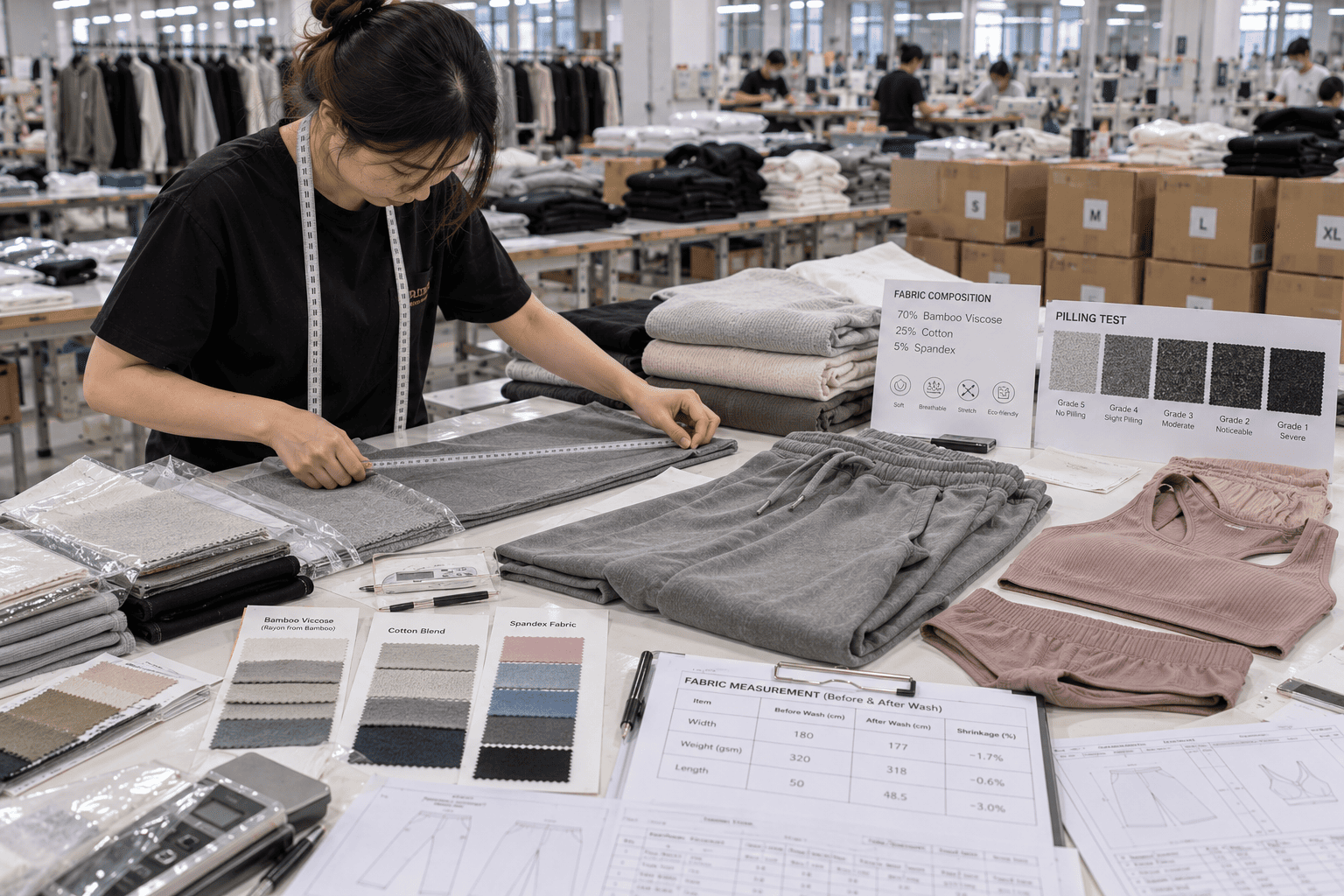
Dimensional change, pilling, and recovery should be tested on the actual fabric or garment. Avoid assuming all viscose or modal behaves the same. Fabric construction, finishing, wash method, friction, yarn quality, and elastane all influence performance.
Shrinkage Should Be Measured
ISO 5077:2007[^5] specifies a method for determining dimensional changes in fabrics, garments, and other textile articles after specified washing and drying procedures.
The standard remains current after review.[^5]
The correct workflow is:
- Measure.
- Wash under an agreed procedure.
- Dry under an agreed procedure.
- Measure again.
- Calculate dimensional change.
Do Not Write “Viscose Shrinks a Lot” as a Universal Rule
Some viscose fabrics may show significant dimensional movement.
Others can be well stabilized.
So instead of telling a customer:
“Bamboo viscose shrinks 5%.”
say:
“We will test the actual fabric under the intended care process.”
That is much more useful.
Pattern Compensation Comes After Testing
Suppose the test shows:
Length: -4%
Width: -1%
You may compensate differently in the pattern.
Do not simply enlarge the whole garment 4%.
Pilling
Pilling depends on:
- Fiber
- Yarn
- Surface
- Knit structure
- Finishing
- Friction
ISO 12945-2:2020[^6] provides a modified Martindale method for determining a textile fabric's propensity to:
- Pill
- Fuzz
- Matt
under controlled conditions.
That is more precise than writing:
“modal pills less than bamboo.”
The actual fabric should be evaluated.
Knee and Seat Bagging
This may involve:
- Fabric recovery
- Pattern
- Elastane
- Knit construction
Adding elastane may help.
But it is not the only answer.
A poorly constructed fabric with elastane can still lose shape.
Seam Twist and Spirality
Soft knitted fabrics can also show:
- Side-seam movement
- Torque
- Spirality
depending on knitting, finishing, cutting, and laundering.
This is another reason the sample should be washed before bulk approval if wash behavior is important.
Sheerness
A very lightweight soft jersey can become transparent.
This is especially relevant for:
- White
- Cream
- Fitted pants
- Leggings
Solutions may include:
- Denser knit
- Different GSM
- Different color
- Lining
- Lower pattern extension
depending on the garment.
Do Not Prescribe One Care Label for Every Bamboo/Modal Garment
The original draft suggested:
machine wash cold, lay flat to dry, do not tumble dry
as a general solution.
That may be appropriate for some products.
But care instructions should be based on the actual tested garment.
The FTC Care Labeling Rule[^7] requires covered apparel sold in the United States to carry regular-care instructions and requires the manufacturer or importer to have a reasonable basis for those instructions.[^7]
So the better workflow is:
test → determine safe care → write label.
Not:
copy a generic viscose care label.
What MOQ, Cost, and Timing Should You Expect?
The manufacturing logic is similar to other knitwear.
But the fabric may change the economics.
MOQ and cost for bamboo-viscose and modal garments depend on stock availability, fabric minimums, colors, GSM, blend, construction, testing, and customization. Do not assume every fabric is available by full roll in every color.
Our Typical Product Starting Points
Depending on the program:
| Product | Typical starting point |
|---|---|
| T-shirts / similar knit tops | Around 100 pcs |
| Matching sets | Around 50 sets |
| Hoodies / sweatshirts | Around 50 pcs |
| Kids' products | Depends on actual product and fabric program |
For children's products, I would avoid publishing one universal MOQ unless it is your confirmed current commercial rule for that specific category.
Fabric Availability Matters
Some regenerated-cellulose fabrics may be available:
- In stock
- In existing mill colors
while others may require:
- Custom dyeing
- Full-roll purchase
- Mill minimums
So the number of colors has a direct impact.
Do Not Promise “Loose-Cut Fabric Costs Double”
Sometimes small cut quantities are much more expensive.
Sometimes they are not.
The difference depends on:
- Supplier
- Fabric
- Stock
- Color
So quote the actual project rather than publishing a fixed multiplier.
Main Cost Drivers
| Cost factor | Why it matters |
|---|---|
| Fiber / fabric | Different mills and constructions |
| Blend | Elastane and specialty yarns |
| GSM | Changes consumption |
| Color | Stock vs custom |
| Finish | Softening / special treatment |
| Construction | Waistbands, binding, flat seams |
| Testing | Lab tests if required |
| Decoration | Print / embroidery |
| Quantity | Production efficiency |
Decoration
Soft, drapey knits should be tested with the decoration.
A heavy, rigid print can:
- Change drape
- Crack under stretch
- Distort the garment
Depending on the design, better options may include:
- Smaller soft-hand prints
- Stretch-compatible transfer
- Light embroidery where suitable
Specialist printing and embroidery can be handled through long-term partner workshops that we manage directly.
Sample Timing
For a standard style using available fabric, sampling may commonly take around:
5–14 days
depending on:
- Fabric
- Pattern
- Decoration
Bulk Timing
For standard programs, bulk production may commonly take around:
20–30 days after final approval and deposit.
Custom fabric or special finishing can add time.
Payment
For new bulk orders, our normal structure remains:
50% before bulk production + 50% before shipment.
How Do You Choose a Bamboo or Modal Clothing Manufacturer?
Do not ask only:
“Do you have bamboo fabric?”
Ask what the supplier means by bamboo.
Green Flags and Red Flags
| Green flag | Red flag |
|---|---|
| Gives actual fiber composition | Says only “100% bamboo” |
| Understands FTC bamboo wording | Uses bamboo as the generic fiber name automatically |
| Provides fabric documentation | Relies on supplier marketing names |
| Wash-tests the actual material | Uses one shrinkage assumption |
| Tests recovery for fitted products | Says elastane always fixes bagging |
| Discusses pilling as fabric-specific | Claims one fiber never pills |
| Builds care instructions from testing | Copies generic wash symbols |
| Is careful with sustainability claims | Calls all bamboo rayon eco-friendly |
| Can substantiate certifications | Uses logos without scope evidence |
Ask for the Fabric Specification
At minimum:
- Generic fiber content
- Percentages
- GSM
- Width
- Color
- Knit structure where useful
Then request a physical swatch.
Ask What “Bamboo” Means
The correct answer should sound something like:
“This fabric is viscose made from bamboo.”
Not:
“Bamboo is a natural antibacterial fiber and completely chemical-free.”
That second answer should make you cautious.
Ask for Evidence Behind Marketing Claims
If you want to advertise:
- Antibacterial
- Eco-friendly
- Hypoallergenic
- Sustainable
- Chemical-free
ask:
What test, certification, or evidence supports this exact claim?
If there is no answer, do not print the claim.
Conclusion
Bamboo and modal products sell because they feel good.
But softness is only the beginning.
Start by identifying the actual fiber.
If the fabric is:
viscose made from bamboo
say that.
Do not turn it into:
100% bamboo
because it sounds more natural.
For U.S. sales, FTC guidance is especially clear on this distinction.
Then choose the fabric based on the garment.
For:
- Lounge sets
- Underwear
- Soft tees
- Fitted basics
a regenerated-cellulose blend may work very well.
But evaluate:
- GSM
- Stretch
- Recovery
- Drape
- Opacity
not only the composition percentages.
Then test the material.
Check:
- Dimensional change
- Pilling
- Recovery
- Sheerness
- Seam behavior
under the conditions the product will actually face.
If elastane is needed, use it because the product needs more stretch or recovery.
Not because every bamboo-viscose garment must contain it.
Develop the care label from testing.
Do not assume all modal and bamboo-viscose fabrics should be washed in exactly the same way.
And be very careful with environmental or health-related claims.
A material's plant origin does not automatically prove:
- Antibacterial performance
- Hypoallergenic performance
- Chemical-free production
- Environmental superiority
Those claims need their own evidence.
Finally, keep the description consistent.
Website.
Hangtag.
Fiber label.
Sales sheet.
They should all tell the same truthful story.
Because a soft fabric can help sell the first order.
But accurate labeling, controlled shrinkage, good recovery, and honest claims are what keep the customer after the first wash.
Footnotes & References
[^1]: U.S. Federal Trade Commission — Bamboo Textiles. FTC guidance states that textiles may only simply be called bamboo when they are made directly from actual bamboo fiber. Rayon or viscose manufactured using bamboo as the plant source may be described as “rayon made from bamboo” or “viscose made from bamboo.”
https://www.ftc.gov/bamboo-textiles
[^2]: U.S. Federal Trade Commission — Kohl's and Walmart Bamboo Marketing Enforcement, April 2022. The FTC pursued civil penalties against Kohl's and Walmart over rayon textile products marketed as bamboo and related environmental claims. The announced penalties were USD 2.5 million for Kohl's and USD 3 million for Walmart, totaling USD 5.5 million.
https://www.ftc.gov/news-events/news/press-releases/2022/04/ftc-uses-penalty-offense-authority-seek-largest-ever-civil-penalty-bogus-bamboo-marketing-kohls
[^3]: U.S. Federal Trade Commission — Textile Fiber Rule, 16 CFR Part 303. Requires covered textile products to disclose the generic names and percentages by weight of constituent fibers, manufacturer or marketer identification, and the country where the product was processed or manufactured.
https://www.ftc.gov/legal-library/browse/rules/textile-fiber-rule
[^4]: U.S. Federal Trade Commission — Bamboo Fabrics Consumer Guidance and Business Guidance. FTC guidance warns that regenerated rayon made using bamboo does not automatically retain natural bamboo properties and that environmental or antibacterial claims require reliable substantiation.
https://consumer.ftc.gov/articles/bamboo-fabrics
https://www.ftc.gov/business-guidance/resources/how-avoid-bamboozling-your-customers
[^5]: International Organization for Standardization — ISO 5077:2007, Textiles — Determination of Dimensional Change in Washing and Drying. Specifies a method for determining dimensional change in fabrics, garments, and other textile articles after specified washing and drying procedures. The standard was reviewed and confirmed in 2022 and remains current.
https://www.iso.org/standard/41877.html
[^6]: International Organization for Standardization — ISO 12945-2:2020, Textiles — Determination of Fabric Propensity to Surface Pilling, Fuzzing or Matting — Part 2: Modified Martindale Method. Specifies a controlled method for evaluating a textile fabric's tendency to pill, fuzz, or matt under repeated rubbing.
https://www.iso.org/standard/75375.html
[^7]: U.S. Federal Trade Commission — Care Labeling Rule, 16 CFR Part 423. Requires manufacturers and importers of covered textile wearing apparel to provide regular-care instructions and maintain an appropriate basis for those instructions.
https://www.ftc.gov/legal-library/browse/rules/care-labeling-textile-wearing-apparel-certain-piece-goods