

How Do You Choose a Cargo Pants Manufacturer That Gets the Fit and Pockets Right?
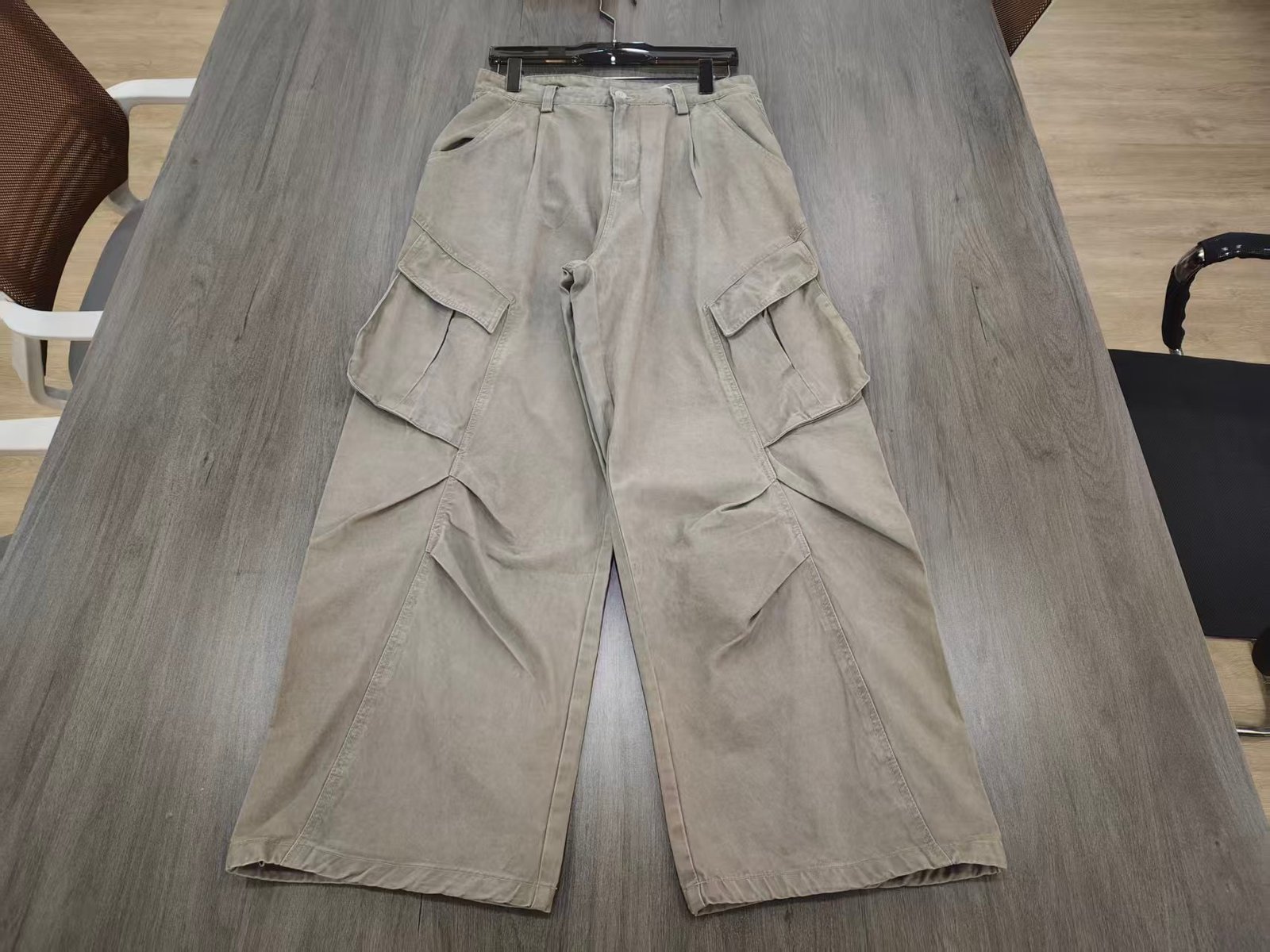
Your cargo pants looked great on the mood board. The fabric had the right texture, the oversized pockets gave the design character, and the wide-leg silhouette matched your brand's collection.
Then the first sample arrived.
The side pockets sagged even when empty. The pocket flaps curled at the corners. A snap pulled loose from the fabric, and the wide-leg trousers looked completely different when worn.
These problems are familiar in cargo pants development. Unlike basic trousers, cargo pants combine garment fit, pocket engineering, fabric behavior, hardware, and reinforcement. A small mistake in one area can affect the appearance and functionality of the entire garment.
For clothing brands, choosing a cargo pants manufacturer is not simply about finding a factory that can sew trousers. It is about working with a team that understands how pockets, patterns, fabric, and construction work together.
Quick Answer: What Makes a Good Cargo Pants Manufacturer?
A good cargo pants manufacturer can produce woven and knitted cargo styles, develop accurate patterns, reinforce pocket stress points, select suitable fabrics and hardware, and maintain consistent sizing during bulk production. For custom and private label cargo pants, the manufacturer should also support sampling, grading, branding, and quality inspection.
At Decheng, we work with clothing brands developing everything from structured cotton-twill cargos to relaxed streetwear styles and knitted cargo sweatpants.
In this guide, we'll explain what matters during cargo pants development, which details affect manufacturing costs, and how to avoid the problems that often appear between the first sample and bulk production.
Table of Contents
- What Does a Cargo Pants Manufacturer Make?
- Which Fabrics Work Best for Custom Cargo Pants?
- Which Cargo Pants Fits Should Clothing Brands Consider?
- How Do You Design Cargo Pockets That Actually Work?
- Which Hardware and Trims Should You Choose?
- How Does a Manufacturer Develop Custom Cargo Pants?
- What Quality Checks Matter for Cargo Pants?
- What MOQ, Cost, and Lead Time Should You Expect?
- How Do You Choose a Reliable Cargo Pants Manufacturer?
- Frequently Asked Questions
- Conclusion
What Does a Cargo Pants Manufacturer Make?
Cargo pants are no longer limited to traditional military-inspired trousers. The category now includes structured workwear, oversized streetwear, lightweight parachute pants, casual cargo sweatpants, and women's fashion cargos.
A custom cargo pants manufacturer may work with both woven and knitted fabrics, depending on the factory's equipment and production capabilities.
The main difference is construction. Woven cargo pants rely on structured fabrics such as cotton twill, canvas, ripstop, or nylon. Knitted cargo pants use French terry, fleece, or other stretchable materials, giving them a softer, more relaxed feel.
Common Types of Cargo Pants
| Cargo Pants Style | Common Fabric | Main Characteristics |
|---|---|---|
| Straight-Leg Cargo Pants | Cotton twill | Classic utility styling and balanced leg shape |
| Wide-Leg Cargo Pants | Twill or canvas | Relaxed fit, wider leg opening, streetwear look |
| Baggy Cargo Pants | Twill or cotton blends | Oversized silhouette with generous thigh room |
| Parachute Pants | Lightweight nylon | Loose fit, adjustable hems, lightweight construction |
| Ripstop Cargo Pants | Cotton or nylon ripstop | Technical appearance and tear-resistant fabric structure |
| Cargo Sweatpants | French terry or fleece | Soft knitted construction with functional pockets |
| Cargo Shorts | Twill, canvas, or ripstop | Short-length utility styles for warm-weather collections |
| Women's Cargo Pants | Twill or stretch woven | Adjustable waist shaping and varied leg silhouettes |
For a streetwear collection, manufacturers may need to develop both woven cargos and matching knitted tops or sweatpants.
Our group has woven and nylon production capabilities for structured cargo pants and parachute styles, while our knitted garment production supports cargo sweatpants.
This distinction matters because woven and knitted garments require different pattern allowances, sewing methods, and fabric-handling techniques.
Why Are Cargo Pants Still Relevant to Streetwear Brands?
Cargo pants offer more design flexibility than many basic trousers. A brand can change the entire appearance of a style by adjusting the leg opening, pocket shape, fabric weight, or hem construction.
An industry report published by Intel Market Research[^1] estimated the global wide-leg cargo pants segment at USD 2.32 billion in 2025 and projected it to reach USD 4.63 billion by 2034.
These are market research estimates rather than confirmed retail sales figures, but they indicate commercial interest in this particular cargo silhouette.
For manufacturers, the important point is that cargo pants allow brands to develop recognizable products through details rather than relying entirely on prints or logos.
Our related woven pants, nylon shorts, sweatpants, and joggers guides explain how different bottom styles are developed for apparel collections.
Which Fabrics Work Best for Custom Cargo Pants?
Fabric is one of the first decisions we discuss with a brand when developing cargo pants.
The material determines not only how the trousers feel, but also how the pockets hang, how the legs fall, and whether the garment keeps its intended shape after washing.
Cotton twill is a practical choice for classic cargo pants. Canvas provides a heavier workwear appearance, ripstop works well for technical styles, and lightweight nylon is common in parachute pants. French terry and fleece are better suited to knitted cargo sweatpants.
Cargo Pants Fabric Comparison
| Fabric | Characteristics | Recommended Applications |
|---|---|---|
| Cotton Twill | Structured, comfortable, versatile | Everyday and classic cargo pants |
| Cotton Canvas | Dense, heavier hand feel | Workwear and heavyweight cargos |
| Cotton Ripstop | Reinforced grid weave | Utility and outdoor-inspired pants |
| Nylon Ripstop | Lightweight with tear-resistant construction | Technical cargo pants |
| Lightweight Nylon | Smooth, light, flexible | Parachute pants |
| Stretch Woven | Improved flexibility and movement | Women's and comfort-focused cargos |
| French Terry | Soft knitted fabric | Casual cargo sweatpants |
| Fleece | Warm, soft interior | Winter cargo sweatpants |
How Does Fabric Weight Affect Cargo Pockets?
Large pockets add weight to the sides of the garment.
When the fabric is too light for the pocket design, the pocket may sag, wrinkle, or pull the leg out of shape.
For example, an oversized bellows pocket made from lightweight fabric may collapse when empty. The same pocket made with a more structured twill may retain a cleaner outline.
However, heavier fabric is not always the better solution.
A parachute pant is supposed to feel lightweight and move naturally. Using heavy cotton canvas would change its intended silhouette and comfort.
The correct fabric depends on the design rather than simply choosing the highest GSM.
When comparing fabric options, we also consider:
- Fabric composition and weight
- Shrinkage after washing
- Colorfastness requirements
- Surface texture and finishing
- Pocket structure
- Sewing performance
- Available fabric colors and minimum order quantities
Fabric testing is especially important for garments that combine multiple panels or undergo washing treatments.
For dimensional stability, ISO 5077[^2] describes methods for determining dimensional changes in textiles after specified washing and drying procedures.
In practical production, this helps explain why a cargo sample should be evaluated after washing rather than relying only on its original measurements.
What Colors Work Best for Cargo Pants?
Black, olive, khaki, stone, and charcoal are practical starting points for many utility and streetwear collections.
These colors work well with cotton twill and canvas and are easy to coordinate with hoodies, T-shirts, and jackets.
However, brands should choose colors based on their customers and collection direction, not assume that every neutral color will sell equally well.
Fabric purchasing also affects color selection.
Many fabrics are ordered by the roll, and suppliers may have minimum quantities for individual colors. Ordering too many colors in a small production run can increase sourcing and cutting costs.
For a new collection, developing fewer colors with a stronger size distribution is often easier to manage.
Our fabric GSM and activewear fabric guides provide further information about fabric weights and nylon materials.
Which Cargo Pants Fits Should Clothing Brands Consider?
The silhouette is one of the most visible parts of any cargo pants design.
Relaxed, baggy, and wide-leg cargo styles have become important options in streetwear collections, while straight-leg cargo pants remain useful for brands seeking a more traditional utility appearance.
The correct fit depends on the intended customer, styling direction, fabric, and reference measurements.
A cargo pants manufacturer should consider waist, rise, hip, thigh, knee, inseam, and leg opening measurements together. Pocket placement must also be adjusted according to the garment's size and silhouette.
Cargo Pants Fit Comparison
| Fit | Main Features | Development Considerations |
|---|---|---|
| Straight Fit | Consistent, moderate leg width | Balance between comfort and structure |
| Relaxed Fit | Extra room through hip and thigh | Maintain shape without excessive bulk |
| Baggy Fit | Generous volume throughout | Control pocket scale and leg proportions |
| Wide-Leg Fit | Large leg opening | Check drape, inseam, and hem position |
| Parachute Fit | Loose leg with optional adjustable hem | Balance lightweight fabric and gathered volume |
| Tapered Cargo | Wider thigh, narrower ankle | Avoid restricting knee movement |
Why Does Pocket Placement Change Between Sizes?
A pocket that looks balanced on a size L sample may appear oversized on a size S garment.
This happens when manufacturers focus on grading the trousers but fail to consider the pocket dimensions and position.
On smaller sizes, a large cargo pocket can occupy most of the visible thigh area. On larger sizes, the same pocket may look too small or sit too high.
Pocket grading should therefore be planned along with the garment measurements.
In our development process, we pay particular attention to how the pocket aligns with the side seam and how its appearance changes when the trousers are worn.
This is especially important for baggy and wide-leg styles, where the pocket must remain visually positioned on the side of the thigh.
Which Measurements Should Be Included in a Cargo Pants Tech Pack?
| Measurement Point | Why It Matters |
|---|---|
| Waist Width | Determines waistband fit |
| Hip Width | Affects seat comfort |
| Front Rise | Controls front waist and crotch position |
| Back Rise | Supports seat coverage and movement |
| Thigh Width | Influences comfort and pocket space |
| Knee Width | Defines the lower-leg silhouette |
| Leg Opening | Determines straight, wide, or tapered appearance |
| Inseam | Controls inside-leg length |
| Outseam | Establishes overall trouser length |
| Pocket Position | Controls pocket appearance and accessibility |
| Pocket Dimensions | Maintains proportion and functionality |
For adjustable-waist cargo pants, brands should also specify elastic width, drawcord length, and waistband construction.
A button-fly waistband with belt loops creates a more classic appearance, while elastic or drawcord waistbands offer flexibility for casual styles.
Our clothing size chart guide explains how garment measurements and grading rules affect finished apparel sizing.
How Do You Design Cargo Pockets That Actually Work?
Cargo pockets are often the main reason a customer chooses this type of trousers.
They also create some of the most common manufacturing problems.
A pocket may look attractive in a flat technical drawing but behave differently when attached to the garment.
Well-made cargo pockets should keep their intended shape, sit in the correct position, open comfortably, close securely, and withstand normal use without damaging the surrounding fabric.
What Are the Main Cargo Pocket Types?
| Pocket Type | Construction | Main Benefit |
|---|---|---|
| Bellows Pocket | Folded panels that expand outward | Increased storage capacity |
| Flat Patch Pocket | Fabric panel attached to the garment | Clean, minimal appearance |
| Zipper Pocket | Opening secured with a zipper | Secure storage |
| Welt Pocket | Reinforced slit-style pocket opening | Refined appearance |
| Flap Pocket | Fabric flap covering an opening | Utility styling and protection |
| Snap-Flap Pocket | Flap secured with metal or plastic snaps | Convenient closure |
| Hook-and-Loop Pocket | Flap secured with hook-and-loop tape | Fast opening and closing |
Why Do Bellows Pockets Need Careful Construction?
A bellows pocket uses additional fabric folds to create expandable volume.
This allows the pocket to carry more than a flat patch pocket, but it also introduces more sewing operations.
The pocket's side folds must be balanced, its bottom corners must be shaped correctly, and the flap must cover the opening without creating unnecessary tension.
If the pocket is too deep or the fabric lacks structure, the lower section may sag.
If the side folds are sewn unevenly, the pocket may twist.
For this reason, we recommend checking bellows pockets both empty and with a reasonable test load during sample development.
Why Are Bartacks Important?
Bartacks are short, dense reinforcement stitches placed at areas exposed to repeated pulling or tension.
On cargo pants, these commonly include:
- Cargo pocket opening corners
- Front pocket opening ends
- Belt-loop attachment points
- Selected pocket flap attachment areas
- Other designated high-stress locations
A useful technical reference is ASTM D1683/D1683M[^3], which addresses sewn-seam strength and related failure behavior in woven fabrics.
This does not mean every cargo pocket requires formal laboratory testing. It means seam construction and reinforcement should be selected according to the fabric and expected use.
What Should Brands Specify About Pocket Construction?
A tech pack should not simply say "two cargo pockets."
It should show the exact pocket dimensions, position, opening size, flap shape, closure type, stitching, and reinforcement points.
For example, two pockets may have identical external dimensions but different internal capacity depending on whether they use flat construction or expandable bellows.
Brands should also define whether pocket dimensions are measured before or after attachment.
These details prevent misunderstandings between designers, pattern makers, and production teams.
Our clothing tech pack guide covers the importance of documenting construction details before sampling.
Which Hardware and Trims Should You Choose?
Cargo pants often use more hardware than basic trousers.
Buttons, snaps, zippers, drawcords, toggles, and adjustable waist components all affect the finished product.
Weak hardware can create customer complaints even when the fabric and stitching are acceptable.
Hardware should be selected according to the garment's function, fabric thickness, appearance, and expected use.
Common Cargo Pants Hardware
| Trim | Options | Main Consideration |
|---|---|---|
| Fly Closure | Zipper fly or button fly | Function and appearance |
| Waist Button | Metal, plastic, or branded button | Attachment strength |
| Pocket Snaps | Metal or plastic snaps | Closure security |
| Zippers | Metal, nylon coil, molded plastic | Smooth operation and durability |
| Toggles | Plastic or metal | Adjustment function |
| Cord Stoppers | Single-hole or double-hole | Drawcord control |
| Drawcords | Flat or round | Comfort and styling |
| Webbing Belt | Woven webbing with buckle | Utility appearance |
| Labels and Patches | Woven, printed, leather-look | Private label branding |
Why Do Snap Buttons Pull Out of Fabric?
A snap attached directly to thin fabric may tear through the material when repeatedly opened.
The problem is not always the snap itself. The surrounding fabric may lack sufficient reinforcement.
Depending on the design, we may recommend interfacing or an additional fabric layer behind the snap.
The snap must also be attached with equipment and settings appropriate for that hardware.
During sampling, opening and closing the snap repeatedly helps reveal attachment problems before bulk production.
How Do You Choose Cargo Pants Zippers?
Zippers must match the intended application.
A fly zipper, for example, has different functional requirements from a small decorative pocket zipper.
Brands should consider zipper type, size, slider operation, color, and strength.
YKK's official zipper testing guidance[^4] describes evaluation methods covering zipper chain strength, stops, sliders, and other components.
These references are useful when discussing hardware performance with suppliers. The actual tests required for an order should be agreed upon in the quality specifications.
Is Custom Hardware Worth the Cost?
Custom hardware can help distinguish a private label collection, but it may add development cost and sourcing time.
For example, custom trims may start at approximately 100 pieces depending on the component and supplier.
A custom zipper pull used with a standard zipper may require approximately USD 150 in tooling, depending on its design.
These figures are indicative project estimates rather than universal prices.
For small production runs, existing hardware in a suitable color and finish is often more economical.
Our clothing trims guide discusses additional options for buttons, zippers, labels, and other components.
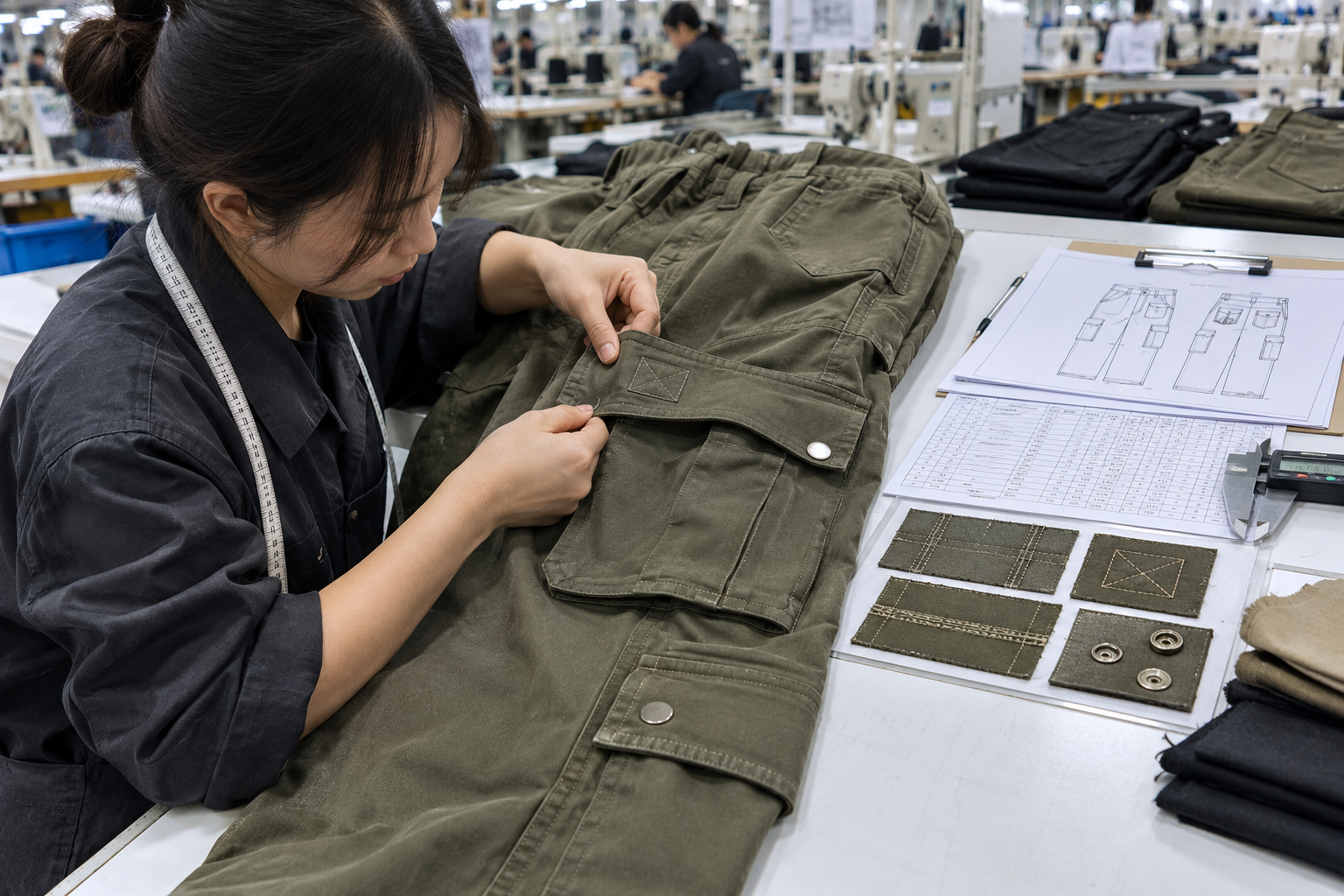
How Does a Manufacturer Develop Custom Cargo Pants?
Developing cargo pants involves more than sending a reference picture to a factory.
The manufacturer needs to translate the design into a pattern, select suitable materials, construct a sample, check the fit, and confirm production details.
For OEM and private label cargo pants, a clear development process reduces mistakes and helps buyers control costs.
Step 1: Review the Design and Tech Pack
We first review the reference images, measurements, material requirements, and construction details.
Important information includes pocket placement, number of pockets, leg silhouette, waistband structure, hardware, and branding requirements.
If a brand does not yet have a complete tech pack, the design still needs to be clarified before sampling.
For technical cargo styles, pocket and hardware specifications are particularly important.
Step 2: Select Fabrics and Trims
The next stage is choosing materials that support the intended design.
A heavy streetwear cargo may use structured twill, while a lightweight parachute style may require nylon.
Fabric sourcing should also consider color availability, shrinkage, composition, finishing, and the fabric supplier's order requirements.
At the same stage, we discuss snaps, zippers, labels, drawcords, and any custom components.
Step 3: Develop the Pattern
The pattern maker develops the trousers using the approved measurements and design references.
For cargo pants, the pattern must accommodate both the garment silhouette and the additional pocket structures.
The team checks the relationship between the side seam, cargo pocket, rise, thigh, and leg opening.
For oversized styles, we pay close attention to the overall proportions rather than simply adding width to a regular trouser pattern.
Step 4: Make and Evaluate the First Sample
The first sample helps determine whether the pattern and materials work together.
We examine the waistband, rise, leg shape, pocket position, pocket opening, and hardware.
A sample should be evaluated both on a table and when worn.
This is particularly important for wide-leg cargo pants. A style that looks balanced when laid flat may fall differently on the body.
Step 5: Revise and Approve the Sample
Brands may request adjustments to the leg width, pocket height, waistband, inseam, or hardware.
Each adjustment should be documented.
The approved sample and final technical information should form the basis for bulk production.
Changing a pocket shape or fabric after sample approval can affect cost, material usage, and lead time.
Step 6: Grade Sizes and Prepare Bulk Production
After the base sample is approved, the pattern is graded according to the agreed size range.
Pocket dimensions and positions should be reviewed across sizes rather than copied without consideration.
Production planning then includes fabric allocation, cutting, sewing operations, reinforcement, finishing, and inspection.
What Quality Checks Matter for Cargo Pants?
Cargo pants have multiple construction points that require attention during quality control.
The more complex the design, the more important it becomes to define inspection requirements before production.
Cargo Pants Quality Control Checklist
| Inspection Area | What to Check |
|---|---|
| Fabric | Composition, appearance, weight, defects |
| Measurements | Waist, hip, rise, thigh, inseam, leg opening |
| Pocket Placement | Height, position, symmetry |
| Pocket Construction | Shape, folds, opening, attachment |
| Pocket Reinforcement | Bartacks and stress-point stitching |
| Hardware | Snap security, zipper operation, button attachment |
| Seams | Stitch consistency and seam integrity |
| Waistband | Elastic recovery or closure function |
| Hem | Length, finish, adjustable components |
| Washing | Dimensional change and garment appearance |
| Branding | Label placement and decoration accuracy |
| Finishing | Loose threads, stains, pressing, packaging |
Why Should Cargo Pants Be Checked After Washing?
Washing can affect the fit, length, shape, and appearance of the garment.
Cotton-rich woven fabrics may experience dimensional changes depending on their finishing and washing conditions.
A small change in inseam length can become noticeable in wide-leg or stacked cargo styles.
For this reason, wash performance should be evaluated according to the fabric and the buyer's requirements.
How Can Brands Evaluate Fabric Safety?
Brands supplying international markets may also require testing or supporting documentation related to textile safety.
For example, OEKO-TEX® STANDARD 100[^5] is a certification system for textiles tested for harmful substances.
Certification claims must apply to the relevant materials or products within the certificate's scope. A factory's general certification information should not automatically be interpreted as certification of every finished cargo pants style.
For buyers, requesting applicable certificates and test documentation is an important part of supplier evaluation.
What MOQ, Cost, and Lead Time Should You Expect?
Minimum order quantity, pricing, and delivery schedules depend on the construction and materials of the cargo pants.
A basic cotton-twill cargo with two side pockets is different from a technical nylon cargo with multiple zipped pockets, adjustable hems, and custom hardware.
For this cargo pants program, the stated minimum is 100 pieces per style per color for woven cargos and 50 pieces per style per color for knitted cargo sweatpants. Exact availability should be confirmed for each project.
Cargo Pants MOQ and Production Timeline
| Item | Indicative Requirement |
|---|---|
| Woven Cargo Pants MOQ | 100 pcs per style per color |
| Knitted Cargo Sweatpants MOQ | 50 pcs per style per color |
| Sample Development | Approximately 10–14 days |
| Bulk Production | Approximately 23–28 days after sample approval and deposit |
| Initial Production Payment | 50% deposit |
| Balance Payment | Before shipment |
These are project-specific planning figures. Production schedules can change according to fabric availability, design complexity, order volume, and hardware requirements.
What Affects Cargo Pants Manufacturing Costs?
| Cost Factor | Effect on Production |
|---|---|
| Fabric Type | Material price varies by composition and construction |
| Fabric Weight | May affect consumption, cutting, and sewing |
| Pocket Quantity | Additional fabric and sewing operations |
| Pocket Construction | Bellows and complex pockets require more work |
| Hardware | Snaps, zippers, toggles, and buckles add cost |
| Reinforcement | Additional stitching and supporting materials |
| Custom Branding | Labels, patches, prints, embroidery |
| Order Quantity | Changes material purchasing and production efficiency |
| Number of Colors | May increase sourcing and minimum fabric requirements |
Why Do More Pockets Increase Manufacturing Costs?
Each pocket adds material and labor.
For example, a cargo pant with two simple side pockets is generally less complicated to manufacture than a six-pocket design with flaps, snaps, zippers, and bartack reinforcement.
Additional operations include cutting pocket components, preparing flaps, attaching hardware, sewing pocket panels, and checking pocket alignment.
These operations affect both production efficiency and inspection requirements.
A useful approach is to identify which pockets are important to the design and which are mainly decorative.
Not every cargo pant needs six functional pockets.
How Does Color Quantity Affect Cost?
Smaller orders with many colors can be more expensive to produce.
When a fabric supplier requires full-roll purchasing, every additional color may increase the sourcing commitment.
If the factory purchases small fabric quantities or loose-cut materials instead, the effective material price may be higher.
For new streetwear brands, selecting a limited number of colors can help control development and production expenses.
How Can Brands Reduce Cargo Pants Costs?
The goal should not simply be removing details.
Instead, manufacturers and buyers can evaluate which design elements provide meaningful value.
Possible adjustments include replacing unnecessary zippers with simpler closures, selecting available hardware, reducing overly complicated pocket structures, and combining color orders where material requirements permit.
Branding also affects the quotation.
Embroidery, printing, woven labels, and patches should be included in the specification before calculating the final unit price.
Our embroidery and printing work may involve long-term specialist production partners, depending on the decoration.
For a complete overview of garment production planning, visit Dechoreal, where we introduce our custom apparel manufacturing services.
How Do You Choose a Reliable Cargo Pants Manufacturer?
Choosing a factory based only on the lowest quotation can lead to problems later.
Cargo pants require attention to pattern development, pocket construction, material behavior, and hardware.
The best supplier for a project is one that can explain how it will manufacture the proposed design.
Green Flags and Red Flags
| Green Flag | Red Flag |
|---|---|
| Reviews pocket dimensions across sizes | Uses identical pocket dimensions without checking fit |
| Recommends appropriate reinforcement | Attaches hardware without considering fabric strength |
| Explains fabric limitations | Promises every design works with any fabric |
| Can explain woven and knit production capabilities | Provides unclear information about production processes |
| Checks pocket appearance on a worn sample | Evaluates the sample only when laid flat |
| Tests hardware functions | Does not check snaps or zippers |
| Provides clear MOQ and color requirements | Gives vague purchasing conditions |
| Documents approved sample changes | Relies only on verbal instructions |
Questions to Ask Before Placing an Order
When discussing a new cargo pants project, brands should ask the manufacturer about fabric availability, pocket construction methods, sample development, grading, hardware sourcing, and inspection procedures.
It is also important to understand which operations are handled within the manufacturer's production facilities and which may involve specialist partners.
For example, a manufacturer may produce the garments directly while sourcing custom hardware or arranging specialized decoration with established suppliers.
What matters is whether the production responsibilities and quality expectations are clear.
For B2B clothing brands, communication during the development stage can be just as important as the final quotation.
Frequently Asked Questions
Can I Manufacture Custom Cargo Pants With My Own Logo?
Yes. Custom cargo pants can include woven brand labels, care labels, embroidery, printed graphics, patches, and selected custom hardware.
The available branding methods depend on the fabric, decoration placement, order quantity, and construction.
Can a Cargo Pants Manufacturer Make Both Woven and Knitted Styles?
Some manufacturers can support both categories, while others specialize in one type.
Woven cargo pants typically use twill, canvas, ripstop, or nylon. Knitted cargo sweatpants commonly use French terry or fleece.
The equipment and production techniques are not identical, so brands should confirm their supplier's capabilities.
Are Wide-Leg Cargo Pants More Difficult to Manufacture?
Not necessarily, but they require careful pattern development.
The manufacturer must balance leg width, rise, inseam, fabric drape, and pocket placement.
Wide-leg styles can also require additional fabric compared with narrower silhouettes.
What Is the Minimum Order for Private Label Cargo Pants?
MOQ varies by fabric, construction, and production arrangement.
For the program described in this guide, the stated MOQ is 100 pieces per style per color for woven cargo pants and 50 pieces per style per color for knitted cargo sweatpants.
Brands should confirm their specific requirements before sampling.
How Long Does It Take to Make Custom Cargo Pants?
The indicative schedule for this cargo pants program is approximately 10–14 days for samples and 23–28 days for bulk production after sample approval and deposit.
Special fabrics, custom hardware, additional sample revisions, or large orders may require more time.
Can I Use My Own Cargo Pants Tech Pack?
Yes. A complete tech pack helps the manufacturer understand your design and quotation requirements.
Ideally, it should include measurements, construction diagrams, fabric specifications, pocket dimensions, hardware information, artwork, labels, and size grading requirements.
What Is the Difference Between Cargo Pants and Cargo Sweatpants?
Cargo pants are commonly made from woven fabrics such as cotton twill or nylon. Cargo sweatpants use knitted fabrics such as French terry or fleece.
Both may feature large side pockets, but their structure, stretch, drape, and sewing requirements differ.
Conclusion
Good cargo pants are built around more than an attractive pocket design.
Fabric selection, leg proportions, pocket grading, hardware, reinforcement, and sewing quality all affect the finished product.
For clothing brands developing custom cargo pants, the most important step is making these decisions during sampling rather than discovering problems after bulk production begins.
A structured cotton-twill cargo and a lightweight parachute pant may share similar design inspiration, but they require different construction decisions.
At Decheng, we believe a useful manufacturer should do more than reproduce a reference image. Our role is to help brands understand how their designs can be developed into practical, repeatable garments.
Whether your collection includes straight-leg utility pants, oversized streetwear cargos, lightweight nylon styles, or knitted cargo sweatpants, clear technical specifications and a well-approved sample are the foundation of consistent production.
Planning a custom cargo pants collection?
Visit Dechoreal.com to learn more about our OEM and ODM garment manufacturing services and discuss your fabric, design, quantity, and production requirements.
Footnotes & References
[^1]: Intel Market Research — Cargo Pants (Wide Leg) Market: Growth Analysis, Outlook and Forecast 2026–2034. Published May 2026. The report provides estimates and projections for the wide-leg cargo pants segment. https://www.intelmarketresearch.com/cargo-pants-market-43939
[^2]: International Organization for Standardization (ISO) — ISO 5077:2007: Textiles — Determination of Dimensional Change in Washing and Drying. Official standard information describing the measurement of dimensional changes in textile materials and garments. https://www.iso.org/standard/41877.html
[^3]: ASTM International — ASTM D1683/D1683M: Standard Test Method for Failure in Sewn Seams of Woven Fabrics. Reference for sewn-seam strength and related failure evaluation. https://store.astm.org/d1683_d1683m-16.html
[^4]: YKK Fastening Products Group — Zipper Testing Methods. Official information explaining zipper strength evaluation, including chain, slider, and stop testing. https://www.ykkfastening.com/quality/methods.html
[^5]: OEKO-TEX® — STANDARD 100. Official information about textiles tested for harmful substances and applicable certification requirements. https://www.oeko-tex.com/en/our-standards/oeko-tex-standard-100