

Chinese New Year 2027: How Should Clothing Brands Plan Production Around the Holiday?
Your spring collection is ready.
The designs are approved.
You plan to send the tech packs to China:
“after the holidays.”
Then you discover the problem.
Chinese New Year is not just a few days when the factory office is closed.
Workers begin travelling home before the holiday.
Fabric mills slow down.
Dye houses stop taking urgent jobs.
Printing and embroidery workshops close.
Freight space becomes tighter.
And after the holiday, production does not instantly return to 100%.
Suddenly, the spring collection you expected in March is arriving much later.
Chinese New Year 2027 falls on February 6, 2027. For clothing brands sourcing from China, the production impact normally begins weeks before the holiday and can continue for several weeks afterward. The safest strategy is to plan backward from your required shipment date, complete samples early, confirm fabrics and bulk quantities before the year-end rush, and avoid treating the official public holiday as the only disruption period.
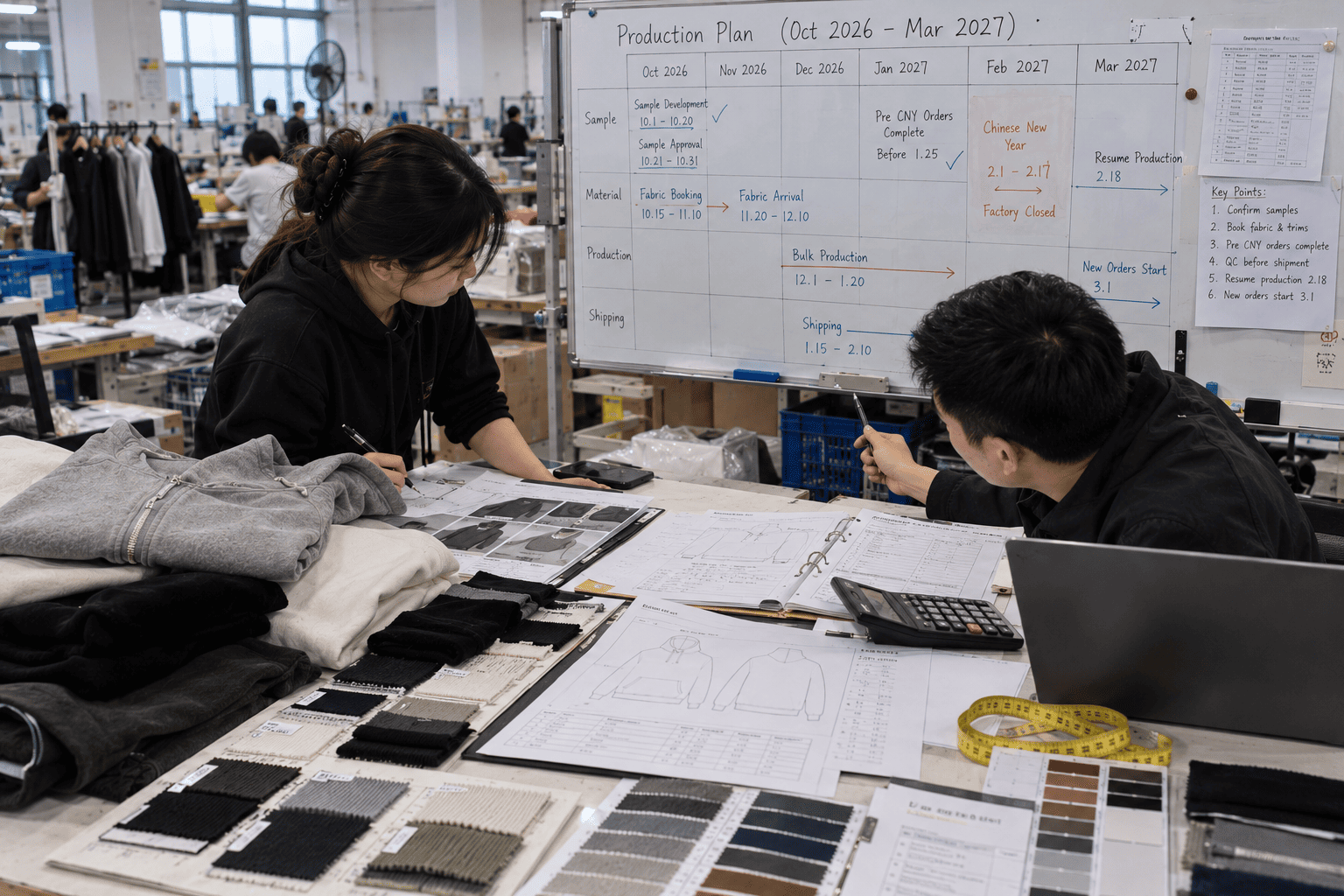
For 2027, timing deserves even more attention because Lunar New Year arrives relatively early in the calendar.
Current supply-chain guidance from SEKO Logistics places the strongest manufacturing disruption roughly around:
- January 2027: progressive slowdown
- Late January to mid-February: broad shutdown period
- Late February to early March: gradual restart
- March: recovery toward normal capacity
These are planning ranges rather than official factory closure dates.
Every factory should still give buyers its own confirmed schedule before production begins.
Table of Contents
- When Is Chinese New Year 2027, and How Long Do Factories Close?
- Why Does the Holiday Affect Production for So Long?
- When Should You Place Orders Before Chinese New Year 2027?
- How Should You Plan Samples and Bulk Around the Holiday?
- What Happens to Shipping Around Chinese New Year?
- What Should You Do If You Are Already Late?
- Conclusion
When Is Chinese New Year 2027, and How Long Do Factories Close?
Chinese New Year 2027 falls on:
February 6, 2027.
That is the Lunar New Year date.
But this is where buyers often make the first mistake:
the Lunar New Year date is not the same thing as the factory shutdown period.
The Official Holiday and the Factory Closure Are Different
China has a national public-holiday system for Spring Festival.
However, the exact annual arrangement—including adjusted working days—is normally announced separately by the State Council closer to the end of the preceding year.
As of now, the detailed 2027 national holiday schedule has not yet been officially published.
China's current national holiday regulation recognizes Spring Festival as a national holiday, but the annual calendar determines the exact combined holiday and adjusted workdays.[^1]
So do not build your 2027 supply plan around an assumed official nine-day schedule before the government publishes it.
Factory Reality Is Longer Than the Official Holiday
Garment factories employ workers from many provinces.
Before Spring Festival, workers may travel hundreds or thousands of kilometers home.
That means some workers leave before the official holiday period starts.
After the holiday, they return gradually.
Some:
- Take extra leave
- Return late
- Move to another factory
- Change industries
This is why factory capacity can remain below normal even after the front gate reopens.
A Practical 2027 Planning Timeline
Current logistics guidance suggests something like:
| Period | Planning window | Likely situation |
|---|---|---|
| Normal but busy | Nov–Dec 2026 | Factories filling pre-holiday schedules |
| Peak production rush | Dec 2026–early Jan 2027 | Buyers push to finish before closure |
| Progressive slowdown | Around mid-Jan 2027 onward | Workers and suppliers begin leaving |
| Major shutdown | Roughly late Jan–mid Feb | Many factories and suppliers closed |
| Initial restart | Late Feb | Production starts returning |
| Ramp-up | Late Feb–early Mar | Staff and suppliers return gradually |
| More normal capacity | During Mar | Production moves closer to normal |
SEKO's 2027 planning guidance places broad factory shutdown concentration around January 30 to February 14, gradual resumption around February 20 to March 6, and fuller recovery during March.[^2]
These are useful planning benchmarks.
They are not universal contractual dates.
Ask Your Actual Factory
For every order, ask:
What is your last production day before Chinese New Year?
What is your planned reopening date?
When will the sewing lines realistically return to normal capacity?
Also ask about:
- Fabric mill
- Dye house
- Printing
- Embroidery
- Washing
- Trim suppliers
because your garment factory can be open while one critical supplier is still closed.
Why Does the Holiday Affect Production for So Long?
A clothing factory is only one part of the supply chain.
Chinese New Year affects apparel production for much longer than the official holiday because fabric mills, dye houses, trim suppliers, specialist decoration workshops, logistics companies, and factory workers all enter holiday schedules at slightly different times.
A Hoodie Is Not Produced by One Department
Take a custom hoodie.
The process may involve:
- Fabric knitting
- Dyeing
- Fabric finishing
- Fabric inspection
- Shrinkage testing
- Cutting
- Printing or embroidery
- Sewing
- Finishing
- QC
- Packing
- Export
If the embroidery partner closes before the sewing factory:
your embroidered panels stop.
If the dye house does not finish your fabric before the holiday:
the cutting room has nothing to cut.
That is why:
“our sewing factory is still open”
does not necessarily mean your order can still move normally.
Where the Delays Usually Come From
| Risk | What it can do |
|---|---|
| Fabric supplier closes | Cutting cannot start |
| Dyeing delayed | Color approval moves after CNY |
| Trim supplier closes | Zippers / labels / hardware wait |
| Decoration workshop closes | Print / embroidery stops |
| Workers leave early | Sewing output drops |
| Freight peak | Space and trucking become tighter |
| Post-holiday labor return | Production resumes gradually |
| Backlog after restart | New orders wait in queue |
Fabric Is Often the Critical Path
For clothing production, fabric usually needs to be available before:
- Cutting
- Decoration
- Sewing
For our own process, we want time for:
- Fabric arrival inspection
- Dimensional-change checking where needed
- Relaxation or preparation
- Cutting planning
before bulk starts.
If the material arrives on the last few days before the factory slows down, there may not be enough time to handle a problem.
Quality Can Also Be Affected by Rushing
The weeks immediately before Chinese New Year are one of the worst times to force an unrealistic deadline.
Why?
Because everyone is trying to finish at once.
Rushing can increase risk around:
- Measurement
- Stitching
- Color grouping
- Packing
- Inspection
A serious supplier should sometimes tell you:
“This order is safer after Chinese New Year.”
That answer may be more reliable than:
“No problem, we can finish anything.”
When Should You Place Orders Before Chinese New Year 2027?
There is no one universal cutoff date.
A basic T-shirt and a heavily washed embroidered jacket do not need the same development time.
The safest way to plan is to work backward from the latest acceptable shipment date and include time for sampling, revisions, material sourcing, bulk production, QC, and freight booking before the January slowdown begins.
For Our Standard Programs
Our general production timing is usually around:
Sampling: approximately 5–14 days
and:
Bulk: approximately 20–30 days after final approval and deposit
for standard programs.
But those are normal operating ranges.
Chinese New Year reduces the amount of usable production time.
A Safer Planning Window
For a standard custom clothing order intended to ship before the 2027 holiday disruption, a practical target would be:
October–November 2026
- Send designs
- Confirm fabric direction
- Start samples
- Develop custom trims
November–Early December
- Review samples
- Correct patterns
- Approve colors
- Finalize artwork
- Confirm sizes and quantities
Early–Mid December
- Approve final sample
- Confirm bulk order
- Pay deposit
- Book fabric and trims
- Reserve production capacity
December–Early/Mid January
- Bulk production
- QC
- Packing
- Shipment preparation
That gives more margin than trying to start everything in January.
Example Backward Plan
Suppose your goal is:
ship before January 20, 2027.
A reasonable planning structure might be:
| Step | Target timing |
|---|---|
| Tech pack / mockup sent | October–early November |
| Fabric confirmation | November |
| First sample | November |
| Sample correction | Late November |
| Final approval | Early December |
| Bulk confirmation / deposit | Early–mid December |
| Material arrival | December |
| Bulk sewing | December–early January |
| QC / packing | Early–mid January |
| Freight handoff | Before the strongest rush |
Again:
this is a planning example.
It is not a guaranteed production calendar for every garment.
Complex Products Need More Time
Start earlier for styles involving:
- Custom-knitted fabric
- Custom dyeing
- Garment wash
- Complex embroidery
- Custom hardware
- Multiple sample rounds
- Specialty testing
For these projects, September or even earlier can be more comfortable.
Large Orders Need Capacity Reservation
For a 100-piece test order, the factory may be able to fit production into an available gap.
For:
5,000
10,000
20,000 pieces
capacity planning becomes much more important.
Share the forecast earlier.
That gives the factory time to think about:
- Fabric
- Production lines
- Specialist processes
- Shipment windows
How Should You Plan Samples and Bulk Around the Holiday?
Chinese New Year creates two useful planning windows:
before the holiday
and:
during the holiday for preparation.
Before the Holiday
Use the pre-holiday period to finish anything that physically requires the factory.
Priority should go to:
- Fabric swatches
- Samples
- Fit approval
- Print / embroidery approval
- Color approval
- Bulk production
if shipment is urgent.
During the Closure
The factory may be closed.
Your brand does not have to stop working.
Use that time to prepare:
- New tech packs
- Artwork
- Size charts
- Color plans
- Quantity forecasts
- Packaging
- Next-season styles
Then, when the factory returns, your project is ready to discuss.
Do Not Wait Until March to Start Thinking
If you know in January that you want:
summer T-shirts in April
prepare the technical information while the factory is closed.
Then you can enter the post-holiday queue earlier.
Lock Specifications Before Bulk
Changes are always expensive in time.
Around Chinese New Year, they are even more disruptive.
Try to lock:
- Fabric
- GSM
- Color
- Size chart
- Artwork
- Decoration
- Labels
- Packaging
before bulk production.
Do Not Approve by Silence
A delayed buyer approval can destroy a carefully planned pre-holiday schedule.
For example:
Factory sends sample Monday.
Buyer answers 10 days later.
Those 10 days may be the difference between:
before holiday
and:
after holiday.
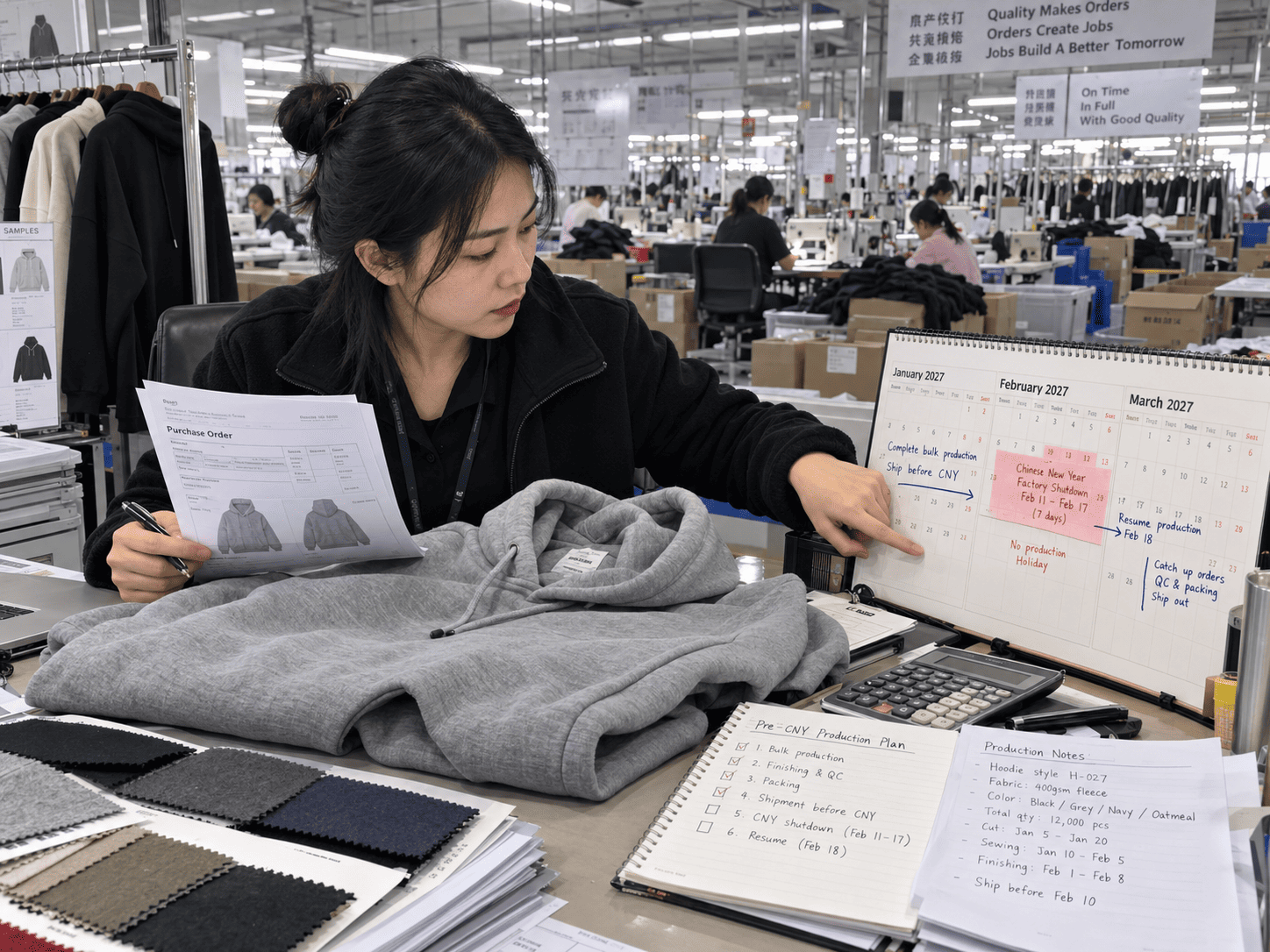
If you have a hard deadline, treat sample approval as part of production planning.
What Happens to Shipping Around Chinese New Year?
Even if production finishes, the order still has to leave China.
The pre-Chinese-New-Year period often creates a logistics peak because many exporters try to move goods before factories and logistics operations reduce activity. Freight space, trucking availability, and pricing can therefore become less predictable.
SEKO's current 2027 supply-chain guidance expects freight pressure to build ahead of the holiday and notes that ocean pricing commonly strengthens during the pre-holiday rush.[^2]
Do Not Treat Freight Rates as Fixed
Avoid publishing:
“Freight will rise by X%.”
The actual rate depends on:
- Lane
- Carrier
- Capacity
- Fuel
- Global disruptions
- Shipment date
Instead, tell buyers:
book early and recheck current rates.
Sea Freight
For ocean shipments, discuss the booking before goods are completed.
That allows the forwarder to plan:
- Vessel
- Cutoff
- Container space
- Trucking
Do not wait until the last carton is sealed to start looking for space.
Air Freight
Air can be useful for:
- Urgent launches
- Samples
- Small high-value orders
- Partial deliveries
But pre-holiday demand can also affect air pricing and capacity.
Split Shipment
For some brands, this can work well.
Example:
2,000 units total.
Ship:
500 best-selling pieces by air
and:
1,500 by sea.
That can protect a launch while reducing the cost of flying the full order.
Whether it makes sense depends on:
- Margin
- Deadline
- Quantity
- Freight rate
Shipping Terms
For our exports, product pricing and shipping should be clearly separated unless a delivered quotation is specifically requested.
Incoterms® such as:
- EXW
- FOB
define different responsibilities between buyer and seller.
Do not compare:
EXW product price
with:
delivered shipping-inclusive price
as if they are the same quotation.
Customs and Documents
Do not leave export paperwork until the last moment.
Depending on shipment, confirm:
- Commercial invoice
- Packing list
- Country of origin information
- Product description
- HS classification information
before pickup.
A shipment finished before the holiday can still be delayed if documentation is incomplete.
What Should You Do If You Are Already Late?
Suppose it is already December.
Your design is not sampled.
You still want to ship before the holiday.
You may still have options.
But flexibility becomes more important.
When timing is tight, simplify the project: reduce styles and colors, use available fabrics and trims, respond quickly to approvals, avoid unnecessary development, and split urgent and non-urgent production when appropriate.
Option 1: Use Stock Fabric
Custom knitting or custom dyeing takes time.
If an acceptable fabric already exists:
use it.
This can eliminate one of the biggest schedule risks.
Option 2: Reduce Colors
Instead of:
6 colors
launch:
2 core colors.
You can add more after the holiday.
This simplifies:
- Fabric
- Cutting
- Thread
- Decoration
- QC
Option 3: Reduce Styles
Instead of launching:
8 styles
choose your:
2 strongest.
The rest can follow later.
Option 4: Simplify Decoration
A simple:
- Chest print
- Small embroidery
may move faster than a product involving:
- Several embroideries
- Appliqué
- Custom wash
- Special hardware
depending on supplier capacity.
Option 5: Approve Faster
When the factory sends:
- Fabric
- Artwork
- Sample photos
- Measurement sheet
reply quickly.
There is no production trick that recovers a week spent waiting for buyer feedback.
Option 6: Split Before and After the Holiday
Perhaps:
Style A → urgent pre-holiday production
Styles B/C → post-holiday
This may be safer than forcing all three into an unrealistic schedule.
Option 7: Partial Air Shipment
If the goods finish close to your deadline:
send the most urgent quantity faster.
Do Not Accept Impossible Promises
If it is late January and a supplier says:
“Sure, we can make any custom order before CNY.”
ask for:
- Fabric status
- Sample status
- Line schedule
- Completion date
- Shipment booking
A confident answer is not the same as a credible production plan.
What Should Brands Ask Their Factory Before CNY?
Use a simple checklist.
Factory Schedule
- What is your last working day?
- When will sampling stop?
- When will bulk cutting stop?
- When will your sewing lines close?
- When will your office reopen?
- When do you expect normal production capacity?
Suppliers
- When does the fabric mill close?
- When does the dye house close?
- When does embroidery close?
- When does printing close?
- When do trim suppliers stop shipping?
My Order
- Is fabric already booked?
- Has bulk fabric been approved?
- Which line will sew the order?
- Is the delivery date still realistic?
- When will final inspection happen?
Logistics
- When should freight be booked?
- What is the forwarder's holiday schedule?
- What is the last comfortable pickup date?
This gives you a real supply-chain picture.
Not just:
“factory closed February 6.”
Green Flags and Red Flags
| Green flag | Red flag |
|---|---|
| Gives exact internal closure dates | Only says “CNY holiday” |
| Separates factory and supplier schedules | Assumes all suppliers close together |
| Tells you the real order cutoff | Accepts unlimited late orders |
| Books material early | Plans to buy fabric at the last minute |
| Gives realistic capacity after reopening | Says full speed on day one |
| Communicates freight risk | Guarantees one freight rate months ahead |
| Recommends simplifying late projects | Says every custom detail is still easy |
| Plans urgent and post-holiday styles separately | Pushes everything into January |
| Shares status before the holiday | Stops communicating unexpectedly |
Conclusion
Chinese New Year 2027 falls on:
February 6, 2027.
But for clothing brands, that date is only the center of the planning problem.
The real supply-chain impact starts earlier.
Factories get busy.
Workers begin leaving.
Fabric and trim suppliers slow down.
Decoration workshops close.
Freight enters a peak period.
Then, after the holiday, everything restarts gradually.
So do not ask:
“When is Chinese New Year?”
Ask:
“What is the latest safe date for my specific order?”
For standard pre-holiday programs, a safer strategy is to:
- Start development in October or November
- Approve samples by early December where possible
- Confirm bulk and materials in December
- Produce and ship before the strongest January slowdown
Complex or high-volume orders should begin earlier.
If you are already late:
simplify.
Use stock fabric.
Reduce colors.
Prioritize the important styles.
Respond quickly.
Split urgent and non-urgent production.
And remember that the exact 2027 official holiday arrangement should be confirmed once the State Council publishes the annual schedule.
The best Chinese New Year strategy is not to work faster during the last week.
It is to avoid needing the last week at all.
Footnotes & References
[^1]: Ministry of Justice of the People's Republic of China — Measures for National Holidays and Memorial Days. China's national holiday regulations recognize Spring Festival as a statutory holiday. The detailed annual arrangement, including combined days off and adjusted working days, is announced separately for each calendar year. The 2024 revision of the national holiday rules recognizes Spring Festival holiday days around Lunar New Year.
https://xzfg.moj.gov.cn/front/law/detail?LawID=6
[^2]: SEKO Logistics — Lunar New Year 2027: Complete Supply Chain Planning Guide for Asia Sourcing. SEKO's current 2027 planning guidance places pre-holiday factory slowdown beginning during January, major shutdown concentration around January 30–February 14, gradual reopening from late February into early March, and fuller manufacturing recovery during March. It also advises importers and exporters to plan freight and production earlier because factory shutdowns and workforce recovery extend beyond the official holiday period.
https://www.sekologistics.com/en/resource-hub/knowledge-hub/lunar-new-year-complete-supply-chain-planning-guide-for-asia-sourcing/