

Clothing Production Process: What Happens from Idea to Delivery?
You paid the deposit.
Then everything went quiet.
Three weeks later, you are wondering:
Has the fabric arrived?
Have my hoodies been cut?
Is the embroidery finished?
Are they already sewing?
When you do not understand the clothing production process, every quiet week can feel like something has gone wrong.
Usually, the reality is much simpler.
Your order is moving through a sequence of steps, and one stage cannot always start until the previous one is finished.
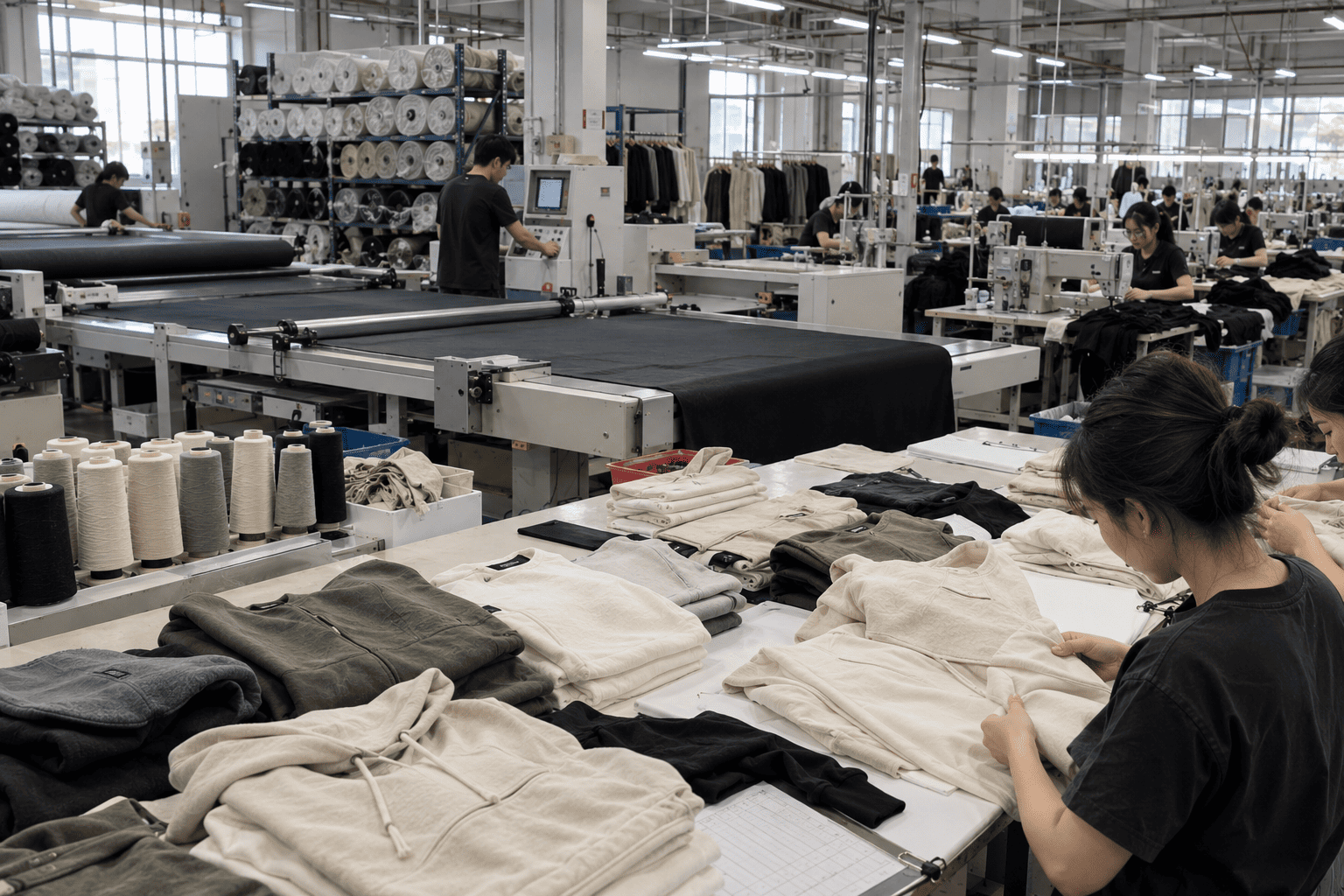
The clothing production process moves from design brief and technical specifications through sampling and approval, then fabric preparation, cutting, decoration, sewing, inspection, packing, and shipping. Each stage has its own approval points, risks, and lead time.
The important thing for a buyer is not memorizing every factory operation.
It is understanding:
Where is my order now?
What is the factory waiting for?
What needs my approval?
Once you understand those three questions, production becomes much easier to manage.
Table of Contents
- What Are the Main Stages of Clothing Production?
- What Happens Before Production Starts?
- What Happens to the Fabric Before Cutting?
- How Is a Garment Cut, Decorated, and Sewn?
- How Is Quality Checked and the Order Packed?
- How Long Does the Whole Process Take?
- Conclusion
What Are the Main Stages of Clothing Production?
A clothing order does not go directly from:
idea → sewing machine
There are several stages before the sewing line ever sees the garment.
The main stages are briefing, product development, sampling, approval, material preparation, cutting, decoration, sewing, finishing, inspection, packing, and shipping.
A useful way to think about production is to divide it into two parts:
Before Bulk Production
This is the development stage.
The buyer and factory are still deciding:
- Pattern
- Measurements
- Fabric
- Color
- Decoration
- Trims
- Price
- Packing
Changes are still relatively easy.
After Bulk Approval
This is the execution stage.
Materials are ordered.
Fabric is cut.
Decoration starts.
Garments go onto the production line.
Changes become much more expensive.
That is why one of the most important rules in clothing production is:
Solve uncertainty before cutting.
Clothing Production Stages at a Glance
| Stage | What happens | Main responsibility |
|---|---|---|
| Brief | Style, quantity, reference and requirements shared | Buyer |
| Development | Pattern, construction, fabric and trims planned | Factory + buyer |
| Sampling | First physical garment made | Factory |
| Sample review | Fit, fabric, artwork and construction checked | Buyer |
| Cost approval | Final specification priced | Factory + buyer |
| Deposit | Bulk order confirmed | Buyer |
| Material preparation | Fabric and trims prepared | Factory |
| Fabric QC | Shrinkage, shade and defects checked | Factory |
| Cutting | Bulk panels cut | Factory |
| Decoration | Print, embroidery, appliqué etc. | Factory / managed partners |
| Sewing | Garments assembled | Factory |
| Inline QC | Problems checked during production | Factory |
| Finishing | Thread trimming, pressing, washing if applicable | Factory / partners |
| Final inspection | Finished goods checked | Factory / third party |
| Packing | Polybags, labels and cartons | Factory |
| Shipping | Export documents and freight | Factory + forwarder |
One mistake I see from new brands is assuming that once the deposit is paid, sewing should begin immediately.
It often cannot.
The factory may first need to:
- Purchase fabric
- Dye fabric
- Produce labels
- Order zippers
- Make embroidery templates
- Arrange print screens
- Complete shrinkage testing
- Prepare patterns and markers
The sewing line comes later.
What Happens Before Production Starts?
Most bulk problems can be traced back to something that was never clearly decided during development.
Before bulk production starts, the factory needs to turn your design into a repeatable technical specification. That usually involves reviewing the brief, creating or checking the pattern, selecting materials, making a sample, confirming decoration, calculating cost, and receiving written approval.
Start With a Clear Brief
A useful first inquiry should include as much of the following as possible:
- Front mockup
- Back mockup
- Reference photos
- Tech pack
- Measurement chart
- Fabric composition
- GSM
- Color
- Artwork
- Decoration size
- Quantity
- Size breakdown
A logo by itself is not enough.
If you send:
“I need 100 hoodies with this logo. Price?”
the factory still does not know:
- Hoodie fit
- GSM
- Fabric composition
- Hood construction
- Pocket style
- Print or embroidery
- Logo dimensions
- Number of colors
- Wash
- Custom trims
So any instant price is only a rough guess.
Pattern Development
Once the design is understood, the pattern translates the idea into actual garment pieces.
For a hoodie, that might include:
- Front
- Back
- Sleeve
- Hood
- Rib
For trousers:
- Front leg
- Back leg
- Waistband
- Pocket bags
- Cuffs
The pattern controls:
- Fit
- Shape
- Fabric consumption
- Sewing construction
That is why fit problems should be corrected at the pattern stage rather than after bulk cutting.
Sampling
The first sample answers questions that drawings cannot.
For example:
Does the shoulder drop enough?
Is the hoodie too long?
Is the collar too loose?
Does the zipper wave?
Is the embroidery too large?
The sample should be judged against:
- Measurement chart
- Reference garment
- Artwork
- Fabric specification
- Construction requirements
Physical Color Approval
If color is important, a screen image is not enough.
Pantone's Fashion, Home + Interiors system[^1] is specifically intended for fashion, textiles, apparel, and related products, and Pantone identifies TCX as the textile format for soft surfaces such as fabrics.[^1]
Pantone also warns that colors displayed on a computer screen may not accurately reproduce physical Pantone standards.
So for important colors, it is better to approve:
- Physical Pantone reference
- Fabric color card
- Lab dip
- Actual fabric swatch
rather than comparing phone screenshots.
What Gets Locked Before Bulk?
Before the deposit triggers bulk material purchasing, we want the major specifications confirmed.
That includes:
- Style
- Pattern
- Measurements
- Fabric
- Color
- Decoration
- Logo placement
- Labels
- Trims
- Packing
- Quantity
- Price
This is the point where the project moves from:
development
to:
production.
What Happens to the Fabric Before Cutting?
Cutting is one of the most important points in the whole process.
Before cutting, a fabric issue can still be fixed.
After cutting 500 garments, the same problem becomes expensive.
Before bulk cutting, fabric should be checked against the approved specification for color, weight, defects, shrinkage or dimensional behavior, and general quality. Depending on the fabric, it may also need relaxation, conditioning, or pre-shrink treatment before cutting.
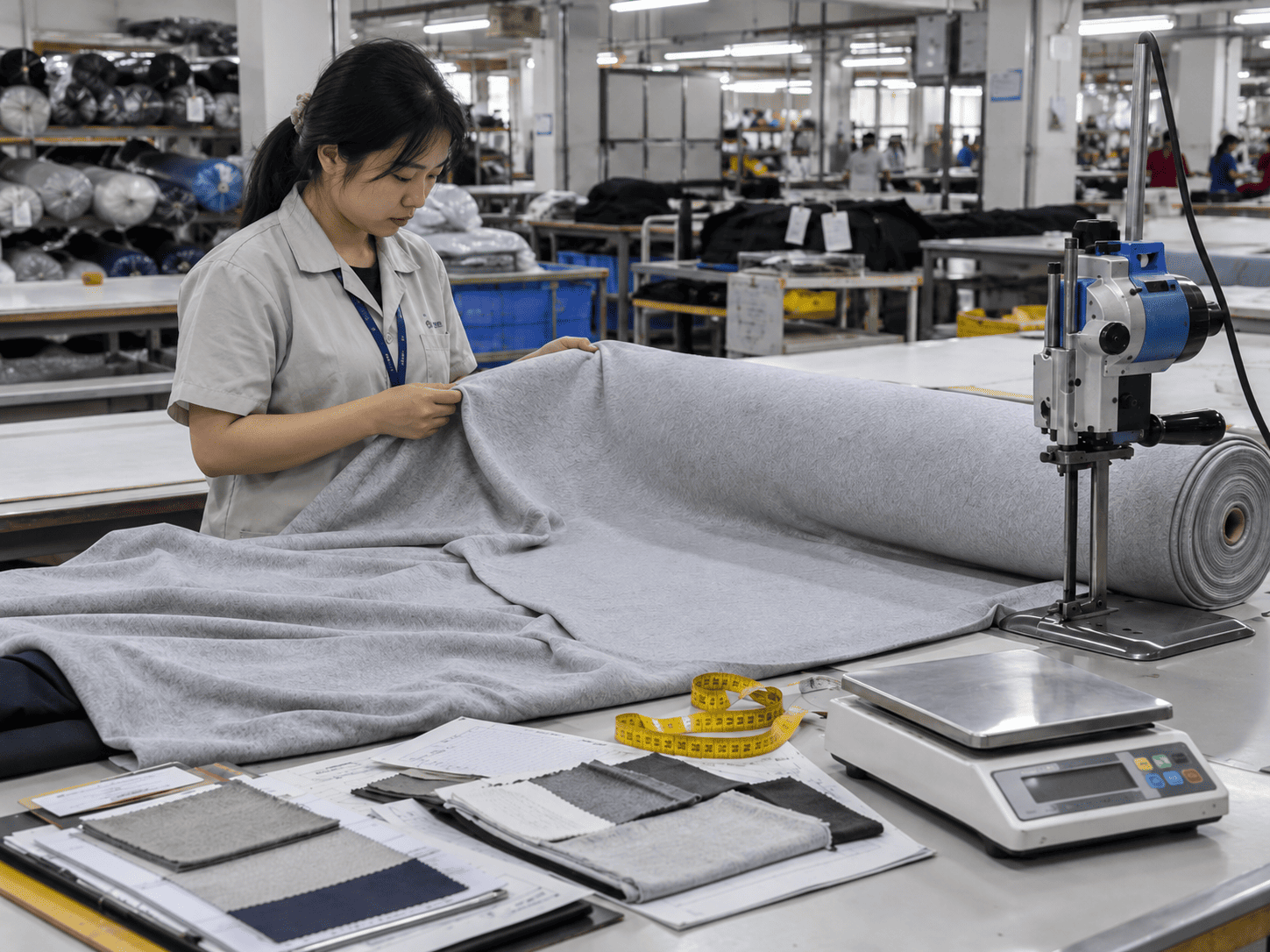
Fabric Arrival Inspection
When bulk fabric arrives, typical checks may include:
- Fabric type
- Composition documentation
- GSM
- Width
- Color
- Shade variation
- Holes
- Stains
- Knitting defects
- Surface defects
Not every style requires the same tests.
A heavyweight hoodie fabric and a lightweight sports fabric have different risks.
Shrinkage Testing
A garment should not be patterned around a guessed shrinkage percentage.
We test the actual material.
ISO 5077[^2] specifies a method for determining dimensional change in textile fabrics and garments after washing and drying.
For standardized washing and drying conditions, ISO 6330:2021[^3] provides defined domestic laundering procedures that can be used in textile testing.
The basic idea is simple:
- Mark or measure the material.
- Wash it under a defined condition.
- Dry it under a defined condition.
- Measure it again.
- Calculate dimensional change.
For example:
Before washing:
100 cm
After washing:
97 cm
Dimensional change:
-3%
That number can then inform pattern development or material treatment.
Do All Fabrics Need "Pre-Shrinking"?
Not in exactly the same way.
The correct treatment depends on:
- Fiber
- Knit or woven construction
- Finishing
- Intended wash
- Supplier preparation
So I prefer to say:
control shrinkage before bulk cutting
rather than:
every fabric must go through exactly the same pre-shrink process.
Depending on the material, this may involve:
- Fabric relaxation
- Compacting
- Pre-washing
- Conditioning
- Pattern compensation
The important point is that dimensional behavior is understood before bulk.
Fabric Relaxation
Knitted fabric can hold tension after:
- Knitting
- Dyeing
- Rolling
- Transport
If it is spread and cut immediately, it may relax afterward and change dimensions.
So appropriate fabrics are allowed to relax before cutting.
That is particularly important for:
- Jersey
- French terry
- Fleece
- Stretch fabrics
Shade Control
One color does not always mean one perfectly identical roll.
Different dye lots can show slight variation.
So we keep references and control fabric lots carefully.
For matching products such as:
hoodie + sweatpants
or:
shirt + trousers
we try to coordinate them from the same approved fabric lot whenever practical.
Reference Swatches Help With Reorders
A retained bulk swatch gives us something physical to compare with when the buyer reorders months later.
That is more reliable than:
“Make the same black as last time.”
The swatch becomes part of the production record.
How Is a Garment Cut, Decorated, and Sewn?
This is the part most buyers picture when they hear:
clothing factory.
But by the time sewing starts, many important decisions have already been made.
After fabric preparation, the approved pattern is converted into a cutting marker, the fabric is spread and cut into panels, applicable decoration is completed, and the pieces then move through sewing operations with checks during production.
Fabric Spreading
Fabric is laid in layers according to the production plan.
The factory needs to control:
- Grain direction
- Fabric tension
- Shade lots
- Layer alignment
Modern factories may use automatic spreading equipment to improve consistency.
Marker Making
A marker arranges pattern pieces across the fabric width.
The goal is to use fabric efficiently while respecting:
- Grain
- Direction
- Pattern orientation
- Nap
- Size ratios
Poor marker efficiency wastes fabric.
And because fabric is normally the largest component of garment cost, a small efficiency difference matters across a large order.
Cutting
After spreading, pattern panels are cut.
Depending on the factory and order, this may involve:
- Manual cutting
- Straight-knife cutting
- Automated cutting / CNC systems
After cutting, panels are:
- Counted
- Bundled
- Identified
- Sent to the next operation
When Does Printing or Embroidery Happen?
Often before final assembly.
A flat front panel is much easier to:
- Screen print
- Embroider
- Appliqué
than an already assembled hoodie.
For example, if a chest embroidery must be:
9 cm below the shoulder seam
the workshop can position that more accurately on a flat panel.
But this is not a universal rule.
Some processes are intentionally done after sewing, including certain:
- Garment prints
- Garment washes
- Finished-garment embroidery
- Specialty effects
The production sequence depends on the design.
Specialist Decoration
We manufacture the garment itself in our factory.
Some specialist processes such as:
- Printing
- Embroidery
- Chenille
- Appliqué
- Rhinestones
- Garment washing
may be carried out by long-term specialist partner workshops that we manage directly.
That is normal in apparel manufacturing.
The important thing is that the garment factory manages:
- Artwork
- Placement
- Samples
- Quantity
- Color
- Return inspection
rather than sending the order to an unknown workshop with no control.
Sewing Line
After decoration, the panels move into assembly.
A hoodie, for example, may go through operations such as:
- Shoulder join
- Sleeve attachment
- Side seam
- Pocket attachment
- Hood construction
- Hood attachment
- Rib attachment
- Label attachment
- Topstitching
- Final assembly
Each operation may be performed by a different operator.
That specialization makes production faster and more repeatable.
Inline Quality Control
Waiting until the final inspection to discover problems is expensive.
Suppose the first 10 hoodies have:
left pocket 2 cm too low.
If the problem is found immediately, the sewing method can be corrected.
If nobody notices until 500 pieces are finished, the correction becomes much harder.
That is why production QC should happen during sewing as well as at the end.
Common Inline Checks
These may include:
- Seam quality
- Stitching
- Pocket placement
- Decoration alignment
- Measurement checkpoints
- Labels
- Construction details
Quality control is not one person looking at the garment five minutes before packing.
It should happen throughout production.
How Is Quality Checked and the Order Packed?
When the garments come off the sewing line, the order is not finished.
The last stages determine what actually reaches the customer.
Finished garments go through trimming, finishing, measurement and workmanship checks before packing. Bulk orders may also be evaluated using a defined statistical sampling plan, and buyers can arrange an independent third-party inspection before shipment.
What Is AQL?
AQL stands for:
Acceptance Quality Limit
It belongs to a statistical sampling system.
The current ISO 2859-1:2026[^4] covers sampling procedures for inspection by attributes, with sampling schemes indexed by AQL for lot-by-lot inspection.[^4]
The important point is:
AQL is not a factory certification.
And:
AQL 2.5 does not mean 2.5% of your garments are allowed to be defective.
That is a common misunderstanding.
The inspection plan uses factors such as:
- Lot size
- Inspection level
- Sample size
- AQL
- Number of observed defects
to determine acceptance or rejection.
Our Final Inspection
For applicable standard orders, we can use an inspection plan based around AQL 2.5, depending on the agreed project requirements.
The exact inspection agreement should define how defects are classified.
Typically, garment defects may be divided into categories such as:
- Critical
- Major
- Minor
For example:
A safety hazard is not treated the same way as one small loose thread.
What Does Final QC Check?
Typical points include:
- Measurements
- Fabric
- Color
- Workmanship
- Stitching
- Embroidery
- Labels
- Quantity
- Size breakdown
- Packing
- Carton marks
The inspection should compare the finished goods with:
- Approved sample
- Tech pack
- Measurement chart
- Artwork
- Production instructions
not someone's memory.
Third-Party Inspection
We also accept third-party pre-shipment inspection.
The buyer may appoint an independent inspection company or their own QC representative.
This is especially useful for:
- Large orders
- New suppliers
- Retail programs
- Corporate procurement
The inspection should normally happen while the goods are still at the factory and before shipment.
That way, if something needs to be:
- Repaired
- Rechecked
- Repacked
it can still be handled.
Social Audits Are Different From Product Inspection
Supplier audits answer another question.
Sedex's SMETA methodology[^6] evaluates supplier-site practices in areas such as labour standards and health and safety, with broader 4-Pillar audits also covering environmental performance and business ethics.[^6]
That is useful for supplier qualification.
But SMETA does not tell you whether:
- Your sleeve is 2 cm too short
- Your logo is crooked
- Your hoodie shrank after washing
Those are product-QC issues.
You need both systems for different reasons.
Finishing
Depending on the style, garments may then go through:
- Thread trimming
- Spot cleaning
- Pressing
- Folding
- Measurement checks
- Metal detection where required by program
- Final appearance inspection
Not every product needs every finishing operation.
Clothing Labels
Before packing, make sure labels are correct.
For the U.S. market, the FTC Textile Fiber Rule and Care Labeling Rule[^5] establish requirements around textile fiber information and care instructions for covered garments.[^5]
Depending on the product and market, labels may need information such as:
- Fiber composition
- Country of origin
- Business identity
- Care instructions
This information should be confirmed before labels go into production.
Do not wait until 500 garments are finished to discover that the care label is wrong.
Packing
Packing instructions should be agreed before bulk.
For example:
- One garment per polybag
- Size sticker on bag
- Hangtag attached
- Fold method
- Pieces per carton
- Carton size
- Carton markings
For wholesale orders, carton marking may include:
- Style
- Color
- Size
- Quantity
- Carton number
Good packing is part of production, not something added randomly at the end.
How Long Does the Whole Process Take?
There is no useful universal answer like:
“Clothing manufacturing takes six months.”
It depends on the project.
A simple garment using available fabric and clear specifications can move relatively quickly, while a custom fabric, repeated sample revisions, special washing, custom trims, or slow buyer approvals can add weeks.
Our Practical Timeline for a Standard Project
A typical project may look like this:
| Stage | Typical timing |
|---|---|
| Specification review | Depends on completeness |
| Standard sample | Often around 5–14 days depending on style |
| Buyer approval | Depends on buyer |
| Revision sample | Additional time if required |
| Bulk material preparation | Depends on fabric / trim availability |
| Bulk production | Commonly around 20–30 days after approval and deposit |
| Final inspection and packing | Several days depending on quantity |
| Shipping | Depends on destination and transport method |
These are planning ranges.
They are not guarantees for every style.
What Makes Sampling Faster?
A customer sends:
- Complete tech pack
- Final artwork
- Clear size chart
- Selected fabric
- Pantone
- Reference garment
That is a fast project.
Another customer sends:
“I want something similar to this Instagram photo.”
Then spends two weeks deciding:
- Fabric
- Fit
- Color
- Sleeve length
That is a different project.
A factory cannot remove those decision steps.
Physical Color Cards Add Time
If the buyer needs actual fabric color cards mailed internationally before choosing a color, that creates additional days.
But if color is important, this can be worth it.
It is often better to add several days before production than spend weeks arguing about a wrong color afterward.
Custom Fabric Adds Time
Stock fabric:
faster.
Existing mill fabric:
usually manageable.
Custom:
- GSM
- Composition
- Knitting
- Dye
- Finish
takes longer.
The fabric itself may become the longest part of the schedule.
Custom Trims Add Time
Special components such as:
- Custom zipper pulls
- Woven labels
- Jacquard elastic
- Metal hardware
- Boxes
may have their own:
- MOQ
- Sample
- Mold
- Production lead time
That should be confirmed before the launch schedule is fixed.
Decoration Can Affect the Critical Path
If a garment requires:
- Complex embroidery
- Large appliqué
- Rhinestone templates
- Multiple print layers
- Garment washing
those operations need to fit into the overall factory schedule.
The sewing time alone does not tell you the delivery date.
Buyer Approval Time Counts Too
This is one of the most overlooked parts.
Suppose:
Monday — factory sends sample photos.
Friday — buyer replies.
Tuesday — revised artwork arrives.
Thursday — buyer confirms Pantone.
The factory did not spend ten days sewing.
The order spent ten days waiting for decisions.
That is why we prefer written approval at each important checkpoint.
Shipping Is Part of the Timeline
Bulk completion does not mean:
goods are in your warehouse.
After production there may still be:
- Inspection
- Packing
- Export documents
- Pickup
- Freight
- Customs
- Final delivery
So plan from:
required arrival date
backwards.
Not from:
factory completion date
forwards.
Holidays Matter
Chinese New Year in particular can affect:
- Fabric mills
- Dye houses
- Trims
- Workshops
- Factories
- Trucking
- Ports
A factory may technically reopen while its fabric supplier is still operating at reduced capacity.
So holiday planning should begin before the holiday itself.
How Can a Buyer Keep Production Moving?
The factory controls production.
But the buyer can still make the process much smoother.
1. Finish the Design Before Bulk
Do not use bulk production as another sample round.
Changing:
- Logo size
- Color
- Fabric
- Measurements
after materials are ordered creates delay and cost.
2. Reply Clearly
Instead of:
“The fit isn't right.”
say:
“Reduce body length by 2 cm and increase chest width by 3 cm.”
Clear comments are easier to execute.
3. Approve in Writing
A WhatsApp:
“looks good”
can be ambiguous if five issues were being discussed.
Use clear approval language for:
- Sample
- Color
- Artwork
- Measurements
- Price
4. Keep the Approved Sample
The approved garment becomes an important production reference.
For repeat orders, it can help confirm:
- Fit
- Hand feel
- Color
- Construction
5. Book Inspection Before Shipment
If you want third-party inspection, arrange it before the order is ready to leave.
Do not wait until the forwarder is already collecting the cartons.
Green Flags and Red Flags in the Clothing Production Process
| Green flag | Red flag |
|---|---|
| Factory explains the production stages | “No problem, very fast” with no schedule |
| Requires sample approval before bulk | Starts bulk from unclear drawings |
| Checks shrinkage before cutting | Assumes shrinkage |
| Keeps approved color references | Matches color from phone photos only |
| Controls specialist partner processes | Cannot explain who prints or embroideries |
| Performs inline QC | Checks only at packing |
| Uses a defined final inspection plan | Calls AQL a certification |
| Accepts third-party inspection | Refuses independent inspection |
| Gives realistic lead times | Promises every style in the same number of days |
Conclusion
Clothing production is not one operation.
It is a chain.
The brief affects the sample.
The sample affects the pattern.
The pattern affects fabric consumption.
The fabric affects cutting.
Cutting affects decoration.
Decoration affects sewing.
Sewing affects inspection.
And all of those stages affect delivery.
So if you want a smoother order, start before the factory ever cuts fabric.
Send clear specifications.
Approve a real sample.
Confirm your fabric and color.
Test dimensional change.
Lock the artwork.
Then start bulk.
During production, the factory should control:
- Fabric
- Cutting
- Decoration
- Sewing
- Inline QC
- Final inspection
before packing.
If specialist decoration or washing is done by partner workshops, that should be managed transparently rather than hidden.
Then inspect the goods before shipment.
The goal is not simply to make the garment quickly.
It is to move through every stage in the correct order.
Because when each stage is approved before the next one starts, clothing production becomes much more predictable.
And when you ask your factory:
“Where is my order now?”
you should get a real production stage.
Not just:
“Don't worry, everything is okay.”
Footnotes & References
[^1]: Pantone — Fashion, Home + Interiors (FHI). Pantone's FHI system is designed for fashion, textile, apparel, and related applications. Pantone identifies TCX as the format intended for textile and other soft surfaces and notes that digital screen representations may not exactly match physical Pantone color standards.
https://www.pantone.com/na/en-us/fashion-home-interiors
[^2]: International Organization for Standardization — ISO 5077:2007, Textiles — Determination of Dimensional Change in Washing and Drying. Specifies a method for determining dimensional changes in textile fabrics, garments, and other textile articles following defined washing and drying procedures.
https://www.iso.org/standard/41877.html
[^3]: International Organization for Standardization — ISO 6330:2021, Textiles — Domestic Washing and Drying Procedures for Textile Testing. Specifies standardized domestic washing and drying procedures used for textile testing, allowing dimensional-change results and other performance assessments to be evaluated under defined conditions.
https://www.iso.org/standard/75934.html
[^4]: International Organization for Standardization — ISO 2859-1:2026, Sampling Procedures for Inspection by Attributes. The current ISO standard establishes sampling schemes indexed by Acceptance Quality Limit (AQL) for lot-by-lot inspection. AQL is part of a statistical acceptance-sampling system and is not a factory certification or a direct percentage of defective garments permitted in an order.
https://www.iso.org/standard/2859-1
[^5]: U.S. Federal Trade Commission — Textile Fiber Rule and Care Labeling Rule. FTC requirements cover fiber-content identification and other labeling information for covered textile products, while the Care Labeling Rule requires appropriate regular-care instructions supported by a reasonable basis.
https://www.ftc.gov/legal-library/browse/rules/textile-fiber-rule
https://www.ftc.gov/legal-library/browse/rules/care-labeling-textile-wearing-apparel-certain-piece-goods
[^6]: Sedex — SMETA Audit. SMETA is a standardized social-audit methodology used to assess supplier sites in areas including labour standards and health and safety. Broader 4-Pillar audits additionally cover environmental performance and business ethics. SMETA is an audit methodology rather than a product-quality certification.
https://www.sedex.com/solutions/smeta-audit/