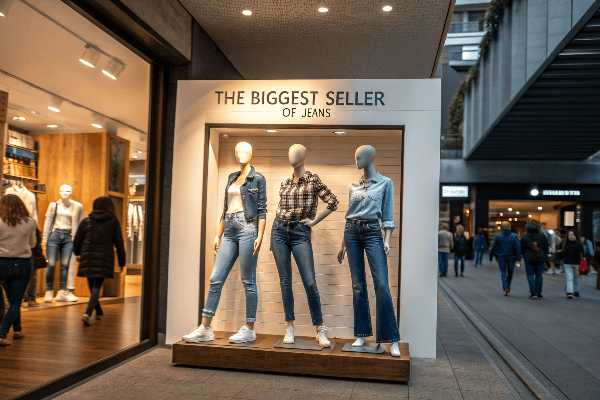
When you think of jeans, one brand probably comes to mind immediately. But is it really the top seller? And how does it compare to fast fashion or newer denim players?
Levi’s is the biggest seller of jeans globally, holding around 20–25% of the branded denim market. Its closest competitors include Wrangler, Lee (via Kontoor Brands), and fast fashion retailers like Zara and H&M[^1].
I’ve worked with denim brands that dream of reaching Levi’s level—but knowing who's dominating helps set realistic goals and strategies.
Table of Contents
- Why is Levi’s the global leader in jeans sales?
- Who are Levi’s biggest competitors in jeans?
- Jeans Seller Comparison
- What makes Levi’s jeans sell more than others?
- Conclusion
Why is Levi’s the global leader in jeans sales?
They weren’t just first—they stayed ahead.
Levi Strauss & Co. dominates the jeans market because of its heritage, global distribution, consistent quality, and iconic products like the 501 Original.
| Reason | Details |
|---|---|
| Brand Legacy | Founded in 1853; invented blue jeans in 1873 |
| Global Presence | 100+ countries, 3,400+ stores |
| Product Range | Fits all body types; men’s, women’s, kids |
| Innovation & Marketing | Sustainable denim, celebrity campaigns, DTC strategy |
They’ve also led in sustainability—launching Water<Less™ techniques and recycled denim lines to appeal to Gen Z buyers.
Who are Levi’s biggest competitors in jeans?
Levi’s may lead, but it’s not alone.
Other major jeans sellers include Kontoor Brands (Wrangler, Lee), Inditex (Zara), VF Corporation, and H&M—all with global distribution and high-volume output.
| Brand / Company | Notable Brands | Market Strength |
|---|---|---|
| Kontoor Brands | Wrangler, Lee | Strong in U.S., functional/workwear focus |
| VF Corporation | Ex-owners of Lee | Focused on lifestyle & activewear |
| Inditex | Zara | Fast fashion denim, global reach |
| H&M | H&M | Trendy styles, affordable prices |
| Uniqlo | Uniqlo | High-tech fabrics, minimal design |
These brands appeal to different markets. Levi’s balances heritage and lifestyle; others compete on price or speed.
Jeans Seller Comparison
| Brand | Founded | Avg. Price | Target Audience | Strengths |
|---|---|---|---|---|
| Levi’s | 1853 | $60–$120 | All ages | Iconic styles, global retail |
| Wrangler | 1947 | $40–$80 | Workwear, rural U.S. | Rugged wear, outdoor focus |
| Zara | 1975 | $40–$70 | Young urban shoppers | Trendy cuts, fast release cycles |
| H&M | 1947 | $25–$50 | Budget-conscious | Low prices, broad styles |
| Uniqlo | 1949 | $30–$60 | Casual tech wearers | Stretch denim, minimal design |
What makes Levi’s jeans sell more than others?
It’s a mix of brand trust, design, and scale.
Levi’s leads because it offers something for everyone—classic fits, premium fabrics, youth trends, and global access, all backed by a trusted brand name.
They’ve also mastered distribution: DTC channels, retailers, online stores, and branded outlets.
Even Beyoncé’s campaign for Levi’s in 2025 helped lift Q1 revenue above $1.1 billion[^2].
Conclusion
Levi’s is the world’s biggest seller of jeans, thanks to its unmatched legacy, smart marketing, and global production power. Other brands may compete in niche markets, but when it comes to denim dominance—Levi’s still rules.
[^1]: Statista – Denim market share worldwide
[^2]: Vogue Business – How Levi’s Got Its Cool Back