
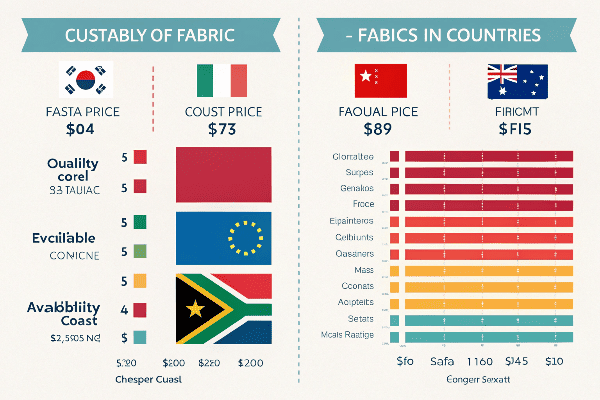
If you’re sourcing fabric for your clothing brand or manufacturing, one key question is: which country offers the cheapest fabric without compromising too much on quality? This matters for cost, execution speed, and product positioning.
Countries like Bangladesh, India, Vietnam, and Pakistan offer some of the lowest-priced fabrics in the world—thanks to low labor costs and large-scale textile production.
I once worked with a startup that cut fabric costs by 30% by switching from China to Bangladesh—all while maintaining acceptable quality and lead time. Let's explore where low-cost fabrics come from.
Table of Contents
- Why are fabrics cheapest in countries like Bangladesh and India?
- How does China compare?
- Are there other low-cost sources?
- Should you go for the cheapest?
- Conclusion
Why are fabrics cheapest in countries like Bangladesh and India?
It comes down to low labor costs, massive production scale, and economies built around cotton and textile value chains.
Bangladesh, India, Pakistan, and Vietnam benefit from low wages, efficient spinning/weaving mills, and strong textile clusters—driving their fabric costs lower than more advanced regions like China.
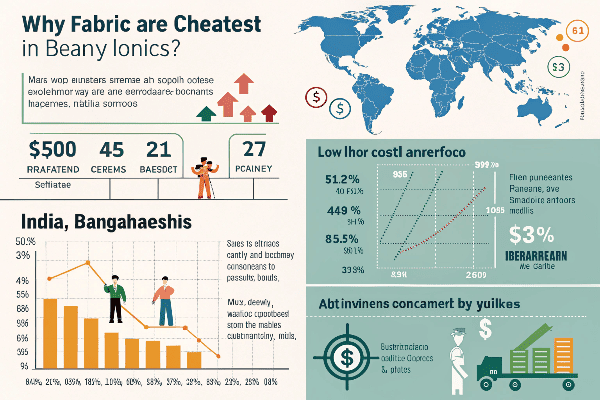
Cost drivers in low-price countries
| Country | Key Advantage |
|---|---|
| Bangladesh | World's cheapest textile labor, major exporter of knit fabrics^[1] |
| India | Strong raw cotton supply, handloom and powerloom clusters^[2] |
| Pakistan | High-volume spinning and low-cost textile manufacturing^[3] |
| Vietnam | Lower labor cost + fast-growing textile tech adoption^[4] |
For basic fabrics—like cotton jersey, twill, poly blends—these countries dominate in affordability.
How does China compare?
China remains a top source for large-volume, speedy production, but it’s no longer the cheapest for basic fabrics.
China and Vietnam offer a balance of price and quality, but for purely low-cost fabric, South Asia leads.
China's fabric economy
- Advanced textile machinery and vertical supply chains
- Higher average wages, but better automation and QC
- Best for mid-tier to premium brands seeking speed and consistency
China is still strong for performance fabrics and complex blends like Tencel, modal, or poly spandex[^5].
Are there other low-cost sources?
Yes—emerging hubs include:
- Morocco: Known for home décor and upholstery fabrics
- Mexico: Offers faster shipping for U.S. buyers, but higher labor cost
- Ethiopia & Cambodia: Apparel manufacturing hubs, still developing fabric mills^[6]
You can also consider sourcing via trade platforms like Alibaba, Fibre2Fashion, and Global Sources to compare pricing across suppliers.
Should you go for the cheapest?
Only if you're okay with basic cottons and minimal specs.
Choosing the cheapest fabric source often means sacrificing quality consistency, certifications, or environmental compliance—know what matters most for your brand.
If you need organic GOTS-certified cotton, OEKO-TEX dyeing, or sustainable recycled poly, then Turkey, China, or European mills may be better options—even at higher cost.
Conclusion
The cheapest fabrics come from Bangladesh, India, Pakistan, and Vietnam—driven by labor, scale, and cotton access. China is still strong, but not the cheapest. Choose the country based on your brand’s quality needs, volume, and certification standards.
- Bangladesh Garment Manufacturers and Exporters Association – https://bgmea.com.bd
- India Textile Ministry – Textile clusters and handloom data: https://texmin.nic.in
- Pakistan Textile Exporters Association – http://www.ptea.org.pk
- Vietnam Textile & Apparel Association (VITAS) – https://vietnamtextile.org.vn
- China National Textile and Apparel Council – http://www.cntac.org.cn
- McKinsey Apparel Sourcing Survey (2023) – Emerging country trends