
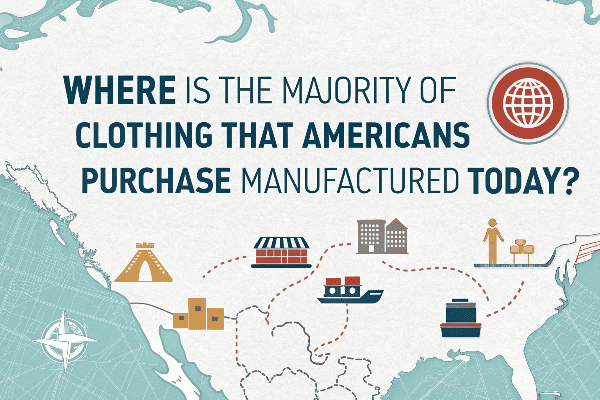
When I started working in apparel manufacturing, I was curious where most clothes in U.S. stores came from. I imagined a lot was made locally. But when I began visiting factories and trade shows, I learned that the vast majority comes from overseas. People often ask me: “Where is most clothing that Americans buy made today?”
Most clothing sold in the United States today is manufactured overseas, primarily in countries like China, Vietnam, Bangladesh, India, and Indonesia. Only a small percentage—less than 3%—is made domestically in the U.S.
I still remember walking through an American department store, checking garment tags out of habit. Almost every tag I saw said “Made in China” or “Made in Vietnam.” It was a clear sign of how global the clothing supply chain has become.
Table of Contents
- Why is so much clothing imported into the U.S.?
- Which countries manufacture most of America’s clothing?
- How much clothing sold in the U.S. is made domestically?
- Has this changed over time?
- Are there efforts to bring manufacturing back to the U.S.?
- What types of clothing are most commonly imported?
- Conclusion
Why is so much clothing imported into the U.S.?
Decades ago, the U.S. produced more apparel domestically. That has changed.
Most American clothing is imported because manufacturing overseas costs less. Lower labor costs, large-scale factories, and established supply chains make countries like China and Vietnam dominant suppliers.
- Lower labor costs: Factories overseas can produce at lower wages.
- Large-scale infrastructure: Countries like China and Bangladesh have massive apparel production capacity.
- Raw material access: Many fabrics are also produced in these regions.
- Focus on speed: Overseas suppliers can deliver high volume fast.
When I visited Guangzhou for the first time, I saw whole industrial zones dedicated just to making garments for export to the U.S.
Which countries manufacture most of America’s clothing?
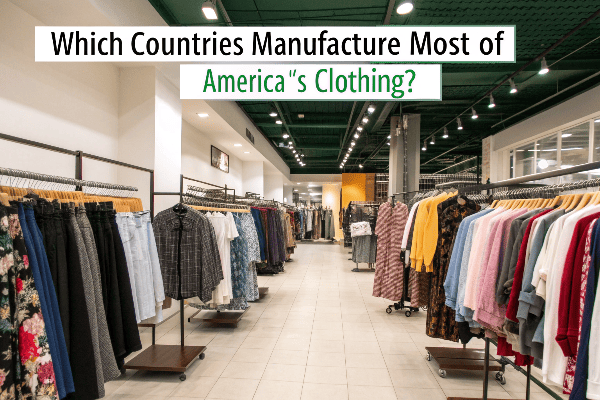
Today, five countries dominate the apparel supply chain for American retailers.
Most clothing sold in the U.S. is manufactured in China, Vietnam, Bangladesh, India, and Indonesia. These countries supply everything from T-shirts to sportswear and luxury items.
- China: The largest supplier, specializing in everything from basics to complex outerwear.
(Learn more: China's textile industry) - Vietnam: Known for high-quality technical garments and sportswear.
- Bangladesh: A leader in mass-market fast fashion and knitwear.
- India: Strong in cotton, embroidery, and home textiles.
- Indonesia: Produces performance apparel and sportswear.
I once managed an order for a U.S. brand that split production between Vietnam for jackets and Bangladesh for T-shirts to balance cost and quality.
How much clothing sold in the U.S. is made domestically?
Very little.
Less than 3% of clothing purchased in the United States is manufactured domestically. Over 97% of apparel comes from foreign factories.
(Source: American Apparel & Footwear Association)
- Cost: Domestic manufacturing is expensive due to wages and regulations.
- Globalization: Brands moved production overseas decades ago.
- Scale: Few U.S. factories can handle massive orders.
I know a small American denim maker who insists on local production. It works for niche, high-end markets, but not for big volume retail.
Has this changed over time?
Yes.
In the 1960s, more than 90% of U.S. clothing was made domestically. Today, that number has dropped to below 3% due to global sourcing and trade agreements.
- 1960s–1970s: Most apparel was made in the U.S.
- 1980s–1990s: Production moved to Asia to reduce costs.
- 2000s–Present: China, Vietnam, and Bangladesh became global leaders.
Looking back at old American clothing labels from my family, I see “Made in USA” all the time. Those tags are rare now.
Are there efforts to bring manufacturing back to the U.S.?
Some, but it is still a small share.
There is a small trend toward reshoring and nearshoring. Brands are opening small factories in the U.S. or in nearby countries like Mexico to reduce shipping times.
(See Reshoring Initiative for more information.)
- High-end niche brands: Focus on “Made in USA” for marketing.
- Automation: Technology can reduce labor cost differences.
- Nearshoring: Some production moves to Mexico or Central America.
I’ve visited a few U.S.-based cut-and-sew facilities. They are much smaller but produce very high-quality garments in small runs.
What types of clothing are most commonly imported?
Almost every type.
T-shirts, hoodies, jeans, activewear, outerwear, lingerie, socks, and even luxury goods are now made overseas. Basic cotton T-shirts and fast-fashion items are especially dominated by imports.
- Basics: T-shirts, sweatshirts, jeans
- Sportswear: Leggings, gym wear, performance apparel
- High fashion: Even luxury brands outsource some production
- Children’s wear: Widely imported due to cost
I often see new brands choose Vietnam or Bangladesh for their first T-shirts because the infrastructure for basics there is unmatched.
Conclusion
Most clothing bought by Americans today comes from overseas—mainly China, Vietnam, Bangladesh, India, and Indonesia. Less than 3% of apparel is made domestically. While there are small efforts to bring back production, the majority of clothes in U.S. stores will continue to come from global supply chains for the foreseeable future.
- Guangzhou – A major hub for garment manufacturing in China.
- China's textile industry - Statista – Data on China's apparel production.
- American Apparel & Footwear Association – Industry data source.
- Reshoring Initiative – Organization tracking manufacturing returning to the U.S.