
If you're starting a clothing brand or customizing tees for your business, choosing the right printing method is key. But with so many options—screen printing, DTG, heat transfer—which one is actually used the most?
Screen printing is the most common T-shirt printing method due to its durability, vibrant colors, and cost-effectiveness for bulk orders. It’s widely used by apparel manufacturers and promotional companies.
I’ve managed thousands of orders for custom shirts. Screen printing remains the go-to because of its balance between quality and affordability—especially for designs that don’t change often.
Table of Contents
- Why is screen printing so widely used?
- How does it compare to other printing methods?
- When should I not use screen printing?
- Conclusion
Why is screen printing so widely used?
It’s affordable, scalable, and produces bold, long-lasting prints.
Screen printing uses a stencil (or "screen") to apply layers of ink directly to fabric. This results in vibrant designs that hold up after dozens of washes.
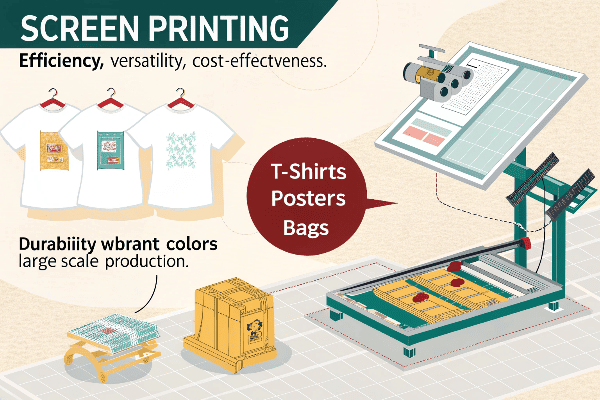
Benefits of screen printing
| Benefit | Why It Matters |
|---|---|
| Bright, rich colors | Great for logos and bold designs |
| High durability | Ink penetrates fabric for lasting quality |
| Low cost per unit | Especially effective for 50+ piece orders |
| Versatile surfaces | Works on cotton, poly, and blends[^1] |
If you're printing in volume, nothing beats the value of screen printing.
How does it compare to other printing methods?
It depends on your order size, design complexity, and fabric type.
For large orders with simple designs, screen printing is best. For full-color or small runs, DTG (Direct-to-Garment) or DTF (Direct-to-Film) printing may be better.
Printing method comparison
| Method | Best For | Limitations |
|---|---|---|
| Screen Print | Bulk orders, simple graphics | Setup cost, not ideal for photos |
| DTG | Small batches, photo prints | Works best on cotton only[^2] |
| DTF | Any fabric, small runs | Needs heat press and film[^3] |
| Heat Transfer | Names/numbers, promo designs | May peel or crack over time |
| Sublimation | Polyester garments, all-over print | Doesn’t work on cotton[^4] |
Each method has strengths—but screen printing dominates for simplicity and reliability.
When should I not use screen printing?
For complex, colorful, or small-run jobs, other options are better.
Avoid screen printing if your design has gradients, fine photo detail, or if you're ordering less than 20 shirts—it becomes expensive due to screen setup fees.
If you’re launching limited editions or testing a new design, start with DTG or DTF instead.
Conclusion
Screen printing is the most common T-shirt printing method because it delivers bright, durable results at scale. While it’s not perfect for every design, it’s still the top choice for most apparel brands looking for cost-effective, high-quality customization.
[^1]: Screen Printing Explained – Printful Guide
[^2]: What Is DTG Printing? – Shopify