
You can have the best design in the world, but if it’s printed on the wrong fabric, it won’t look—or last—the way you expect. Whether you’re screen printing, DTG printing, or using heat transfer, fabric matters more than most people realize.
The type of fabric affects how ink is absorbed, how vibrant the print appears, and how well it holds up over time. Cotton absorbs ink well for bold prints, while synthetics like polyester may require special treatments to prevent fading, bleeding, or poor adhesion.
I’ve worked with hundreds of garment orders where fabric choice either enhanced or ruined the final print quality. Once, a client switched from cotton to polyester mid-run without adjusting the print settings—and ended up with a dull, blotchy result.
Table of Contents
- How does fabric composition affect print quality?
- How does fabric texture impact print clarity?
- How does fabric weight (GSM) affect printing?
- Which print method works best for each fabric?
- Conclusion
How does fabric composition affect print quality?
Each fiber reacts differently with ink and heat.
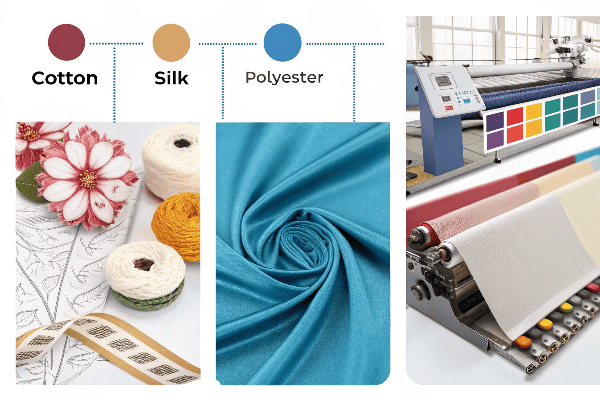
Natural fibers like cotton absorb ink deeply, resulting in strong, vibrant colors. Synthetic fabrics like polyester, on the other hand, repel water-based inks and often require sublimation or pre-treatment.
Print performance by fabric type
| Fabric Type | Ink Absorption | Print Vibrancy | Print Durability | Notes |
|---|---|---|---|---|
| 100% Cotton | ★★★★★ | ★★★★★ | ★★★★☆ | Ideal for DTG and screen printing |
| Cotton-Poly Blend | ★★★★☆ | ★★★★☆ | ★★★★☆ | Balanced performance, less bleeding |
| 100% Polyester | ★★☆☆☆ | ★★★☆☆ | ★★★★★ | Requires sublimation or pre-treatment |
| Rayon/Viscose | ★★★☆☆ | ★★★★☆ | ★★☆☆☆ | Soft drape but prone to heat damage |
| Nylon/Spandex | ★★☆☆☆ | ★★☆☆☆ | ★★☆☆☆ | Sensitive to heat and ink migration |
Learn more from Printful’s fabric and printing guide.
Using the wrong ink for the fabric will often result in cracking, fading, or color mismatch after just a few washes.
How does fabric texture impact print clarity?
It’s not just the fiber—the surface matters too.
Smooth fabrics like combed cotton or polyester jersey create cleaner, sharper prints. Textured surfaces like ribbed knits, fleece, or waffle fabric can distort or break up the ink coverage.
Texture vs print quality
- Smooth knits: Ideal for DTG and screen print
- Heavy fleece: Absorbs more ink, may blur edges
- Ribbed fabric: Ink may settle unevenly in grooves
- Canvas/heavy twill: Better suited for blocky or bold graphics
Check out this Ink Kitchen guide on how fabric surface affects print sharpness.
I always recommend running print tests on textured fabrics—what looks good on a flat cotton tee might look distorted on a hoodie’s brushed fleece.
How does fabric weight (GSM) affect printing?
Weight impacts both ink coverage and curing.
Lighter fabrics require less ink but may ghost or show through. Heavier fabrics absorb more ink, need stronger curing, and often yield richer print results—especially with thicker inks like plastisol.
GSM and ink compatibility
| GSM Range | Print Suitability | Notes |
|---|---|---|
| < 140 GSM | Risk of bleed-through | Best for subtle or soft prints |
| 160–200 GSM | Most versatile range | Good for T-shirts, soft knits |
| 220–300 GSM | Rich, bold prints | Ideal for hoodies, sweats |
| 300+ GSM | Heavy ink load needed | May need preheat and longer cure |
See Bella+Canvas’s GSM chart for common weight ranges and print recommendations.
Factories should always test ink curing at different fabric weights to avoid under-cured or over-burned prints.
Which print method works best for each fabric?
Matching method to fabric is critical.
Screen printing works well on most cottons and blends. DTG prefers high-cotton content. Sublimation is best for polyester. Heat transfer can be universal, but needs testing for durability.
Recommended fabric–print pairings
| Print Method | Best Matched Fabric | Comments |
|---|---|---|
| Screen Printing | Cotton, blends, fleece | Durable, bold colors |
| DTG Printing | 100% combed cotton | Sharp detail, soft hand feel |
| Sublimation | 100% polyester (white/light) | Long-lasting, vibrant on poly |
| Heat Transfer | Most fabrics | Depends on vinyl + heat control |
Learn more from Kornit’s digital printing compatibility guide based on fabric behavior.
Mixing the wrong method with the wrong fabric leads to peeling, cracking, or dull results.
Conclusion
The fabric you choose plays a major role in how your print turns out—affecting color, clarity, and long-term durability. Matching fiber type, texture, and weight with the right printing method ensures a high-quality finished product every time.
- DTG (Direct to Garment) printing performs best on combed, ringspun cotton due to ink absorption characteristics.
- Polyester resists water-based inks, requiring dye-sublimation or specialized plastisols to avoid poor adhesion.
- Fabric weight (GSM) determines how much ink and heat are needed—under-curing results in fading; over-curing can scorch fibers.
- Texture affects coverage: rough or uneven surfaces like waffle knit may cause ink pooling or breakup.
- Synthetics like rayon and spandex may yellow or distort under high heat, especially in heat transfer or screen printing processes.