Many buyers contact a clothing factory and say they need OEM or ODM service, but they are not always sure what those terms actually mean. The difference matters because it affects design control, development time, cost, communication, and even who is responsible for solving product problems.
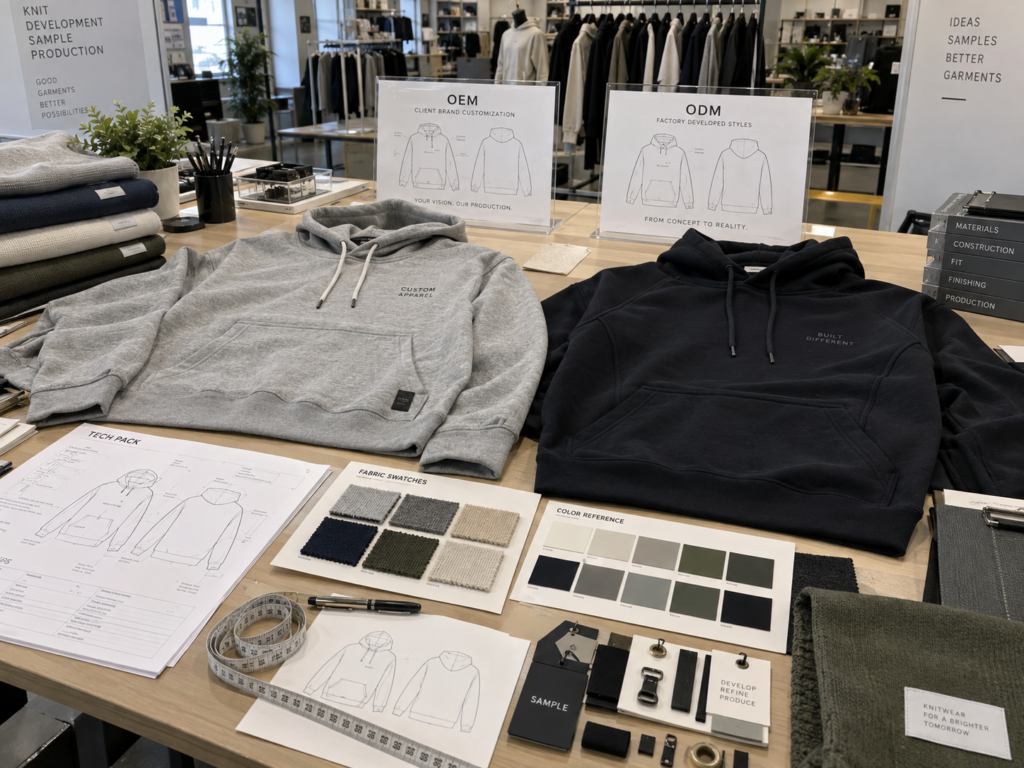
OEM means the buyer provides the design, specifications, or product concept, and the factory manufactures it according to those requirements. ODM means the factory provides an existing design or develops the product concept, and the buyer customizes elements such as fabric, color, logo, labels, and packaging. OEM gives buyers more control, while ODM usually reduces development time.
I work with both types of projects. Some clients arrive with a complete tech pack and know every measurement. Others only have a reference image and a brand idea. Both can become good products, but the development process is very different.
Table of Contents
- What Does OEM Mean in Custom Knit Garment Manufacturing?
- What Does ODM Mean in Custom Clothing Production?
- What Is the Main Difference Between OEM and ODM?
- How Does the OEM Development Process Work?
- How Does the ODM Development Process Work?
- Is OEM or ODM Better for a New Clothing Brand?
- Which Option Gives Buyers More Control Over Design?
- Which Option Is Faster for Garment Development?
- How Do OEM and ODM Affect Sample Costs?
- What Are the Risks of OEM Production?
- What Are the Risks of ODM Production?
- Can a Clothing Project Use Both OEM and ODM?
- What Should Buyers Ask a Factory Before Choosing OEM or ODM?
- Conclusion
- Footnotes & References
What Does OEM Mean in Custom Knit Garment Manufacturing?
OEM is usually the right model when the buyer already knows what product they want to make. The buyer controls most of the product definition, and the factory focuses on turning that design into a real garment.
OEM stands for Original Equipment Manufacturing. In custom knit garments, the buyer normally provides the design, tech pack, measurements, fabric requirements, colors, logo details, labels, and other specifications. The factory then develops samples and produces the garment according to those instructions. The final product is sold under the buyer's own brand.
In a typical OEM project, I may receive:
- A tech pack
- A size chart
- Front and back drawings
- Fabric composition
- GSM requirement
- Pantone colors
- Logo artwork
- Print dimensions
- Embroidery dimensions
- Label files
- Packaging requirements
For fabric color development, standardized references make communication much clearer. Pantone's official Fashion, Home + Interiors color system[^1] includes color references designed for fashion, textiles, and apparel.
The more complete the information is, the more accurate the development can be.
OEM Does Not Mean the Factory Has No Input
Some buyers think OEM means the factory simply follows instructions and never makes suggestions.
That is not how a good project should work.
If I see a problem in the specification, I should say something.
For example, the buyer may request:
- 600 GSM fabric with a very lightweight rib
- A logo that crosses several thick seams
- A zipper construction that does not work with the pattern
- A fabric composition that is difficult to source
- An embroidery design that is too detailed for the requested size
I can still manufacture under the OEM model, but I should explain the production risk first.
The buyer keeps final control.
My job is to help turn the concept into something that can actually be produced.
What Does ODM Mean in Custom Clothing Production?
ODM works differently because the factory is more involved in creating the product itself.
ODM stands for Original Design Manufacturing. In custom apparel, the manufacturer provides an existing garment design, product base, or development concept that the buyer can modify. The buyer may change the fabric, color, logo, fit, decoration, labels, or packaging without creating the entire product from zero.
This model is common when a buyer wants to launch products quickly.
For example, I may already have a proven oversized hoodie pattern.
The buyer may say:
I like this hoodie, but I want it in 480 GSM cotton, dark brown, with a small chest embroidery and a large back print.
That is much closer to ODM.
The base style already exists.
We are adapting it to the buyer's brand.
ODM Is Not the Same as Buying a Ready-Made Product
This distinction is important.
ODM does not always mean the buyer chooses a completely finished garment from a catalog.
There can still be a lot of customization.
Depending on the factory, buyers may change:
- Fabric weight
- Fabric composition
- Colors
- Measurements
- Fit
- Logo
- Embroidery
- Labels
- Drawstrings
- Zippers
- Packaging
The main difference is that the buyer does not need to build every technical detail from zero.
What Is the Main Difference Between OEM and ODM?
The clearest difference is where the original product design comes from.
In OEM manufacturing, the buyer usually owns or provides the main product design and specifications. In ODM manufacturing, the factory provides the base design or product concept and the buyer customizes it. OEM offers more originality and control, while ODM usually requires less development work and can move into sampling and production faster.
Here is a simple comparison.
| Factor | OEM | ODM |
|---|---|---|
| Main design source | Buyer | Factory |
| Tech pack | Usually provided by buyer | Often not required at first |
| Development work | Higher | Lower |
| Buyer control | Very high | Medium to high |
| Development speed | Usually slower | Usually faster |
| Initial cost | Often higher | Often lower |
| Product originality | Higher potential | Depends on customization |
| Best for | Established brands, unique designs | New brands, quick launches |
| Factory involvement | Manufacturing-focused | Design + manufacturing |
| Sample changes | Often detailed | Usually easier initially |
This table looks simple, but real clothing projects are rarely completely OEM or completely ODM.
There is often some overlap.
How Does the OEM Development Process Work?
An OEM project usually starts with product information from the buyer.
The OEM process normally begins with a tech pack, reference sample, or complete design. The factory reviews feasibility, confirms materials and construction, gives a quotation, develops a sample, receives buyer comments, revises the sample if needed, and then moves into bulk production after approval.
A normal OEM process may look like this:
Step 1: Product Review
I check:
- Design
- Measurements
- Fabric
- GSM
- Construction
- Decoration
- Labels
- Packaging
I also look for technical risks.
Clean artwork also makes this stage easier. For logos and print files, common working formats include AI, PDF, EPS, and SVG. Adobe's official Illustrator supported file formats documentation[^2] provides a useful reference for these formats.
Step 2: Material Sourcing
If the buyer requests 100% cotton 500 GSM French terry, I need to confirm whether that fabric is available.
If the buyer needs a special color or finish, I need to check development time and minimum quantity.
Step 3: Pattern Development
The pattern maker builds the garment according to the buyer's measurements.
This is a major part of OEM work.
A drawing alone is not enough.
The pattern controls the actual fit.
Step 4: Sample Production
The factory makes the first prototype.
The buyer then checks:
- Fit
- Fabric
- Color
- Construction
- Logo size
- Logo placement
- Stitching
- Overall appearance
Step 5: Revision
The buyer may request changes.
For example:
Increase chest width by 2 cm.
Move the back logo 3 cm higher.
Change the rib from 2×2 to 1×1.
Make the hood deeper.
Each change needs to be documented clearly.
Step 6: Pre-Production Confirmation
Once the final sample is approved, the factory prepares for bulk production.
This stage may include:
- Final size grading
- Fabric booking
- Trim confirmation
- Print approval
- Embroidery approval
- Packaging confirmation
Then production can begin.
How Does the ODM Development Process Work?
ODM usually starts with a factory-developed product or an existing sample.
In ODM development, the buyer selects a factory style or base product and then customizes the parts that matter to the brand. Because the pattern and basic construction already exist, the factory can often quote and sample faster. The buyer still needs to confirm materials, colors, branding, measurements, and final quality requirements.
Suggested image: Side-by-side garment development scene showing an OEM project with a detailed tech pack and custom pattern, and an ODM project using an existing hoodie sample that is being customized.
Suggested ALT text:OEM and ODM custom clothing development process
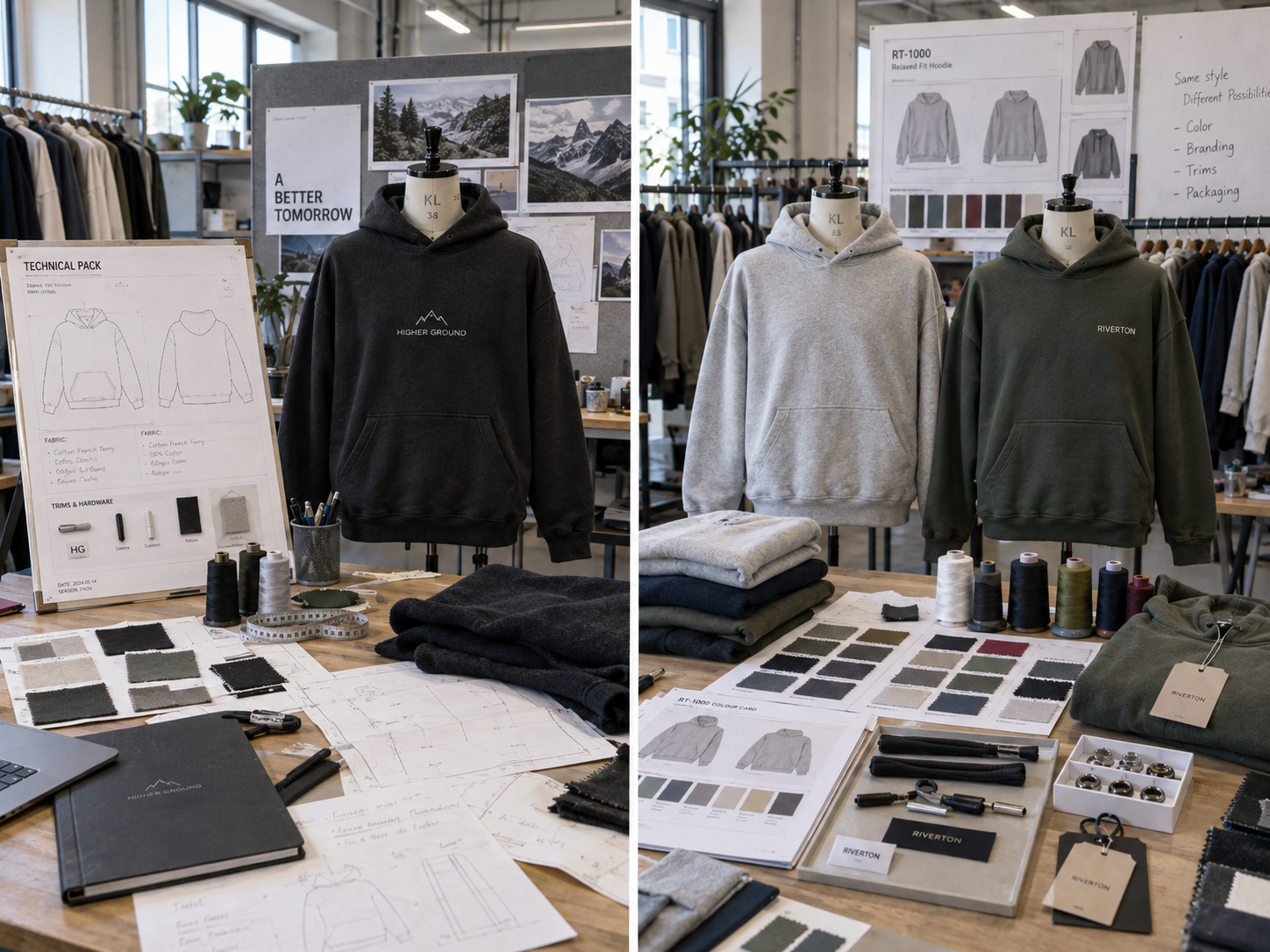
For example, I may show a buyer several heavyweight hoodie bases.
The buyer chooses one.
Then we change:
- 400 GSM to 500 GSM
- Standard black to Pantone brown
- Regular fit to slightly oversized
- Plain front to embroidery
- Plain back to screen print
- Standard neck label to custom woven label
The product becomes the buyer's version without starting from zero.
Why ODM Can Be Faster
The pattern already exists.
The sewing method is known.
The factory may already know which fabric works.
The production team may have made the same structure before.
This removes a lot of uncertainty.
That is the biggest reason ODM projects usually move faster.
Is OEM or ODM Better for a New Clothing Brand?
I get this question often from new brand owners. There is no single answer because it depends on how developed the brand already is.
ODM is often easier for a new clothing brand because it reduces technical development work, sample cost, and decision-making pressure. OEM can be better when the brand already has a strong design identity, clear measurements, experienced designers, or a detailed tech pack that needs to be reproduced accurately.
ODM Can Be Easier for Beginners
A new brand may know:
- The visual style
- The target customer
- The colors
- The logo
- The general fit
But the founder may not know:
- Rib ratios
- Stitch types
- Fabric shrinkage
- Shoulder slope
- Pattern balance
- Sewing tolerances
- Zipper specifications
That is normal.
ODM gives the buyer a stronger starting point.
OEM Works Better When the Product Is the Brand
Some brands are built around very specific products.
For example:
- A special oversized silhouette
- A unique sleeve shape
- A custom sportswear fit
- A signature pocket structure
- A particular garment wash
- A special fabric combination
In this case, OEM gives the buyer more control.
If the product shape itself is part of the brand identity, I would not rely too heavily on a standard factory style.
Which Option Gives Buyers More Control Over Design?
OEM generally gives the buyer more control because the buyer defines the product from the beginning.
OEM usually provides more design control because the buyer specifies the measurements, fabric, construction, trims, artwork, branding, and packaging. ODM still allows customization, but some elements are based on the factory's original product structure. Buyers who want a highly distinctive garment usually choose a more OEM-driven development process.
Control sounds attractive, but more control also means more responsibility.
If the buyer defines every technical detail, those decisions need to be correct.
More Control Also Means More Decisions
With OEM, the buyer may need to decide:
- 380 GSM or 420 GSM?
- French terry or fleece?
- 1×1 rib or 2×2 rib?
- 95% cotton 5% elastane rib or 100% cotton rib?
-
5 or #8 zipper?
- Screen print or DTG?
- 6 cm or 8 cm chest logo?
- 30 cm or 35 cm back print?
These details matter.
Zippers are a good example. A buyer may write only “YKK zipper” in a tech pack, but there are many zipper structures, sliders, materials, and finishes. YKK's official fastening product search[^3] shows how many different fastening options may need to be specified before production.
For an experienced buyer, this level of control is useful.
For a beginner, it can become overwhelming.
Which Option Is Faster for Garment Development?
ODM is usually faster because many technical decisions have already been solved.
ODM garment development is generally faster than OEM because the factory already has the base pattern, construction method, and product knowledge. OEM takes longer when the factory must create a new pattern, source special materials, interpret a new tech pack, test unfamiliar construction, or make several rounds of revisions.
A basic ODM hoodie might move into sampling very quickly.
A completely custom OEM hoodie could require:
- Pattern development
- Fabric sourcing
- Custom dyeing
- Custom rib
- Embroidery test
- Print test
- Fit adjustment
- Second sample
That does not mean OEM is inefficient.
It simply involves more development work.
Typical Development Comparison
| Stage | OEM | ODM |
|---|---|---|
| Design confirmation | 1–3 days | 1–2 days |
| Pattern development | 2–5 days | Often already available |
| Fabric sourcing | 2–7 days | Often faster |
| First sample | 7–14+ days | 5–10 days |
| Revision rounds | Often more | Often fewer |
| Overall development | Longer | Usually shorter |
These are general ranges.
A complicated ODM project can still take longer than a simple OEM project.
How Do OEM and ODM Affect Sample Costs?
The cost difference comes from how much development work the factory must do before the sample can be made.
OEM samples often cost more because they may require new patterns, special fabric sourcing, technical development, artwork setup, and several revisions. ODM samples can cost less because the factory already has the base pattern and production method. However, heavy customization can make an ODM sample nearly as expensive as an OEM sample.
This is why I do not judge a project by the label alone.
An ODM hoodie with:
- Custom fabric
- Custom dye
- Large appliqué
- Special wash
- Custom zipper pull
- Custom labels
can still become an expensive sample.
Development Cost Is More Important Than the Term
I prefer to ask:
What needs to be developed from zero?
That question gives me a better idea of cost than asking whether the project is OEM or ODM.
If five parts need new development, the cost increases.
If most of the product already exists, the cost stays lower.
What Are the Risks of OEM Production?
OEM gives buyers more freedom, but that freedom creates more room for technical mistakes.
The main risks of OEM production are incomplete tech packs, unrealistic specifications, misunderstood measurements, unsuitable materials, repeated sample revisions, and differences between the buyer's design idea and actual production limits. These risks can be reduced with clear documentation, experienced pattern making, sample approval, and strong communication before bulk production.
A Drawing Is Not Enough
One of the biggest problems I see is a buyer sending one image and calling it a complete design.
The image may show style.
It does not show production details.
I still need to know:
- Fabric
- GSM
- Size
- Measurements
- Stitching
- Logo size
- Construction
- Labels
If those details are missing, the factory has to make assumptions.
Assumptions create risk.
Too Many Revisions Can Delay Launches
OEM projects often go through more sample rounds.
A buyer may change the fit after seeing the first sample.
Then the buyer changes the fabric.
Then the buyer changes the logo size.
Each change can add time.
This is why I encourage buyers to make major decisions before the first sample starts.
What Are the Risks of ODM Production?
ODM reduces development work, but buyers need to make sure the product is customized enough for their market.
The main risks of ODM are limited product uniqueness, dependence on the factory's existing designs, unclear design ownership, and the chance that similar base styles may be offered to other buyers. Brands should ask what can be customized, whether designs are exclusive, and which parts of the product come from the manufacturer's existing development library.
Similar Products May Exist in the Market
If you choose a factory's standard hoodie and only change the logo, another buyer may use a very similar base.
That may not matter for some businesses.
For others, it matters a lot.
If your brand depends on unique design, ask the factory clearly:
Is this your standard style?
Do other buyers use the same pattern?
Can we change the fit and construction?
Can this design become exclusive?
These questions are much better than assuming.
Design ownership should also be discussed clearly before development starts. The World Intellectual Property Organization provides an official overview of industrial designs and design protection[^4], which is useful background when buyers are thinking about originality, exclusivity, and ownership.
For important designs, buyers should also get appropriate legal advice for the markets where they plan to sell.
Can a Clothing Project Use Both OEM and ODM?
Yes. In fact, many of the projects I work on are a mix of both.
A clothing project can combine OEM and ODM. A buyer may start with the factory's existing hoodie pattern, then provide a custom tech pack for measurements, fabric, pockets, embroidery, labels, and trims. This hybrid approach can reduce development time while still giving the brand meaningful control over the final garment.
I think this hybrid model is very practical.
Example of a Hybrid Project
A buyer likes one of our existing oversized hoodie patterns.
We keep:
- Basic body structure
- Sleeve construction
- Hood construction
Then the buyer changes:
- Chest width
- Body length
- Fabric from 400 GSM to 500 GSM
- Custom brown color
- Rib specification
- Front embroidery
- Back print
- Neck label
- Packaging
Technically, the starting point is ODM.
The final development becomes heavily customized.
That is why real projects do not always fit perfectly into one label.
What Should Buyers Ask a Factory Before Choosing OEM or ODM?
The most important thing is not the terminology. The important thing is understanding what the factory will actually do.
Before choosing OEM or ODM, buyers should ask who provides the design, whether new patterns are required, what customization is possible, who owns the final design, what the sample cost includes, how many revisions are allowed, what the MOQ is, and whether the approved sample can be repeated accurately in bulk production.
I recommend asking these questions:
| Question | Why It Matters |
|---|---|
| Do you create new patterns from my tech pack? | Confirms OEM capability |
| Do you have existing styles I can customize? | Confirms ODM capability |
| Can I change the measurements? | Checks design flexibility |
| Can I specify fabric and GSM? | Checks material control |
| Can I use my own logo and labels? | Confirms private labeling |
| Is the design exclusive? | Important for uniqueness |
| Who owns the custom pattern? | Important for long-term sourcing |
| How many sample revisions are included? | Helps control cost |
| What is the MOQ? | Affects commercial feasibility |
| Can bulk production match the approved sample? | Critical for quality control |
Buyers who have specific material or certification requirements should also verify exactly what a supplier's certificate covers. For example, OEKO-TEX® STANDARD 100[^5] focuses on textiles tested for harmful substances, while the Global Organic Textile Standard (GOTS)[^6] covers requirements related to certified organic textile processing and production. These are different standards, so a logo alone should never replace checking the actual certification scope.
I Care More About Factory Capability Than the Label
I have seen suppliers use “OEM” and “ODM” very loosely.
Some factories write both terms on their website because buyers search for them.
That does not automatically mean they are good at either service.
I look at actual capability.
Can the factory:
- Read a tech pack?
- Develop patterns?
- Source fabric?
- Control shrinkage?
- Handle printing and embroidery?
- Make revisions?
- Control bulk quality?
- Communicate problems clearly?
Those questions tell me much more than the words OEM or ODM.
Conclusion
OEM means the buyer mainly provides the design, while ODM starts from the manufacturer's design or product base. OEM offers more control and originality. ODM usually saves development time and cost.
The important thing is not simply choosing the word OEM or ODM. Buyers should understand where the design comes from, what the factory is developing from zero, which parts can be customized, who controls the specifications, and who owns the final design.
For a brand with a complete tech pack and a highly specific product, an OEM-driven process usually provides more control. For a buyer who wants to launch more quickly and does not want to develop every technical detail from zero, ODM can provide a much easier starting point.
In real custom knitwear production, many successful projects use a mix of both models depending on the buyer's experience, product goals, and level of customization.
Footnotes & References
[^1]: Pantone — Fashion, Home + Interiors (FHI). Official Pantone color system covering fashion, textiles, apparel, and related product development.
https://www.pantone.com/na/en-us/fashion-home-interiors
[^2]: Adobe — Supported File Formats in Illustrator. Official Adobe documentation covering AI, PDF, EPS, SVG, and other artwork formats used in design workflows.
https://helpx.adobe.com/illustrator/desktop/get-started/learn-the-basics/supported-file-formats.html
[^3]: YKK Fastening Products Group — Product Search. Official YKK resource covering zipper structures, sliders, fastening products, and related options.
https://www.ykkfastening.com/products/search/
[^4]: World Intellectual Property Organization (WIPO) — Industrial Designs. Official overview of industrial designs, protection, and design rights.
https://www.wipo.int/en/web/designs
[^5]: OEKO-TEX® — STANDARD 100. Official information about STANDARD 100 and testing of textiles for harmful substances.
https://www.oeko-tex.com/en/our-standards/oeko-tex-standard-100
[^6]: Global Organic Textile Standard (GOTS) — Version 8.0. Official GOTS standard covering requirements for organic textile processing, manufacturing, labelling, and related supply-chain criteria.
https://global-standard.org/images/resource-library/documents/standard-and-manual/GOTS_v8.0_signed.pdf