
How to Start a Clothing Brand: What Do You Need to Do Before, During, and After Working With a Manufacturer?
You have a brand name.
A logo.
A folder full of reference photos.
Maybe even an Instagram page ready to launch.
Then you contact ten clothing manufacturers.
One asks:
“What fabric?”
Another asks:
“What GSM?”
Another asks:
“What quantity per color?”
Then somebody asks for:
your size chart,
your artwork,
your target price,
and your launch date.
Suddenly, starting a clothing brand feels much more complicated than designing one.
We see this all the time from the factory side.
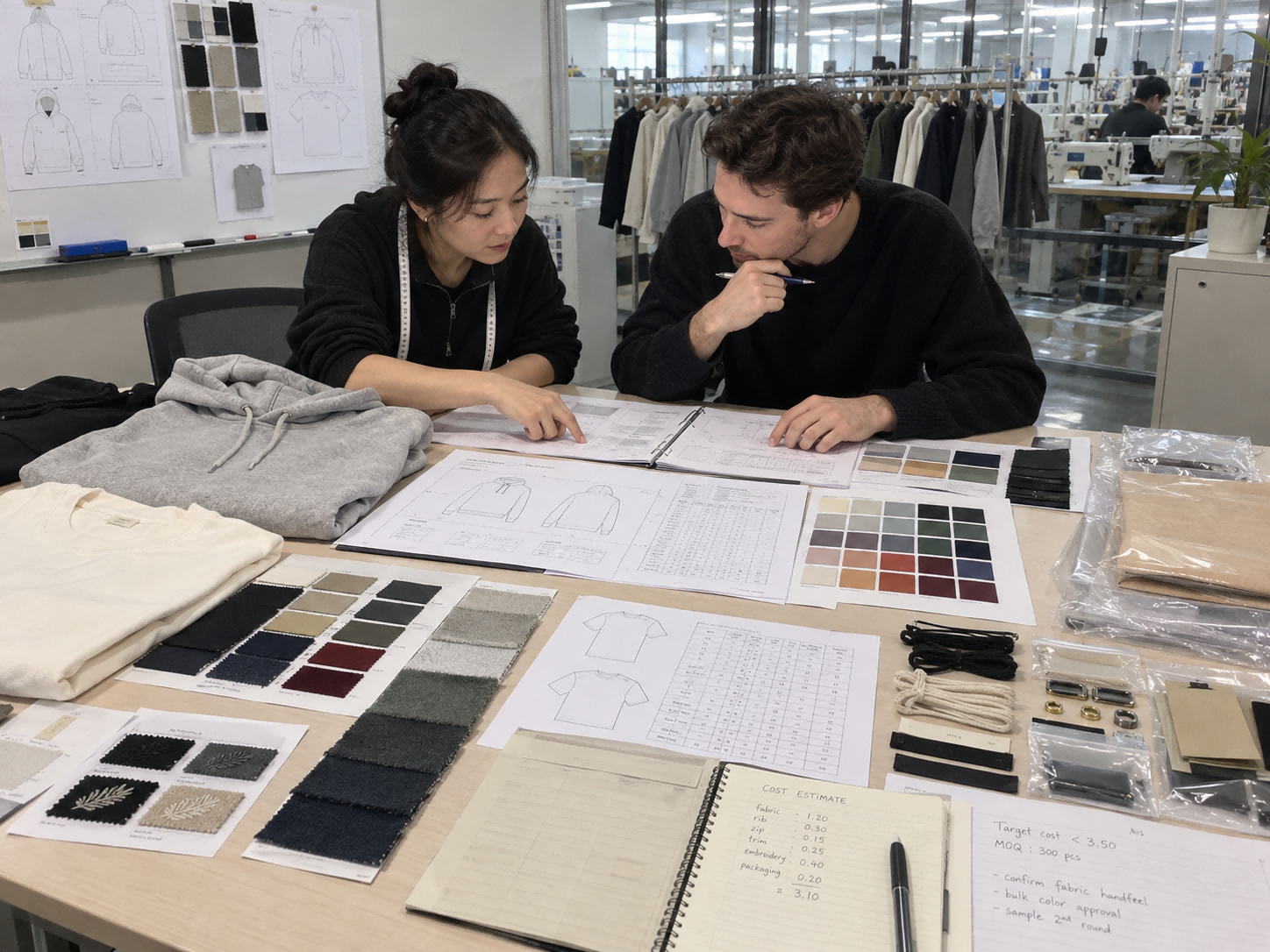
You do not need to know everything before contacting a manufacturer. But you do need a clear customer, a focused first product range, useful design references, a realistic quantity and budget, and enough information for the factory to understand what you are trying to build. Then sampling turns that idea into a production standard before bulk begins.
Starting a clothing brand is not one decision.
It is a sequence:
Customer → Product → Specification → Sample → Cost → Production → Shipping → Sales → Reorder
If the early steps are unclear:
the later steps become expensive.
Table of Contents
- What Do You Need Before You Contact a Manufacturer?
- How Do You Choose Your First Products?
- How Do You Find and Check the Right Manufacturer?
- What Happens During Sampling?
- How Much Do You Need for Your First Order?
- What Happens After Production?
- Conclusion
What Do You Need Before You Contact a Manufacturer?
You do not need a perfect business before:
sending the first message.
But you should know enough to have:
a useful conversation.
Before contacting a manufacturer, try to define your customer, product category, initial styles, quantities, size range, visual direction, approximate fabric requirements, decoration, budget, and launch timing. A professional tech pack is extremely helpful, but a factory can often begin the development conversation from clear sketches, reference garments, photos, measurements, and written notes.
Start With the Customer
Do not start with:
“I want to make clothes.”
Ask:
Who is buying them?
For example:
- Streetwear customers
- Gym customers
- Golf players
- Running customers
- Creator merch fans
- Corporate teams
- Children's apparel customers
That decision influences:
- Fabric
- Fit
- Features
- Price point
- Size range
A 500 GSM oversized hoodie and a lightweight running top are both:
clothing.
But they are completely different manufacturing projects.
Decide Your First Product Category
Write down the actual products.
For example:
Streetwear first drop
- Oversized hoodie
- Heavyweight T-shirt
- Sweatpants
That is much clearer than:
“I want a streetwear collection.”
Prepare Visual References
These may include:
- Sketches
- Photos
- Existing garments
- Mood boards
- Detail references
But tell the factory:
what you like in each reference.
For example:
Reference A: body shape
Reference B: hood construction
Reference C: pocket size
Reference D: embroidery position
Otherwise, the factory may not know:
which part you want copied as inspiration.
Do You Need a Tech Pack?
Ideally:
yes.
A tech pack may include:
- Technical drawings
- Measurements
- Fabric
- Color
- Construction
- Stitching
- Artwork
- Labels
- Packaging
But a new brand does not always have:
a complete professional tech pack
on day one.
We can often begin by helping turn your references into a more manufacturable specification.
Our technical development team can help with areas such as:
- Fabric direction
- Fit
- Pattern
- Construction
- Decoration method
- Production feasibility
But your:
brand identity,
logo,
and original graphic artwork
should come from you or your designer.
We should not invent:
your brand.
Our job is to help turn it into:
a garment that can actually be manufactured.
Know Your Approximate Quantity
Factories need quantity because:
50 pieces
and:
5,000 pieces
do not use the same sourcing strategy.
Tell the supplier:
Style: Hoodie
Quantity: 100 pcs
Colors: Black / Grey
Sizes: S–2XL
That is enough to begin a much more useful conversation.
Know Your Size Range
Do you need:
S–XL?
XS–3XL?
Plus-size?
Men's?
Women's?
Unisex?
This affects:
- Pattern
- Grading
- Fabric consumption
- Size breakdown
Have a Rough Budget
You do not need to know the exact manufacturing price.
But you should know whether you are building:
a $25 retail T-shirt
or:
a $90 retail T-shirt.
Those two products may need:
very different fabric and construction decisions.
Decide Your Launch Timing
Work backwards from:
the date customers need to receive the product.
Do not use:
the production date
as your launch date.
You also need time for:
- Sampling
- Revisions
- Bulk materials
- Production
- Inspection
- Freight
- Customs
- Photography
- Website setup
- Launch marketing
Pre-Contact Checklist
| Item | What to prepare |
|---|---|
| Customer | Who is buying? |
| Product | What exact styles? |
| References | Sketches / photos / garments |
| Fabric direction | Composition, GSM, hand if known |
| Colors | Core colorways |
| Size range | XS–XL, S–3XL, etc. |
| Quantity | Pieces per style/color |
| Branding | Logo, print, embroidery |
| Budget | Rough target |
| Launch | When stock needs to arrive |
Should You Protect Your Brand Name Before Manufacturing?
At minimum:
check it early.
A beautiful garment does not help much if you later discover:
the brand name conflicts with an existing trademark.
The World Intellectual Property Organization's trademark guidance[^1] explains that trademarks distinguish one business's goods or services from another's and that protection is generally obtained through national or regional registration systems.
For U.S. brands, the USPTO Trademark Basics[^1] also recommends searching for potentially conflicting marks before applying.
This does not mean:
you must finish worldwide trademark registration before making one sample.
It means:
do not ignore brand-name clearance until after you have ordered thousands of labels.
How Do You Choose Your First Products?
New brands often make one of two mistakes.
They launch:
too many products.
Or they launch:
one random product
with no collection logic.
Your first collection should be focused enough to manufacture and manage, but complete enough to communicate what the brand is. Choose core products your customer understands, then connect them through fabric, color, fit, and branding where practical.
Start With a Hero Product
A hero product is:
the piece that represents the brand best.
For a streetwear brand, that might be:
an oversized hoodie.
For an activewear brand:
leggings.
For a golf brand:
a polo.
For running:
shorts.
Then build around it.
Example: Streetwear
Hero:
Heavyweight hoodie
Supporting products:
- Heavy tee
- Sweatpant
- Short
Example: Activewear
Hero:
Legging
Supporting:
- Sports bra
- Tank
- Short
Example: Athleisure
Hero:
Quarter-zip
Supporting:
- Jogger
- Matching short
Should Everything Use the Same Fabric?
No.
But sharing fabric where it makes sense can help:
- Purchasing
- Shade control
- Reorder planning
For example:
hoodie + sweatpant
may use the same French terry.
But:
polo + tailored short
might work better with different fabrics.
Do not force two products into:
the same textile
just to reduce sourcing complexity.
Keep the First Collection Manageable
Imagine you launch:
8 styles
× 5 colors
× 6 sizes
That creates:
240 style/color/size combinations
before you even sell one garment.
For a small brand:
inventory complexity can become bigger than the clothing itself.
A focused first drop may give you better information about:
- Best colors
- Best sizes
- Best styles
before the next order.
But Do Not Remove the Brand Story
“Start small” does not mean:
make one generic black T-shirt.
If your brand concept depends on:
a complete matching set,
develop the set.
The goal is:
focused, not empty.
How Do You Find and Check the Right Manufacturer?
There is no universal:
“best clothing factory.”
A good manufacturer for one brand can be:
wrong for another.
Choose a manufacturer whose normal product categories, MOQ, development capability, quality level, communication, and supply-chain structure match your project.
Ask What They Make Every Day
A factory that regularly develops:
- Hoodies
- Sweatshirts
- T-shirts
- Joggers
already understands:
the fabrics,
patterns,
sewing,
and trims
used in those categories.
That is more useful than a supplier saying:
“We can make everything.”
Ask the MOQ Early
A factory may be excellent.
But if its normal minimum is:
1,000 pieces/color
and your budget supports:
50 pieces,
it is probably the wrong match.
Our typical starting points vary by category.
For example:
- Hoodies / crewnecks / sets: around 50 pcs/style
- T-shirts / shorts: around 100 pcs/style
- Leggings: around 150 pcs/style
The exact minimum still depends on:
fabric,
color,
trims,
and construction.
Ask Who Makes the Pattern
For custom production, pattern development matters.
Ask:
- Is pattern making available?
- Who grades the sizes?
- Can measurements be adjusted?
- Is the approved pattern retained for reorders?
Ask How Sampling Works
You should know:
- Sample cost
- Expected timing
- Fabric availability
- Revision process
before you pay.
Ask What Is Actually In-House
Transparency matters.
Our core garment development, cutting, and sewing are handled through our garment-production operation.
Some specialist processes may be completed through long-term partner workshops, including certain:
- Printing
- Embroidery
- Washing
depending on the product.
That is normal garment manufacturing.
The important thing is:
knowing who controls the work.
Ask About Social Compliance
If your retailer or buyer requires:
SMETA,
BSCI,
WRAP,
SA8000,
or another system,
do not accept:
“We are compliant.”
Ask for:
the actual report or certificate
and check:
- Legal entity
- Factory address
- Validity
- Scope
Our own company can reference our:
SMETA / Sedex social-audit work
where applicable.
We do not claim certifications or audit systems that are not documented for the relevant site.
Ask About Quality Control
A useful answer should include actual steps.
For example:
- Fabric inspection
- Measurement checks
- In-line inspection
- Decoration check
- Final inspection
- Packing check
Not simply:
“Quality is no problem.”
Manufacturer Checklist
| Question | Why ask it? |
|---|---|
| What products do you make most? | Checks specialization |
| What is your MOQ? | Checks commercial fit |
| Can you make patterns? | Checks development capability |
| How does sampling work? | Avoids surprises |
| What is the normal timeline? | Helps launch planning |
| What is done by partners? | Checks transparency |
| What audits do you actually hold? | Checks compliance |
| How do you inspect bulk? | Checks QC process |
What Happens During Sampling?
Sampling is where:
the idea meets reality.
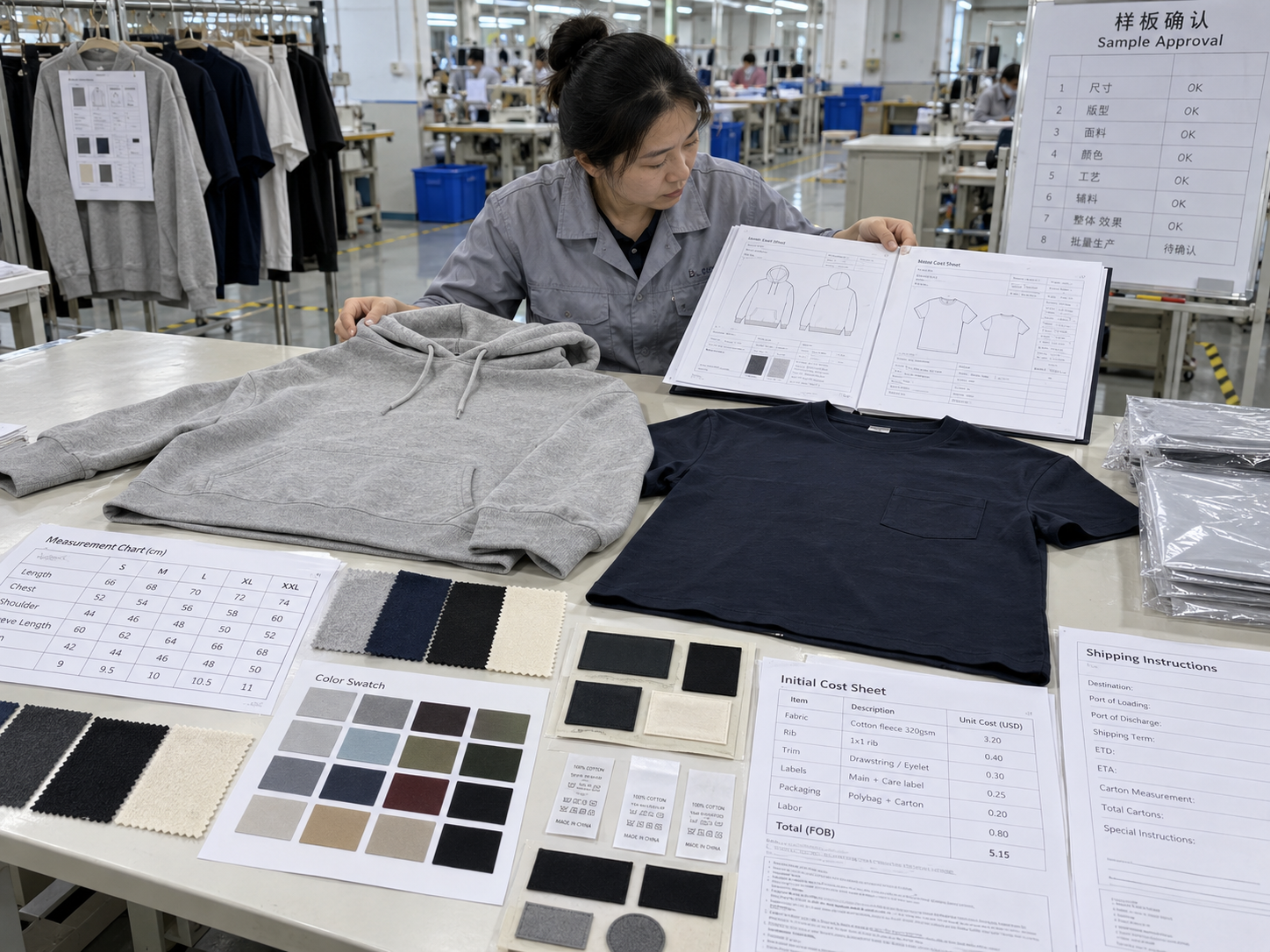
The first sample is not only a miniature bulk order. It is a development tool used to confirm fabric, fit, construction, decoration, measurements, and manufacturability before production.
Step 1: Design Review
We review:
- Style
- Fabric
- Measurements
- Artwork
- Construction
and identify:
unclear points.
This is where a good manufacturer should ask:
questions.
Questions are not a bad sign.
Silence can be worse.
Step 2: Preliminary Cost Discussion
A manufacturer may be able to give:
a preliminary bulk estimate
before sampling
if the specification is clear enough.
But it should be treated as:
an estimate.
Why?
Because the sample can reveal changes in:
- Fabric consumption
- Pattern
- Stitching
- Pocket construction
- Decoration
The final production price should be based on:
the final approved specification.
So avoid both extremes:
“A factory must give a final price before sampling.”
and:
“A factory can never quote bulk before the sample.”
The realistic process is:
preliminary estimate → sample confirmation → final quotation.
Step 3: Sample Payment
Samples are normally paid:
before development begins.
Our standard simple garment sample fee may start around:
USD 50 per piece,
but actual sample cost depends on:
- Style
- Fabric
- Decoration
- Development work
Custom printing or embroidery may also require:
setup charges.
Do not assume one fixed sample price applies to:
every design.
Step 4: Fabric and Trim Selection
You may choose from:
- Existing fabric swatches
- Color cards
- Custom-dyed fabric
For custom development, physical fabric approval is usually safer than:
choosing only from a screen.
Step 5: Pattern Making
The pattern turns:
measurements
into:
garment shape.
For a custom style, this is one of the most important technical stages.
Step 6: Sample Sewing
The first sample is made.
Depending on complexity and material availability, our normal development range is roughly:
5–14 days.
Complex:
- Washing
- Custom fabric
- Special hardware
- Detailed embroidery
can take longer.
Step 7: Review the Sample
Do not only ask:
“Do I like it?”
Check:
Fit
- Chest
- Shoulder
- Length
- Sleeve
- Waist
- Hip
depending on the product.
Fabric
- Hand
- GSM
- Stretch
- Drape
Construction
- Pockets
- Seams
- Hood
- Collar
- Waistband
Branding
- Logo size
- Placement
- Color
Wash Performance
Where relevant:
wash the garment.
Step 8: Give Clear Feedback
Instead of:
“Make it more oversized.”
say:
Increase 1/2 chest from 61 cm to 64 cm.
Instead of:
“Logo too small.”
say:
Increase back print from 30 cm to 34 cm.
Specific feedback creates:
better samples.
Step 9: Approve the Production Standard
Once everything is correct:
confirm the final data.
That may include:
- Approved sample
- Measurements
- Fabric
- Color
- Artwork
- Labels
- Packaging
Bulk should start from:
the approved information.
How Much Do You Need for Your First Order?
The garment unit price is only:
one part of the budget.
A realistic first-order budget should consider development, samples, bulk production, decoration, labels, packaging, freight, import charges, photography, website setup, marketing, and a contingency for changes.
Sample Costs
Budget for:
more than one sample round
if your product is highly customized.
The first version may not be:
perfect.
That is normal development.
Bulk Production
Typical payment for our new bulk orders is:
50% before production + 50% before shipment.
Do not plan your cash flow assuming:
you pay only after everything sells.
Sample-Fee Policy
Avoid assuming that:
sample fees are automatically refunded at a particular quantity.
Different projects may use different commercial arrangements.
For some bulk programs, sample charges may be waived or credited when agreed as part of:
the bulk-order terms.
Confirm this:
in writing
for the actual order.
Labels
Do not forget:
- Main label
- Size label
- Care label
- Hangtag
U.S. Textile Labeling
For clothing sold in the United States, the FTC Textile Fiber Rule[^2] requires covered textile products to disclose information including:
- Generic fiber names and percentages
- Country of origin
- Manufacturer or marketer identity
as applicable.
So a new brand should plan:
legal labeling
at the same time as:
brand labels.
Care Labels
The FTC Care Labeling Rule[^3] requires covered manufacturers and importers to provide care instructions and have a reasonable basis for those instructions.
That means:
do not simply copy:
Machine Wash Cold
from another brand.
Develop care information for:
your actual garment.
Packaging
Possible packaging includes:
- Standard polybag
- Custom bag
- Hangtag
- Box
But custom packaging can create:
- Extra MOQ
- Cost
- Freight volume
A first brand does not necessarily need:
expensive packaging
to look professional.
Shipping
Freight depends on:
- Carton size
- Weight
- Destination
- Transport method
Air is usually faster.
Sea can be more economical for:
larger shipments.
But compare:
the actual quotation.
Import Duties and Taxes
Do not use an old internet rule such as:
“Orders under $800 enter the U.S. duty-free.”
That is no longer a safe assumption.
U.S. Customs and Border Protection states that duty-free de minimis treatment for imported goods valued at $800 or less was suspended for shipments from all countries effective August 29, 2025, subject to applicable exceptions.[^4]
So if you are importing into the U.S. in 2026:
include duties, taxes, entry requirements, and brokerage in your planning rather than building the business model around the old $800 exemption.
For other countries:
rules differ.
Confirm them for:
your destination market.
What Do EXW, FOB, and DDP Actually Mean?
Do not treat Incoterms as:
shipping-price labels.
The International Chamber of Commerce Incoterms® 2020 rules[^5] allocate specific delivery obligations, costs, and risk between buyer and seller.
EXW
Under EXW, goods are made available at:
the seller's premises or named place,
with relatively limited seller obligations under the rule.
ICC notes that EXW is primarily suitable for:
domestic trade
and can create practical issues in international transactions.[^5]
FOB
FOB is designed for certain:
sea or inland-waterway shipments
where delivery occurs when goods are:
on board the vessel
at the named port.
So write:
FOB Shenzhen, Incoterms® 2020
rather than simply:
FOB price.
For containerized shipments, ICC guidance often points parties toward:
FCA
depending on how delivery to the carrier actually works.[^5]
DDP
DDP places much more responsibility on:
the seller,
including delivery to the named destination and certain import responsibilities under the Incoterms framework.
But DDP does not mean:
“nothing can ever happen at customs.”
Customs requirements depend on:
the destination,
product,
documentation,
and local rules.
If we quote DDP:
the exact service scope should be confirmed for:
that shipment.
What Does a First Clothing Order Budget Include?
A simple planning table may look like this:
| Cost area | Budget for |
|---|---|
| Development | Tech pack / artwork if outsourced |
| Samples | Garment samples + setup |
| Bulk | Unit price × quantity |
| Decoration | Print / embroidery / patches |
| Labels | Main, size, care |
| Packaging | Bags, tags, boxes |
| Inspection | If third-party QC is used |
| Freight | Air / sea |
| Import | Duty, tax, brokerage |
| Content | Photos / video |
| Ecommerce | Website / payment systems |
| Marketing | Ads / creators / launch |
| Buffer | Unexpected changes |
Do Not Spend Everything on Inventory
A common mistake is:
using almost the entire budget on garments.
Then there is no money left for:
- Freight
- Photography
- Website
- Advertising
A product sitting in cartons is:
not a launch.
What Happens After Production?
Bulk production finishing does not mean:
the business is finished.
After production, the garments need final inspection, packing, international transport, customs clearance, receiving, launch, customer feedback, inventory tracking, and eventually reorder planning.
Final Inspection
Before shipment, check:
- Quantity
- Measurements
- Construction
- Decoration
- Labels
- Packing
depending on the agreed QC plan.
For larger programs, brands may also use:
independent inspection companies.
Packing
Packing should match:
how the inventory will actually be used.
For ecommerce:
SKU and size identification matter.
For wholesale:
carton breakdown may matter more.
Shipping
Confirm:
- Incoterm
- Named place
- Forwarder
- Freight mode
- Required documents
before the goods leave.
Do not wait until:
packing day
to decide how the shipment works.
Receiving
When the shipment arrives:
check it.
Do not store every carton unopened until:
launch week.
Review:
- Carton count
- Size breakdown
- Obvious damage
- Product quality
while issues are still easier to investigate.
Launch
Now the brand side takes over.
You need:
- Product photos
- Size chart
- Product descriptions
- Pricing
- Inventory
- Marketing
The factory manufactures:
the product.
The factory does not create:
customer demand.
Track Sales by SKU
Do not only track:
total revenue.
Track:
Style
Color
Size
For example:
Black hoodie M sells out
Black hoodie 2XL moves slowly
Cream hoodie L performs well
That information is extremely useful for:
the second order.
Reorder Before You Reach Zero
A reorder still needs:
- Fabric
- Production
- QC
- Freight
So do not wait until:
your last piece sells.
Are Reorders Faster?
Usually:
development is easier
because the approved:
- Pattern
- Measurements
- Fabric specification
- Artwork
already exist.
But a reorder still needs:
quality control.
New fabric can come from:
a different dye lot.
Trims may change.
Suppliers can change.
So:
reorder ≠ automatic copy with zero checking.
What About Warehousing and Direct Fulfillment?
Some factories can hold goods temporarily or coordinate:
shipping and fulfillment-related services.
But factory storage is not automatically the same as:
a professional third-party logistics company.
If you need:
- Long-term inventory storage
- Individual DTC orders
- Returns
- Same-day fulfillment
- Multiple-market shipping
define the service scope carefully.
You may be better using:
a dedicated 3PL
once order volume grows.
What Are the Biggest Mistakes New Clothing Brands Make?
From the manufacturing side, we see the same problems repeatedly.
1. Contacting Factories With No Product Definition
“How much is a hoodie?”
cannot produce:
a useful quote.
2. Developing Too Many Styles
A complicated first drop spreads:
budget and attention
too thin.
3. Choosing Only by Unit Price
The cheapest quotation can become expensive if it creates:
- Bad fit
- Returns
- Delays
- Rework
4. Skipping Physical Samples
Do not approve a custom garment from:
a rendering alone.
5. Changing the Design During Bulk
Small late changes can affect:
- Pattern
- Materials
- Production
- Price
- Delivery
Finalize as much as possible before:
bulk starts.
6. Ignoring Labels Until Production Ends
Fiber, origin, care, and other required information should be planned:
before labels are ordered.
7. Forgetting Freight and Duties
A factory price is not:
your landed cost.
8. Ordering Too Much Before Testing Demand
The first order should teach you:
what sells.
9. Waiting Too Long to Reorder
A successful product can still lose momentum if:
replacement stock takes months.
10. Treating the Manufacturer Like a Logo Designer
Your manufacturer can help develop:
the garment.
Your brand identity should remain:
yours.
Green Flags and Red Flags
| Green flag | Red flag |
|---|---|
| Asks who your customer is | Only asks “how many pieces?” |
| Helps clarify the product specification | Quotes an unclear product immediately |
| Gives preliminary and final pricing appropriately | Calls an estimate a guaranteed final price |
| Explains sample charges before work starts | Adds surprise fees later |
| Makes and adjusts patterns | Uses one generic block for every customer |
| Explains partner processes | Claims every technique is in-house |
| Shows actual audit documentation | Says “we have every certification” |
| Waits for sample approval before bulk | Starts bulk from unclear references |
| Explains textile and care labeling | Treats labels as decoration only |
| Uses Incoterms correctly | Says EXW/FOB only mean freight included/not included |
| Discusses import costs honestly | Promises duty-free entry |
| Keeps approved production references | Makes reorders from memory |
Conclusion
Starting a clothing brand is not mainly about:
finding a factory.
It is about creating:
a clear product system
that a factory can manufacture.
Start with:
the customer.
Who are they?
What do they buy?
What problem does your product solve?
Then choose:
the first collection.
Not 20 random styles.
A focused range that makes sense:
together.
Next:
prepare the product information.
A complete tech pack is ideal.
But if you are early in development:
good references, measurements, artwork, and clear notes
can be enough to start the conversation.
Then find a manufacturer that matches:
your product
and:
your quantity.
Ask what they make regularly.
Ask how they sample.
Ask which processes are done:
in-house
and which are handled by:
specialist partners.
Then make:
the sample.
Wear it.
Wash it.
Measure it.
Check the artwork.
Check the fabric.
Check the labels.
Do not treat sampling as:
an unnecessary expense before “real production.”
Sampling is where you prevent:
expensive bulk mistakes.
Then confirm:
the final specification
and:
final bulk quotation.
Budget beyond:
the garment price.
Include:
- Labels
- Packaging
- Freight
- Duties
- Marketing
- Contingency
If you are importing into the United States:
do not build your 2026 budget around the old assumption that every shipment under $800 is automatically duty-free.
Then place:
the bulk order.
Inspect it.
Ship it.
Launch it.
And track:
what actually sells.
Because your first production order should not only create:
inventory.
It should create:
data.
That data tells you:
which style,
which color,
which size
deserves the second order.
A clothing brand rarely becomes successful because:
the first collection was perfect.
It grows because the founder builds a process that becomes:
clearer, more controlled, and more repeatable with every production run.
Footnotes & References
[^1]: World Intellectual Property Organization — Trademarks; and U.S. Patent and Trademark Office — Trademark Basics. WIPO explains that trademarks distinguish the goods or services of one business from another and are generally protected through national or regional registration. USPTO provides guidance on searching for similar marks, filing, and federal trademark registration in the United States.
https://www.wipo.int/en/web/trademarks
https://www.uspto.gov/trademarks/basics
[^2]: U.S. Federal Trade Commission — Textile Fiber Rule, 16 CFR Part 303. Requires covered textile products sold in the United States to disclose information including generic fiber names and percentages by weight, country of origin, and manufacturer or marketer identification as applicable.
https://www.ftc.gov/legal-library/browse/rules/textile-fiber-rule
[^3]: U.S. Federal Trade Commission — Care Labeling Rule, 16 CFR Part 423. Requires covered manufacturers and importers of textile wearing apparel to provide regular care instructions and to have a reasonable basis supporting those instructions.
https://www.ftc.gov/legal-library/browse/rules/care-labeling-textile-wearing-apparel-certain-piece-goods
[^4]: U.S. Customs and Border Protection — Suspension of Duty-Free De Minimis Treatment. CBP states that effective August 29, 2025, imported goods from all countries valued at or below USD 800 generally no longer qualify for the former duty-free de minimis treatment and are subject to applicable duties, taxes, and fees, subject to applicable exceptions.
https://www.cbp.gov/sites/default/files/2025-08/factsheet_suspension_of_duty-free_de_minimis_treatment.pdf
https://www.help.cbp.gov/s/article/Article-1919
[^5]: International Chamber of Commerce — Incoterms® 2020. ICC's Incoterms rules allocate specific delivery obligations, costs, and risk between buyers and sellers. ICC guidance notes that EXW is primarily suitable for domestic trade, while FOB applies to appropriate sea or inland-waterway shipments with delivery on board the vessel; FCA may be more appropriate for many containerized or multimodal shipments.
https://iccwbo.org/business-solutions/incoterms-rules/incoterms-2020/