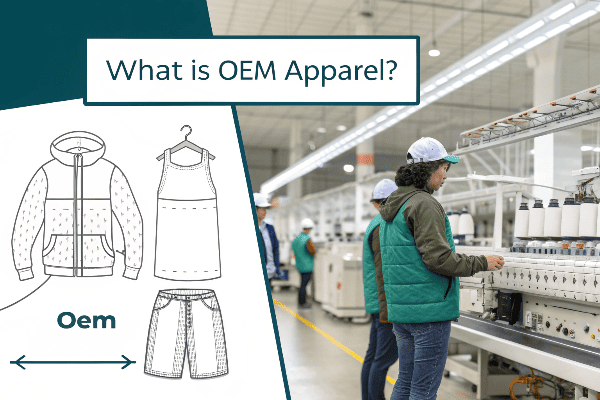
If you’ve searched for custom clothing suppliers, you’ve likely seen the term “OEM” again and again. But what does it really mean in the apparel industry?
OEM apparel means “Original Equipment Manufacturer” clothing—where a factory produces garments based on a client’s designs, specs, or branding, but doesn’t own the final brand itself.
I started my factory by offering OEM services for brands that had great ideas but no production capacity. Over the years, I’ve seen how OEM partnerships help both new and big brands scale efficiently.
Table of Contents
- What exactly does OEM mean in clothing?
- What does the OEM process look like?
- Why do brands choose OEM apparel manufacturing?
- Is OEM right for my clothing brand?
- Conclusion
What exactly does OEM mean in clothing?
In short, it’s your design—manufactured by someone else.
In the apparel industry, OEM refers to manufacturers who make clothing for other brands using the brand’s custom designs, fabric selections, sizes, and labels[^1].
OEM vs ODM vs Private Label
| Term | You provide design? | Manufacturer design? | Branding ownership |
|---|---|---|---|
| OEM | ✅ Yes | ❌ No | ✅ Brand's logo |
| ODM | ❌ No | ✅ Yes (you modify) | ✅ Brand’s logo |
| Private Label | ❌ No | ✅ Yes (pre-designed) | ✅ Brand's logo |
OEM is perfect if you have your own fashion ideas and need someone to bring them to life.
What does the OEM process look like?
The steps usually follow a clear pattern.
The OEM apparel process starts with your tech pack or sample, then moves to sampling, approval, bulk production, and delivery—while the factory stays behind the scenes.
Typical OEM workflow
- Design submission: Tech pack, sketches, measurements
- Sample development: Factory makes your prototype
- Quote & approval: Cost per unit, MOQ, lead time
- Bulk production: After sample approval and deposit
- Branding: Your labels, tags, and packaging
- Delivery: Factory ships under your brand name
You don’t need to own a factory—you just need a good OEM one[^2].
Why do brands choose OEM apparel manufacturing?
Because it’s faster, cheaper, and less risky than building your own facility.
OEM allows brands to focus on marketing and sales while outsourcing production. It reduces startup costs, shortens time to market, and gives access to skilled production teams.
OEM benefits
- Lower investment: No factory setup or labor hiring
- Flexibility: Produce as needed, scale up or down
- Customization: Control over designs, trims, fabrics
- Speed: Many OEM factories have ready material sources
- Quality control: If vetted well, factories meet brand standards
That’s why even billion-dollar brands still use OEMs for seasonal drops[^3].
Is OEM right for my clothing brand?
It depends on how much control and customization you need.
If you want your own designs made with your logo and packaging—but don’t want to deal with factory management—OEM is the ideal solution.
OEM isn’t for everyone. If you want to just sell trendy styles without designing them, consider ODM or private label models[^4].
Conclusion
OEM apparel manufacturing is a cost-effective way to bring your custom clothing line to life. It gives you full creative control without the hassle of running a factory. Just make sure you pick a trusted partner who can follow your designs accurately.
[^1]: OEM definition – Investopedia
[^2]: What is a tech pack? – Techpacker Guide
[^3]: How OEM manufacturing supports fashion brands – Maker’s Row
[^4]: Private Label Guide – Shopify