You contact 10 Chinese factories. Eight of them quote a 500-piece MOQ. You only have $3,000 to test the market. Suddenly your dream of launching a brand feels impossible. The factories are not wrong. You are just asking the wrong question.
MOQ stands for Minimum Order Quantity. It is the smallest order a factory will accept per style, per color. Standard MOQs in China range from 300-1,000 pieces. Low-MOQ factories accept 50 pieces for heavy items like hoodies and jackets, 100 pieces for lighter items like tees and shorts, and 200+ for kids clothing. Understanding MOQ is the difference between launching your brand and waiting another year.
After 20 years running a factory, I have watched hundreds of new brands give up because they thought MOQ was a fixed wall. It is not. Let me show you what MOQ really means, why factories set it, and how to find the right factory for your actual budget.
[Table of contents]
What Does MOQ Actually Mean in Clothing Manufacturing?
MOQ is the minimum number of pieces a factory will produce in a single run. Below this number, the factory either refuses the order or charges a premium that makes it uneconomical for you.
MOQ is set per style and per color. A 300-piece MOQ means 300 pieces of ONE style in ONE color. If you want 2 colors, you need 600 pieces. If you want 3 styles, you need 900 pieces. Most new brands miss this detail and underestimate how big their first order needs to be.
The Three Ways MOQ Gets Measured
Different factories use different definitions. Always clarify before you commit:
| MOQ Type | What It Means | Example |
|---|---|---|
| Per style | Total pieces of one design | 100 pieces of a hoodie design |
| Per style, per color | Pieces of each design + color combination | 100 black hoodies + 100 navy hoodies = 200 pieces |
| Per fabric roll | Minimum based on fabric purchase | 50kg of fabric (around 150-200 pieces) |
The most common is "per style, per color." When a factory says "50 MOQ," ask: "Is that 50 pieces total, or 50 per color?" The answer changes your budget by 2-3x.
Why MOQ Exists
Factories do not set MOQ to be difficult. They set it because of real production costs:
- Cutting fabric for small batches wastes more material
- Setting up sewing machines takes the same time for 50 or 500 pieces
- Printing/embroidery has setup fees that get spread across the order
- Quality control teams cost the same to run regardless of size
- Profit margins on small orders barely cover labor
A factory that accepts your 50-piece order is either taking a near-zero margin or has built their operation to handle small batches efficiently. Most factories cannot do either.
Why Do Most Chinese Factories Have High MOQs?
When you see a 500-piece MOQ on Alibaba, the factory is not trying to scare you. They are telling you what their production model can profitably handle.
Most Chinese factories run on 300-1,000 piece MOQs because their equipment, workforce, and supply chain are optimized for bulk production. Small batch orders disrupt their workflow and lower their per-piece profit. To accept low MOQ, a factory needs different machinery, separate production lines, and flexible fabric sourcing.
The Economics Behind High MOQs
Let me show you the math from inside a factory:
Setup Costs (Same for 50 or 5,000 pieces)
| Cost Category | Typical Cost |
|---|---|
| Pattern making | $200-500 |
| Sample development | $100-300 per sample |
| Screen printing setup | $50-150 per color |
| Embroidery digitizing | $30-80 per design |
| Fabric ordering and inspection | $200-500 |
If a factory spends $1,500 on setup for a 50-piece order, that is $30 per piece just for setup. The hoodie itself only costs $12 to make. The math does not work.
For a 500-piece order, the same $1,500 setup spreads to $3 per piece. The math works.
Why Some Factories Made the Choice to Go Low MOQ
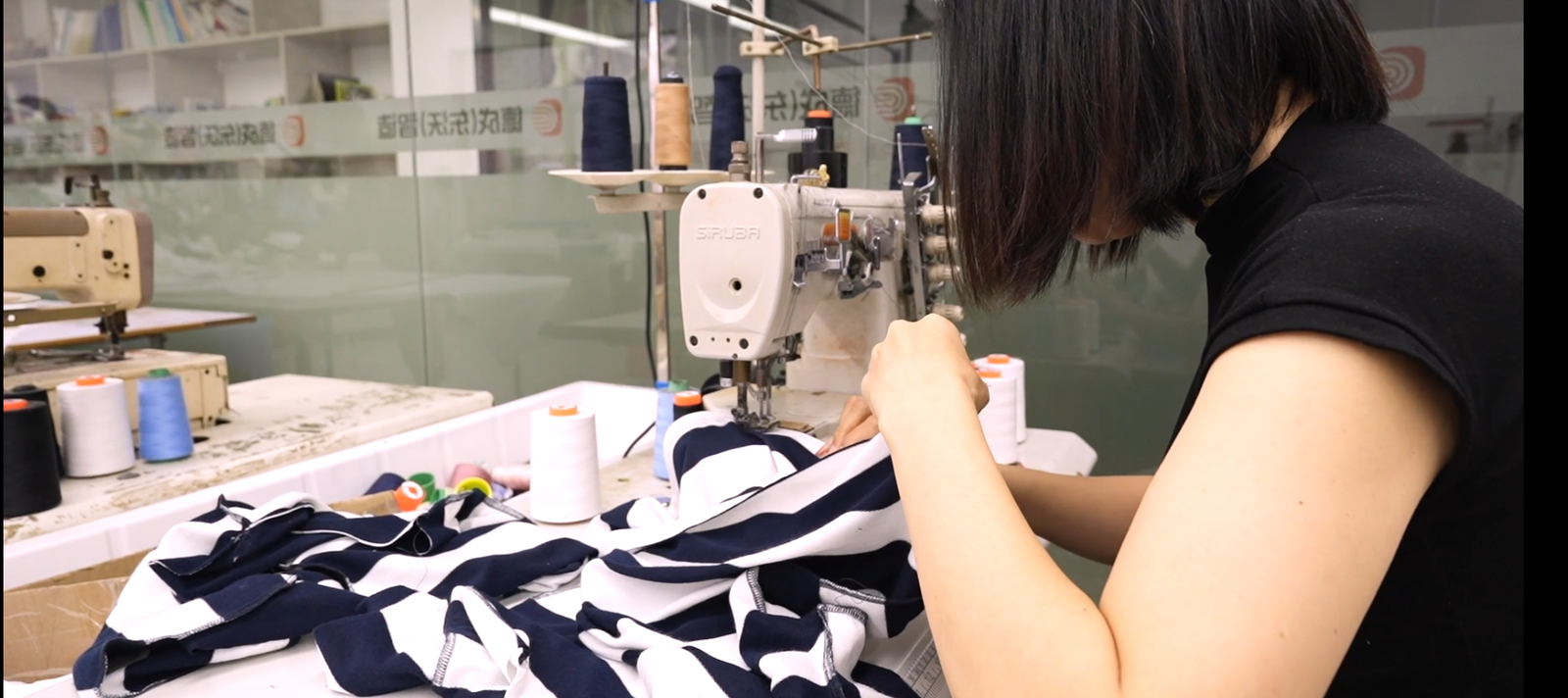
A small number of Chinese factories built their operations specifically for low MOQ. We are one of them. The choice requires:
- Dedicated small-batch production lines (3-5 workers instead of 20)
- In-stock fabric inventory (so you do not need to order 500m minimum)
- Flexible cutting equipment that handles short runs
- A sample/development team that is also part of small batch production
- Lower profit per piece, made up by faster project turnover
This setup costs the factory more to run, but it serves a different market: emerging brands, D2C startups, and creators testing new products.
What Is a Realistic MOQ for Different Clothing Categories?
MOQ varies a lot by product type. Some categories are easier to do in small batches. Others are nearly impossible below 500 pieces.
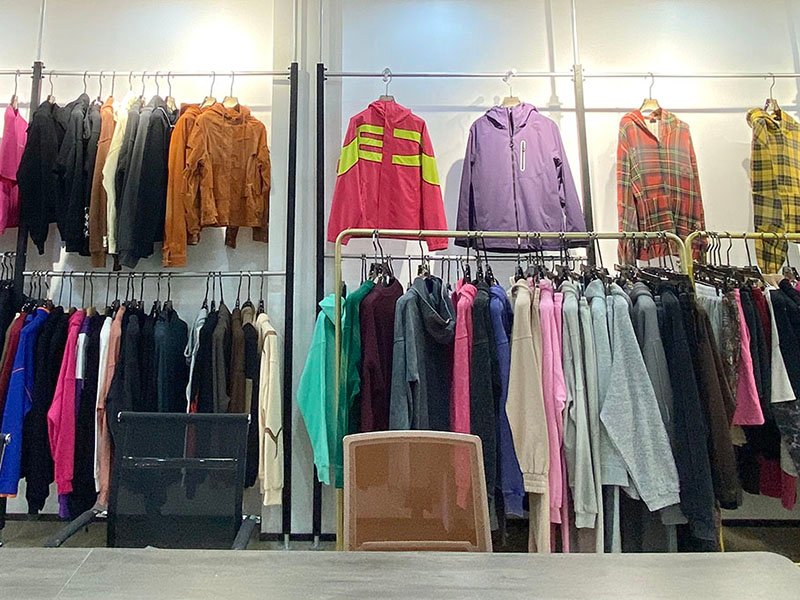
Hoodies, baseball jackets, and sweatpants can usually be made at 50-piece MOQs because heavyweight fabrics use enough material to justify cutting setup. T-shirts, shorts, and activewear typically need 100-piece MOQs because thinner fabrics waste more in cutting. Kids clothing needs 200+ because children's sizes use so little fabric per piece that you need more units to fill one fabric roll.
MOQ by Category: What to Expect
| Category | Standard Factory MOQ | Low-MOQ Factory MOQ | Why |
|---|---|---|---|
| Hoodies, sweatshirts | 300-500 | 50 | Heavy fabric, forgiving construction |
| Baseball jackets, outerwear | 300-500 | 50 | Premium pricing absorbs setup costs |
| Sweatpants, joggers | 300-500 | 50 | Heavy fabric same as hoodies |
| T-shirts | 500-1,000 | 100 | Thin fabric wastes more in cutting |
| Shorts | 500-1,000 | 100 | High volume category, low margin per piece |
| Activewear, gym wear | 500-1,000 | 100 | Stretch fabrics, technical sewing |
| Polo shirts | 500-1,000 | 100 | Embroidery and collar construction adds complexity |
| Swimwear | 500-1,000 | 200-300 | Specialized fabrics and seam construction |
| Knitwear (sweaters) | 300-500 | 100-200 | Yarn ordering minimums dictate batch size |
| Kids clothing | 500-1,000 | 200 | Small fabric usage per piece + fabric roll minimums |
Why These Numbers Are Different at Our Factory
We set our MOQs based on what the production math actually allows, not on what sounds nice in marketing:
- 50 pieces for hoodies, baseball jackets, sweatpants, and other heavyweight outerwear. Thick fabrics use more material per piece, which means 50 pieces uses enough fabric to justify cutting setup. Construction is forgiving and our small-batch line handles it efficiently.
- 100 pieces for t-shirts, shorts, activewear, and thinner garments. Light fabrics need more pieces to justify the cutting waste, since a 100-piece tee run uses less than half the fabric of a 100-piece hoodie run.
- 200 pieces for kids clothing. This is not arbitrary. Children sizes use much less fabric per piece (a kids tee uses 0.4m versus 1.0m for an adult tee). To buy a full fabric roll—which is the smallest economic purchase from our mills—we need at least 200 pieces. Anyone offering 50-piece kids MOQ is either buying leftover fabric scraps or quietly raising your unit price 50%+.
These MOQs are not flexible because they are rooted in real production economics. A factory that claims "any quantity, any product" is hiding the cost somewhere—usually in the fabric quality or the final unit price.
If you want to see the full breakdown of what we make and at what MOQ, check out our hoodie manufacturing service or t-shirt service pages.
How Do You Negotiate a Lower MOQ?
Most buyers think MOQ is fixed. It is not always. There are 4 real ways to reduce MOQ on a quote, and 3 fake ways that just trap you in worse deals.
To lower a factory MOQ, you can: pay a higher per-piece price, combine multiple styles into one fabric order, agree to longer lead times, or commit to a larger future order in writing. Avoid factories that lower MOQ by switching to lower-quality fabric or skipping pre-production samples.
The 4 Real Ways to Lower MOQ
1. Pay 20-40% More Per Piece
The honest negotiation. If the factory quotes $14 per hoodie at 500 MOQ, ask if they can do 100 pieces at $18 per piece. Most factories will say yes if the math works for them.
This is not the factory being greedy. It is them recovering setup costs.
2. Combine Styles Into One Fabric Order
If you want 3 hoodie designs at 50 pieces each (150 total), some factories will accept that if all three use the same fabric. They cut and sew separately, but order fabric once.
This works because fabric ordering is one of the biggest setup costs.
3. Accept Longer Lead Times
Tell the factory: "If you can do 100 pieces, I am OK with a 6-week lead time instead of 4 weeks." This lets them slot your small order into gaps in their production schedule, which is when small orders are profitable for them.
4. Commit to Future Orders in Writing
If you can put in writing: "I commit to ordering 500 more pieces in the next 6 months," some factories will accept a 100-piece test order at higher pricing. The risk for them is lower because there is a future order on the books.
The 3 Fake Ways That Cost You Money
Fake Way 1: Factory Switches to Cheaper Fabric
The factory agrees to 100 MOQ but quietly downgrades from 320gsm cotton to 240gsm blend. You only notice when bulk arrives.
Fake Way 2: Factory Skips Pre-Production Sample
To save time, the factory promises 100 MOQ but refuses to do a pre-production sample. Bulk has no quality reference. Bulk fails.
Fake Way 3: Factory Outsources to a Smaller Shop
The factory accepts your 100 MOQ but secretly sends it to a 3-person workshop. Quality drops. The "factory" you visited never actually makes your order.
If a factory drops MOQ without raising the price, asking for a deposit, or extending the lead time, something is wrong. Ask directly: "How are you making this work financially?"
What Mistakes Do First-Time Brands Make Around MOQ?
I see the same MOQ mistakes every month from new brands. Most of these mistakes are not about money. They are about misreading what MOQ really means.
The 5 most common MOQ mistakes are: ordering too many colors at first, forgetting that MOQ applies per size, underestimating fabric loss in cutting, not testing the factory before scaling, and confusing factory MOQ with fabric MOQ.
Mistake 1: Too Many Colors on Your First Order
A brand orders 50 hoodies in 4 colors. They think they ordered 50 pieces. The factory tells them they ordered 50 per color = 200 pieces. Their budget triples overnight.
Fix: Launch with 1-2 colors. Add more colors after you know which sells.
Mistake 2: Forgetting Size Distribution
If you order 100 hoodies, but want 5 sizes (S, M, L, XL, XXL), you get 20 pieces per size. That is too few of the most-needed sizes (M and L).
Fix: Either order more pieces or skip rare sizes (XXL is often optional for first orders).
Mistake 3: Not Asking About Fabric MOQ
Sometimes the factory MOQ is fine, but the fabric supplier requires a 500m roll minimum. The factory has to buy 500m of fabric to make your 100 hoodies. They pass on the cost or refuse the order.
Fix: Ask the factory: "Do you have this fabric in stock or need to order it for my run?" In-stock fabric eliminates this problem.
Mistake 4: Scaling Too Fast After First Order
A brand orders 50 hoodies. Quality is great. They jump to 5,000 for the second order. Production at scale exposes problems that did not appear in small batches.
Fix: Do a 300-500 piece pilot between your test order and your first big order.
Mistake 5: Confusing Factory MOQ With Fabric MOQ
A factory says "50 MOQ" but their fabric supplier needs 500m minimum. Your 50 pieces use 75m of fabric. The factory either eats the extra 425m or charges you for it.
Fix: Confirm both factory MOQ and fabric availability before you commit.
How Should Your First Order Use MOQ Strategically?
Your first order is a test, not a launch. The goal is to validate three things: the factory can execute, the product can sell, and your operations can handle fulfillment. MOQ should serve this goal, not fight it.
For your first order, choose the lowest MOQ that still gets you a serious factory. Order 1-2 colors, 1-2 styles, in standard sizes (S to XL). Spend 30% on product, 30% on testing the market, and 30% on improving the product based on what you learn. Save the 50,000-piece run for later.
The Smart First-Order Framework
Order 1: The Test (50-100 pieces)
- 1 product, 1 color
- Sizes S to XL only
- Goal: validate factory execution
- Budget: $1,000-3,000
Order 2: The Pilot (300-500 pieces)
- 1-2 products, 2-3 colors
- Full size range
- Goal: validate market response
- Budget: $5,000-10,000
Order 3: The Launch (1,000-3,000 pieces)
- 3-5 products, 3-5 colors
- Full size range plus accessories
- Goal: scale the proven concept
- Budget: $15,000-50,000
This three-stage approach removes most of the risk. Each stage answers a specific question before you commit more money.
Why This Beats "Just Order Big"
I have seen brands skip stage 1 and 2. They saw a similar product selling on Instagram and ordered 2,000 hoodies on their first run. The hoodies sold poorly. The brand had $40,000 in unsold inventory and shut down within 6 months.
The brands that survive almost always start small, learn fast, and scale based on real data. MOQ should make this possible, not prevent it.
Conclusion
MOQ is not a wall blocking your brand. It is a starting point that varies by factory, category, and how you structure your order. If you are looking for a factory that supports 50-piece hoodie orders, 100-piece tee orders, and 200-piece kids clothing runs—structured around real production economics—reach out at www.dechoreal.com or email joe@dc-garment.cn.