
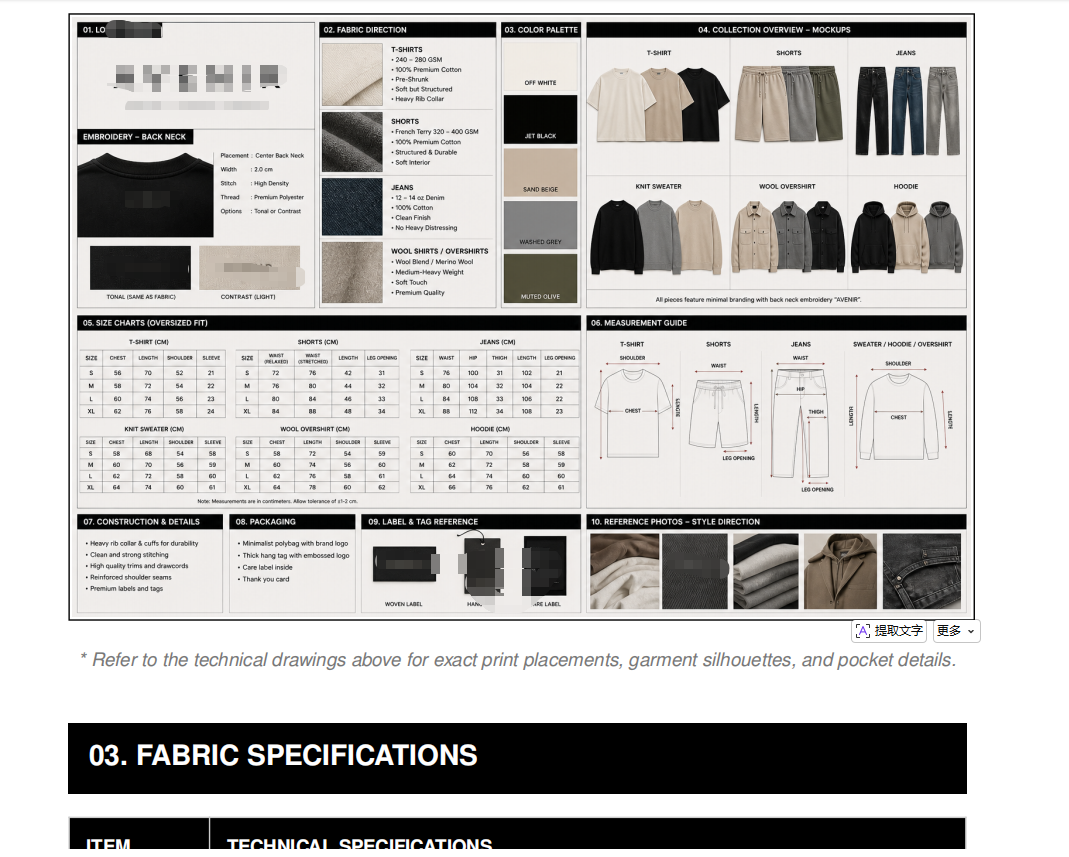
You email a Chinese factory: "Can you make me a hoodie? Here is a picture from Pinterest." They quote $14 per piece. Bulk arrives with the wrong fit, wrong fabric weight, and a logo that looks nothing like your reference. Now you blame the factory. But the real problem is you never sent a tech pack.
A tech pack is a document that tells the factory exactly how to make your garment. It contains measurements, fabric specs, construction notes, color codes, labels, and packaging details. Without a tech pack, the factory has to guess. Guessing is where bulk production goes wrong.
After 20 years in the factory business, I can tell you that 90% of "the factory got it wrong" complaints actually trace back to a missing or weak tech pack. Let me show you exactly what goes in one, and how to make yours in a single afternoon.
[Table of contents]
Why Do You Need a Tech Pack Before Sending Any Order?
Most new brands skip the tech pack because it looks technical and intimidating. They send a Pinterest board and a few notes. Then they wonder why the factory delivered something completely different.
A tech pack removes guessing from production. Without it, the factory must invent answers to 50+ questions about your garment. Each invented answer is a place where bulk can fail. A 2-page tech pack prevents 80% of the problems that cause buyers to lose money on first orders.
What Happens Without a Tech Pack
Here is what I see when a buyer sends a vague inquiry:
| You Said | Factory Heard | What Bulk Looks Like |
|---|---|---|
| "Heavy cotton hoodie" | 280gsm cotton blend | 240gsm thinner fabric |
| "Like Champion fit" | Loose modern fit | Strange in-between fit |
| "Black color" | Pure black (Pantone Black 6 C) | Off-black with grey tint |
| "Logo on chest" | 8cm wide centered | 5cm wide off-center |
| "Standard packaging" | Polybag with hangtag | Just polybag, no hangtag |
Every "you said vs factory heard" gap is real money lost.
Why Factories Cannot Read Your Mind
A Chinese factory makes 50+ different garments per month. The person running your order has never seen your brand, your customers, or your reference pieces. They only see what is on paper. If it is not on paper, it does not exist.
What Are the Essential Sections of a Clothing Tech Pack?
A tech pack does not need to be a 30-page document. A good one fits on 2-3 pages and covers the essentials.
The 7 essential sections of a tech pack are: cover page with brand info, flat sketches (front and back), bill of materials, measurement chart, construction notes, label and hangtag specs, and packaging instructions. Anything beyond these is optional.
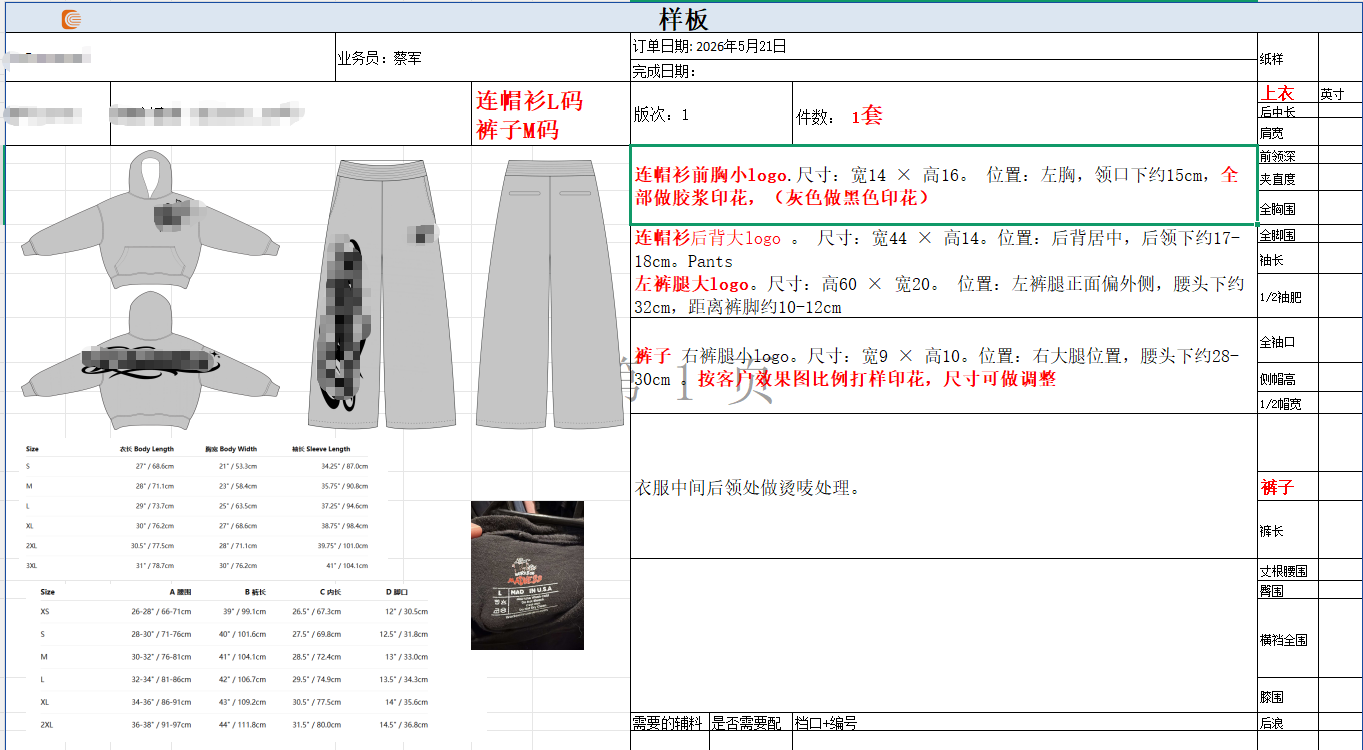
The image at the top of this post is a real tech pack from our factory floor—a custom hoodie and pants order we ran in May 2026. Client info is blurred for confidentiality, but you can see the actual structure: flat sketches, logo placement with exact dimensions (14cm x 16cm, positioned 15cm below the neckline), Pantone color references, and a full size chart from XS to 3XL. This is the level of detail that prevents bulk from going wrong.
Section 1: Cover Page
The cover page tells the factory who you are and what this document is for. Include:
- Brand name and logo
- Style number (your internal code, like "SS25-HOODIE-001")
- Product name (like "Heavyweight Pullover Hoodie")
- Date created and version number
- Designer/contact name and email
Section 2: Flat Sketches
Flat sketches are line drawings of your garment from the front and back. They do not need to be artistic. They need to be clear.
What to show:
- Front view with all visible seams and details
- Back view with all visible seams and details
- Side view if the silhouette is unusual
- Detail callouts for special features (hood, pockets, cuffs)
You can draw these in Adobe Illustrator, Procreate, or even by hand. The factory cares about clarity, not artistry.
Section 3: Bill of Materials (BOM)
The BOM lists every material that goes into the garment.
| Component | Material | GSM/Weight | Color | Quantity |
|---|---|---|---|---|
| Body fabric | 100% cotton fleece | 380gsm | Pantone Black 6 C | 1.5m per piece |
| Lining | None | - | - | - |
| Drawcord | Cotton braided | 5mm thick | Black | 1.2m per piece |
| Zipper | YKK metal | #5 | Antique brass | None |
| Label | Woven damask | - | Black + white | 1 per piece |
The factory uses this to quote your bulk price. Missing items means missing line items in the quote.
Section 4: Measurement Chart (POM)
POM stands for Points of Measure. This chart shows every measurement on your garment, in every size.
For a hoodie, you need measurements like:
- Chest width (1 inch below armhole)
- Body length (HPS to hem)
- Sleeve length (shoulder to cuff)
- Hood height
- Hood width
- Cuff height
- Hem height
- Armhole drop
You measure these on a reference garment (a sample you bought or made), then build a size chart from XS to XL. Most factories follow the size chart you provide. If you do not provide one, they use their own. That is when fit goes wrong.
Section 5: Construction Notes
Construction notes explain how the garment is sewn. This is where you lock in quality details.
Examples:
- "Stitch type: 4-thread overlock on body seams, double needle topstitch on hem"
- "Stitches per inch: 10-12 on visible seams"
- "Tape on shoulder seam: 1.5cm twill tape, color match"
- "Hood drawstring: through metal eyelets, no tied knots"
If you skip this section, the factory uses their default construction. Default construction is built for the cheapest production cost, not for your brand.
Section 6: Labels and Hangtags
Specify every label that goes on the garment:
- Main label: location (back neck), size, material, print/woven, attachment method
- Care label: location (inside side seam), required wash instructions, language
- Size label: separate or combined with main
- Hangtag: dimensions, paper weight, string color, attachment point
Send the factory artwork files (AI, EPS, or high-res PDF) for all labels.
Section 7: Packaging
Packaging is where 50% of buyers forget to specify, then complain about the result.
Specify:
- Polybag size and material
- Hangtag attachment point
- Folding method (some factories fold differently)
- Tissue paper or not
- Outer box dimensions
- Pieces per outer box
- Outer box marking (SKU, color, size, quantity)
How Do You Create a Tech Pack If You Have Never Made One?
You do not need a fashion design degree to make a tech pack. You need a template, a reference garment, and 3-4 hours of focused work.
The fastest way to create a tech pack is: download a free template, buy a reference garment that matches your target style, measure every point on it, fill in the template, and ask your factory to review it before bulk. This process takes one afternoon for your first tech pack.
The 5-Step DIY Process
Step 1: Get a Template
Download a free template from sources like Techpacker, Fashionary, or even Google "free tech pack template PDF." Pick one that covers the 7 sections above.
Step 2: Buy a Reference Garment
Find a garment in stores or online that matches your target fit, fabric, and construction. Buy it. This becomes your reference sample.
A $40 hoodie from Champion or H&M is a better tech pack tool than a Pinterest board. You can measure it, photograph it, and ship it to the factory.
Step 3: Measure Everything
Use a measuring tape. Measure every POM (point of measure) listed in your template. Record measurements in cm or inches—pick one and stay consistent.
Tip: measure the same point twice to confirm. Cheap rulers and floppy tape measures give different readings.
Step 4: Fill in the Template
Open the template. Fill in every section. Be specific. Avoid words like "normal," "standard," "regular," or "good quality." These are meaningless to the factory.
Bad: "Good quality cotton"
Good: "100% combed ring-spun cotton, 320gsm, OEKO-TEX certified"
Step 5: Send to the Factory for Review
Before you commit to bulk, send the tech pack to the factory and ask them to flag anything unclear. Real factories will come back with questions. If they accept it without questions, that is a warning sign—they are guessing.
Free vs Paid Tech Pack Tools
| Tool | Cost | Best For |
|---|---|---|
| Excel template | Free | First tech pack, simple products |
| Techpacker | $19+/month | Brands with multiple SKUs |
| Fashion Design Software (CLO 3D, Browzwear) | $250+/month | Established brands |
| Hire a freelance tech pack designer | $80-300 per pack | One-off projects |
For your first order, an Excel template is enough.
What Mistakes Do First-Time Buyers Make in Tech Packs?
I review tech packs from new brands every week. The same mistakes show up over and over. Avoid these five and you skip past most first-order problems.
The 5 most common tech pack mistakes are: vague fabric descriptions, missing GSM specs, no Pantone color codes, no tolerance ranges, and unclear logo placement measurements.
Mistake 1: Vague Fabric Descriptions
Bad: "Cotton hoodie material"
Good: "100% cotton French Terry, 380gsm, brushed back, pre-shrunk"
The factory cannot quote a vague fabric. They will pick the cheapest interpretation.
Mistake 2: No GSM Specs
Fabric weight (GSM = grams per square meter) determines feel, drape, and price. Without GSM, the factory uses their stock fabric—usually lighter than you expect.
Mistake 3: No Pantone Codes
"Black" can mean 20 different blacks. "Navy" is 50 different navies. Always specify Pantone codes (TPX for textiles, TCX for color books). If you do not have Pantone access, send a fabric swatch or a physical color reference.
Mistake 4: No Tolerance Ranges
Specs without tolerances are unenforceable. Write "280gsm ±5gsm" instead of just "280gsm." Write "chest width 56cm ±1cm" instead of just "56cm." Tolerances give you grounds for return if bulk is off.
Mistake 5: Logo Placement in Words, Not Numbers
Bad: "Logo centered on chest, medium size"
Good: "Logo placement: 8cm wide x 3cm tall, centered horizontally, 12cm down from HPS"
Numbers cannot be misinterpreted. Words always can.
How Does a Strong Tech Pack Speed Up Your Factory Quote?
A good tech pack is not just for production—it is for getting accurate quotes. Factories quote faster and more accurately when they have full information upfront.
A complete tech pack gets you a quote in 1-3 working days. A vague inquiry without a tech pack takes 7-14 days of back-and-forth questions before you get a real quote. Strong tech packs also signal that you are a serious buyer, which gets you priority attention from the factory.
What Factories Do When They Get a Strong Tech Pack
- They route it directly to the technical team (not sales)
- They calculate accurate fabric, trim, and labor costs
- They flag any production challenges upfront
- They commit to clear lead times
- They often offer better unit pricing because the risk is lower for them
What Factories Do When They Get a Vague Inquiry
- Sales team handles it
- They quote a generic average price
- They never flag specific risks
- They give vague lead times like "4-6 weeks"
- They prepare to "interpret" your spec during production (expensive for you)
The tech pack is your filter. It tells the factory you are not just shopping for the cheapest quote—you are looking for a real partner.
Conclusion
A tech pack is the most important document in your first clothing order. It removes guessing, locks in quality details, and gets you accurate quotes faster. If you are looking for a factory that reviews your tech pack carefully and walks you through every spec before bulk, reach out at www.dechoreal.com or email joe@dc-garment.cn.