
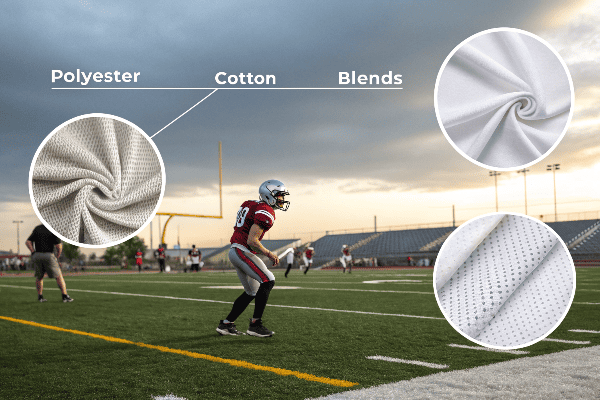
If you’ve ever worn or customized a football jersey, you’ve probably noticed that it feels different from everyday T-shirts. But what exactly is that fabric—and why is it used so often?
Football jerseys are typically made from polyester or polyester mesh because the fabric is lightweight, durable, moisture-wicking, and breathable—ideal for high-performance sports.
I’ve worked with both amateur teams and professional clubs[^1], and polyester is always the top request. It performs well on the field and holds up under tough conditions.
Table of Contents
- Why is polyester the go-to fabric for football jerseys?
- What are the types of polyester fabrics used?
- Can you use cotton for football jerseys?
- What GSM is ideal for football jerseys?
- Conclusion
Why is polyester the go-to fabric for football jerseys?
It’s all about performance.
Polyester is strong, doesn’t absorb water, and maintains its shape during high-intensity play. It's also perfect for sublimation printing, which is common for custom jerseys.
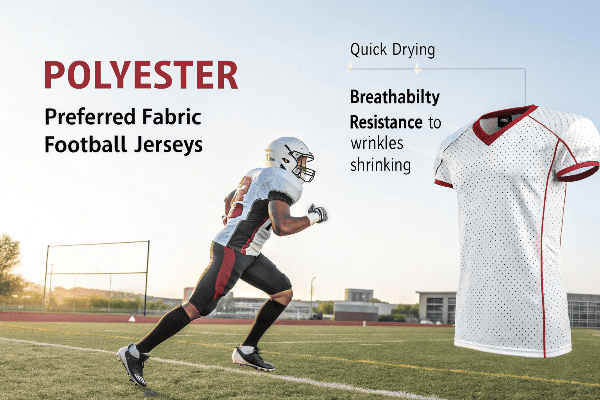
Key reasons polyester dominates
| Property | Benefit for Football Jerseys |
|---|---|
| Moisture-wicking | Keeps players dry by pulling sweat away[^2] |
| Lightweight | Doesn’t weigh players down |
| Quick-drying | Minimizes discomfort during and after games |
| Durable | Withstands friction, tackling, and laundering |
| Sublimation-friendly | Enables vibrant, fade-free custom designs[^3] |
In short: it keeps players comfortable and logos looking fresh.
What are the types of polyester fabrics used?
Not all polyester is the same.
The most common football jersey fabrics include interlock polyester, bird’s eye mesh, and jacquard mesh—all engineered for stretch, airflow, and durability.
Fabric types for different jersey styles
| Fabric Type | Texture & Use Case |
|---|---|
| Interlock Polyester | Smooth, slightly thicker, used for pro uniforms |
| Bird’s Eye Mesh | Dimpled surface, extra breathable[^4] |
| Jacquard Mesh | Woven patterns for durability and airflow |
| Pinhole Mesh | Small holes for ventilation (often in side panels) |
Some jerseys also blend spandex or elastane to increase flexibility—especially in compression fits[^5].
Can you use cotton for football jerseys?
Not for real play.
Cotton holds moisture, stretches out, and feels heavy when soaked with sweat. It’s used in fan merch, but not in on-field gear.
If you're creating jerseys for casual wear or spectators, cotton-blend T-shirts are fine. But for athletic use, polyester is essential.
What GSM is ideal for football jerseys?
Balance is key.
The best football jerseys use polyester fabric with GSM (grams per square meter) ranging from 140 to 200, depending on the level of play and style of the jersey.
Choosing the right weight
| GSM Range | Best For |
|---|---|
| 130–150 | Youth jerseys, practice kits |
| 150–170 | Standard team jerseys |
| 180–200 | Premium or heavyweight matchwear |
A pro-style jersey might use 180 GSM interlock polyester with mesh side panels to balance strength and ventilation.
Conclusion
Football jerseys are made from performance-engineered polyester for a reason: it keeps players cool, dry, and focused. Whether it’s mesh or interlock, this fabric is the foundation of every high-quality jersey on the field.
[^1]: See how DecGarment helps brands and teams develop professional jerseys.
[^2]: Polyester moisture management explained: ScienceDirect - Moisture wicking fabrics
[^3]: Sublimation printing benefits and process from Printful
[^4]: Guide to mesh fabric types from Mood Fabrics
[^5]: Sportswear stretch fabric properties from Textile Learner