
Tracksuit Manufacturer: How Do You Make a Custom Tracksuit or Sweatsuit Set?
You designed the perfect set. Then the samples arrive, and the top and the pants are two different shades.
Now your "set" is two separate garments.
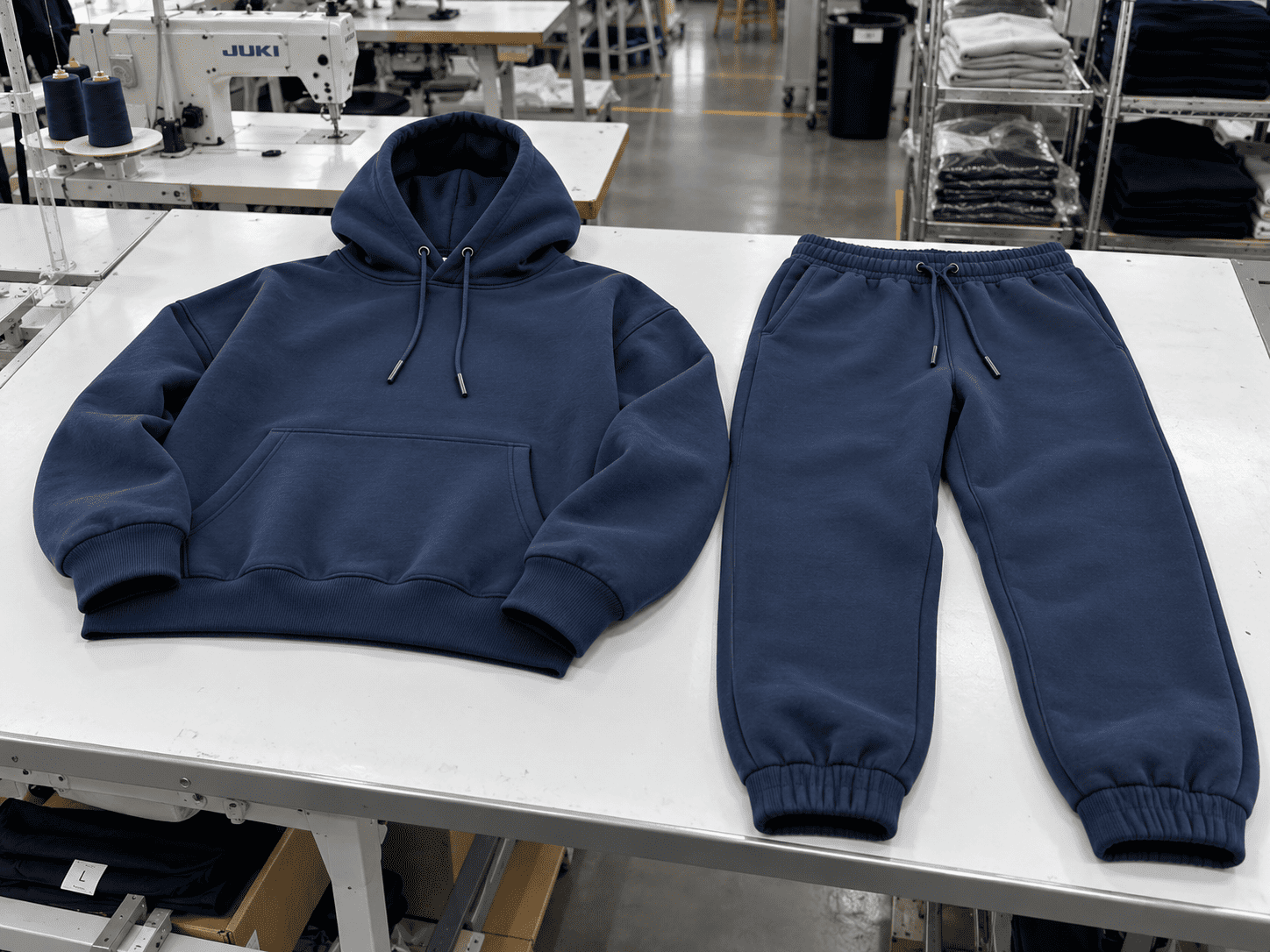
A tracksuit or sweatsuit set manufacturer produces a matching top and bottom from the same fabric, dye lot, and trims. The hard part is not sewing two garments. It is making them look like one outfit.
Sets continue to be an important category across sportswear, streetwear, and casual apparel. According to Research and Markets[^1], the global tracksuit market is projected to grow from approximately USD 12.17 billion in 2025 to USD 19.43 billion by 2031, representing a CAGR of about 8.1%.
So the demand is real.
But a set carries risks that a single hoodie never does.
Let me walk you through them.
Table of Contents
- What Is a Tracksuit or Sweatsuit Set Manufacturer?
- Which Fabric Should You Choose for Your Set?
- Why Is Matching the Top and Bottom So Hard?
- What MOQ and Cost Should You Expect for a Set?
- How Do You Choose a Tracksuit Manufacturer You Can Trust?
- Conclusion
What Is a Tracksuit or Sweatsuit Set Manufacturer?
Many founders use "tracksuit" and "sweatsuit" as if they mean the same thing.
They do not.
The difference changes which factory you need.
A tracksuit is usually a zip jacket and pants in a smooth fabric such as polyester tricot. A sweatsuit is usually a hoodie or crewneck with joggers in a cotton-based knit such as fleece or French terry.
Both are sold as a set.
Both must match.
But they come from different fabric worlds, and not every factory is equally strong in both.
Two Products, Two Skill Sets
A classic tracksuit is primarily a sportswear product. It often uses synthetic knits, zippers, piping, contrast panels, and technical trims.
A sweatsuit is closer to streetwear and loungewear. It relies more heavily on fleece, French terry, ribbing, drawcords, and relaxed silhouettes.
The sewing machines may be similar.
The fabric knowledge is not.
| Feature | Tracksuit | Sweatsuit |
|---|---|---|
| Typical top | Zip jacket or track top | Hoodie or crewneck |
| Typical fabric | Polyester tricot, nylon, poly blends | Cotton fleece, French terry |
| Look | Sleek, sporty, often with piping | Soft, relaxed, heavyweight |
| Common buyer | Sports teams, athleisure brands | Streetwear, loungewear brands |
| Key trims | Zippers, piping tape, zip pullers | Ribbing, drawcords, eyelets |
Our core is heavyweight knitwear, so sweatsuits are one of our strongest set categories.
We also make zip-jacket tracksuits in knit fabrics.
Before you contact any factory, decide which of the two you are really building.
Then ask the factory what share of its daily production is that exact product.
Relaxed and oversized silhouettes are also clearly visible across current sportswear collections. Major brands including Adidas[^2] and Nike currently offer dedicated oversized tracksuit and trackwear collections, which reflects how loose fits have become a mainstream part of modern sportswear and streetwear.
That matters because oversized sets need different pattern balance, fabric drape, shoulder construction, and pant proportions than a standard athletic tracksuit.
If your set is built around a hoodie, our low MOQ hoodie guide covers the top half in more depth.
Which Fabric Should You Choose for Your Set?
Fabric decides the price, the feel, the drape, and the final look of your set.
Pick it wrong, and no design detail can save the product.
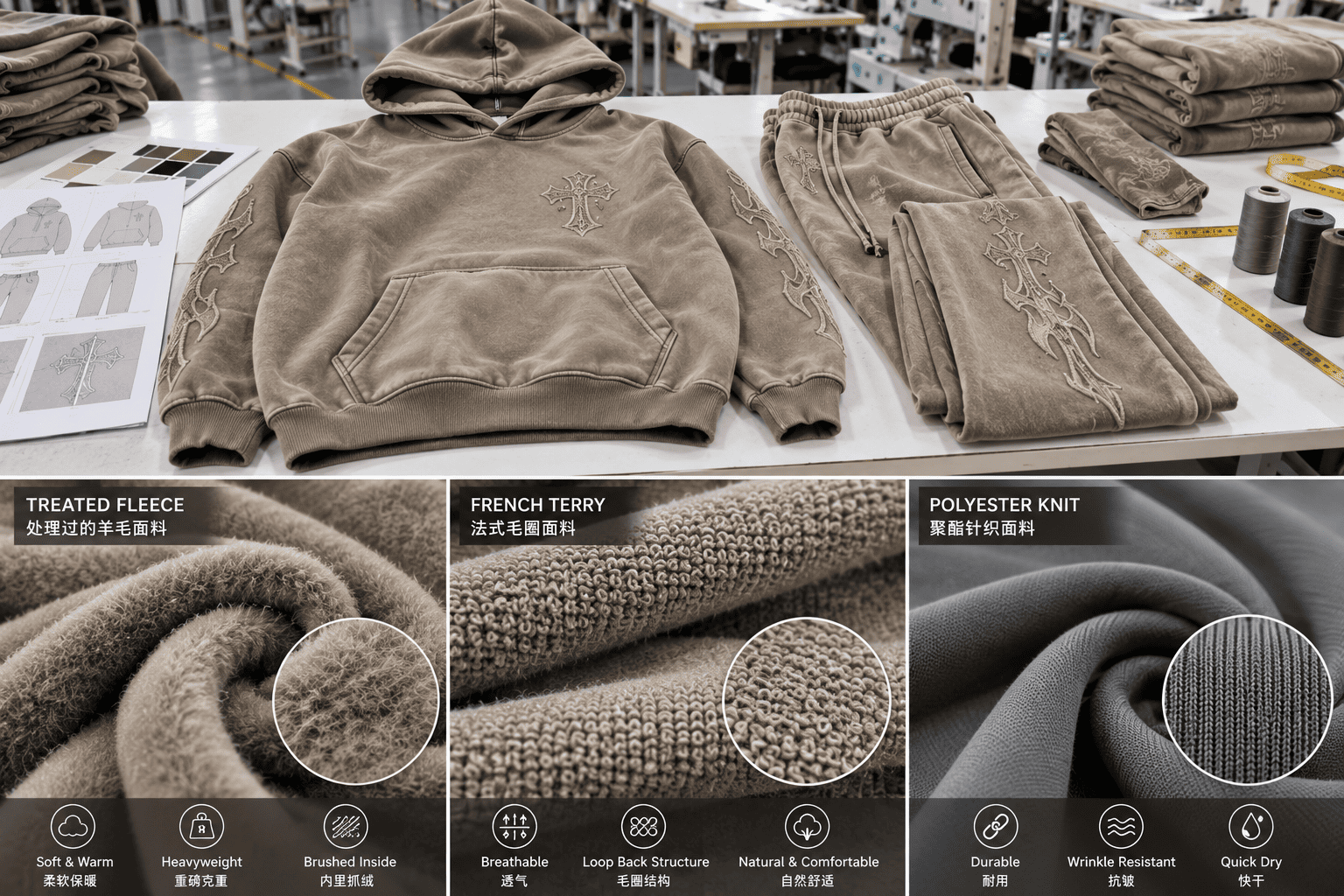
For a cotton sweatsuit, choose brushed fleece for warmth or French terry for a lighter, cleaner feel. For a sporty tracksuit, polyester tricot or another performance-oriented poly blend is usually more suitable. Match the fabric weight to the season and intended use.
Most first-time brands ask for "the heaviest fabric possible."
That is not always the right call.
A 400 GSM set can look very premium, but it is also warmer, heavier to ship, and more expensive.
Fabric Options Compared
| Fabric | Feel | Best season | Best for |
|---|---|---|---|
| Brushed fleece (cotton/poly) | Warm, fluffy inside | Autumn, winter | Streetwear sweatsuits |
| French terry (cotton) | Smooth outside, looped inside | Spring, autumn | Premium lounge and street sets |
| Polyester tricot | Sleek, slight sheen | All year | Classic sports tracksuits |
| Velour | Plush, soft pile | Autumn, winter | Retro and luxury lounge sets |
| Nylon or poly woven | Light, crisp | Spring, summer | Windbreaker-style sets |
For cotton sets, our stock heavyweight fabric sits at around 330 GSM.
That weight feels substantial without turning the set into a winter coat.
If you need a weight above our stock range, we can knit it to order. That normally brings a separate fabric minimum and adds time because the knitting or dyeing mill has its own setup requirements.
Think about shipping too.
A heavy set costs more to fly, and freight becomes part of your real landed unit cost.
One more tip:
Ask for the fabric composition in writing, not just the GSM.
An 80/20 cotton-poly fleece and a 100% cotton fleece can share the same GSM but behave very differently in shrinkage, hand feel, surface appearance, and washing.
Material safety may also matter depending on your market and customer requirements. OEKO-TEX® STANDARD 100[^3] tests textile products and individual components against a list of harmful substances, from yarn and fabric through buttons and other accessories.
If your pants are the hero piece, our sweatpants and joggers guide goes deeper on bottoms.
Why Is Matching the Top and Bottom So Hard?
This is where most sets fail.
Each piece can look great alone.
Side by side, they look like strangers.
Matching fails when the top and bottom come from different dye lots, different fabric rolls, or poorly matched trims. A good set manufacturer plans both garments together and checks shade consistency before sewing.
Fabric dyed in two separate batches rarely matches perfectly.
The difference may look small under factory lighting.
In daylight, with the hoodie and joggers worn together, it can become obvious.
The Four Places a Set Breaks
The first is the dye lot.
If the hoodie fabric and pant fabric are dyed separately, the shades can drift.
The safest approach is to prepare enough body fabric for the complete set within the same controlled dye lot whenever possible.
The second is the rib fabric.
Cuffs, hems, waistbands, and sometimes collars use a different knitted structure from the garment body. That rib still needs to match the main fabric visually.
| Risk point | What goes wrong | How to prevent it |
|---|---|---|
| Dye lot | Top and pants differ in shade | Produce both from the same controlled lot |
| Rib fabric | Cuffs look lighter or darker | Match and approve rib against body fabric |
| Shrinkage | Pants shrink differently from top | Test wash both garments together |
| Trims | Drawcord or zipper looks off-color | Approve every trim color with the set |
The third is shrinkage.
Fleece pants and a fleece hoodie can shrink at different rates after washing, especially when their patterns, ribs, waistbands, or fabric orientations differ.
That can destroy the balance of the set even when both pieces looked perfect before washing.
Ask for a wash test on the sample.
International textile testing standards also address this type of quality control. ISO 105-C06[^4], for example, provides methods for evaluating textile colour fastness under domestic and commercial laundering conditions.
You do not necessarily need to quote an ISO test number in every purchase order, but your supplier should understand that shade stability and wash behavior need to be tested, not guessed.
The fourth issue is trims.
A drawcord, zipper tape, zip puller, eyelet, embroidery thread, or printed logo that is slightly off-color can break the visual consistency of the entire outfit.
This is why I tell founders to approve the set as a pair, never piece by piece.
Lay the top and pants together.
Check them under daylight or controlled lighting.
Then wash and review them together.
It takes a little more time during sampling, but it can save an entire production run.
What MOQ and Cost Should You Expect for a Set?
A set is two garments, so buyers often expect two sets of minimums.
The good news is that the MOQ can be friendlier than you think.
At our factory, the MOQ for sets is 50 pieces per style. Your cost covers both garments, the fabric, and the required branding or trims. You should also budget for sampling, custom labels, packaging, and production deposits.
Why is a set minimum not necessarily higher than a basic T-shirt?
Because the value of one complete set is higher, and the garment itself normally involves more fabric and more construction.
That can make a short production run more practical than a very low-value lightweight product.
Minimums and the Money Flow
| Product | Typical MOQ per style |
|---|---|
| Hoodies, joggers, tracksuits, sets | 50 pcs |
| T-shirts, shorts, lighter knits | 100 pcs |
| Children's clothing | 200 pcs |
Your unit price depends on:
- Fabric composition
- GSM
- Fabric finish
- Top construction
- Pant construction
- Zippers and hardware
- Decoration
- Custom labels
- Washing or garment finishing
- Packaging
- Total order quantity
A 330 GSM cotton fleece set with embroidery on both pieces costs more than a simple printed polyester tricot set.
So no honest factory can give you an accurate final price before the specifications are locked.
Also ask whether the supplier's MOQ is counted:
- Per style
- Per color
- Per fabric
- Per size breakdown
These rules can dramatically change how many actual sets you need to buy.
| Stage | What you pay | Typical terms |
|---|---|---|
| Sample | Fee per style | Credited to bulk only if bulk ≥ 300 pcs |
| Deposit | Before production | 50% for new clients |
| Balance | Before shipment | Remaining 50% |
The sample fee comes first.
We credit it against bulk only when that style reaches 300 pieces or more.
New clients normally pay 50% before production and the remaining 50% before shipment.
After a few smooth orders, terms may ease to 30/70 depending on the relationship.
If this is your first order, our guide for clothing startups explains how to plan cash flow around these stages.
How Do You Choose a Tracksuit Manufacturer You Can Trust?
Many factories say they make sets.
Far fewer make sets that actually match.
You need to identify the second group.
Choose a manufacturer that specializes in the type of fabric your set uses, controls dye lots for both pieces, shows real matching-set samples, understands wash testing, can document compliance, and answers technical questions clearly.
The single best filter is the shade question.
Ask the factory:
"How do you keep the top and bottom the same color?"
A specialist will usually talk about dye lots, body fabric, rib matching, trims, shade approval, and wash testing.
A weak supplier says:
"No problem."
Then moves straight to price.
Green Flags and Red Flags
| Green flag | Red flag |
|---|---|
| Explains dye-lot control for sets | Says "no problem" with no detail |
| Knitwear is a core specialty | Claims to specialize in every product |
| Shows its own matching-set samples | Only uses stock catalog photos |
| Can provide relevant audit information | Cannot explain compliance |
| Quotes after specifications are clear | Gives a final price before seeing the design |
Specialty matters.
A knitwear factory handles fleece, French terry, ribbing, shrinkage, garment washing, and knit fabric behavior every day.
That is exactly what a cotton sweatsuit needs.
Compliance can also matter to brands evaluating long-term manufacturing partners. Sedex's SMETA methodology[^5] covers labour standards, health and safety, environmental performance, and business ethics as part of supplier-site assessments.
We have completed Sedex/SMETA-related factory auditing as part of our compliance work.
If you sell apparel into the United States, labeling is another detail worth discussing before bulk production. The U.S. Federal Trade Commission Care Labeling Rule[^6] requires manufacturers and importers of covered textile apparel to provide regular care instructions to consumers.
That matters for matching sets because the top and bottom should ideally be given compatible care instructions when they are designed to be worn and sold together.
Then check decoration.
A set often carries branding on both pieces, so the factory must position embroidery, screen printing, appliqué, rhinestones, or other decorations consistently across the top and pants.
Ask for real photos of matching sets it has produced recently.
If you are building a full clothing brand rather than one product, our custom clothing manufacturer guide shows how fabric sourcing, sampling, decoration, labels, bulk production, inspection, and shipping fit together.
The last signal is communication.
A factory that answers your first technical questions clearly is more likely to manage the production details clearly too.
Conclusion
A great set is one outfit, not two garments.
Choose the right fabric.
Control the dye lot.
Match the rib and trims.
Wash test the top and pants together.
Approve the pair together before bulk production.
The difficult part of making a custom tracksuit or sweatsuit is not sewing a jacket and a pair of pants.
It is controlling all the small variables so the customer sees one complete product.
Fabric shade, shrinkage, GSM, ribbing, drawcords, zippers, decoration placement, and fit all have to work together.
For brands, that means choosing a manufacturer based on product knowledge and process control rather than price alone.
If your supplier understands the fabric under the design and treats the two garments as one production system, your chances of receiving a truly matching set become much higher.
Footnotes & References
[^1]: Research and Markets — Tracksuit Market: Global Industry Size, Share, Trends, Opportunity, and Forecast, 2021–2031. The January 2026 report projects the global tracksuit market to grow from approximately USD 12.17 billion in 2025 to USD 19.43 billion by 2031, representing a CAGR of about 8.11%.
https://www.researchandmarkets.com/report/tracksuit-market
[^2]: Adidas — Oversized Fit Track Suits. Current Adidas product category demonstrating the continued commercial presence of oversized tracksuit silhouettes across sportswear and lifestyle apparel.
https://www.adidas.com/us/oversized_fit-track_suits
[^3]: OEKO-TEX® — STANDARD 100. Official textile safety standard covering testing for harmful substances in textiles and garment components from yarn through finished products and accessories.
https://www.oeko-tex.com/en/our-standards/oeko-tex-standard-100/
[^4]: International Organization for Standardization — ISO 105-C06:2010, Textiles — Tests for Colour Fastness to Domestic and Commercial Laundering. Provides methods for evaluating the resistance of textile colors under domestic and commercial laundering conditions. The standard was reviewed and confirmed as current in 2026.
https://www.iso.org/standard/51276.html
[^5]: Sedex — SMETA Audit. Official information about the Sedex Members Ethical Trade Audit methodology, covering labour standards, health and safety, environmental performance, and business ethics.
https://www.sedex.com/solutions/smeta-audit/
[^6]: U.S. Federal Trade Commission — Care Labeling of Textile Wearing Apparel & Certain Piece Goods. Official U.S. requirements for manufacturers and importers to provide appropriate regular care instructions for covered textile apparel.
https://www.ftc.gov/legal-library/browse/rules/care-labeling-textile-wearing-apparel-certain-piece-goods