
Sweatpants and Joggers Manufacturer: How Do You Get the Fit and Weight Right?
You want sweatpants that feel substantial and hang cleanly.
Not a thin pair that loses shape around the knees after a few wears.
Not a jogger with a waistband that twists.
And not a pair where the ankle opening looks completely different from the reference photo you approved.
A good sweatpants and joggers manufacturer develops the garment from the fabric and pattern together. For custom knit bottoms, French terry and fleece from roughly 280 to 400 GSM are common practical options, while heavier 400 GSM+ fabrics can create a denser streetwear look. The final fit depends on the pattern, especially the rise, thigh, knee, leg opening, taper, waistband, and cuff construction.
I manufacture knit garments in Dongguan, and sweatpants are one of the products that look simple in a sketch but are very easy to get wrong in production.
A hoodie can have an excellent fabric and still look acceptable with a slightly different body width.
With pants, a few centimeters can change the whole silhouette.
Too much thigh width and the pair looks baggy.
Too much taper and it feels restrictive.
The wrong rise changes how the entire garment sits.
The wrong cuff changes the leg line.
So when a buyer asks me:
Can you make heavyweight joggers?
I do not only ask for the GSM.
I also want to know:
What fit are you trying to create?
Table of Contents
- What Is the Difference Between Sweatpants and Joggers?
- What Fabric Is Best for Custom Sweatpants and Joggers?
- What Is the Difference Between French Terry and Fleece?
- What GSM Should You Choose for Sweatpants?
- Does Higher GSM Always Mean Better Sweatpants?
- How Do You Get the Jogger Fit Right?
- What Waistband Construction Should You Use?
- What Cuff or Hem Should You Choose?
- What Pocket Options Can Be Added to Joggers?
- What Printing and Embroidery Can Be Used on Sweatpants?
- How Do Colors Affect Custom Jogger Production?
- What MOQ Should You Expect for Custom Joggers?
- What Affects the Cost of Custom Sweatpants?
- Why Should You Make a Sample Before Bulk Production?
- What Should You Send a Sweatpants Manufacturer?
- How Do You Choose a Reliable Sweatpants Manufacturer?
- Conclusion
- Footnotes & References
What Is the Difference Between Sweatpants and Joggers?
The terms are often used loosely, and there is no universal technical standard forcing every brand to use them in exactly the same way.
But in everyday apparel sourcing, there is a useful distinction.
Sweatpants is the broader category of casual knit pants, often with a straight, relaxed, elastic, or open hem. Joggers usually refer to a more tapered silhouette that narrows toward the ankle and often finishes with a rib or elastic cuff.
A practical comparison looks like this:
| Feature | Sweatpants | Joggers |
|---|---|---|
| Leg shape | Straight or relaxed | Usually tapered |
| Ankle | Open, elastic, or cuffed | Usually cuffed |
| Silhouette | Relaxed / traditional | Cleaner tapered line |
| Pattern shaping | Moderate | More taper control |
| Typical styling | Casual / retro / streetwear | Casual / active / streetwear |
Neither style is automatically better.
It depends on the brand.
A vintage streetwear collection might want a wide open-leg sweatpant.
A matching hoodie set may use a relaxed jogger with a moderate taper.
A more athletic style may use a narrower calf and elastic cuff.
Do Not Brief the Factory With Only One Word
If the buyer sends:
I need sweatpants.
that leaves too much room for interpretation.
I would rather receive:
Relaxed heavyweight sweatpants
Wide thigh
Slight taper
Open hem
Mid-rise
or:
Oversized joggers
Relaxed thigh
Tapered lower leg
7 cm rib cuff
That tells the pattern maker much more.
What Fabric Is Best for Custom Sweatpants and Joggers?
For knit sweatpants, two of the most common fabric families are:
- French terry
- Fleece
Both can work extremely well.
The correct choice depends on:
- Climate
- Season
- Weight
- Desired hand feel
- Structure
- Brand positioning
French terry generally offers a smoother, less bulky inside surface and works well for year-round or transitional garments. Fleece uses a napped or brushed technical back to create a softer, warmer surface and is especially suitable for winter sweatpants and heavyweight streetwear sets.
CottonWorks lists both fleece and French terry among common cotton knit constructions for relaxed apparel and active garments.[^1]
Common Fiber Compositions
Joggers may use:
- 100% cotton
- 80% cotton / 20% polyester
- 90% cotton / 10% polyester
- Cotton/spandex blends
- Polyester blends
There is no single best composition.
100% cotton can give a natural, premium hand feel.
Cotton/polyester blends can improve:
- Stability
- Durability
- Cost control
- Shape retention
The correct choice depends on the product goal.
What Is the Difference Between French Terry and Fleece?
This is one area where apparel terminology is often simplified too much.
CottonWorks explains that what the industry commonly calls French Terry can be an un-napped 2-end fleece construction, with float loops visible on the technical back.[^1]
When those back loops are brushed or napped, they develop the soft, fuzzy surface associated with fleece.
French Terry
French terry normally has:
- Smooth technical face
- Visible loops or floats inside
- No heavy brushing
- More breathable feel
- Less bulk
It works well for:
- Spring
- Autumn
- Mild climates
- Premium casualwear
- Year-round streetwear
Brushed Fleece
Fleece normally has a brushed or napped back.
That creates:
- More warmth
- Softer inner surface
- Greater bulk
- Winter feel
It works well for:
- Cold-weather joggers
- Winter tracksuits
- Heavy streetwear
- Loungewear
3-End Fleece
Another option is 3-end fleece.
CottonWorks explains that 3-end fleece uses separate face, tie-in, and pile yarns, creating a fuller and more stable fleece structure.[^1]
This can be useful when a brand wants:
- Dense fabric
- Stable shape
- Premium surface
- Heavyweight construction
So when a buyer says:
I want fleece.
I still need more information.
What GSM Should You Choose for Sweatpants?
GSM means grams per square meter.
It describes fabric weight per unit area.
But there is no official universal rule saying:
279 GSM is light and 280 GSM is officially heavyweight.
The following ranges are practical sourcing references rather than formal classifications.
| GSM | Practical Feel | Possible Use |
|---|---|---|
| 220–280 GSM | Light to medium | Lightweight joggers |
| 280–320 GSM | Medium | Year-round French terry |
| 320–380 GSM | Heavy | Premium joggers / fleece |
| 380–400 GSM | Very substantial | Heavy streetwear |
| 400–500 GSM | Heavyweight | Structured premium sets |
| 500 GSM+ | Ultra-heavy | Niche / very structured styles |
280–320 GSM
This can work well for:
- Warm climates
- Transitional seasons
- Lighter streetwear
- Sports-inspired joggers
The garment still feels substantial without becoming too warm.
320–380 GSM
This is one of the ranges I often consider practical for premium sweatpants.
It offers:
- Better structure
- More substantial hand feel
- Stronger streetwear appearance
- Good balance of weight and comfort
400 GSM+
This creates a heavier product.
It can be excellent for:
- Oversized sets
- Boxy streetwear
- Winter collections
- Premium fleece
But heavier is not automatically better.
Does Higher GSM Always Mean Better Sweatpants?
No.
GSM tells you fabric weight. It does not directly tell you yarn quality, knitting quality, pilling resistance, shrinkage, softness, colorfastness, or garment construction.
Imagine two fabrics.
Fabric A
420 GSM
Poor yarn
Loose construction
Rough surface
High shrinkage
Fabric B
350 GSM
Better yarn
Stable knitting
Controlled shrinkage
Cleaner finish
I would not automatically choose Fabric A.
Yarn Also Matters
Ring-spun and combed cotton are two terms buyers often hear.
They are not the same process.
CottonWorks explains that ring spinning produces a yarn structure widely used as a quality benchmark, with ring-spun fabrics known for a particularly soft hand.[^2]
Combing is an additional fiber-preparation step that removes short fibers. CottonWorks notes that combed cotton can produce improved hand, drape, softness, and durability.[^2]
That is why:
100% cotton, 350 GSM
still does not tell me everything I need to know.
I may also ask:
- Ring-spun or open-end?
- Combed or carded?
- 2-end or 3-end?
- French terry or fleece?
- Washed or unwashed?
- What shrinkage?
How Do You Get the Jogger Fit Right?
This is where the pattern becomes more important than the GSM.
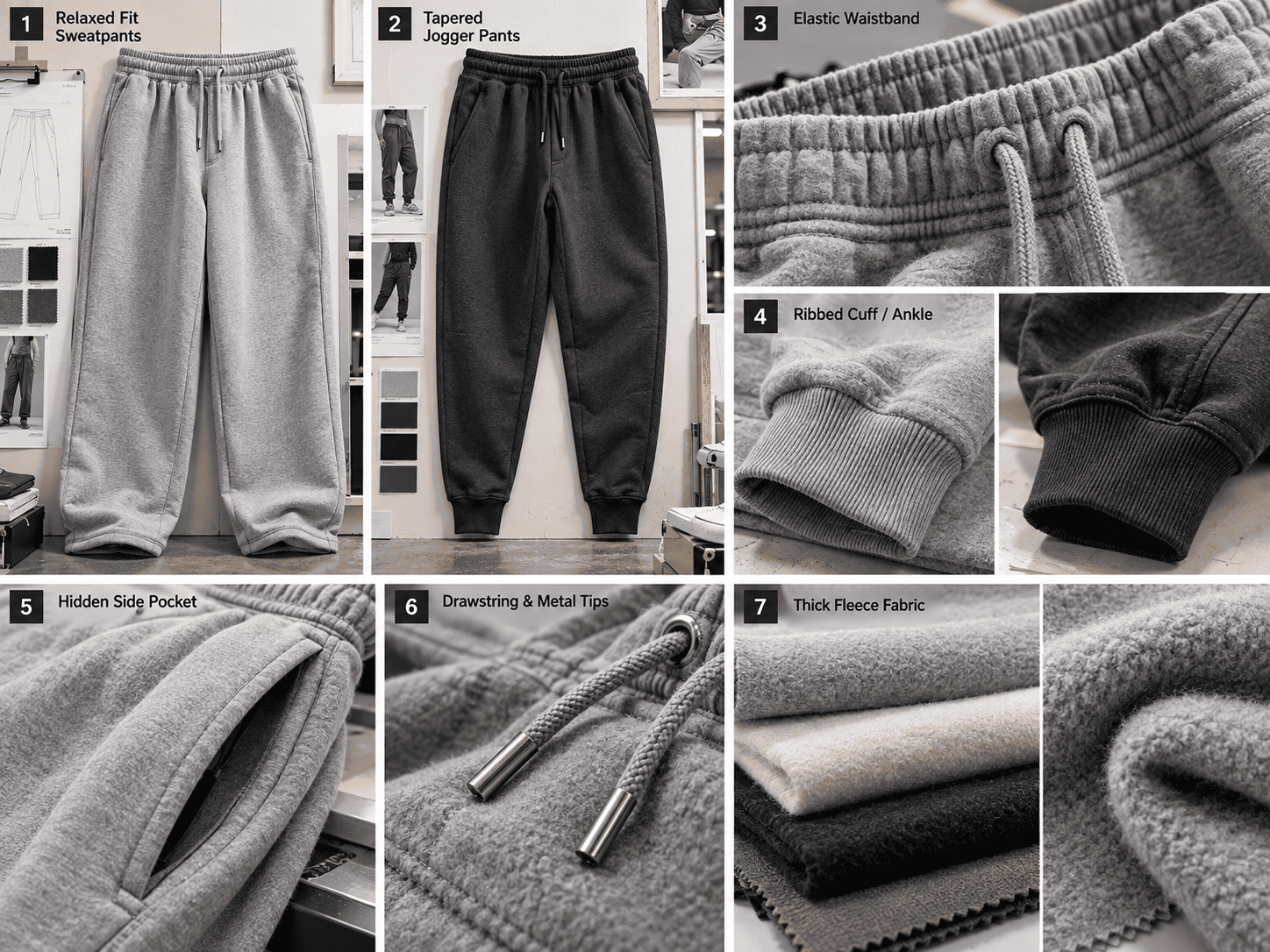
The main measurements controlling jogger fit include waist, hip, front rise, back rise, thigh, knee, inseam, outseam, leg opening, and cuff size.
For example, two pants can have the same waist and length but look completely different because of:
- Rise
- Thigh width
- Knee width
- Taper
- Leg opening
Relaxed Fit
Usually has:
- More thigh room
- More seat room
- Softer taper
- Casual silhouette
Slim Jogger
Usually has:
- Narrower thigh
- Stronger taper
- Smaller cuff
- Closer lower-leg fit
Oversized Sweatpant
May use:
- Wide leg
- Lower or longer rise
- Minimal taper
- Larger leg opening
Fit Needs Real Measurements
Instead of writing:
Oversized.
I prefer a measurement chart.
For example:
| Point | Example Measurement |
|---|---|
| Waist relaxed | 38 cm |
| Hip | 58 cm |
| Front rise | 33 cm |
| Thigh | 35 cm |
| Knee | 27 cm |
| Inseam | 75 cm |
| Leg opening | 15 cm |
These are only example figures.
Your actual size chart should match your intended fit.
What Waistband Construction Should You Use?
The waistband is one of the most important functional areas on sweatpants.
Customers feel it immediately.
Common options include:
- Encased elastic
- Rib waistband
- Elastic + drawcord
- Wide waistband
- Internal drawcord
- External drawcord
Elastic Quality Matters
A poor elastic can:
- Twist
- Roll
- Lose recovery
- Feel too tight
- Become loose after washing
A good waistband needs the correct combination of:
- Elastic width
- Elastic tension
- Waist measurement
- Stitching
- Fabric thickness
Drawcord Options
You may customize:
- Flat cotton cord
- Round cotton cord
- Polyester cord
- Matching color
- Contrast color
- Metal tips
- Plastic tips
- Knotted ends
These seem like small details.
But on minimalist sweatpants, the waistband and drawcord may be among the most visible design elements.
What Cuff or Hem Should You Choose?
This choice changes whether the pant feels like a jogger or a sweatpant.
Rib Cuff
A classic jogger option.
The rib can vary by:
- Height
- Composition
- Stretch
- Recovery
- Tightness
Elastic Cuff
Creates a similar tapered finish but with a different appearance.
Open Hem
Common for:
- Straight-leg sweatpants
- Wide-leg styles
- Vintage designs
- Relaxed streetwear
Raw or Special Finish
Some fashion projects may use:
- Raw edge
- Distressed hem
- Adjustable hem
- Drawcord hem
Again, the cuff is not only a trim.
It affects the pattern and silhouette.
What Pocket Options Can Be Added to Joggers?
Pockets are one of the most practical areas of customization.
Common choices include:
- Side seam pockets
- Slant pockets
- Welt pockets
- Back pocket
- Patch pocket
- Zipper pockets
- Hidden side pockets
- Phone pockets
Hidden Pockets
A hidden side pocket can be integrated into a side seam or structural seam so the opening is less visible from the front.
For a functional phone pocket, I check:
- Pocket opening
- Pocket depth
- Pocket width
- Bag fabric
- Reinforcement
A pocket that looks clean but cannot hold a normal phone is not useful.
Zipper Pockets
These add security but also increase:
- Trim cost
- Sewing time
- Construction complexity
If the buyer specifies a branded zipper, the exact zipper type should be confirmed rather than simply writing:
Premium zipper.
What Printing and Embroidery Can Be Used on Sweatpants?
Custom joggers can use many of the same decoration techniques as hoodies.
Common options include:
- Screen printing
- DTF
- DTG where suitable
- Standard embroidery
- Puff print
- Appliqué
- Chenille
- Rhinestones
- Silicone
- Reflective transfer
Popular logo positions include:
- Upper thigh
- Lower leg
- Side leg
- Back pocket area
Embroidery
A small tonal embroidery on the thigh can create a very clean premium look.
Large dense embroidery needs more care because it can:
- Stiffen the panel
- Add weight
- Distort softer fabrics
Large Leg Prints
For a large print running down the leg, placement needs to be confirmed before production.
The print may interact with:
- Side seam
- Knee
- Hem
This is why I prefer actual artwork dimensions.
How Do Colors Affect Custom Jogger Production?
Color affects more than appearance.
A buyer might order:
50 black joggers.
That is relatively straightforward if black fabric is available.
Now imagine:
50 joggers
10 black
10 brown
10 olive
10 navy
10 cream
The total quantity is still 50.
But production becomes more complicated.
Each color may need:
- Separate fabric
- Matching rib
- Thread matching
- Drawcord matching
- Cutting separation
- Production tracking
Custom-Dyed Colors
If the buyer needs a specific textile shade, I prefer using a physical textile reference.
Pantone's Fashion, Home + Interiors system identifies TCX for soft surfaces such as textiles and apparel.[^3]
This gives the dyeing supplier a clearer reference than a screenshot.
A custom dye may also introduce:
- Lab dip
- Approval time
- Fabric minimum
- Dye-lot considerations
That can increase MOQ and lead time.
What MOQ Should You Expect for Custom Joggers?
For flexible custom production, around 50–100 pieces per style can be a practical starting range for some jogger projects.
The exact MOQ depends on:
- Fabric
- Color
- Sizes
- Trims
- Printing
- Embroidery
- Washing
Matching Sets
If the jogger is part of a hoodie set, using the same fabric across both pieces can simplify sourcing.
For example:
50 hoodie + jogger sets
Same 400 GSM black fleece
can be easier to manage than separate products using unrelated custom fabrics.
Fabric MOQ Can Change Everything
The garment factory may accept 50 pieces.
But the fabric supplier may not accept enough custom-knitted fabric for only 50 joggers.
This is especially important for:
- Special GSM
- Custom compositions
- Special structures
- Custom-dyed colors
Low garment MOQ does not automatically mean low fabric MOQ.
What Affects the Cost of Custom Sweatpants?
Custom sweatpants do not have one fixed unit price.
The main cost factors include:
- Fabric composition
- GSM
- Yarn
- Quantity
- Pattern complexity
- Pockets
- Zippers
- Drawcords
- Cuffs
- Printing
- Embroidery
- Washing
- Labels
- Packaging
A simple 320 GSM French terry sweatpant with side pockets will normally cost less than:
450 GSM brushed fleece
Custom oversized pattern
Hidden phone pocket
Two zipper pockets
Embroidery
Custom drawcord
Garment wash
They are different products.
Small Orders Cost More Per Piece
Fixed costs such as:
- Pattern development
- Cutting setup
- Embroidery setup
- Printing setup
- Production preparation
- QC
are spread across fewer garments.
This is why a 50-piece price should not be expected to match a 500-piece price.
Sample Cost
A custom sample may require:
- Pattern development
- Fabric sourcing
- Cutting
- Sewing
- Decoration setup
- QC
The sample fee therefore should not be compared directly to the bulk unit price.
For new bulk customers, a common payment structure may be:
50% deposit before production
50% balance before shipment
Specific terms should always be agreed before the order starts.
Why Should You Make a Sample Before Bulk Production?
For sweatpants, I strongly recommend a physical sample.
A flat sketch does not tell you how the pants will hang.
The sample should be used to evaluate fabric, fit, rise, thigh width, taper, cuff, waistband tension, pocket function, decoration, and shrinkage before bulk production.
Try the Sample On
Check:
- Waist comfort
- Seat
- Rise
- Thigh room
- Knee
- Calf
- Cuff
- Overall length
Then move.
Sit down.
Walk.
Put a phone in the pocket.
These tests reveal problems that a flat measurement table does not.
Wash the Sample
After washing, check:
- Waist
- Inseam
- Outseam
- Twisting
- Shrinkage
- Cuff
- Surface
- Color
If the bulk product will be washed by customers, the development sample should also be evaluated after washing.
What Should You Send a Sweatpants Manufacturer?
A useful inquiry might look like this:
| Item | Requirement |
|---|---|
| Product | Heavyweight relaxed joggers |
| Quantity | 50 pcs |
| Fabric | 100% cotton fleece |
| GSM | 380–420 GSM |
| Color | Black |
| Fit | Relaxed with slight taper |
| Sizes | S–XL |
| Sample size | L |
| Waist | Elastic + drawcord |
| Two side pockets | |
| Cuff | Rib cuff |
| Logo | Small thigh embroidery |
| Label | Custom woven label |
| Packaging | Individual polybag |
| Market | United States |
Now the manufacturer can check:
- Fabric availability
- MOQ
- Pattern
- Sample cost
- Bulk price
- Lead time
Tell the Factory What Is Flexible
For example:
I prefer 400 GSM, but 380–420 GSM is acceptable if you have a stock fabric.
That can help the factory find a material faster.
You may reduce:
- Fabric MOQ
- Development time
- Cost
without changing the product concept.
How Do You Choose a Reliable Sweatpants Manufacturer?
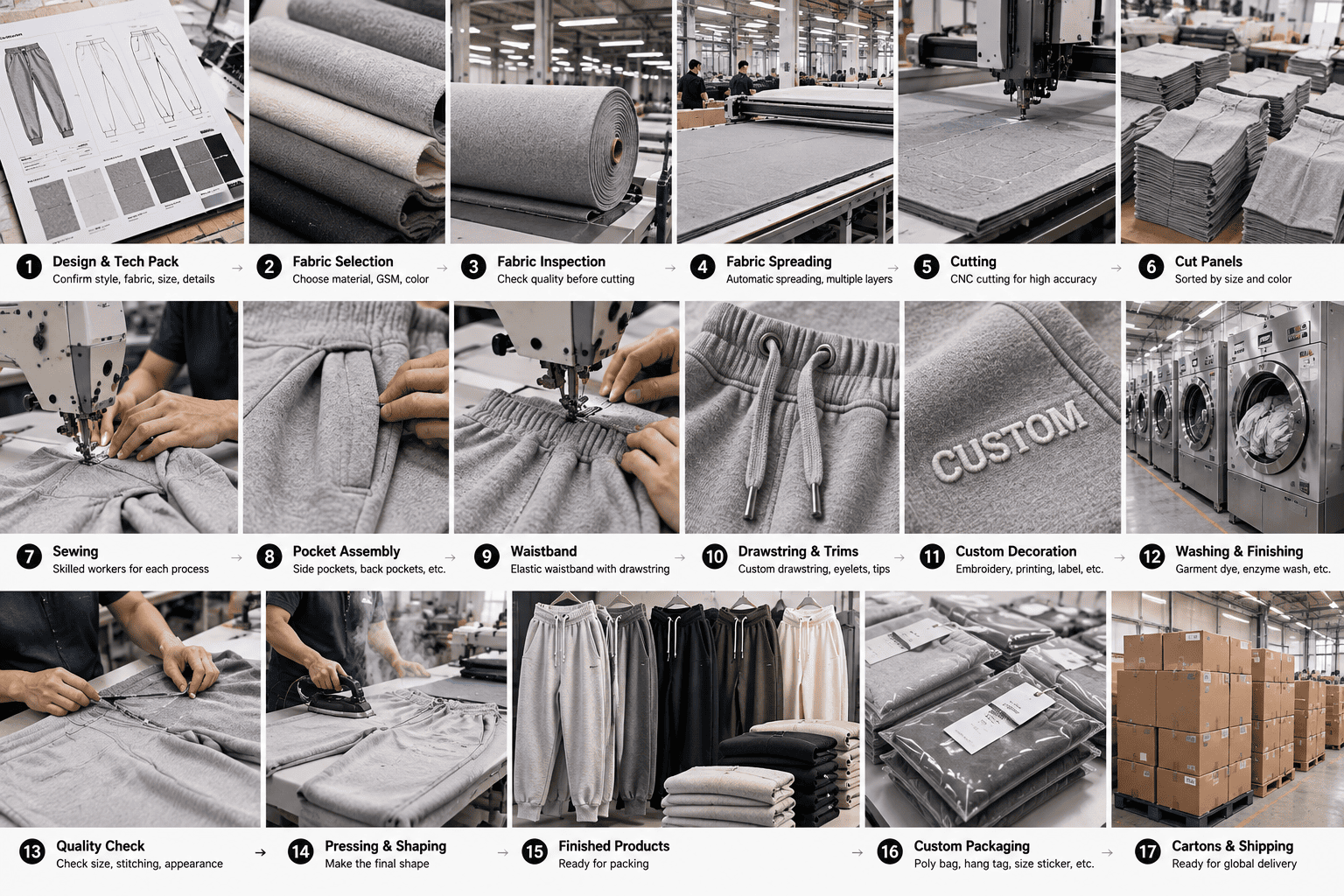
The first thing I would check is whether the factory regularly works with knit bottoms and fleece sets.
A strong sweatpants manufacturer should understand fabric, pattern development, waistband construction, taper, pockets, cuffs, shrinkage, and bulk measurement control—not only sewing.
Ask Fabric Questions
Ask:
What stock GSM do you have?
French terry or fleece?
2-end or 3-end?
What composition?
What shrinkage?
What stock colors?
A factory that regularly makes knitwear should be able to discuss these details.
Ask About Pattern Development
A jogger is not just a T-shirt pattern with legs.
Check whether the manufacturer can adjust:
- Rise
- Hip
- Thigh
- Knee
- Taper
- Leg opening
- Cuff
If the factory cannot modify the pattern, custom fit becomes much harder.
Check Real Production
Useful evidence includes:
- Fabric rolls
- Cutting
- Waistband sewing
- Pocket construction
- Cuff attachment
- QC measurement
- Finished joggers
Check Compliance Claims Correctly
Sedex describes SMETA as a social-audit methodology, not a certification.[^4]
It covers areas including:
- Labour standards
- Health and safety
- Environment
- Business ethics
If a factory says it has completed a SMETA audit, buyers can ask for relevant audit information.
OEKO-TEX® STANDARD 100 answers a different question.
It is a certification for textile products and components tested for harmful substances.[^5]
A social audit and a textile product certification should not be presented as the same thing.
Target Market and Labels
If the joggers will be sold in the United States, the Federal Trade Commission states that most covered textile products need labels including:
- Fiber content
- Country of origin
- Identity of the manufacturer or responsible marketer
and covered apparel also needs appropriate care information.[^6]
That is why I prefer knowing the target market before final care labels are produced.
Green Flags and Red Flags
| Green Flag | Red Flag |
|---|---|
| Regularly produces fleece sets | Joggers are an occasional product |
| Gives exact GSM | Only says “heavyweight” |
| Understands taper and rise | Talks only about waist and length |
| Can adjust patterns | Cannot explain pattern changes |
| Explains stock vs custom fabric | Promises every fabric at low MOQ |
| Has a clear sample process | Pushes straight to bulk |
| Shows real production | Only catalog images |
| Explains audit/certification correctly | Uses logos without documents |
| Gives specific answers | Says yes to everything |
A good manufacturer does not need to say yes to every request.
Sometimes the more useful answer is:
We can do this, but this fabric requires a higher MOQ.
or:
This cuff is too tight for your current leg opening, so we should adjust the pattern.
That kind of answer tells me someone is actually thinking about the garment.
Conclusion
Good sweatpants and joggers are not created by adding a logo to a generic pair of pants.
They come from the combination of:
- Fabric
- GSM
- Yarn
- Pattern
- Rise
- Thigh
- Taper
- Waistband
- Pockets
- Cuffs
- Construction
- Decoration
For practical sourcing, I often see good results in the 280–400 GSM range, with heavier 400 GSM+ fabrics suitable when the brand wants a denser, more structured product.
But GSM is not a quality score.
A well-developed 350 GSM jogger can be better than a poorly knitted 450 GSM pair.
The same applies to fit.
A buyer should not only write:
Relaxed joggers.
Specify the silhouette.
Is the thigh wide?
How strong is the taper?
How high is the rise?
What is the cuff opening?
Do you want a phone pocket?
Do you want an open hem or rib cuff?
These decisions turn a generic pair of sweatpants into a product that actually belongs to a brand.
For a first order, I would focus on:
- The right fabric
- The right fit
- A strong waistband
- Functional pockets
- A clean cuff or hem
- Simple, repeatable branding
Then make a physical sample.
Wear it.
Wash it.
Measure it again.
Only after that would I move into bulk production.
A good sweatpants and joggers manufacturer should not only tell you:
We can make 400 GSM joggers.
It should be able to explain how that fabric will work with the pattern, waistband, taper, cuff, pockets, washing, and final fit.
That is the difference between producing a pair of pants and developing a product your customers will want to wear again.
Footnotes & References
[^1]: CottonWorks™ — Single & Double Knits. Cotton Incorporated technical resource explaining French Terry, 2-end fleece, 3-end fleece, napping, and common knit constructions.
https://cottonworks.com/learning-hub/knitting/single-and-double-knits/
[^2]: CottonWorks™ — Yarn Spinning & Fiber Preparation for Spinning. Cotton Incorporated technical resources explaining ring spinning and cotton combing. Ring-spun fabrics are noted for their soft hand, while combing removes shorter fibers and can improve hand, drape, softness, and durability.
https://cottonworks.com/learning-hub/yarn-manufacturing/yarn-spinning/
https://cottonworks.com/learning-hub/yarn-manufacturing/fiber-preparation-for-spinning/
[^3]: Pantone — Fashion, Home + Interiors (FHI). Official Pantone information explaining that TCX is used for soft surfaces such as textiles and apparel.
https://www.pantone.com/na/en-us/fashion-home-interiors
[^4]: Sedex — SMETA Audit. Official Sedex information describing SMETA as a social-audit and continuous-improvement methodology rather than a certification.
https://www.sedex.com/solutions/smeta-audit/
[^5]: OEKO-TEX® — STANDARD 100. Official information about testing and certification of textile products and components for harmful substances.
https://www.oeko-tex.com/en/our-standards/oeko-tex-standard-100
[^6]: U.S. Federal Trade Commission — Apparel and Labeling. Official FTC guidance covering fiber content, country of origin, responsible-business identification, and care requirements for covered textile apparel.
https://www.ftc.gov/news-events/topics/tools-consumers/apparel-labeling