
Sustainable Clothing Manufacturer: What Can You Honestly Claim About Organic and Recycled Fabrics?
You printed:
“GOTS certified organic cotton.”
on your hang tag.
Then a retailer asks for the certificate covering the finished garment.
You send the certificate from the fabric mill.
They reply:
“This certificate does not cover your finished product.”
Now the launch is delayed, the packaging may need to be reprinted, and your sustainability claim is being questioned.
This is one of the biggest misunderstandings I see around sustainable clothing manufacturing.
Sustainable clothing manufacturing is not one certificate or one “eco” fabric. It involves material choice, chemical management, working conditions, product durability, production volume, traceability, and accurate marketing claims. Certifications can support those claims, but every certificate has a specific scope. A certified fabric does not automatically make the finished garment certified.
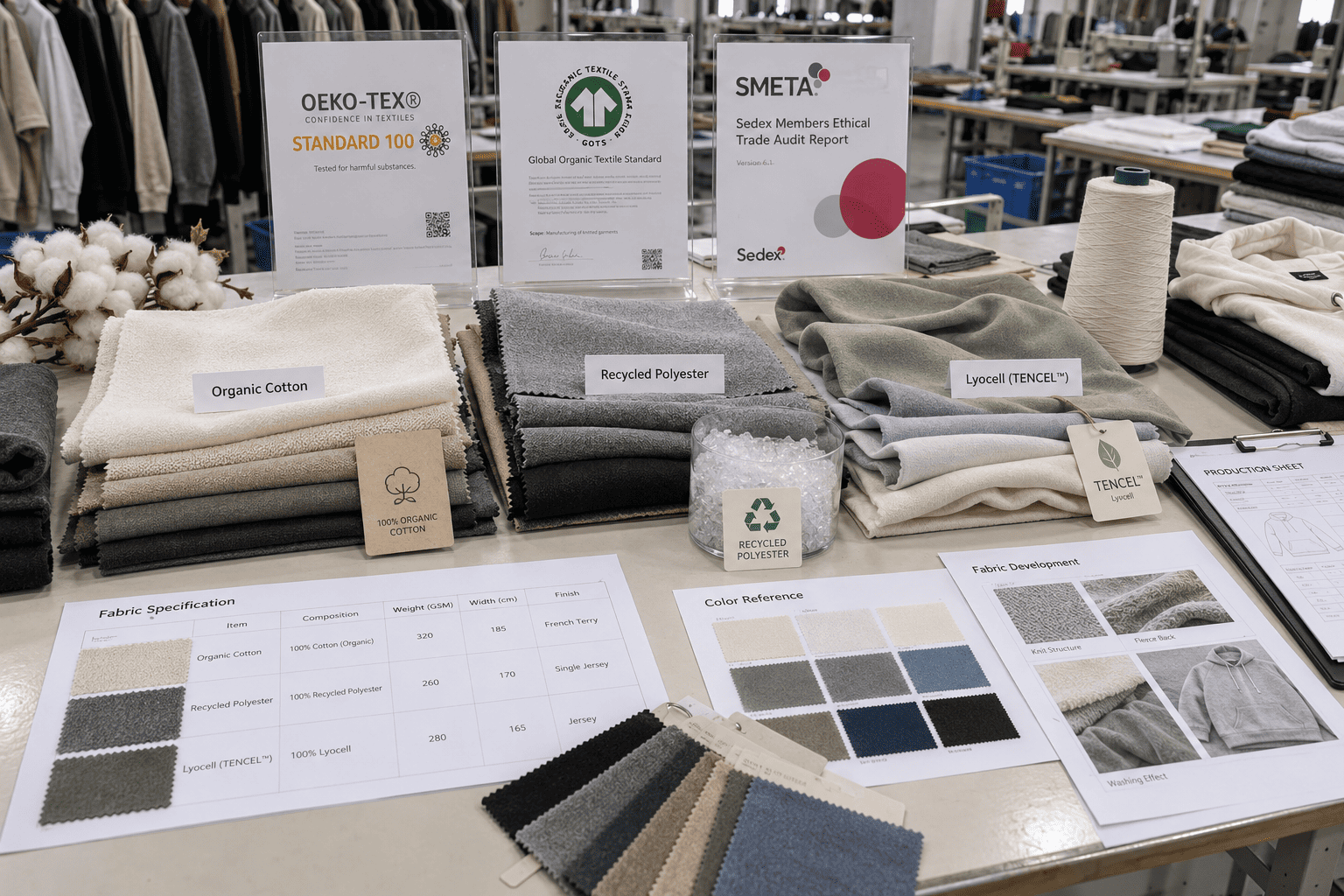
The scale of the material problem is worth understanding.
According to the latest Textile Exchange Materials Market Report 2026, global fiber production reached a record 139 million tonnes in 2025, up from 132 million tonnes in 2024.
Polyester alone accounted for 59% of global fiber production.
Recycled polyester production reached approximately 9.7 million tonnes, but 97% of it came from plastic bottles rather than old textiles.
And textile-to-textile recycled fiber represented only about 0.76% of global fiber production.
So sustainability claims matter.
But accuracy matters just as much.
Table of Contents
- What Makes Clothing Manufacturing Sustainable?
- Which Sustainable Fabrics Can You Choose?
- What Do GOTS, GRS, and OEKO-TEX Actually Certify?
- What Can You Claim If the Garment Maker Is Not Certified?
- How Can You Make a Collection More Sustainable in Practice?
- How Do You Choose an Honest Sustainable Clothing Manufacturer?
- Conclusion
What Makes Clothing Manufacturing Sustainable?
“Sustainable clothing” is used so broadly that it can become almost meaningless.
A better approach is to break the product into separate areas and ask:
What exactly are we claiming?
What evidence supports that claim?
Sustainability in apparel can include fiber sourcing, chemical management, working conditions, production efficiency, product durability, waste reduction, and responsible order quantities. These areas need different forms of evidence.
Different Parts of Sustainability
| Area | What it covers | Possible evidence |
|---|---|---|
| Fiber | Organic, recycled, preferred materials | Scope certificates, transaction documents, material records |
| Chemistry | Harmful substances and processing chemicals | Testing, chemical-management standards |
| Social conditions | Working hours, safety, labour practices | Social audits |
| Durability | How long the garment performs | Wash, pilling and dimensional tests |
| Traceability | Where materials came from | Chain-of-custody documentation |
| Production volume | Avoiding unnecessary overproduction | Smaller planned runs |
| Claims | What the brand tells consumers | Documents supporting each statement |
One certification does not cover every row.
For example:
A social audit does not certify organic cotton.
An OEKO-TEX STANDARD 100 certificate does not prove that a fiber is organic.
A GOTS certificate is not the same thing as a SMETA audit.
Social Compliance Is a Separate Question
Working conditions are still part of responsible sourcing.
For example, Sedex's SMETA methodology is used to assess areas including labour standards and health and safety, with 4-Pillar audits also covering environmental performance and business ethics.
Sedex is very clear that SMETA is not a certification and not a simple pass/fail badge.
It is an audit methodology designed around continuous improvement.
That distinction matters.
You should not say:
“Our fabric is sustainable because our factory has SMETA.”
The audit and the material claim are two separate things.
If you are building a new clothing brand, our private-label guide explains how material claims, labels, packaging, and supplier documentation fit together.
Which Sustainable Fabrics Can You Choose?
There is no single fabric called:
“sustainable fabric.”
Every material solves a different problem and creates different trade-offs.
Common options include certified organic cotton, recycled polyester, recycled cotton, lyocell, responsibly sourced man-made cellulosic fibers, linen, hemp, and other materials with verified sourcing or content claims.
The important word is:
verified.
Material Options Compared
| Material | Potential advantage | What to verify |
|---|---|---|
| Organic cotton | Certified organic agricultural input | Which standard and which supply-chain stages are certified |
| Recycled polyester | Reduces demand for virgin polyester feedstock | Actual recycled percentage and chain of custody |
| Recycled cotton | Reuses cotton textile or production waste | Source, recycled percentage and blend |
| Lyocell | Regenerated cellulose with potentially efficient solvent recovery | Fiber producer and process |
| Modal | Soft regenerated cellulosic fiber | Producer, wood sourcing and manufacturing process |
| Viscose made from bamboo | Soft regenerated cellulose | Correct fiber labeling and environmental evidence |
| Linen | Durable bast fiber | Origin and processing |
| Hemp | Durable bast fiber | Origin, processing and blend |
Recycled Polyester Needs an Honest Explanation
Recycled polyester is useful.
But it is often marketed too simply.
The latest Textile Exchange data shows that approximately 97% of recycled polyester produced in 2025 still came from plastic bottles.
That means most recycled polyester is not:
old T-shirt → new T-shirt
It is more often:
plastic bottle → textile fiber
This can reduce demand for virgin polyester feedstock.
But it does not by itself create a closed textile-to-textile system.
Textile Exchange reports textile-to-textile recycled fiber at only around 0.76% of global fiber production in 2025.
So instead of saying:
“This garment closes the loop.”
say exactly what you know.
For example:
“Made with 50% certified recycled polyester.”
if your documentation supports that percentage.
Specific claims are much safer than broad claims.
Recycled Cotton
Recycled cotton can come from:
- Pre-consumer cutting waste
- Yarn waste
- Post-consumer textile waste
Mechanical recycling can shorten fibers, so recycled cotton is often blended with:
- Virgin cotton
- Polyester
- Other fibers
to maintain yarn strength and consistency.
That does not make it bad.
It simply means you need to know what is actually inside the fabric.
Ask for:
- Fiber percentage
- Recycled-content documentation
- Supplier certificate
- Transaction documentation where applicable
Be Careful With Bamboo Claims
This is one of the easiest ways for a brand to make an inaccurate sustainability claim.
Soft clothing marketed as:
“bamboo fabric”
is often actually rayon or viscose produced using bamboo as the cellulose source.
The U.S. Federal Trade Commission's Bamboo Textiles guidance says that unless the textile is made directly from actual bamboo fiber, it cannot simply be labeled or advertised as bamboo.
If the fiber is viscose or rayon made using bamboo, appropriate wording may be:
“viscose made from bamboo”
or
“rayon made from bamboo.”
FTC guidance also warns against unsupported claims such as:
- Naturally antibacterial
- Eco-friendly
- Biodegradable
simply because bamboo was the original plant source.
So if a supplier sends you a composition saying:
95% bamboo / 5% spandex
ask:
“What is the generic fiber name on the test report?”
before you print 10,000 labels.
What Do GOTS, GRS, and OEKO-TEX Actually Certify?
This is where many brands get into trouble.
A logo looks simple.
The certification system behind it is not.
GOTS, GRS, and OEKO-TEX STANDARD 100 answer different questions. GOTS focuses on certified organic textile processing and chain-of-custody requirements. GRS verifies recycled materials and chain of custody while adding processing requirements. OEKO-TEX STANDARD 100 tests covered textile articles and components for harmful substances.
What the Main Standards Mean
| Standard | Main purpose | Important point |
|---|---|---|
| GOTS | Organic textile standard + processing requirements | Certification scope and chain matter |
| GRS | Recycled content + chain of custody + processing criteria | Certified supply chain required |
| RCS | Recycled-content verification | Focuses mainly on recycled content and chain of custody |
| OEKO-TEX STANDARD 100 | Harmful-substance testing | Certificate covers specified tested articles/components |
| SMETA | Social-audit methodology | Not a fiber/product certification |
GOTS: Scope Matters
The official Global Organic Textile Standard states that GOTS labeling can only be applied to GOTS Goods by a certified entity and must follow specific labeling conditions.
GOTS maintains Scope Certificates showing:
- Certified entity
- Certification scope
- Validity
And for specific certified shipments, suppliers should provide a Transaction Certificate.
GOTS itself states that the transaction certificate should identify the certified product and shipment details.
That is much stronger evidence than seeing:
“GOTS cotton”
written on a supplier quotation.
Ask for Two Different Documents
When buying GOTS material, ask about:
1. Scope Certificate
This answers:
“Is this company certified, and for what activities?”
Then ask about:
2. Transaction Certificate
This helps answer:
“Is this specific shipment covered as certified goods?”
They are not the same document.
GRS Works Through Chain of Custody Too
The Textile Exchange Global Recycled Standard verifies recycled content and the chain of custody through the supply chain.
Textile Exchange explains that GRS also includes additional:
- Social requirements
- Environmental requirements
- Chemical restrictions
for processing certified products.
Under the GRS system, professional third-party certification bodies audit relevant supply-chain stages.
The current GRS framework also requires chain-of-custody documentation for claimed recycled material.
One Important 2026 Update
Textile Exchange is currently transitioning its standards system.
It has announced the new Materials Matter Standard, with the standard becoming effective on December 31, 2026, followed by a longer transition period.
That means brands sourcing recycled material over the next few years should not assume certification programs will remain administratively unchanged forever.
When planning a future collection, always confirm which Textile Exchange standard and claim policy is current at the time of production.
What Does OEKO-TEX STANDARD 100 Mean?
OEKO-TEX® STANDARD 100 is different.
It is an independent testing and certification system for:
- Textile raw materials
- Intermediate products
- Finished textile products
- Accessories
that fall within the certificate's scope.
Its main focus is testing covered products or components for harmful substances.
OEKO-TEX STANDARD 100 also uses different product classes depending on intended use and skin contact.
So if your fabric supplier gives you an OEKO-TEX certificate, check:
- Certificate number
- Validity
- Product description
- Which article/material is covered
Do not assume:
“Supplier has OEKO-TEX = every product I order is automatically OEKO-TEX certified.”
What Can You Claim If the Garment Maker Is Not Certified?
This is the section that can save brands the most trouble.
Many garment factories source certified materials.
That does not automatically mean the garment factory itself is certified under the same chain-of-custody standard.
If the finished garment is not covered by the required certification scope, you should not market it as a certified GOTS or GRS finished product merely because the upstream fabric mill holds certification.
Example: GOTS Fabric, Non-GOTS Garment Factory
Imagine:
Fabric mill = GOTS certified
Fabric = supplied with relevant documentation
Garment sewing factory = not GOTS certified for that production scope
The wrong conclusion is:
“Finished hoodie is GOTS certified.”
The mill's certification does not automatically transfer to another facility outside the applicable certified chain.
GOTS officially requires compliance with its certification and labeling rules before a textile product may be represented with GOTS signs or certification references.
Example: GRS Fabric
The same chain-of-custody logic matters for GRS.
Textile Exchange explains that RCS and GRS are designed to verify recycled material and trace it through supply-chain stages.
A fabric certificate is useful evidence about the upstream material.
But do not automatically convert that into:
“GRS-certified finished garment”
unless the finished product and relevant supply chain actually meet the applicable certification and claim rules.
Practical Claim Guide
| Situation | Safer approach | Avoid |
|---|---|---|
| Certified organic fabric, final product not covered by GOTS certification | State verified fiber composition without implying finished-product GOTS certification | “GOTS-certified hoodie” |
| Certified recycled input but finished garment outside GRS chain | State supported recycled-content facts carefully | GRS logo / finished-product certification claim |
| OEKO-TEX-certified fabric | State only what the valid certificate actually covers | Implying unrelated finished components were tested |
| Independent finished-garment test | Describe the test/result accurately | Turning a lab report into a certification it is not |
| Social audit | State audit type and scope | Calling it an environmental fiber certification |
Our Position
This is an area where being precise is more valuable than trying to sound impressive.
If our garment-making operation is not within the required GOTS or GRS certified chain for a particular final-product claim, we should not tell the buyer that the finished garment itself is GOTS- or GRS-certified.
Instead, we can work with material suppliers that hold relevant certification and provide the documentation available for the certified material.
Where a customer needs additional product assurance, third-party testing can also be arranged through qualified laboratories depending on the program.
And if the customer specifically requires a fully certified finished garment carrying a particular certification label, that requirement needs to be confirmed before production starts.
Sometimes that means using a supplier whose certification scope covers the required final processing stage.
That is better than discovering the problem after the hang tags have already been printed.
Do Not Borrow Someone Else's Certification Logo
A certification logo is not just a decorative badge.
It comes with usage conditions.
GOTS states that parties intending to label or represent goods with GOTS signs must meet the applicable program and certification conditions.
Similarly, Textile Exchange standards have claims and logo-use rules.
So never ask a factory:
“Can you just print the GOTS or GRS logo on our hang tag?”
The correct question is:
“Is this specific final product eligible to carry this claim and logo?”
How Can You Make a Collection More Sustainable in Practice?
Certifications matter.
But not every improvement requires another logo.
A clothing collection can also reduce unnecessary impact by improving durability, ordering closer to actual demand, consolidating fabrics and colors, reducing avoidable waste, controlling quality, and making products customers keep longer.
Practical Production Decisions
| Decision | Practical benefit |
|---|---|
| Improve garment durability | Longer useful product life |
| Order closer to real demand | Lower overstock risk |
| Share one fabric across styles | Better material utilization |
| Limit unnecessary colorways | Less fragmented fabric purchasing |
| Use suitable stock fabric | Avoid unnecessary custom development |
| Wash-test samples | Fewer fit-related returns |
| Improve size charts | Lower avoidable exchanges |
| Verify decoration durability | Less premature garment failure |
| Plan repeat orders | Reduce rushed production decisions |
Durable Does Not Automatically Mean Heavy
I often say durability matters more than putting an “eco” word on the hang tag.
But that does not mean:
heavier = automatically more sustainable.
A 500 GSM hoodie consumes more material than a 320 GSM hoodie.
If the customer wants a 320 GSM product and it performs well for years, making it 500 GSM just to call it “premium” may not improve the environmental story.
The goal is:
appropriate durability for the intended product.
Check:
- Yarn quality
- Seam strength
- Pilling
- Shrinkage
- Colorfastness
- Decoration durability
rather than GSM alone.
Smaller Runs Can Reduce Inventory Risk
Low MOQ can be useful when the alternative is over-ordering.
For example:
Brand realistically expects to sell 150 pieces.
Option A:
Order 150–200 pieces.
Option B:
Order 1,000 pieces to reduce unit cost and then discount or dispose of unsold inventory.
The first option may make more business and inventory sense.
But low MOQ should not automatically be advertised as:
“sustainable production.”
It is better to say that smaller production runs can help brands align inventory more closely with expected demand.
That is a specific, defensible benefit.
Reduce Unnecessary Color Fragmentation
One fabric used across:
- Hoodie
- Sweatshirt
- Sweatpants
- Shorts
may allow a brand to use material more efficiently than developing four unrelated fabrics.
Likewise, making:
500 pieces across three strong colors
may be more efficient than:
500 pieces across fifteen colors
if every color creates small material lots and leftover fabric.
Again, the correct sustainability decision depends on the actual supply chain.
Be Careful With Broad Environmental Claims
Words such as:
- Sustainable
- Green
- Eco-friendly
- Environmentally friendly
- Planet-friendly
are broad.
If a brand uses them without explaining what they mean, the claim can become difficult to substantiate.
The U.S. Federal Trade Commission's environmental marketing guidance emphasizes that environmental marketing claims should be truthful, not misleading, and properly supported.
Specific claims are usually more useful.
Instead of:
“Eco-friendly hoodie.”
consider something factual and supportable, such as:
“Body fabric contains 50% certified recycled polyester.”
if the documentation supports it.
Specific beats vague.
How Do You Choose an Honest Sustainable Clothing Manufacturer?
The best sustainability question to ask a supplier is not:
“Are you sustainable?”
Almost everyone will answer yes.
Ask:
“What exactly is certified, who holds the certificate, and does it cover my finished garment?”
A trustworthy manufacturer should separate factory audits from material certifications, explain the scope of each document, provide current certificates where available, support third-party verification, and refuse to use certification logos when the product is not eligible.
Green Flags and Red Flags
| Green flag | Red flag |
|---|---|
| Explains certification scope clearly | “Everything is certified” |
| Separates mill certificates from factory certification | Uses supplier certificate as its own |
| Provides certificate numbers and validity | Only sends a logo image |
| Understands transaction certificates | Cannot explain what a TC is |
| Supports third-party testing | Avoids independent verification |
| Uses accurate fiber names | Markets rayon as bamboo fiber |
| Explains social audits separately | Calls SMETA a product certification |
| Warns about unsupported claims | Offers any certification logo you request |
Ask for the Scope Certificate
For GOTS in particular, the official certified-supplier system says buyers should request the supplier's Scope Certificate, which identifies:
- Supplier
- Certification scope
- Validity
and can be checked against the certification system.
This is more useful than a screenshot of a GOTS logo.
Then Ask About the Transaction Certificate
For applicable certified GOTS shipments, the supplier should also be able to provide the relevant Transaction Certificate, identifying the actual certified products and shipment.
A simple purchasing rule is:
Scope Certificate = who and what is certified.
Transaction Certificate = evidence connected to a specific certified transaction/shipment.
That distinction is worth teaching your purchasing team.
Check OEKO-TEX Coverage Too
For STANDARD 100, ask:
“Which exact article is covered by this certificate?”
A fabric certificate may cover:
- A certain fabric family
- Certain colors
- Particular components
It does not mean unrelated:
- Zippers
- Prints
- Embroidery thread
- Buttons
- Complete garment
have automatically been tested under the same certificate.
Check Social Audits Separately
If responsible sourcing is part of your vendor policy, ask about:
- SMETA report
- Audit site
- Audit date
- Audit scope
- Corrective-action status where relevant
But remember:
SMETA answers questions about site practices.
It does not verify recycled percentage or organic fiber content.
Ask What Happens Outside the Factory
Another useful question is:
“Which processes are done by your own factory, and which are done by partners?”
Specialized processes may include:
- Embroidery
- Screen printing
- Garment washing
- Specialty dyeing
- Rhinestones
- Caps
- Special hardware
Using specialist partners is not automatically a problem.
Hiding them is.
For us, core garment manufacturing is handled through our garment production operation, while certain specialist processes may be handled through long-term workshops we manage directly.
We prefer to explain that clearly so a buyer understands the real supply chain.
Sustainability Claims Should Survive a Retailer's Question
Before printing your hang tag, imagine a retailer asks:
“Can you prove this?”
If the answer is yes, keep the claim.
If the answer is:
“Our fabric salesman told us.”
do not print it yet.
Ask for the documents first.
Conclusion
Sustainable clothing manufacturing starts with better decisions.
But credible sustainability marketing starts with accurate claims.
Do not treat:
organic, recycled, OEKO-TEX, GOTS, GRS, SMETA
as interchangeable badges.
They answer different questions.
Ask:
What exactly is certified?
Which company holds the certificate?
What processing stages are covered?
Is this exact material included?
Is my finished garment covered?
Do I have the transaction documentation?
Then write your product claim.
For recycled materials, state the supported recycled percentage.
For organic materials, understand the applicable certification chain.
For OEKO-TEX STANDARD 100, confirm which article or component is actually covered.
For bamboo-derived viscose, use the correct generic fiber terminology.
And for social compliance, describe the audit accurately rather than calling it a product certification.
Certifications are useful.
But the certificate should come before the marketing claim.
Not after it.
The goal is not to make your sustainability story sound as green as possible.
The goal is to make every sentence on your website, hang tag, and product page something you can prove.
That is the kind of sustainability claim a retailer, customer, and long-term brand can trust.
Footnotes & References
[^1]: Textile Exchange — Materials Market Report 2026. Textile Exchange reports that global fiber production reached approximately 139 million tonnes in 2025. Polyester represented 59% of global fiber production. Approximately 9.7 million tonnes of recycled polyester were produced, with 97% coming from plastic bottles, while textile-to-textile recycled fiber represented approximately 0.76% of global fiber production.
https://textileexchange.org/knowledge-center/reports/materials-market-report-2026/
[^2]: Global Organic Textile Standard (GOTS) — Certification, Labelling, Scope Certificates and Transaction Certificates. GOTS requires certification and compliance with its labeling rules before GOTS signs may be used on certified goods. Its certified-supplier system explains the role of Scope Certificates and Transaction Certificates in verifying certified entities and specific certified transactions or shipments.
https://global-standard.org/en/404?id=84&view=category
https://global-standard.org/en/find-suppliers-shops-and-inputs/certifiedsuppliers
[^3]: Textile Exchange — Global Recycled Standard (GRS) and Recycled Claim Standard (RCS). GRS and RCS provide third-party verification of recycled material and chain of custody. GRS additionally includes social, environmental, and chemical-processing requirements. Textile Exchange is also transitioning its standards framework toward the Materials Matter Standard beginning in late 2026.
https://textileexchange.org/recycled-claim-global-recycled-standard/
[^4]: OEKO-TEX® — STANDARD 100. STANDARD 100 is an independent testing and certification system for textile raw materials, intermediate products, finished textile products, and accessories that fall within the relevant certificate scope. It focuses on testing covered articles and components for harmful substances.
https://www.oeko-tex.com/en/our-standards/oeko-tex-standard-100/
[^5]: U.S. Federal Trade Commission — Bamboo Textiles and Environmental Marketing Guidance. FTC guidance explains that rayon or viscose manufactured using bamboo as the cellulose source generally cannot simply be labeled as “bamboo.” Environmental marketing claims must also be truthful, properly qualified where necessary, and supported by reliable evidence.
https://www.ftc.gov/bamboo-textiles
https://www.ftc.gov/business-guidance/advertising-marketing/environmental-marketing
[^6]: Sedex — SMETA Audit. SMETA is a social-audit methodology covering labour standards and health and safety, with 4-Pillar audits additionally covering environmental performance and business ethics. Sedex explains that SMETA is an audit methodology focused on continuous improvement rather than a product certification or simple pass/fail system.
https://www.sedex.com/solutions/smeta-audit/