

Rhinestone Apparel Manufacturer: How Do You Make Custom Rhinestone Hoodies and Tees That Last?
Your rhinestone hoodie looks amazing in the photo.
Then a customer washes it once, and half the stones end up in the machine.
Now your five-star product has a one-star review.
A rhinestone apparel manufacturer applies crystal or glass stones to garments, usually with heat-set hotfix adhesive. A good supplier controls the garment fabric, stone quality, design density, application process, and testing so the sparkle survives normal wear and washing.
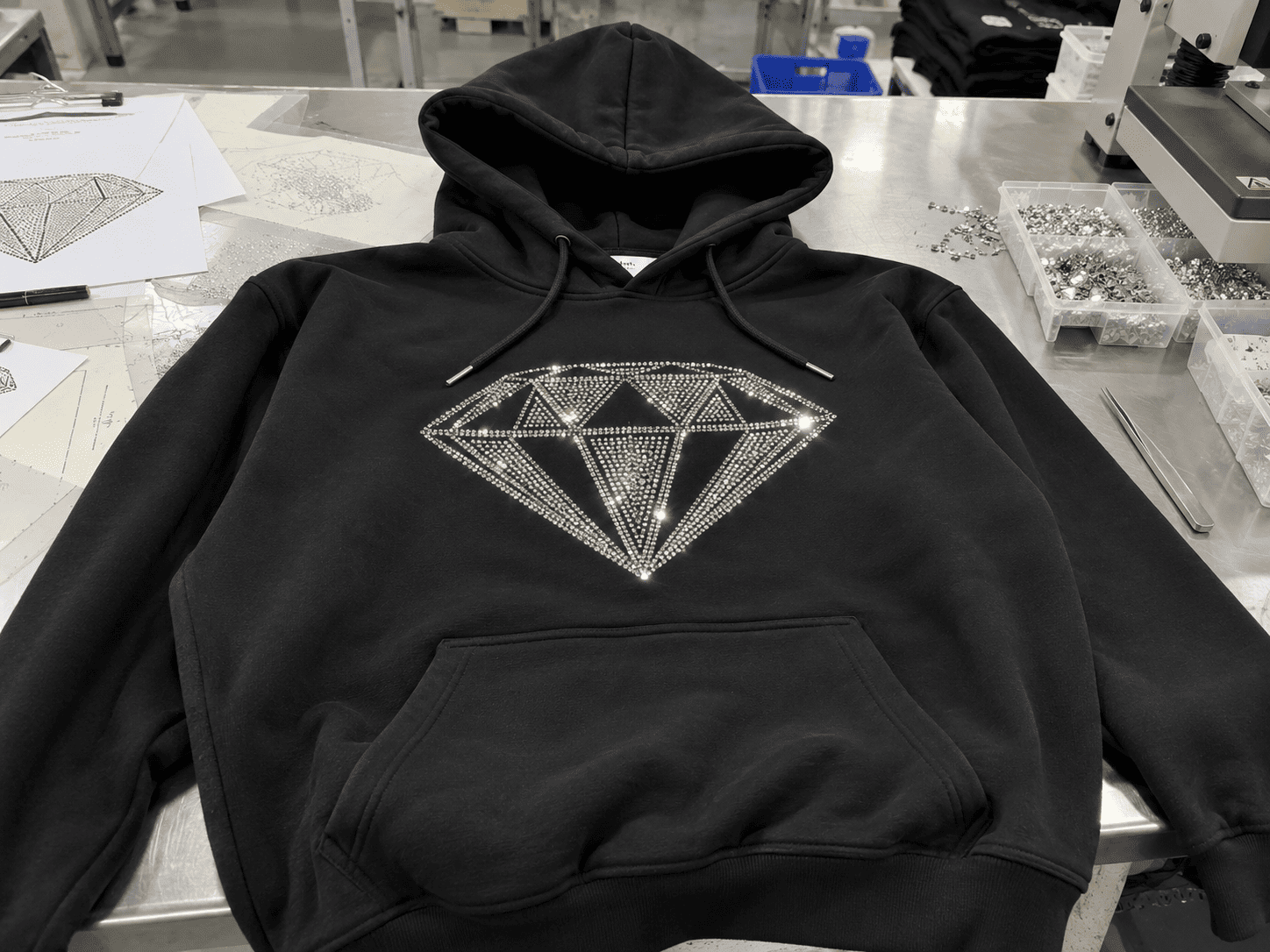
Rhinestones are not a small niche anymore.
According to Verified Market Research[^1], the global rhinestone market was valued at approximately USD 1.59 billion in 2025 and is projected to reach about USD 2.50 billion by 2033, representing a CAGR of around 5.8%.
Fashion and apparel remain important end-use applications, while hotfix rhinestones are a major product category because they allow faster and more repeatable application in production.[^1]
But rhinestone work is easy to do badly.
Here is how to get it right.
Table of Contents
- What Does a Rhinestone Apparel Manufacturer Actually Do?
- Which Rhinestone Method Should You Choose?
- How Do Stone Type and Size Change the Look?
- How Do You Stop Rhinestones From Falling Off?
- What MOQ and Cost Should You Expect?
- How Do You Choose a Rhinestone Apparel Manufacturer?
- Conclusion
What Does a Rhinestone Apparel Manufacturer Actually Do?
Many brands think a rhinestone manufacturer just glues stones onto a shirt.
The real job starts long before any stone touches fabric.
A rhinestone apparel manufacturer turns your artwork into a stone layout, prepares the template, selects the stones, tests the decoration on your actual fabric, manages application, and inspects the finished garment before bulk shipment.
Ideally, the supplier responsible for the rhinestone work also understands how the garment itself is made.
That matters more than most founders expect.
If a decoration workshop only receives a finished blank hoodie, it may know very little about the fabric composition, stretch, shrinkage, surface treatment, or previous washing process.
But all of those details can affect how well the stones bond.
Decorator Versus Garment Manufacturer
There are several kinds of suppliers in this space.
The first is a decoration shop.
It buys or receives finished garments, applies the rhinestones, and returns them.
The second is a garment manufacturer that makes the clothing and manages rhinestone decoration as part of the same production order.
The third is a trading company that may outsource both the garment and the decoration.
| Supplier type | What it controls | Main risk |
|---|---|---|
| Decoration shop | Rhinestones and application | Limited control over garment fabric and fit |
| Garment manufacturer managing rhinestone work | Fabric, fit, decoration specifications, testing and QC | Requires strong partner management |
| Trading company | Usually manages external suppliers | Less visibility into actual production |
We work as the second type.
Our core is heavyweight knitwear, which we manufacture in our own garment factory.
The rhinestone application itself is handled by a long-term specialist partner workshop that we manage directly.
Before decoration, we select and confirm the garment fabric.
We send the actual garment or actual production fabric for rhinestone testing.
We check the stone layout, application result, and bonding.
Then we inspect the finished garments before shipment.
So although the specialized rhinestone process is completed by our partner, one team remains responsible for the complete garment.
That distinction matters.
If the stones stay attached but the hoodie shrinks badly, the product still fails.
If the hoodie fits perfectly but the rhinestones start falling after washing, the product still fails.
The customer buys one garment, not separate manufacturing processes.
Ask any supplier one direct question:
"Do you make the garment yourself, or do you only decorate finished blanks?"
Then ask a second question:
"If the decoration is outsourced, who controls the testing and final quality?"
Those two answers tell you much more than a showroom photo.
If you want the full picture on building the base garment first, our low MOQ hoodie guide explains heavyweight custom hoodie production in more detail.
Which Rhinestone Method Should You Choose?
The application method affects durability, appearance, production speed, and cost.
Most buyers never ask about it.
They should.
For most commercial custom apparel, hotfix rhinestones applied using controlled heat and pressure are the most practical choice. Sew-on stones work better for certain heavy or couture pieces, while simple cold-glued stones generally carry more durability risk for washable garments.
Hotfix rhinestones have a heat-activated adhesive layer on the back.
During application, controlled temperature, pressure, and time activate the adhesive and bond the stones to the textile surface.
That combination of application speed and repeatability is one reason hotfix is such an important segment of the rhinestone market. Verified Market Research[^1] identifies hotfix as the dominant rhinestone product segment, citing application speed, repeatability, and lower labor variability.
Three Methods Compared
| Method | How it works | Durability | Best for |
|---|---|---|---|
| Hotfix / heat transfer | Pre-coated stones bonded using controlled heat and pressure | Good to very good when correctly applied | Hoodies, tees, sets, bulk apparel |
| Sew-on | Stones or settings physically stitched to garment | Very good | Jackets, couture, large decorative stones |
| Cold glue | Stones manually attached using adhesive | Variable | Costume pieces, special applications, small runs |
Hotfix production usually starts with a template.
Your artwork is converted into a rhinestone placement file.
Each position in the design corresponds to a stone.
The stones are arranged in a template, picked up using transfer material, and then positioned on the garment so the complete motif can be pressed in one operation.
This is much more consistent than trying to position hundreds or thousands of stones individually.
But hotfix does not automatically mean durable.
The result still depends on:
- Stone quality
- Adhesive quality
- Fabric surface
- Fabric stretch
- Press temperature
- Pressure
- Pressing time
- Cooling
- Washing conditions
That is why I would never choose a supplier based only on a photo of the finished design.
I want to know how they applied it.
Cold glue can sometimes hit a lower initial price, but the application system has to match the intended use of the garment.
For everyday hoodies and T-shirts that customers will repeatedly wash, I prefer a tested hotfix process.
If one quotation is dramatically cheaper than every other quotation, ask exactly which stone and application method the supplier plans to use.
How Do Stone Type and Size Change the Look?
Two rhinestone hoodies can use the same artwork and still look completely different.
The difference is often the stone itself.
Glass rhinestones generally create stronger sparkle and a more premium appearance than basic resin or acrylic options. Stone size also changes how much detail the design can reproduce.
Stone quality affects:
- Light reflection
- Color
- Clarity
- Surface consistency
- Backing quality
- Adhesion
- Final cost
Under bright retail lighting or phone-camera flash, these differences become much easier to see.
Stone Grades and Sizes
| Stone type | Sparkle | Typical durability | Cost |
|---|---|---|---|
| Premium crystal glass | Highest | High | Highest |
| Standard glass | Good | Good | Medium |
| Resin or acrylic | Lower | Variable | Lowest |
Rhinestone sizes are commonly described using SS, or stone size.
Approximate measurements can vary slightly by supplier and cutting system, so always confirm the actual sample rather than relying only on the SS number.
| Size | Approx. diameter | Typical use |
|---|---|---|
| SS6 | Around 2.0 mm | Fine details and outlines |
| SS10 | Around 2.8 mm | Logos and lettering |
| SS16 | Around 3.9 mm | Bold fills and graphics |
| SS20 | Around 4.7 mm | Large motifs and statement designs |
Size affects what your artwork can do.
Very small lettering can look perfect in an Illustrator file but become unreadable once each line has to be formed from individual stones.
Each letter needs enough space for the stones to maintain its shape.
That is why a good manufacturer sometimes needs to adjust the artwork slightly rather than mechanically copying it.
Thicker lines, cleaner spacing, and simpler shapes generally translate better into rhinestones.
Stone color also changes the mood of the garment.
Common options include:
- Clear
- Black diamond
- Gold
- Red
- Blue
- Pink
- AB / Aurora Borealis
- Mixed-color layouts
A multi-color rhinestone graphic normally requires more sorting and production control than a single-color layout.
The stone color also needs to be checked against the actual garment color.
A clear stone on black fleece looks completely different from the same stone on cream, grey, or washed navy.
So before bulk production, always inspect a physical rhinestone sample on the actual fabric color you plan to use.
How Do You Stop Rhinestones From Falling Off?
Stone loss is one of the biggest complaints in rhinestone apparel.
It is also one of the most preventable.
Rhinestones last when the factory matches the stone and adhesive system to the fabric, controls heat, pressure and time, then verifies the finished result through testing and appropriate care instructions.
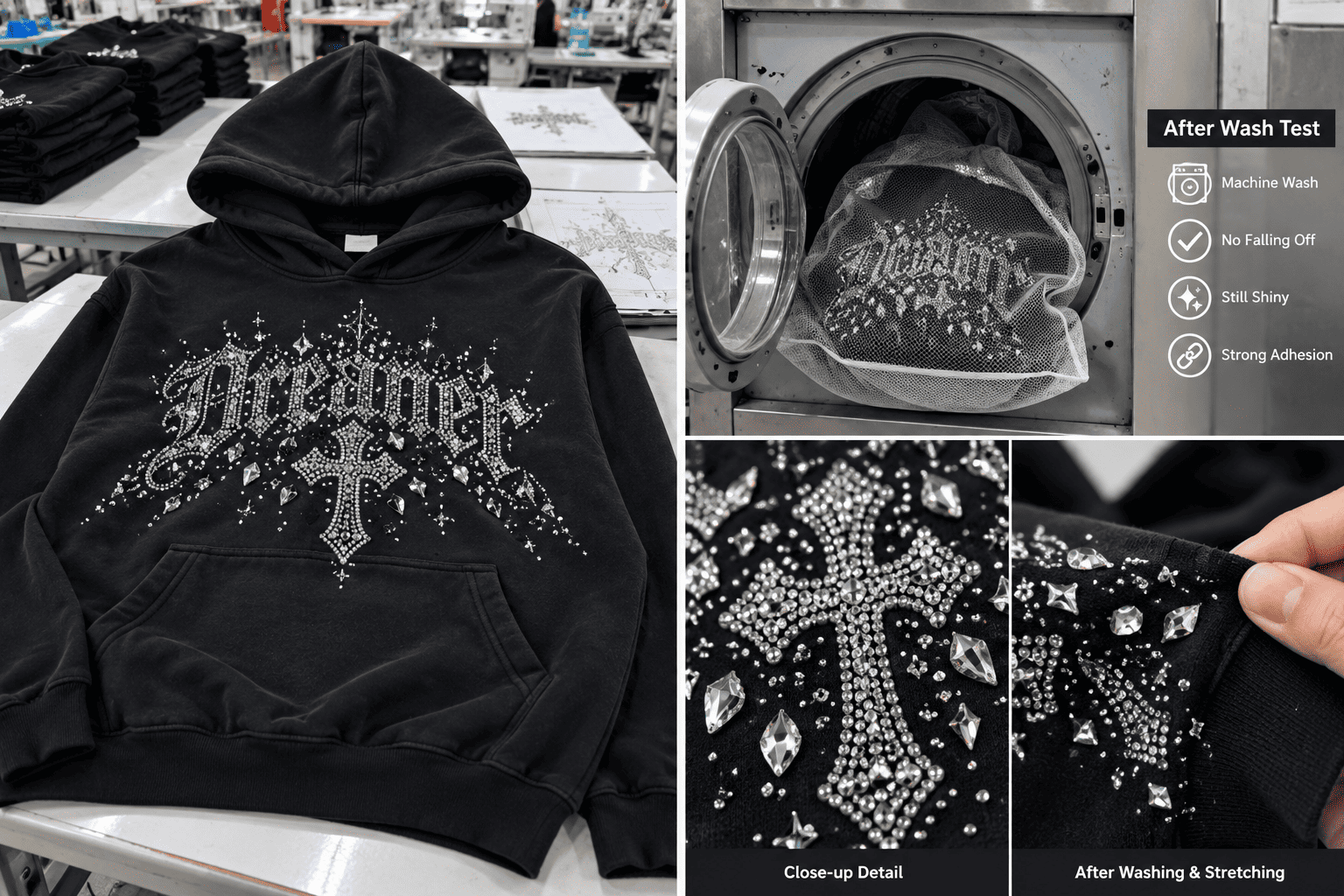
Most bonding failures are not caused by one single factor.
They happen because something in the application system is wrong.
Too little heat can prevent the adhesive from activating correctly.
Too much heat can damage certain fabrics or affect the adhesive.
Insufficient pressure can reduce contact between the adhesive and fabric.
Very stretchy, coated, textured, or unstable fabrics can create additional challenges.
Where the Bond Breaks
| Cause | What happens | Prevention |
|---|---|---|
| Low-quality adhesive | Stones detach after wear or washing | Use suitable, tested hotfix stones |
| Incorrect heat or time | Adhesive does not activate correctly | Test settings on actual fabric |
| Incorrect pressure | Incomplete contact with textile | Control heat-press pressure |
| Unsuitable fabric surface | Bonding becomes inconsistent | Test before approving bulk |
| Excessive fabric stretch | Decoration flexes and separates | Match design and fabric construction |
| Incorrect garment care | Heat and abrasion weaken decoration | Provide tested care instructions |
Fabric plays a big role.
Heavyweight fleece and French terry generally provide a more stable base than very thin, highly elastic fabrics.
But you should never assume that one press setting works for every 400 GSM hoodie.
Fabric composition, surface finishing, dyeing, washing, silicone treatment, brushed surfaces, and other finishing processes can change how the adhesive behaves.
That is why we prefer to test rhinestones on the actual fabric used for the garment, not simply on a random black fabric from the workshop.
Material safety can matter too, especially for brands selling internationally. OEKO-TEX® STANDARD 100[^2] is an independent certification system for textile products and components tested for harmful substances.
The important point is that certifications should apply to the relevant certified product or component. You should not assume that an entire rhinestone garment is certified simply because one fabric supplier has an OEKO-TEX certificate.
Wash Testing Before Bulk Production
Ask your manufacturer to test the approved decoration before moving into bulk production.
Testing can reveal:
- Stone loss
- Adhesive failure
- Fabric shrinkage
- Cracking around the motif
- Distortion
- Dye transfer
- Surface damage
If the garment is intended for repeated home washing, the care instructions should be based on what the finished product can actually tolerate.
For apparel sold in the United States, the Federal Trade Commission's Care Labeling Rule[^3] requires covered manufacturers and importers to provide regular care instructions and to have a reasonable basis for those instructions.
So do not simply copy:
"Wash cold. Do not tumble dry."
from another brand's label.
Test your own finished garment first.
Depending on the actual fabric and decoration test result, rhinestone garments may benefit from instructions such as:
- Wash inside out
- Use a gentle cycle
- Avoid excessive mechanical abrasion
- Use lower washing temperatures
- Avoid excessive tumble-drying heat
- Do not iron directly over the rhinestones
International care symbols are also standardized through systems associated with GINETEX and ISO 3758[^4]. GINETEX specifically notes that care instructions need to consider not only the textile itself but also accessories and applications attached to the article.
For rhinestone apparel, that is important.
Your hoodie fabric may survive one washing condition while the decoration cannot.
The final care label has to protect the complete product.
What MOQ and Cost Should You Expect?
Rhinestone garments usually cost more than basic printed garments.
The important question is why.
Our MOQ follows the base garment: typically 50 pieces per style for hoodies and sets and 100 pieces for T-shirts. Rhinestone cost then depends mainly on stone quantity, stone type, stone size, number of colors, design complexity, and decoration placements.
The biggest cost driver is usually the total number of stones.
A small chest logo may use a few hundred.
A dense full-back graphic may use several thousand.
The stone material and application work increase as the design becomes larger or more complicated.
What Changes the Rhinestone Cost?
- Total stone count
- Stone grade
- Stone size
- Number of stone colors
- Design density
- Design dimensions
- Number of placements
- Template complexity
- Garment fabric
- Order quantity
Minimums and the Money Flow
| Product | Typical MOQ per style |
|---|---|
| Hoodies, tracksuits, sets, jackets | 50 pcs |
| T-shirts, shorts, lighter knits | 100 pcs |
| Children's clothing | Depends on product and program |
Each new rhinestone artwork normally needs its own template or layout setup.
That creates an initial development cost.
Once the same design moves into a larger quantity, that setup cost is distributed across more pieces.
The same principle applies when one approved rhinestone motif is reused across several garment colors.
This is why no responsible factory should give you an exact final rhinestone price before reviewing:
- Artwork
- Dimensions
- Stone type
- Stone size
- Stone quantity
- Colors
- Placement
- Base fabric
- Order quantity
| Stage | What you pay | Typical terms |
|---|---|---|
| Sample | Sample and decoration development cost | Paid before sample development |
| Deposit | Before bulk production | Typically 50% for new clients |
| Balance | Before shipment | Remaining 50% |
For our regular production, sample charges and bulk-payment terms depend on the actual project.
The important point is to separate development cost from bulk unit cost.
A complicated full-back rhinestone design may cost more to develop than a small chest logo even when both are placed on the same hoodie.
If you plan to put rhinestones on a matching hoodie and sweatpants set, our tracksuit and sweatsuit guide explains how to keep the fabric color, trims, decoration, and fit consistent across both pieces.
How Do You Choose a Rhinestone Apparel Manufacturer?
Every supplier's photos sparkle.
You need to find the supplier whose garments still look good after production, shipping, wear, and washing.
Choose a manufacturer that understands the base garment as well as the decoration, clearly states the stone specification, tests the actual fabric, shows real production evidence, manages wash testing, and refuses unauthorized trademark copying.
The best question is not:
"Are your rhinestones strong?"
Every supplier will say yes.
Ask:
"How do you test that the rhinestones stay attached?"
Then listen to the answer.
A supplier with real production experience should be able to discuss:
- Fabric
- Stone type
- Adhesive
- Temperature
- Pressure
- Pressing time
- Test sample
- Wash testing
- Final inspection
A weak supplier simply says:
"Very strong. No problem."
Green Flags and Red Flags
| Green flag | Red flag |
|---|---|
| Understands and controls the base garment | Knows only the decoration |
| States stone type and grade clearly | Vague about stone material |
| Tests actual production fabric | Tests only random sample fabric |
| Shows real production photos | Uses only catalog or stock images |
| Explains its wash-test process | Says only "very strong" |
| Takes responsibility for partner processes | Blames subcontractors when problems occur |
| Refuses unauthorized trademark copying | Offers to reproduce any famous logo |
That last row deserves attention.
Rhinestone versions of famous logos are common.
But a factory willing to copy another company's protected trademark without authorization is not necessarily a factory you should trust with your own brand.
The World Intellectual Property Organization[^5] explains that trademarks are protected intellectual property rights and that registration generally gives the owner an exclusive right to use the registered mark or authorize another party to use it.
We do not reproduce protected brand logos or licensed characters without authorization.
For co-branded or licensed work, we may request confirmation that the customer has permission to use the artwork.
That rule protects both sides.
Compliance Is Different From Product Quality
Factory compliance also matters when you are choosing a long-term manufacturer.
But compliance and garment quality are not the same thing.
For example, Sedex's SMETA methodology[^6] evaluates areas including labour standards and health and safety. The 4-Pillar version also covers environment and business ethics.
It is a social-audit methodology used for supply-chain due diligence.
It does not mean that every rhinestone, stitch, or garment leaving the factory automatically passes a product-quality test.
You still need:
- Product sampling
- Fabric approval
- Decoration approval
- Wash testing
- Bulk QC
- Final inspection
We use compliance audits as one part of factory verification, while product quality is controlled separately through sampling and production inspection.
For the bigger picture on building a complete apparel line, our custom clothing manufacturer guide explains how fabric sourcing, sampling, decoration, production, quality control, and shipping fit together.
Conclusion
Great rhinestone apparel is a bonding job, a fabric job, and a garment-production job at the same time.
The rhinestones may be the first thing your customer notices.
But their durability depends on everything underneath them.
Choose the stone type carefully.
Confirm the stone size.
Test the rhinestones on the actual fabric.
Control heat, pressure, and application time.
Wash test the approved sample.
Then give customers care instructions based on the finished garment you actually tested.
For most custom hoodies, tees, and matching sets, a properly controlled hotfix process offers a practical balance of visual impact, consistency, and production efficiency.
But the supplier matters just as much as the application method.
We manufacture the base garments ourselves and manage specialized rhinestone application through a long-term partner workshop.
That allows us to control the fabric first, check the decoration on the actual garment, and inspect the complete piece before it ships.
Because your customer does not care which workshop completed which process.
They only care whether the finished hoodie still looks good after they wear it.
Footnotes & References
[^1]: Verified Market Research — Rhinestone Market. The report values the global rhinestone market at approximately USD 1.59 billion in 2025 and projects it to reach approximately USD 2.50 billion by 2033, at roughly a 5.8% CAGR. It also identifies hotfix as a leading segment because of application speed and repeatability.
https://www.verifiedmarketresearch.com/product/rhinestone-market/
[^2]: OEKO-TEX® — STANDARD 100. Official information about the globally standardized testing and certification system for textiles and textile components tested for harmful substances.
https://www.oeko-tex.com/en/our-standards/oeko-tex-standard-100/
[^3]: U.S. Federal Trade Commission — Care Labeling of Textile Wearing Apparel & Certain Piece Goods. Official U.S. rule requiring covered textile apparel manufacturers and importers to provide regular care instructions and possess a reasonable basis for those instructions.
https://www.ftc.gov/legal-library/browse/rules/care-labeling-textile-wearing-apparel-certain-piece-goods
[^4]: GINETEX — Textile Care Labelling. Official information on standardized textile-care symbols and care instructions, including consideration of textile coloration, finishing, accessories, and applications.
https://www.ginetex.net/labelling/
[^5]: World Intellectual Property Organization (WIPO) — Trademarks. Official overview of trademark protection, registration, ownership rights, and authorized use of registered trademarks.
https://www.wipo.int/en/web/trademarks
[^6]: Sedex — SMETA Audit. Official overview of the Sedex Members Ethical Trade Audit methodology. SMETA assesses labour standards and health and safety, while the 4-Pillar format also covers environment and business ethics.
https://www.sedex.com/solutions/smeta-audit/