

Plus-Size Clothing Manufacturer: How Do You Make Extended Sizes That Actually Fit?
You add 2XL, 3XL, and 4XL to your best-selling hoodie.
On the product page, everything looks fine.
Then the reviews arrive.
The sleeves are too long.
The shoulder seam drops halfway down the arm.
The body pulls across the stomach.
The hem rides up over the hips.
And the neckline looks much wider than it does on the smaller sizes.
The garment is technically bigger.
But it does not fit better.
That is the difference between:
making a larger garment
and:
developing an extended size range.
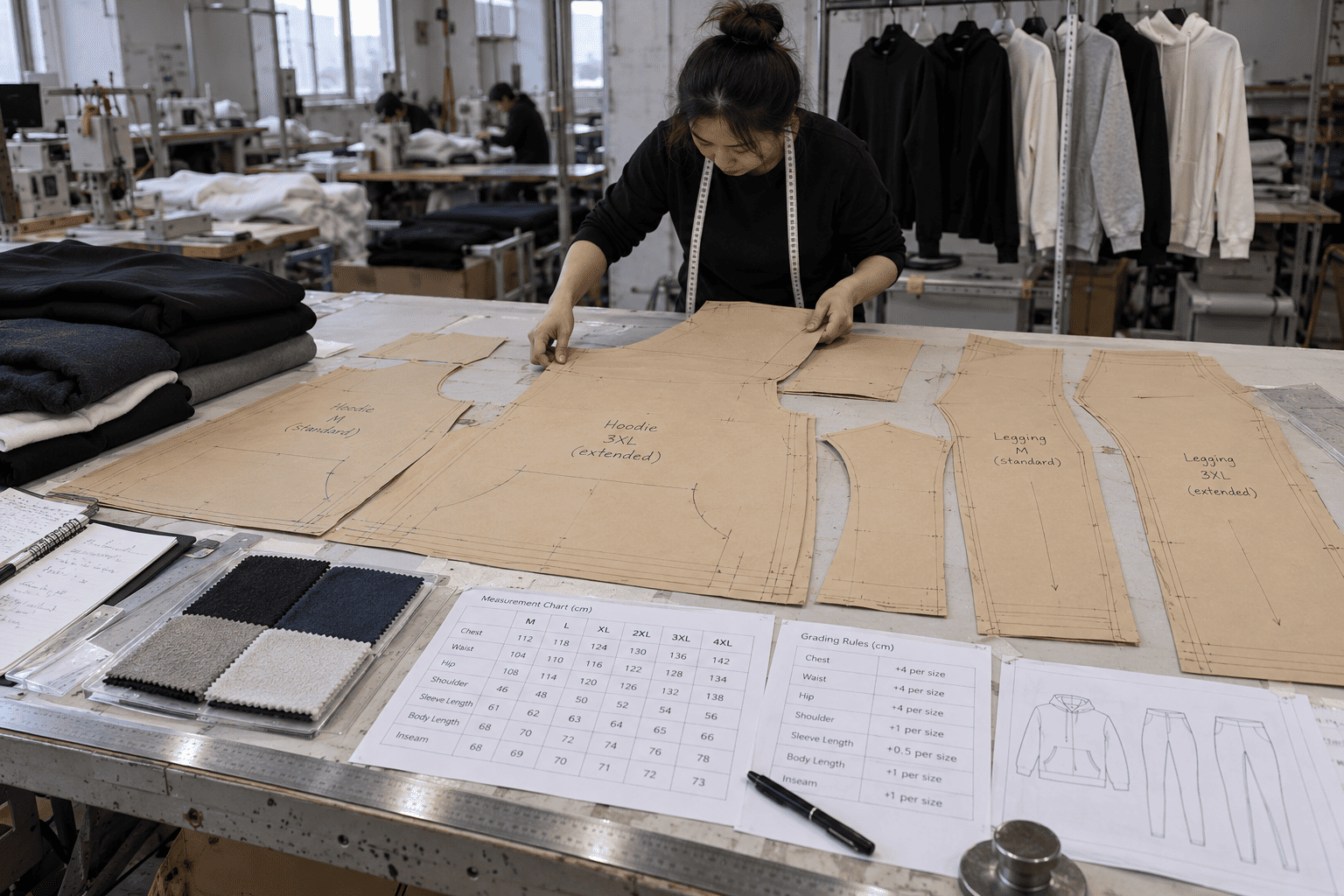
A plus-size clothing manufacturer develops patterns, grading, fit, fabric performance, and proportions for larger body sizes rather than simply enlarging every measurement from a standard base size. Good extended sizing is based on body measurements, target fit, real fit testing, and controlled grading across each area of the garment.
The commercial opportunity is substantial.
According to Persistence Market Research's Plus-size Clothing Market report[^1], the global plus-size clothing market is expected to reach approximately USD 345.6 billion in 2026 and is projected to grow to around USD 457.9 billion by 2033, at a CAGR of about 4.1%.
But there is another reason brands should take extended sizing seriously:
Customers notice when larger sizes were designed as an afterthought.
A size label can say:
3XL
but the customer only cares about one thing:
Does it fit my body properly?
Table of Contents
- What Does a Plus-Size Clothing Manufacturer Do Differently?
- Why Can't You Just Scale Up a Standard Pattern?
- How Do You Fit-Test Plus Sizes Properly?
- Which Fabrics and Details Work Best in Extended Sizes?
- How Do Prints, Labels, and Sizing Charts Change for Plus Sizes?
- What MOQ, Cost, and Timing Should You Expect?
- Conclusion
What Does a Plus-Size Clothing Manufacturer Do Differently?
From a sewing perspective, making a 4XL hoodie is not especially mysterious.
The difficult part comes before sewing.
Extended-size development requires deciding which body measurements need more room, which dimensions should increase only slightly, where a different pattern block is useful, and how the garment should fit across the full target size range.
There Is No Universal "Plus Size Starts at 1XL" Rule
This is important.
Different brands use different systems such as:
- XL
- XXL
- 1XL
- 2XL
- 3XL
- 4XL
But those labels do not represent one universal body measurement.
A 2XL from one brand can fit very differently from another brand's 2XL.
The international sizing framework reflects this.
ISO 8559-1:2017[^2] defines anthropometric body measurements that can be used to create size and shape profiles for clothing development.
The standard was reviewed and confirmed again in 2026, so it remains current.[^2]
Instead of saying:
"1XL means this exact body."
a more technical approach begins with measurements such as:
- Bust / chest
- Waist
- Hip
- Height
- Upper arm
- Inseam
depending on the garment.
Size Designation Should Relate to the Body
ISO 8559-2:2025[^3] is the current international standard covering primary and secondary dimension indicators for clothing size designation.
The 2025 edition replaced the previous 2017 version.[^3]
The important principle is that size designation is built around body dimensions, while the actual garment measurements are decided by the designer and manufacturer according to:
- Fit
- Ease
- Style
- Fabric
- Intended use
That is exactly how brands should think about extended sizing.
The customer's body measurement is one thing.
The finished hoodie measurement is another.
Standard Development vs Extended-Size Development
| Area | Weak approach | Better approach |
|---|---|---|
| Body data | Assumes 2XL means the same everywhere | Defines target body measurements |
| Pattern | Enlarges one base block continuously | Reviews proportions at larger sizes |
| Grading | Same increment everywhere | Different increments by measurement |
| Fit | Checks one standard sample | Checks strategic larger sizes |
| Sleeve | Continues adding length | Adds circumference where needed |
| Neck | Continues widening | Controls neckline proportion |
| Fabric | Assumes same performance | Checks stretch, opacity, recovery |
| Size chart | Lists only S–4XL | Gives useful measurements |
Our Development Process
Our in-house development covers:
- Pattern making
- Grading
- Technical specifications
- Sampling
- Measurement checking
- Costing
That means extended-size adjustments can be made during pattern development rather than asking the sewing department to "make it bigger."
That distinction matters.
Sewing follows the pattern.
If the pattern is wrong, perfect sewing still produces the wrong fit.
Why Can't You Just Scale Up a Standard Pattern?
Grading is the process of creating multiple sizes from a pattern.
The problem is not grading itself.
The problem is assuming that every body measurement changes at the same rate.
Human bodies do not increase proportionally in every dimension. A larger body does not necessarily have proportionally longer arms, a proportionally wider neck, and proportionally broader shoulders. That is why extended-size grading often needs different rules for different measurements or a second base block.
ISO sizing guidance supports this broader idea.
ISO 8559-3:2018[^4] describes a methodology for creating body-measurement tables and intervals for ready-to-wear clothing.
It specifically recognizes that body shapes and proportions can differ significantly across target population groups, which is why sizing systems need flexibility.[^4]
The Sleeve Example
Imagine your standard hoodie grades like this:
M → L → XL → 2XL → 3XL → 4XL
and every size adds:
2 cm sleeve length.
From M to 4XL, the sleeve may become 8–10 cm longer.
But your customer may need:
- More bicep room
- More armhole room
without needing an arm that is 10 cm longer.
This is how oversized sleeves happen.
Where Grading Often Needs More Thought
| Area | Possible problem from mechanical scaling | What to review |
|---|---|---|
| Shoulder | Becomes excessively wide | Shoulder increment |
| Upper arm | Remains too tight | Bicep width |
| Sleeve length | Becomes too long | Length increment |
| Chest | Insufficient room | Chest increment |
| Stomach | Front pulls upward | Front width / length |
| Hip | Hem catches at hip | Hip sweep |
| Neck | Becomes too open | Neck width |
| Body length | Becomes excessively long | Length grading |
| Back rise | Too shallow in leggings / pants | Rise and seat shaping |
These are examples.
There is no single grading formula that automatically solves every style.
Larger Sizes May Need a Different Block
Many brands use what is sometimes called:
block segmentation
or separate base patterns across the size range.
For example:
Standard block:
XS–XL
Extended block:
1XL–4XL
The exact break point depends on the brand's target body measurements.
The advantage is that the extended block can be developed around a different body proportion instead of forcing the original base pattern to carry the entire range.
This Is Not About Making Plus Sizes "Looser"
Another misconception is that plus-size fit simply means adding more ease everywhere.
That can create a shapeless garment.
A fitted product can still be fitted in an extended size.
A relaxed product can still be relaxed.
The goal is to preserve the design intent.
If a hoodie is meant to have:
- Dropped shoulder
- Oversized chest
- Cropped length
the 3XL should still look like the same hoodie.
Not like a completely different long tunic.
How Do You Fit-Test Plus Sizes Properly?
A perfect size M sample proves that your size M is good.
It does not prove your 3XL is good.
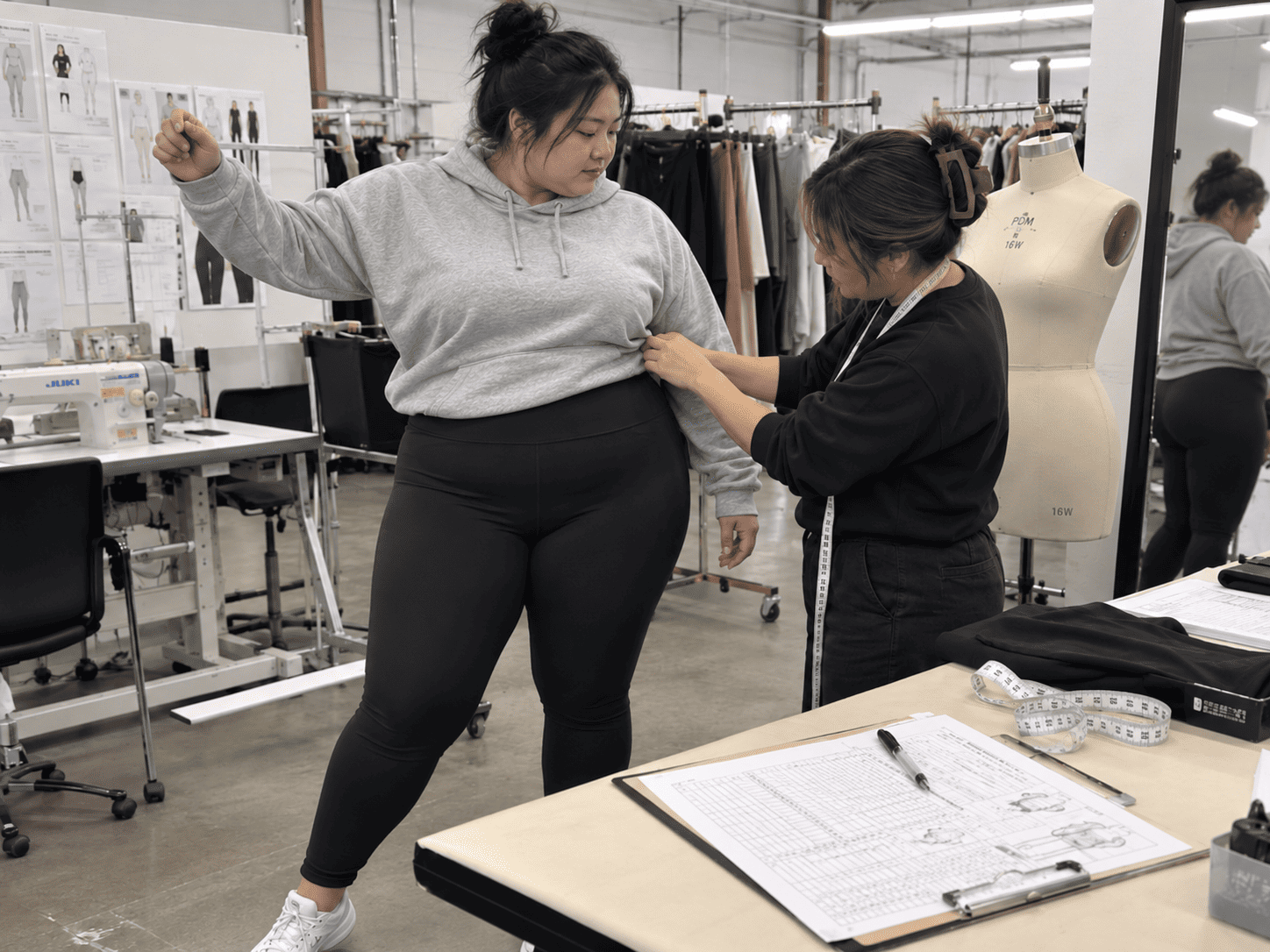
Extended-size fit should be checked in at least one strategically selected larger size, and ideally across a size set when the range is wide or the garment is highly fitted. The sample should be evaluated on a person or suitable fit form that represents the target measurements.
Start With Defined Body Measurements
ISO 8559-1 gives standardized definitions for anthropometric body measurements used in clothing development.[^2]
This matters because even simple terms such as:
- Waist
- Hip
- Back length
need consistent measuring methods.
If the customer measures hip one way and the factory measures it differently, the chart can appear correct while the garment fits incorrectly.
Fit Models Should Match the Target Size
A fit model is useful only if their body measurements are relevant to the size being developed.
Do not say:
"This person usually wears 3XL."
Record actual measurements.
For example:
- Bust
- Waist
- Hip
- Height
- Bicep
Then compare them with the intended body-size chart.
What Should the Wearer Do?
A fit session should not consist only of standing in front of a mirror.
Ask the wearer to:
- Sit
- Bend
- Raise arms
- Walk
- Reach
- Squat where appropriate
Different garments need different movement checks.
Hoodie Fit Checklist
Check:
- Shoulder position
- Chest room
- Stomach room
- Hip sweep
- Body length
- Sleeve length
- Bicep
- Armhole
- Neckline
- Hood size
Legging Fit Checklist
Check:
- Waistband
- Front rise
- Back rise
- Seat
- Thigh
- Knee
- Crotch
- Inseam
- Opacity
Sports Bra Fit Checklist
Check:
- Underband
- Cup coverage
- Armhole
- Strap length
- Side coverage
- Back
- Support during movement
One Plus-Size Sample Can Catch Expensive Problems
Suppose your order is:
500 hoodies.
You make only size M for approval.
Then after bulk, customers in 3XL and 4XL complain that:
- Sleeve is too long
- Neck is too wide
- Hip is too narrow
The cost of one additional development sample would have been tiny compared with:
- Returns
- Discounts
- Bad reviews
- Remaking stock
That is why a second strategic fit sample can be worthwhile.
Size Sets Become More Important as the Range Widens
If a style runs:
XS–4XL
that is a large span.
For key products, consider checking strategic points such as:
- Small end
- Base size
- Extended-size base
- Largest size
You may not need every size as a complete fit sample for every simple style.
But you should not assume the grading works simply because the measurement spreadsheet increases smoothly.
Which Fabrics and Details Work Best in Extended Sizes?
There is no special fabric category called:
plus-size fabric.
The same fabrics used in standard sizes can work very well.
The important question is how the material behaves on the intended garment and body.
For extended sizing, fabric should be evaluated for its actual function: drape, stretch, recovery, opacity, abrasion resistance, warmth, and dimensional stability. Heavier fabric is not automatically better, and stretch is not required for every plus-size garment.
Hoodies
For hoodies, a brand might use:
- French terry
- Brushed fleece
- Cotton/poly fleece
- Heavyweight cotton blends
The correct weight depends on the design.
A 500 GSM hoodie is not automatically better for a larger customer than a 350 GSM hoodie.
Heavier fabric can create:
- More warmth
- More structure
- More garment weight
A customer may prefer the lighter version.
T-Shirts
For tees, consider:
- Drape
- Opacity
- Body length
- Sleeve opening
- Neck recovery
A very stiff heavy tee may stand away from the body.
A softer fabric may drape more naturally.
The right choice depends on the brand.
Leggings and Bike Shorts
These need much more attention to:
- Stretch
- Recovery
- Opacity
- Pilling
- Waistband stability
The fabric should not become transparent simply because it is stretched over a larger hip circumference.
But the solution is not automatically:
use thicker fabric.
Opacity depends on:
- Knit density
- Color
- Extension
- Pattern negative ease
- Fabric construction
Inner-Thigh Pilling
Friction can be an important wear point on leggings, shorts, and some trousers.
ISO 12945-2:2020[^5] provides the modified Martindale method for evaluating a fabric's tendency to:
- Pill
- Fuzz
- Matt
under controlled conditions.[^5]
This can be useful for products where repeated surface friction is expected.
But pilling is influenced by several variables.
Do not advertise one fiber as universally "pill-proof."
Construction Details That Can Help
Depending on the garment:
- Gusset
- Wider waistband
- Flat seams
- Reinforced thigh
- Deeper rise
- Adjustable drawcord
may improve comfort and performance.
But use them because the design needs them.
Not because every plus-size garment must contain them.
A Wide Waistband Is Not Automatically Better
For leggings or joggers, a wider waistband may distribute pressure more comfortably.
But if the waistband is:
- Too tight
- Poorly shaped
- Too stiff
it can still roll or dig into the body.
Fit comes from the whole construction.
How Do Prints, Labels, and Sizing Charts Change for Plus Sizes?
Extended sizing is not only about patterns.
Visual proportions change too.
Logos and prints should be reviewed across the garment size range so they maintain the intended visual proportion. Some brands use one artwork size across all garments, while others use two artwork sizes for standard and extended sizes. Neither method is universally correct.
One Print Size
Suppose your chest print is:
30 cm wide.
On size S, it may appear large.
On size 4XL, the exact same 30 cm artwork will occupy a smaller percentage of the garment front.
That might be fine.
If consistency means:
identical physical print dimensions
then use one print size.
Two Print Sizes
Another brand may prefer:
Standard range:
30 cm print
Extended range:
36 cm print
That maintains a more similar visual proportion.
But screen printing may require:
- Additional screen
- Additional setup
- Separate production handling
So it costs more.
Print Strategy
| Strategy | Advantage | Trade-off |
|---|---|---|
| One artwork size | Simple and consistent | Looks proportionally smaller on large sizes |
| Two artwork sizes | Better visual balance | Additional setup |
| Multiple sizes | Highly controlled proportion | More complex / expensive |
| Embroidery size change | Can improve balance | Requires separate digitizing / setup |
Do Not Scale the Artwork Automatically
The biggest logo is not always the best logo.
A 40 cm chest graphic on a large hoodie may look good.
The same proportional enlargement of a small embroidered logo may look awkward.
Review the actual design visually.
Size Charts Need Real Body Measurements
This is another important improvement.
A size chart that says only:
S
M
L
XL
2XL
3XL
does not help someone understand fit.
The current ISO 8559-2:2025[^3] bases clothing size designation on body dimensions.
That does not mean every fashion brand must use ISO numbers as its commercial size names.
It means the technical logic should be:
size labels should correspond to defined body dimensions.
Body Measurements vs Garment Measurements
Brands should clearly distinguish:
Body measurement
from:
Garment measurement.
Example:
Customer body chest:
120 cm
Oversized hoodie garment chest circumference:
132 cm
The 12 cm difference is part of the intended ease.
If a customer sees only:
Chest 66 cm
they may not even know whether that means:
- Flat garment half chest
- Full garment chest
- Body chest
That confusion creates returns.
A Useful Size Chart Can Include
For a hoodie:
- Recommended body chest
- Garment chest
- Garment length
- Sleeve
- Shoulder
For leggings:
- Body waist
- Body hip
- Garment inseam
depending on the product.
U.S. Labeling Does Not Change Because the Garment Is Plus Size
For U.S. textile products, FTC Textile Fiber Rule[^6] requirements apply based on the textile product—not because it is standard or extended size.
Covered products generally need information including:
- Generic fiber names
- Percentages by weight
- Manufacturer or marketer identity
- Country of processing or manufacture
And the FTC Care Labeling Rule[^6] requires covered textile apparel to carry appropriate regular-care instructions.
A 4XL garment does not need different legal fiber information from the same garment in M.
The sizing may change.
The composition does not.
What MOQ, Cost, and Timing Should You Expect?
One of the biggest advantages of planning extended sizes inside the original product is that you do not necessarily need a separate production order for each size.
For our standard programs, MOQ is generally set by the style and production requirements rather than as an independent MOQ for every size. The order can usually be distributed across the agreed size range, although very wide size ranges, low quantities per size, special patterns, or material limits can affect production efficiency.
Our Typical Starting Quantities
Depending on the product:
| Product | Typical starting point |
|---|---|
| Hoodies / sweatshirts | Around 50 pcs per style |
| Sweatpants / sets | Around 50 pcs per style |
| T-shirts | Around 100 pcs per style |
| Shorts | Around 100 pcs per style |
| Compression leggings | Around 150 pcs per style |
Final MOQ still depends on:
- Fabric
- Colors
- Trims
- Decoration
- Size range
You Do Not Need 100 Pieces of Every Size
For example:
100 T-shirts total
could be distributed:
S — 10
M — 15
L — 20
XL — 20
2XL — 15
3XL — 12
4XL — 8
That is one possible size breakdown.
The correct distribution should come from your customer data.
Larger Sizes Use More Fabric
This is real.
A 4XL hoodie consumes more fabric than an S.
But that does not automatically mean the retail or manufacturing price must increase dramatically at every size.
Factories can handle size consumption in different ways.
For example:
- Average one price across the full size range
- Add surcharge only above certain sizes
- Quote different size groups
It depends on:
- Fabric price
- Style
- Width
- Size distribution
Very Wide Size Ranges Affect Marker Efficiency
Cutting efficiency also matters.
A marker combines different pattern pieces across the fabric width.
Changing the size mix affects:
- Fabric utilization
- Consumption
So actual garment costing should come from the planned size ratio.
Not only from the base-size sample.
Second Pattern Block
If your extended range needs a separate block, that creates additional development work.
That may include:
- Pattern
- Grading
- Sample
- Fit correction
But the cost is usually much smaller than producing hundreds of poorly fitting garments.
Print Sizes Can Add Setup Cost
If standard sizes use one screen and extended sizes use another:
you may need:
two print screens
instead of one.
The same principle applies to:
- Embroidery files
- Appliqué templates
- Other decoration setups
Timing
A standard garment sample may take roughly:
5–14 days
depending on:
- Fabric
- Style
- Decoration
If an extended-size fit sample is produced at the same development stage, some work can happen in parallel.
Bulk production for standard programs commonly falls around:
20–30 days after final approval and deposit
depending on fabric and complexity.
Payment
For new bulk orders, our normal structure is:
50% before bulk production and 50% before shipment.
Plan Size Distribution From Real Data
If you already sell clothing, use:
- Sales by size
- Return data
- Exchange data
- Out-of-stock history
If you are launching for the first time, begin cautiously.
Then adjust the second order based on real sell-through.
A larger size range is useful.
But producing equal quantities of every size without knowing your customers can create unnecessary inventory.
How Do You Choose a Plus-Size Clothing Manufacturer?
Do not ask only:
"Can you make 4XL?"
Almost every factory can make a physically larger garment.
Ask:
"How do you develop the 4XL?"
Green Flags and Red Flags
| Green flag | Red flag |
|---|---|
| Defines target body measurements | Treats 2XL as a universal measurement |
| Explains grading strategy | "We just enlarge the pattern" |
| Reviews strategic extended sizes | Fits only size M |
| Can discuss separate pattern blocks | Uses one rule through every size |
| Checks movement | Checks flat measurements only |
| Reviews fabric opacity / recovery where needed | Assumes heavier is always better |
| Reviews print proportions | Automatically uses one tiny logo |
| Separates body and garment measurements | Size chart is only S/M/L/XL |
| Makes grading changes intentionally | No technical record of changes |
Ask to See the Measurement Chart
The factory should be able to explain:
How does chest grow?
How does hip grow?
What happens to sleeve length?
What happens to the neckline?
What happens after the size-range transition?
Those answers are more valuable than:
"Yes, we can make up to 5XL."
Ask Where the Pattern Is Developed
For us, pattern development and grading are handled within our garment-development workflow.
That makes it easier to adjust:
- Chest
- Hip
- Bicep
- Sleeve
- Rise
without treating the extended size as a simple enlargement request at the sewing stage.
Conclusion
Extended sizing should start with the customer.
Not with the letter:
3XL.
Define the body measurements your brand wants to serve.
Then build the size chart.
Remember:
There is no single international body measurement attached to the label:
1XL
or:
3XL.
The important technical information is the actual body dimensions.
Next, develop the pattern.
Do not assume every measurement should grow by the same amount.
Review:
- Chest
- Stomach
- Hip
- Shoulder
- Bicep
- Sleeve length
- Neck
- Rise
independently.
If the size range is wide, consider a separate extended-size base block.
Then fit-test it.
A size M sample cannot prove that your 3XL fits.
Use a suitable extended-size fit model or fit form and check the garment while:
- Standing
- Sitting
- Bending
- Walking
- Moving
Choose the fabric for the garment's function.
Do not assume:
heavier fabric = better plus-size fabric.
For leggings, check:
- Stretch
- Recovery
- Opacity
- Pilling
For hoodies, check:
- Drape
- Weight
- Hip room
- Sleeve
- Neckline
For tees, check:
- Length
- Sleeve proportion
- Fabric drape
Then review the graphics.
One print size may work.
Two print sizes may look better.
That is a brand and production decision.
Finally, build a useful size chart.
Separate:
body measurements
from:
garment measurements.
Because the customer does not care how smoothly your spreadsheet grades from XL to 4XL.
They care about whether the garment fits when they put it on.
That is what good extended-size development is supposed to solve.
Footnotes & References
[^1]: Persistence Market Research — Plus-size Clothing Market Size, Share and Growth Forecast 2026–2033. Persistence Market Research estimates the global plus-size clothing market at approximately USD 345.6 billion in 2026 and projects it to reach approximately USD 457.9 billion by 2033, representing a CAGR of around 4.1%.
https://www.persistencemarketresearch.com/market-research/plus-size-clothing-market.asp
[^2]: International Organization for Standardization — ISO 8559-1:2017, Size Designation of Clothes — Part 1: Anthropometric Definitions for Body Measurement. Defines anthropometric measurements that can be used to create body-measurement databases, population size and shape profiles, and fit mannequins for clothing development. The standard was reviewed and confirmed in 2026 and remains current.
https://www.iso.org/standard/61686.html
[^3]: International Organization for Standardization — ISO 8559-2:2025, Size Designation of Clothes — Part 2: Primary and Secondary Dimension Indicators. The current 2025 edition defines primary and secondary body-dimension indicators used for clothing size designation and replaced the 2017 edition. Its sizing logic is based on the body dimensions of the person the garment is intended to fit rather than on garment measurements alone.
https://www.iso.org/standard/85590.html
[^4]: International Organization for Standardization — ISO 8559-3:2018, Size Designation of Clothes — Part 3: Methodology for the Creation of Body Measurement Tables and Intervals. Provides methodology for developing body-measurement tables and size intervals for ready-to-wear garments. ISO notes that body shape and proportions differ significantly across target population groups and that sizing systems need flexibility to accommodate these differences.
https://www.iso.org/standard/67334.html
[^5]: International Organization for Standardization — ISO 12945-2:2020, Textiles — Determination of Fabric Propensity to Surface Pilling, Fuzzing or Matting — Part 2: Modified Martindale Method. Specifies a controlled test method for evaluating a textile fabric's tendency to pill, fuzz, or matt under repeated rubbing.
https://www.iso.org/standard/75375.html
[^6]: U.S. Federal Trade Commission — Textile Fiber Rule and Care Labeling Rule. The Textile Fiber Rule requires covered textile products to disclose generic fiber names and percentages by weight, manufacturer or marketer identification, and country of processing or manufacture. The Care Labeling Rule separately requires covered textile apparel to carry regular-care instructions supported by an appropriate basis.
https://www.ftc.gov/legal-library/browse/rules/textile-fiber-rule
https://www.ftc.gov/legal-library/browse/rules/care-labeling-textile-wearing-apparel-certain-piece-goods