Low MOQ Hoodie Manufacturer: How Few Custom Hoodies Can You Actually Order?
You have a hoodie design and a small budget.
Then one factory asks for 1,000 pieces per color, and suddenly the entire launch becomes much harder.
For a startup clothing brand, this is a common problem. You want a real custom hoodie—not a blank garment with a logo—but you also do not want to invest in hundreds of pieces before you know whether customers will buy it.
A realistic low MOQ for fully custom hoodies can start around 50 pieces per style when the factory is set up for flexible small-batch production. At that quantity, buyers can still control fabric, GSM, measurements, fit, printing, embroidery, labels, and many trims. However, custom fabric, multiple colors, special hardware, and complex decoration can increase the real minimum.
I work with heavyweight knit garments, and one thing I have learned is that MOQ should never be discussed as one isolated number.
The sewing factory may accept 50 hoodies.
But the fabric mill, zipper supplier, embroidery factory, label supplier, or packaging supplier may each have their own minimum.
That is why the better question is not only:
What is your hoodie MOQ?
It is:
What specifications can I realistically customize at that MOQ?
Table of Contents
- What Counts as a Low MOQ for Custom Hoodies?
- What Is the Difference Between a Custom Hoodie and a Printed Blank?
- What Fabric and GSM Make a Good Custom Hoodie?
- How Do Colors and Sizes Affect Hoodie MOQ?
- What Can You Customize on a Low-MOQ Hoodie?
- Can Low-MOQ Hoodies Use Printing and Embroidery?
- How Much Does a Low-MOQ Custom Hoodie Cost?
- Why Does a Custom Hoodie Sample Cost More Than the Bulk Unit Price?
- How Long Does a Low-MOQ Hoodie Order Take?
- How Do You Spot a Reliable Low MOQ Hoodie Manufacturer?
- What Should You Send a Hoodie Manufacturer Before Asking for a Quote?
- How Can a Startup Keep Hoodie MOQ and Cost Under Control?
- Conclusion
- Footnotes & References
What Counts as a Low MOQ for Custom Hoodies?
Every supplier says it is “flexible.”
That word means very little until you see the actual quantity and what is included.
For fully custom cut-and-sew hoodies, around 50–100 pieces per style is a practical low-MOQ range for some flexible manufacturers. Fifty pieces can work when the fabric is available, the size range is controlled, and the design does not require too many custom components.
For example, this is a relatively practical 50-piece order:
- One hoodie style
- One color
- Four sizes
- Stock 400 GSM fleece
- Custom fit
- Small chest embroidery
- Large back print
- Woven neck label
- Standard polybag
Now compare it with another 50-piece order:
- Five colors
- Seven sizes
- Custom-knitted 470 GSM fabric
- Five custom Pantone colors
- Custom zipper pull
- Appliqué embroidery
- Rhinestone logo
- Custom rigid box
Both orders say “50 pcs.”
But they are completely different manufacturing programs.
Why 50 Pieces Can Work
A hoodie still has fixed setup work:
- Fabric sourcing
- Pattern making
- Cutting markers
- Cutting
- Print or embroidery setup
- Sewing-line preparation
- Finishing
- QC
- Packing
At 50 pieces, those costs are spread across a relatively small quantity, which is why the unit price is higher.
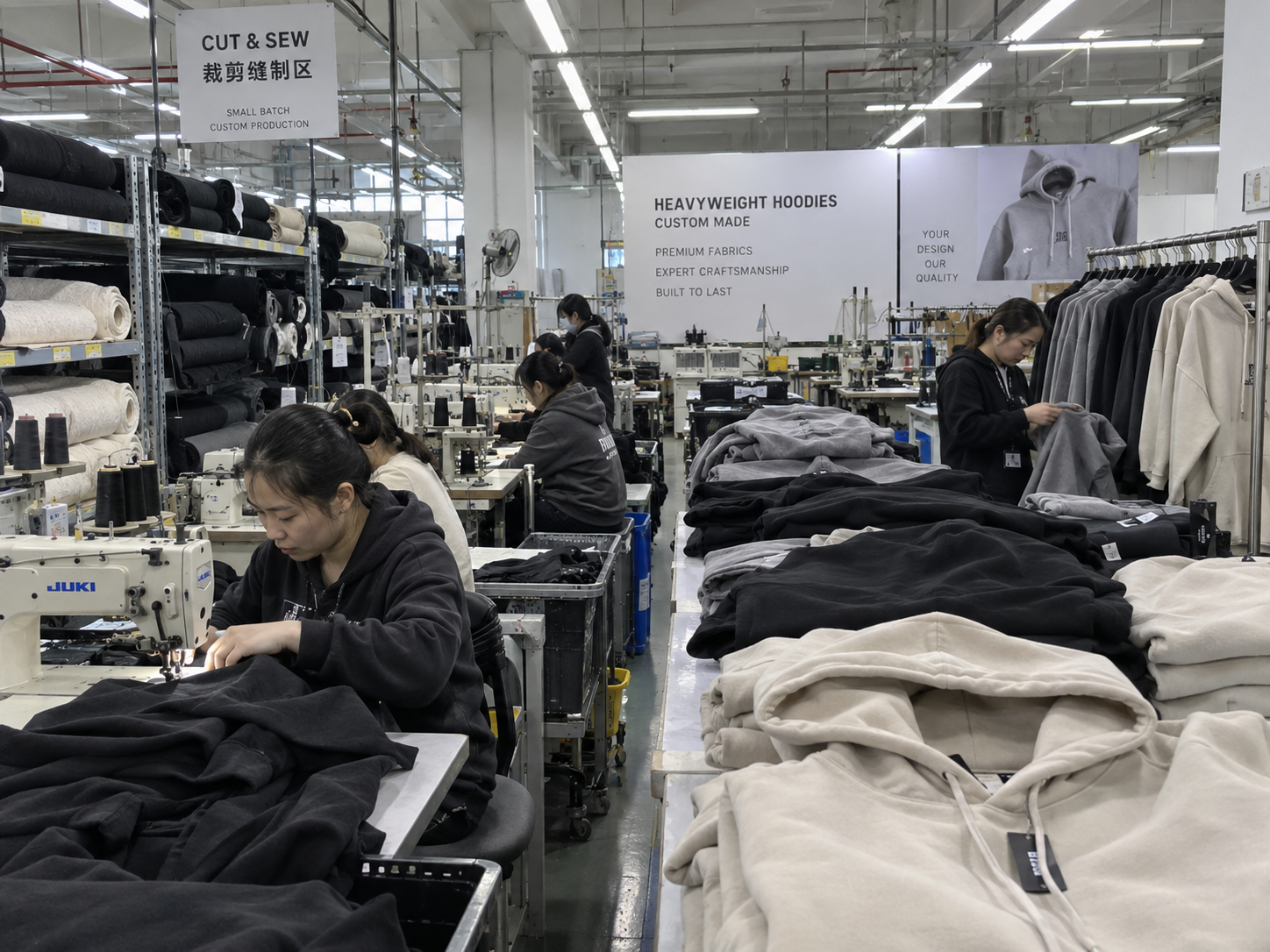
But for a factory structured around flexible custom production, 50 pieces can still be enough to run a proper small batch.
A simple way to think about the quantities is:
| Order Quantity | Typical Production Approach | Best For |
|---|---|---|
| 1–10 pcs | Blank garment / prototype / sample | Artwork or fit testing |
| 20–30 pcs | Very limited custom production in some cases | Special projects |
| 50 pcs | Real small-batch custom hoodie | First brand drop |
| 100 pcs | More flexibility in sizes and colors | Startup production |
| 300+ pcs | Better unit economics | Proven styles and reorders |
| 500+ pcs | More sourcing and pricing flexibility | Scaling products |
These are working ranges, not universal industry rules.
Every project still needs to be checked individually.
What Is the Difference Between a Custom Hoodie and a Printed Blank?
This is one of the most important differences for a startup to understand.
A print-on-demand supplier may allow you to order one hoodie.
But normally you are choosing an existing blank and adding your artwork.
You may have little or no control over:
- Fabric composition
- GSM
- Hood shape
- Shoulder width
- Body length
- Sleeve shape
- Rib specification
- Pocket construction
- Internal labels
- Pattern
- Fit
A fully custom hoodie is different.
The garment is developed around your specifications.
A true custom hoodie can control the pattern, fabric, measurements, construction, decoration, trims, and branding rather than only adding artwork to an existing blank.
That is why fully custom manufacturing needs a higher minimum than print-on-demand.
You are not only buying printing.
You are creating a garment.
For some brands, blanks are completely suitable.
If you are only testing whether customers like a graphic, they can be a smart starting point.
But if the selling point of your hoodie is:
- Heavyweight fabric
- Oversized fit
- Cropped body
- Wide sleeves
- Special hood structure
- Custom wash
- Premium embroidery
- Branded trims
then a real cut-and-sew manufacturer gives you much more control.
What Fabric and GSM Make a Good Custom Hoodie?
Founders often spend hours adjusting the logo and only a few minutes choosing the fabric.
I think that priority should be reversed.
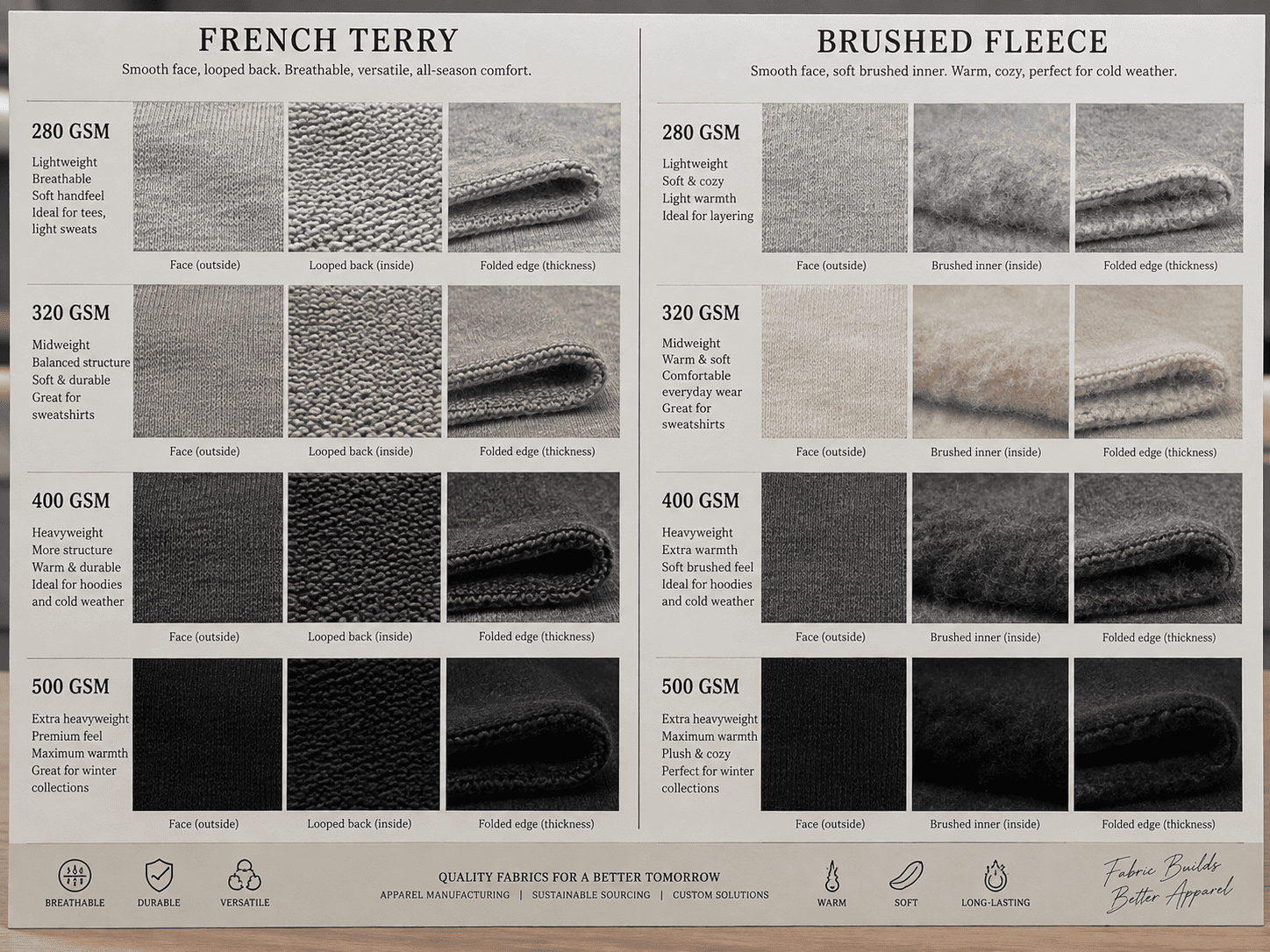
Fabric has a major influence on how a hoodie feels, hangs, washes, fits, and is perceived by the customer. Common custom hoodie options range from lighter French terry around 280–320 GSM to heavyweight fleece of 400 GSM, 500 GSM, or even higher.
French Terry
French terry normally has visible loops on the inside.
It can feel:
- Cleaner
- More breathable
- Less bulky
- Suitable for transitional seasons
Common weights may include:
- 320 GSM
- 350 GSM
- 380 GSM
- 400 GSM
Brushed Fleece
Brushed fleece has a softer, warmer inner surface.
It works well for:
- Winter hoodies
- Heavy streetwear
- Oversized styles
- Premium casualwear
Common options can include:
- 320 GSM
- 350 GSM
- 400 GSM
- 480 GSM
- 500 GSM
There is no single “premium” GSM.
A 400 GSM fabric can be excellent or poor depending on:
- Yarn
- Knitting density
- Fiber composition
- Surface finish
- Shrinkage
- Hand feel
GSM is important, but it is not the entire quality specification.
Stock Fabric Makes Low MOQ Easier
This is where fabric and MOQ connect.
If I already have access to:
400 GSM black cotton fleece
I may only need to purchase enough for 50 hoodies.
If the buyer asks for:
473 GSM custom structure, special cotton blend, custom Pantone green
the mill may need to knit and dye a completely new batch.
Now the fabric MOQ can become higher than the garment MOQ.
For startup brands, I often recommend asking:
What stock fabrics do you already have between 380 and 500 GSM?
before insisting on one exact number.
Sometimes a 480 GSM existing fabric gives the buyer exactly the result they want without developing a special 500 GSM fabric from zero.
How Do Colors and Sizes Affect Hoodie MOQ?
A 50-piece order does not tell me enough.
I also need to know how those 50 pieces are divided.
For example:
| Order | Colors | Sizes | Production Difficulty |
|---|---|---|---|
| A | 1 | 4 | Low |
| B | 2 | 4 | Medium |
| C | 5 | 7 | High |
Fifty black hoodies across S–XL are much easier than 50 hoodies split across five colors and seven sizes.
For smaller hoodie orders, I normally prefer a controlled size range.
Around four sizes is much easier to manage at 50 pieces.
If the brand wants five or more sizes, increasing the total quantity usually makes production more practical.
Custom Color Can Also Create a Fabric MOQ
If stock black, grey, navy, or brown is available, sampling and production can move faster.
A custom color may require:
- Lab dip
- Color approval
- Dye-lot minimum
- Production dyeing
- Finishing
For textile color references, Pantone's official Fashion, Home + Interiors system[^1] identifies TCX as the appropriate system for soft surfaces such as textiles and apparel.
I prefer a physical textile color reference rather than trying to approve production color from a phone screen.
What Can You Customize on a Low-MOQ Hoodie?
A real custom hoodie gives you much more control than a stock blank.
Even at a relatively low MOQ, buyers can often customize the fit, fabric, GSM, color, printing, embroidery, hood construction, pockets, drawcords, zippers, rib, labels, trims, and packaging.
What is practical depends on the supplier minimum for each component.
Fit
Possible options include:
- Regular
- Oversized
- Boxy
- Cropped
- Drop shoulder
- Wide sleeve
- Straight body
- Longer body
Fit comes from the pattern.
It does not come from simply choosing heavier fabric.
If you want an oversized hoodie, give the manufacturer actual measurements.
Hood
You may change:
- Single-layer hood
- Double-layer hood
- Hood depth
- Hood width
- Drawcord
- No drawcord
- Eyelets
Pockets
Options can include:
- Kangaroo pocket
- Split pocket
- Hidden side pocket
- Zipper pocket
- No pocket
Rib
You can adjust:
- Rib width
- Rib composition
- Cuff height
- Waistband height
- Rib tension
Zippers
For a zip hoodie, “YKK zipper” is not a complete specification.
YKK's official fastening product search[^2] shows metal, coil, VISLON®, slider, plastic hardware, snap and other product categories.
A useful zipper specification may look more like:
YKK #5 metal zipper
Gunmetal finish
Black zipper tape
Standard puller
A custom branded zipper pull may require a separate mold and MOQ.
For low-volume first orders, a standard zipper is often more economical.
Can Low-MOQ Hoodies Use Printing and Embroidery?
Yes.
Low MOQ does not mean your hoodie has to look generic.
A small-batch custom hoodie can still use screen printing, DTG, DTF, standard embroidery, puff print, appliqué, chenille, rhinestones, patches, silicone, and mixed decoration. The main difference is that setup costs have fewer garments to absorb them.
For example:
| Technique | Small-Batch Suitability | Main Consideration |
|---|---|---|
| Standard embroidery | Good | Digitizing/setup |
| DTF | Very good | Hand feel on large designs |
| DTG | Good | Fabric suitability |
| Screen print | Good | Screen setup |
| Puff print | Good | Artwork must suit effect |
| Appliqué | Possible | Template and labor |
| Chenille | Possible | Higher setup cost |
| Rhinestones | Possible | Template/setup |
| Silicone | Possible | Mold/setup may apply |
Artwork Quality Matters
For production, I prefer original artwork rather than screenshots.
Useful files include:
- AI
- EPS
- SVG
- Vector PDF
Adobe's official Illustrator supported file formats documentation[^3] confirms support for AI, PDF, EPS, SVG, and other common artwork formats.
A factory may still need to prepare separate embroidery or screen-printing files.
But good source artwork makes development much easier.
Keep the First Drop Focused
A first hoodie does not need every decoration technique.
Sometimes:
Small front embroidery + large back screen print
is enough to create a strong branded product.
Complexity should support the design.
It should not exist only to prove that the factory can do it.
How Much Does a Low-MOQ Custom Hoodie Cost?
There is no responsible way to quote one universal custom hoodie price.
The cost depends on:
- Fabric composition
- GSM
- Fabric availability
- Quantity
- Fit
- Printing
- Embroidery
- Washing
- Zipper
- Labels
- Trims
- Packaging
Low-MOQ hoodies normally cost more per piece than larger runs because pattern work, cutting setup, decoration setup, production preparation, and QC costs are divided across fewer units.
Imagine one setup costs $100.
At 50 pieces:
$100 ÷ 50 = $2 per hoodie
At 500 pieces:
$100 ÷ 500 = $0.20 per hoodie
The setup has not become cheaper.
The cost is simply spread across more pieces.
That is why startup brands should be careful when comparing quotations.
A $20 hoodie and a $30 hoodie may not be the same product.
One might be:
- 320 GSM polyester/cotton fleece
- Standard blank-style construction
- Simple DTF logo
while the other is:
- 500 GSM cotton fleece
- Custom oversized pattern
- Double-layer hood
- Embroidery
- Large back screen print
- Custom woven labels
Compare specifications first.
Then compare price.
Why Does a Custom Hoodie Sample Cost More Than the Bulk Unit Price?
This question comes up often.
A buyer may think:
If bulk is $30 per hoodie, why is one sample over $100?
Because a sample is not bulk production.
One sample may require:
- Fabric sourcing
- Pattern development
- Cutting
- Sewing
- Embroidery digitizing
- Print setup
- Label setup
- QC
- One-piece handling
All those development costs are concentrated into one garment.
Sample Fee and Bulk Terms Should Be Confirmed Early
Every manufacturer handles sample credits differently.
In our own project structure, when a sample-fee credit is offered, the qualifying bulk quantity and conditions should be confirmed before sampling begins.
For example, a factory may state:
Sample fee can be credited toward bulk when that style reaches 300 pieces.
If the buyer orders only 50 pieces, the sample fee remains a development cost.
The important thing is not that every factory uses the same rule.
The important thing is that the rule is written clearly before payment.
Bulk Payment
For a new customer, a common structure is:
50% deposit before bulk production
50% balance before shipment
The deposit is used to prepare:
- Fabric
- Rib
- Labels
- Zippers
- Printing
- Packaging
- Other production materials
Startup founders should plan cash flow around these payment stages instead of budgeting only for the final unit price.
How Long Does a Low-MOQ Hoodie Order Take?
A smaller quantity does not mean production happens instantly.
A custom hoodie still goes through:
- Fabric preparation
- Pattern confirmation
- Cutting
- Printing or embroidery
- Sewing
- Washing if required
- Finishing
- QC
- Packing
For many normal knitwear projects, a custom sample may take roughly 5–14 days, depending on fabric availability and decoration.
Bulk production may take approximately 20–30 days after sample approval and material confirmation, depending on complexity.
Special processes can extend the timeline.
These include:
- Custom fabric
- Custom dyeing
- Garment washing
- Large appliqué
- Complex embroidery
- Custom hardware
- Special packaging
For a startup with a launch date, I always recommend working backward from the required delivery date instead of assuming the factory can compress every stage.
How Do You Spot a Reliable Low MOQ Hoodie Manufacturer?
Low MOQ alone does not make a factory a good partner.
A reliable low MOQ hoodie manufacturer should have real knitwear experience, clear MOQ rules, a proper sample process, useful technical communication, quality-control procedures, and evidence that it can move from small orders into repeat bulk production.
Check the Factory's Real Specialty
Ask:
What do you make most often?
If you need heavyweight hoodies, look for evidence of:
- Hoodies
- Sweatshirts
- Joggers
- Heavyweight T-shirts
- Knit sets
Ask for factory production photos or videos.
Look at:
- Cutting
- Sewing
- QC
- Fabric
- Finished goods
A manufacturer whose daily production matches your product is usually safer than one with an enormous catalog covering every possible garment.
Check Compliance Claims Correctly
Buyers should also understand what different documents actually mean.
Sedex describes SMETA[^4] as a social audit methodology covering areas including labor standards, health and safety, environmental performance, and business ethics.
Sedex also explicitly states that SMETA is not a certification.
That distinction matters.
A supplier should be able to show the relevant audit information rather than simply placing a Sedex logo on its website.
For textile product safety, OEKO-TEX® STANDARD 100[^5] serves a different purpose: it covers textile products and components tested for harmful substances.
One document does not replace the other.
Look at the First Three Conversations
Communication during inquiry often tells me a lot.
Good questions include:
- What GSM?
- What fabric composition?
- French terry or fleece?
- Sample size?
- How many sizes?
- How many colors?
- What logo dimensions?
- What printing technique?
- Target market?
- Target quantity?
Vague communication creates vague production.
Green Flags and Red Flags
| Green Flag | Red Flag |
|---|---|
| Clear MOQ by product | “Any MOQ” without explanation |
| Hoodies are a core product | “We manufacture everything” |
| Clear sample process | Pushes directly into bulk |
| Actual factory photos/videos | Only stock images |
| Asks technical questions | Quotes from one photo |
| Explains limitations | Says yes to everything |
| Documents available for claims | Certification logos with no proof |
| Pricing after specs are understood | Final price before details |
A manufacturer saying “this may be difficult” is not necessarily a bad sign.
Sometimes it is evidence that someone actually understands the product.
What Should You Send a Hoodie Manufacturer Before Asking for a Quote?
The better your inquiry, the better your quotation.
Before requesting a custom hoodie price, send the factory your quantity, fabric composition, GSM, color, size range, sample size, measurements, logo artwork, decoration technique, labels, trims, packaging, and target market.
A useful inquiry might look like this:
| Item | Requirement |
|---|---|
| Product | Oversized pullover hoodie |
| Quantity | 50 pcs |
| Fabric | 100% cotton fleece |
| GSM | 450–500 GSM |
| Color | Black |
| Sizes | S–XL |
| Sample size | L |
| Front logo | 8 cm embroidery |
| Back logo | 32 cm screen print |
| Hood | Double layer |
| Neck label | Custom woven |
| Care label | Custom |
| Packaging | Individual polybag |
| Market | United States |
Now I can actually check:
- Fabric availability
- MOQ
- Sample cost
- Bulk price
- Sample lead time
- Production time
Target Market Matters
Labels are not only branding.
If a product will be sold in the United States, the U.S. Federal Trade Commission's Textile Fiber Rule[^6] requires covered textiles to disclose information including fiber content, the responsible manufacturer or marketer, and country of origin.
Care instructions also need to be considered for covered apparel.
That is why the manufacturer should know where the garment will ultimately be sold.
How Can a Startup Keep Hoodie MOQ and Cost Under Control?
The easiest way is not to negotiate every supplier down to an impossible minimum.
It is to design the first order around a practical supply chain.
Use Stock Fabric Where Possible
Instead of:
It must be exactly 463 GSM.
consider:
I want a premium heavyweight fabric between 430 and 500 GSM. What do you already have available?
That gives the manufacturer room to find a good stock option.
Start With Fewer Colors
One strong black hoodie usually creates less production risk than five colors with ten pieces each.
You can add colors after the first design proves itself.
Keep the Size Range Practical
For 50 pieces, four sizes may be easier than seven or eight.
Use your expected customer distribution instead of splitting everything equally.
Avoid Custom Hardware Too Early
A custom zipper pull or metal logo may require:
- Mold cost
- Minimum production quantity
- Additional sample time
That detail may be worth it at 500 pieces.
It may not be worth it at 50.
Spend Money Where Customers Feel It
For a first hoodie, I would prioritize:
- Fabric
- Fit
- Construction
- Decoration
- Quality control
Then I would think about expensive custom packaging and special hardware.
A premium box cannot fix a bad hoodie.
Treat the First 50 Pieces as a Test
Your first production run should teach you:
- Which sizes sell
- Which customers return
- Whether the fit works
- Whether the fabric performs well
- Whether the print survives washing
- Whether the price works
- Whether the factory follows instructions
If the product succeeds, the second order becomes easier.
You now have:
- Approved pattern
- Approved measurements
- Approved fabric
- Approved artwork
- Production experience
- Real customer feedback
That is how a 50-piece order can become a 300-piece or 1,000-piece reorder.
Conclusion
Yes, a real low MOQ custom hoodie can start around 50 pieces with the right manufacturer.
But that does not mean every possible hoodie specification can be produced at 50 pieces.
The actual minimum depends on:
- Fabric
- GSM
- Color
- Size range
- Printing
- Embroidery
- Washing
- Zippers
- Hardware
- Labels
- Packaging
For a startup, I think the smartest first order is usually simple enough to manufacture efficiently but custom enough to feel like a real brand.
That may mean:
- One hoodie style
- One or two colors
- Around four sizes
- Available heavyweight fabric
- Custom fit
- One or two decoration techniques
- Custom labels
- Simple packaging
This gives the brand real control over the garment without creating unnecessary MOQ problems.
I would also avoid choosing a manufacturer only because the website says:
Low MOQ.
Ask what that actually means.
Can you choose the fabric?
Can you change the pattern?
Can you control measurements?
Can you add your own labels?
Can you approve a real sample?
Can the same factory reproduce the hoodie later when the order grows?
Those questions separate real custom manufacturing from blank-product decoration.
A good low MOQ hoodie manufacturer should not only help you make the fewest possible pieces.
It should help you build a hoodie that is good enough to sell, learn from the first order, and then scale the same product when your brand grows.
Footnotes & References
[^1]: Pantone — Fashion, Home + Interiors (FHI). Official Pantone color system explaining that TCX is used for soft surfaces such as textiles and apparel.
https://www.pantone.com/na/en-us/fashion-home-interiors
[^2]: YKK Fastening Products Group — Product Search. Official YKK database covering metal, coil and VISLON® zippers, sliders, plastic hardware, snaps, buttons, and other fastening components.
https://www.ykkfastening.com/products/search/?cl=on
[^3]: Adobe — Supported File Formats in Illustrator. Official Adobe documentation covering AI, PDF, EPS, SVG, and other file formats commonly used for scalable production artwork.
https://helpx.adobe.com/illustrator/desktop/get-started/learn-the-basics/supported-file-formats.html
[^4]: Sedex — SMETA Audit. Official Sedex information describing SMETA as a social-audit methodology covering labour standards, health and safety, environmental performance, and business ethics. Sedex states that SMETA is a continuous-improvement methodology rather than a certification.
https://www.sedex.com/solutions/smeta-audit/
[^5]: OEKO-TEX® — STANDARD 100. Official information about STANDARD 100 certification for textile products and components tested for harmful substances.
https://www.oeko-tex.com/en/our-standards/oeko-tex-standard-100
[^6]: U.S. Federal Trade Commission — Textile Fiber Rule. Official U.S. rules requiring covered textile products to disclose fiber content, the responsible manufacturer or marketer, and country of origin.
https://www.ftc.gov/legal-library/browse/rules/textile-fiber-rule