Loungewear Manufacturer: How Do You Get the Softness and Fit Right?
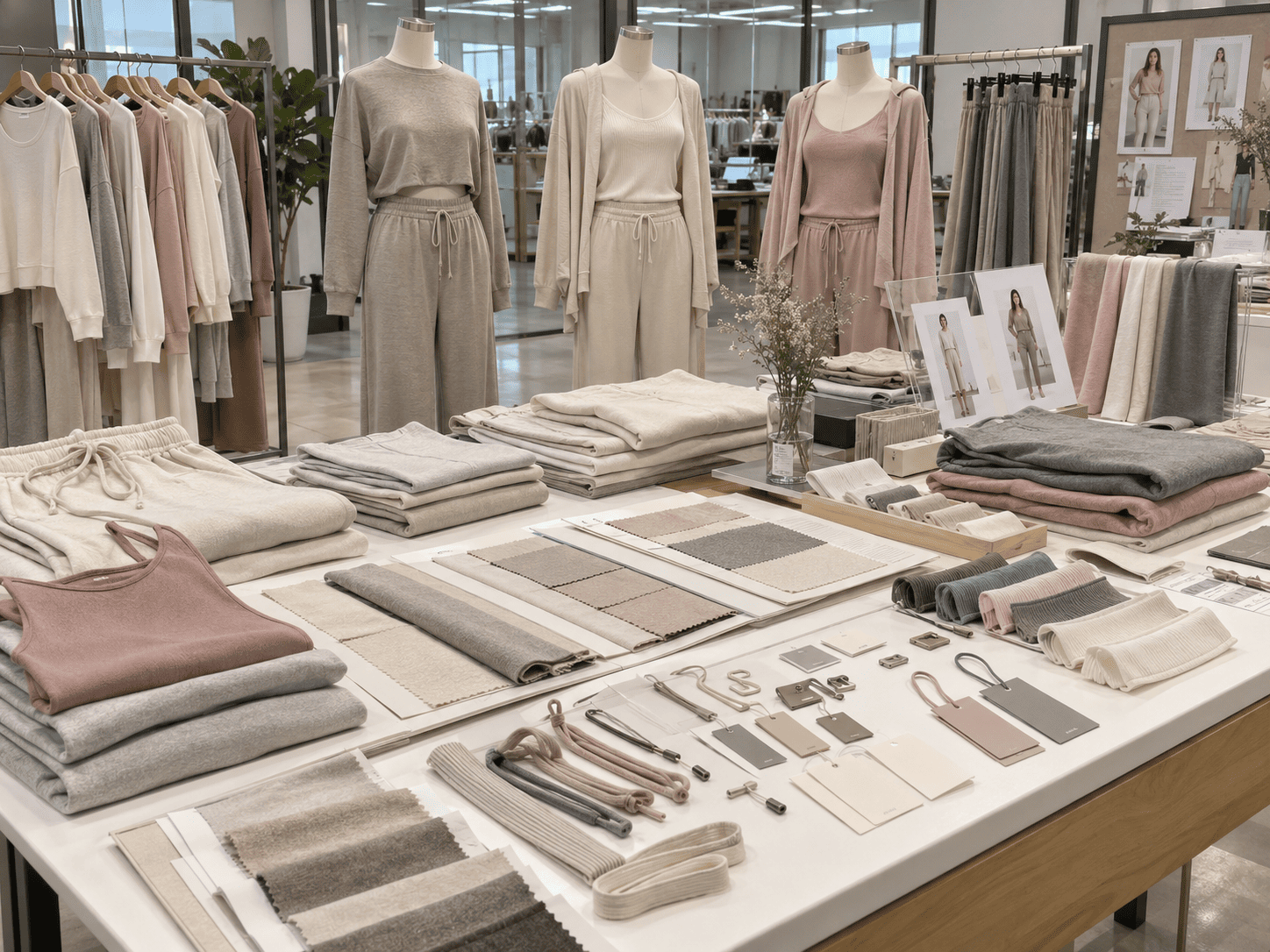
Loungewear looks simple.
A soft top.
A relaxed pair of pants.
Maybe a matching set.
But when you actually manufacture it, getting the product to feel premium without becoming shapeless is harder than it looks.
If the fabric is too stiff, it does not feel like loungewear.
If the fabric is too soft with poor recovery, the garment can stretch out and lose its shape.
If the elastic is too strong, the waistband becomes uncomfortable.
If the pattern is too loose, the set starts looking more like sleepwear than a product your customer wants to wear outside the house.
A good loungewear manufacturer needs to balance softness, drape, breathability, stretch recovery, and fit. Fabrics such as cotton jersey, modal, viscose, lyocell, and blended knits can all work, but the correct fiber, GSM, finish, pattern, waistband, seams, and labels depend on how the finished garment is intended to feel and be worn.
I work with knit garments in Dongguan, and for loungewear I normally start with one question:
What do you want the customer to feel when they touch the garment?
That answer usually tells us more than the logo.
Table of Contents
- What Counts as Loungewear?
- What Makes Loungewear Feel Premium?
- What Fabric Is Best for Loungewear?
- What Is the Difference Between Viscose, Modal, and Lyocell?
- Can You Label Fabric as Bamboo?
- How Much Stretch Should Loungewear Have?
- What GSM Should You Choose for Loungewear?
- How Do You Get the Loungewear Fit Right?
- What Waistband Construction Feels Most Comfortable?
- What Labels and Trims Work Best for Loungewear?
- What Decoration Should You Use?
- How Important Are Shrinkage and Wash Testing?
- What MOQ Should You Expect for Custom Loungewear?
- What Affects Loungewear Manufacturing Cost?
- Why Should You Make a Sample First?
- What Should You Send a Loungewear Manufacturer?
- How Do You Choose a Reliable Loungewear Manufacturer?
- Conclusion
- Footnotes & References
What Counts as Loungewear?
Loungewear overlaps with several categories.
It can sit somewhere between:
- Sleepwear
- Casualwear
- Athleisure
- Knit basics
That is why the term is sometimes vague.
Loungewear generally refers to comfortable garments designed primarily for relaxing and casual everyday wear, including matching sets, relaxed pants, soft tops, lightweight sweatshirts, robes, and similar easy-wearing pieces.
A loungewear collection might include:
| Product | Typical Role |
|---|---|
| Matching top + bottom set | Core loungewear product |
| Wide-leg lounge pants | Relaxed everyday bottom |
| Lounge joggers | Casual fitted bottom |
| Soft T-shirt | Base layer |
| Long-sleeve top | Transitional piece |
| Lightweight hoodie | Layering |
| Crewneck | Casual top |
| Robe / kimono | Home / gifting |
| Shorts set | Warm-weather collection |
Loungewear Is Not Necessarily Sleepwear
A pajama can be intentionally loose and visually very relaxed.
Loungewear often needs a cleaner silhouette because customers may wear it for:
- Working from home
- Traveling
- Coffee runs
- Shopping
- Casual social situations
The product still needs comfort.
But it also needs shape.
That is where fabric drape and pattern development become important.
What Makes Loungewear Feel Premium?
For loungewear, the first impression usually comes from touch.
Before the customer studies the stitching, they feel the fabric.
So I look at:
- Softness
- Smoothness
- Drape
- Weight
- Stretch
- Recovery
- Breathability
- Surface finish
Premium loungewear is not automatically the softest fabric available. The fabric also needs enough stability and recovery to maintain the intended fit after hours of wear and repeated washing.
Imagine a very soft pair of lounge pants.
On the first fitting it feels excellent.
After two hours:
- Knees become baggy
- Waist stretches
- Seat loses shape
That is not a premium result.
Softness has to be balanced with stability.
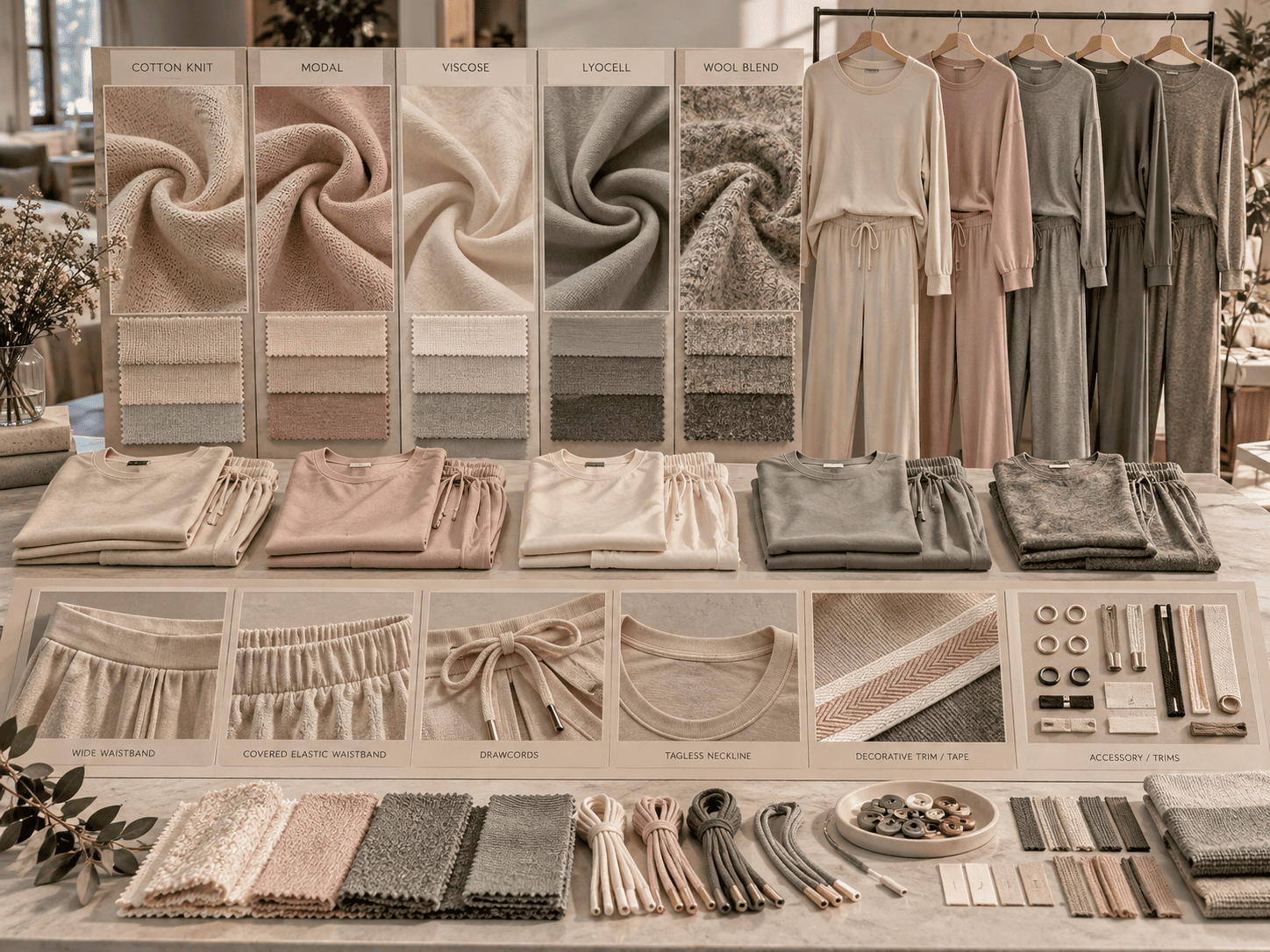
What Fabric Is Best for Loungewear?
There is no single best fiber.
Different fabrics create different products.
Common choices include:
- Cotton jersey
- Cotton/elastane
- Viscose
- Modal
- Lyocell
- Polyester blends
- French terry
- Brushed fleece
Cotton
Cotton is familiar and versatile.
It can work well for:
- T-shirts
- Shorts
- Pants
- Casual sets
Depending on the yarn and finish, cotton can feel:
- Crisp
- Dry
- Soft
- Vintage
- Smooth
Cotton + Elastane
A small amount of elastane can improve:
- Stretch
- Recovery
- Body fit
This can work well for:
- Fitted lounge tops
- Leggings-style bottoms
- Slim lounge pants
Modal
Modal is widely used for next-to-skin garments because it can provide a smooth and soft hand feel.
Lenzing describes modal as a regenerated cellulosic fiber produced under modified viscose conditions and notes its softness and dimensional characteristics. Its branded TENCEL™ Modal fibers[^1] are one example of branded modal fiber.
This distinction matters:
Modal is a generic fiber category. TENCEL™ Modal is a branded modal fiber made by Lenzing.
A generic modal fabric should not automatically be advertised as TENCEL™.
Lyocell
Lyocell is another regenerated cellulosic fiber.
It can be used for garments that need:
- Smooth hand feel
- Soft drape
- Fluid silhouette
Again, TENCEL™ Lyocell is Lenzing's brand.
Not every lyocell fabric is TENCEL™.
Viscose
Viscose can create:
- Softness
- Fluid drape
- Smooth surface
It is commonly used in:
- Lounge sets
- Tops
- Soft trousers
- Dresses
- Sleepwear
But the exact performance still depends on yarn and fabric construction.
Fiber name alone does not tell you everything.
What Is the Difference Between Viscose, Modal, and Lyocell?
This is a common sourcing question.
All three belong to the broader family of regenerated cellulosic fibers, but their production methods and resulting properties differ.
A simplified sourcing comparison:
| Fiber | Typical Product Character |
|---|---|
| Viscose | Soft, fluid, drapey |
| Modal | Very soft, suitable for next-to-skin products |
| Lyocell | Smooth, drapey, versatile |
| Cotton | Natural familiar hand, wide range of structures |
Lenzing's technical information describes modal as a modified viscose-type fiber and emphasizes its softness for next-to-skin applications.[^1]
The important thing for a brand is not to rely on fiber names alone.
Ask for the actual fabric.
Feel it.
Stretch it.
Wash it.
Blending Changes the Result
For example:
90% modal / 10% elastane
will behave differently from:
60% modal / 40% cotton.
The blend changes:
- Stretch
- Recovery
- Drape
- Weight
- Cost
- Hand feel
So I always prefer discussing the complete composition.
Can You Label Fabric as Bamboo?
This is one of the most important compliance issues in loungewear because “bamboo” is frequently used in soft sleepwear and lounge products.
In the United States, you need to be careful.
The U.S. Federal Trade Commission's bamboo textile guidance[^2] states that textiles may only simply be called bamboo if the textile fiber is actually made directly from bamboo fiber.
When bamboo is used as the cellulose source and converted through a rayon or viscose process, FTC guidance says appropriate terminology may include:
Rayon made from bamboo
or:
Viscose made from bamboo
rather than simply:
Bamboo.
Why Does This Matter?
A supplier may tell you:
This is 95% bamboo, 5% spandex.
But before printing 10,000 care labels, I would ask:
What is the actual generic fiber?
If it is regenerated viscose derived from bamboo, the U.S. label needs to reflect the correct fiber identity.
Be Careful With Eco Claims Too
The FTC also warns against assuming that soft viscose fabric made from bamboo automatically retains environmental or antibacterial properties of the original bamboo plant.[^2]
That means I would avoid unsupported statements such as:
Naturally antibacterial bamboo fabric
or:
100% eco-friendly bamboo
unless the specific claim can actually be substantiated.
Good sourcing includes good labeling.
How Much Stretch Should Loungewear Have?
Not every loungewear garment needs elastane.
A relaxed wide-leg pant may use a fluid fabric with no elastane at all.
A fitted lounge top may benefit from stretch.
The amount depends on:
- Fit
- Product
- Fabric structure
- Customer expectation
Relaxed Fit
May prioritize:
- Drape
- Softness
- Breathability
over high stretch.
Fitted Lounge Set
May need more:
- Stretch
- Recovery
- Body movement
Recovery Is Important
Soft fabric can sometimes stretch during wear.
If the product does not recover well, you may see:
- Baggy knees
- Loose elbows
- Sagging seat
- Stretched neckline
That is why I evaluate the garment after wearing it, not only when it comes off the sewing line.
What GSM Should You Choose for Loungewear?
There is no universal loungewear GSM.
The right weight depends on the product.
Practical starting ranges might look like:
| Product | Possible Fabric Range |
|---|---|
| Lightweight lounge tee | 140–190 GSM |
| Soft long-sleeve top | 160–220 GSM |
| Jersey lounge pants | 180–260 GSM |
| Lightweight set | 180–280 GSM |
| French terry set | 260–350 GSM |
| Warm fleece loungewear | 300–400+ GSM |
These are practical sourcing ranges.
Not formal industry standards.
GSM Does Not Equal Softness
A 180 GSM modal jersey can feel much softer than a 300 GSM cotton fabric.
Weight and hand feel are different properties.
So never write:
I want premium 300 GSM loungewear
and assume that is enough.
Also describe:
- Surface
- Drape
- Softness
- Structure
How Do You Get the Loungewear Fit Right?
This is where the product can easily become shapeless.
Relaxed does not mean uncontrolled.
A good loungewear pattern should provide enough ease for comfort while still controlling the shoulder, body width, rise, hip, leg width, and length.
For a lounge top I may check:
- Chest
- Shoulder
- Length
- Sleeve
- Bottom width
For pants:
- Waist
- Hip
- Front rise
- Back rise
- Thigh
- Inseam
- Leg opening
Wide-Leg Lounge Pants
For wide-leg styles, the important points include:
- Hip ease
- Rise
- Thigh
- Hem width
- Fabric drape
A very wide pattern made from stiff fabric can look bulky.
The same pattern made from fluid modal can fall very differently.
Oversized Tops
Again:
Oversized
is not a measurement.
A cleaner approach is to specify actual measurements and use reference photos for silhouette.
What Waistband Construction Feels Most Comfortable?
For lounge pants, the waistband is often one of the most important comfort areas.
Common options include:
- Covered elastic
- Rib waistband
- Drawcord
- Elastic + drawcord
- Wide self-fabric waistband
Covered Elastic
This can keep the elastic itself away from the skin.
That may improve comfort.
But elastic still needs:
- Correct width
- Correct tension
- Good recovery
Wide Waistband
A wider waistband can distribute pressure across a larger area.
But if the elastic is too strong, even a wide waistband can feel uncomfortable.
Drawcord
Drawcords allow some adjustment.
Options include:
- Flat cotton
- Round cotton
- Tonal
- Contrast
- Internal
- External
For minimalist loungewear, small trim details can strongly affect the final look.
What Labels and Trims Work Best for Loungewear?
A fabric can be extremely soft and then the neck label scratches the customer's skin.
That is why label selection matters more in loungewear than people sometimes expect.
Common options include:
- Printed label
- Heat-transfer neck label
- Soft woven label
- Satin label
Tagless / Printed Neck Label
This can reduce bulk at the neck.
It works especially well for:
- T-shirts
- Soft tops
- Close-to-skin garments
Woven Label
Still useful for branding.
But choose:
- Soft material
- Correct edge finish
- Suitable position
A beautiful heavy woven label may work on a streetwear hoodie.
It may be less comfortable inside a thin modal lounge top.
Trims
Other details may include:
- Piping
- Binding
- Buttons
- Drawcord tips
- Contrast stitching
Loungewear often works best when these details are subtle.
What Decoration Should You Use?
The decoration should not destroy the hand feel.
Common options include:
- Soft-hand screen print
- Water-based print where suitable
- Small embroidery
- Tonal embroidery
- Heat transfer
Large Heavy Prints
A very large thick print can create a stiff panel.
That may work for streetwear.
For soft loungewear, it can feel out of place.
Embroidery
Embroidery works well for:
- Small chest logos
- Cuffs
- Small tonal branding
But large dense embroidery may feel rough against the skin if it is not properly backed or positioned.
In this category, less is often more.
How Important Are Shrinkage and Wash Testing?
Very important.
Soft regenerated-cellulosic fabrics and cotton fabrics can change during washing depending on their construction and finishing.
Before bulk production, I want to understand:
- Shrinkage
- Twisting
- Surface change
- Pilling
- Stretch recovery
- Color change
Care Labels Need a Basis
For U.S. apparel, the FTC Care Labeling Rule[^3] requires manufacturers and importers of covered textile apparel to provide appropriate regular-care instructions.
Importantly, the FTC requires a reasonable basis for the care instructions provided.[^3]
So the factory should not randomly print:
Machine wash cold
Tumble dry low
because that sounds standard.
The care method should match the product.
Test the Whole Garment
Fabric data is useful.
But the garment may contain:
- Elastic
- Labels
- Buttons
- Piping
Those components also need to survive the proposed care method.
What MOQ Should You Expect for Custom Loungewear?
MOQ depends on the product.
For flexible custom manufacturing, practical starting quantities might look like:
| Product | Possible Starting MOQ |
|---|---|
| Lounge top | Around 100 pcs |
| Lounge shorts | Around 100 pcs |
| Lounge pants | 50–100 pcs |
| Hoodie / crewneck | Around 50 pcs |
| Matching set | Around 50 sets |
| Pajama / lounge set | Project dependent |
These are working ranges.
They are not universal industry standards.
A Matching Set Can Be One Commercial Product
If a top and bottom are being ordered as one coordinated set, a factory may quote the MOQ as:
50 sets.
If the buyer wants to sell and order the two pieces independently, then the factory may treat them as separate styles.
So always clarify:
Is MOQ per piece, per style, or per set?
Fabric MOQ Can Be Higher
If you choose:
Stock black cotton jersey
a smaller quantity is easier.
If you choose:
Custom modal blend
Custom GSM
Custom Pantone color
the textile mill may have its own MOQ.
That can become the real limitation.
What Affects Loungewear Manufacturing Cost?
The biggest variables include:
- Fiber
- GSM
- Fabric finish
- Quantity
- Pattern
- Stretch
- Waistband
- Trims
- Printing
- Embroidery
- Labels
- Packaging
A basic cotton T-shirt and shorts set will not cost the same as:
Modal/elastane long-sleeve set
Wide-leg pants
Covered elastic
Contrast piping
Soft printed labels
Fabric Can Be the Biggest Difference
Premium regenerated-cellulose fabrics may cost more than basic cotton or polyester blends.
But price should be evaluated together with:
- Hand feel
- Drape
- Stability
- MOQ
Small-Batch Orders
At low quantity, setup costs are divided across fewer garments.
These may include:
- Pattern making
- Cutting preparation
- Print setup
- Embroidery setup
- Label setup
So a 50-piece price and a 500-piece price should not be expected to match.
For new bulk customers, a common payment structure may be:
50% deposit before production
50% balance before shipment
Specific terms should always be confirmed for the project.
Why Should You Make a Sample First?
Loungewear needs to be touched and worn.
A photo cannot tell you:
- Softness
- Drape
- Waistband pressure
- Stretch recovery
- Fabric temperature
- Label comfort
Feel the Fabric Swatch First
Before sampling, request the actual fabric swatch when possible.
I prefer the buyer to confirm:
Yes, this hand feel is what I want.
before cutting the garment.
Then Make the Garment Sample
Evaluate:
- Fit
- Length
- Waist
- Rise
- Drape
- Sleeve
- Neckline
- Elastic
- Labels
Wear It for Several Hours
This is especially useful for loungewear.
A garment may feel excellent for five minutes.
After several hours you may discover:
- Waist pressure
- Knee bagging
- Seat stretching
- Neckline stretching
Wash It
Then check the product again.
This category is designed for repeated comfortable use.
It needs to remain comfortable after laundering.
What Should You Send a Loungewear Manufacturer?
A useful inquiry could look like this:
| Item | Requirement |
|---|---|
| Product | Women's lounge set |
| Quantity | 100 sets |
| Top | Relaxed long-sleeve |
| Bottom | Wide-leg pants |
| Composition | Modal / cotton / elastane blend |
| GSM | Around 220–260 GSM |
| Hand feel | Soft and fluid |
| Color | Cream |
| Sizes | XS–XL |
| Waist | Wide covered elastic |
| Logo | Small tonal embroidery |
| Neck label | Soft printed / heat-transfer |
| Care label | Custom |
| Packaging | Individual polybag |
| Market | United States |
Now the factory can evaluate:
- Fabric availability
- MOQ
- Drape
- Pattern
- Sample cost
- Bulk cost
- Lead time
Describe the Feel You Want
Do not only write:
Premium.
Tell me:
Soft, cool, fluid fabric with a silky hand feel.
or:
Soft cotton feel with slightly more structure and good recovery.
Those descriptions are much more useful for sourcing.
How Do You Choose a Reliable Loungewear Manufacturer?
Start with fabric.
Ask for physical swatches.
A loungewear supplier should be able to discuss:
- Composition
- GSM
- Stretch
- Hand feel
- Finish
- Shrinkage
- MOQ
Ask About the Actual Generic Fiber Name
Especially if the supplier uses words like:
Bamboo
TENCEL™
ask exactly what the fiber is.
The FTC's bamboo textile guidance[^2] makes the U.S. labeling distinction very clear.
And branded fiber names should only be used when the actual material is supplied under that brand.
Understand Modal Branding
Lenzing identifies TENCEL™ Modal as part of its own TENCEL™ branded fiber portfolio.[^1]
That means:
Modal
does not automatically mean:
TENCEL™ Modal.
If the brand wants to advertise a specific branded fiber, the sourcing documentation should support it.
Check Textile Safety Claims Separately
OEKO-TEX® STANDARD 100[^4] addresses textiles and textile components tested for harmful substances.
That is different from:
- Softness
- Organic content
- Social compliance
- Fiber identity
Each claim needs the right supporting document.
Check Social Compliance Correctly
Sedex describes SMETA[^5] as a social-audit methodology covering areas such as labor standards, health and safety, environmental performance, and business ethics.
Sedex explicitly describes SMETA as a continuous-improvement methodology rather than a certification.[^5]
So I would say:
SMETA audited
or explain the audit status accurately.
I would not write:
SMETA certified factory.
Check U.S. Label Requirements
For products sold in the United States, the FTC Apparel and Labeling guidance[^6] states that most covered textile products require information including:
- Fiber content
- Country of origin
- Identity of the manufacturer or responsible marketer
Care instructions also need to comply with applicable requirements.[^3]
This is especially important when a collection uses:
- Viscose
- Modal
- Lyocell
- Bamboo-derived rayon
because fiber terminology needs to be accurate.
Green Flags and Red Flags
| Green Flag | Red Flag |
|---|---|
| Sends real fabric swatches | Quotes only from photos |
| Discusses hand feel and drape | Talks only about GSM |
| Uses accurate fiber terminology | Calls every soft fiber “bamboo” |
| Distinguishes modal from branded TENCEL™ Modal | Uses branded fiber names loosely |
| Understands recovery | Focuses only on softness |
| Discusses wash performance | No wash testing |
| Offers comfortable label options | Uses the same label on every product |
| Explains fabric MOQ | Promises every custom fabric at tiny MOQ |
| Explains SMETA correctly | Calls SMETA a certification |
A good loungewear manufacturer does not just say:
Very soft fabric.
It should be able to explain:
what the fiber is,
why it feels soft,
how it drapes,
how it recovers,
and:
what happens after washing.
Conclusion
Loungewear is one of the categories where a simple garment can require very careful fabric development.
There may be no complicated zipper.
No huge embroidery.
No technical waterproof membrane.
But the customer notices everything that touches the body.
That includes:
- Fabric
- Waistband
- Neckline
- Seams
- Elastic
- Labels
For a new loungewear collection, I would focus first on:
- Hand feel
- Drape
- Fit
- Stretch and recovery
- Waistband comfort
- Label comfort
- Wash performance
- Accurate fiber labeling
Do not select a fabric only from a photograph.
Get the swatch.
Touch it.
Stretch it.
Make the sample.
Wear it for several hours.
Wash it.
Wear it again.
Then decide.
And when working with fibers such as viscose, modal, lyocell, or bamboo-derived rayon, make sure the product description and care label use the correct terminology for the target market.
A beautiful fabric description is not useful if it creates a labeling problem later.
For me, the best loungewear manufacturer is not simply the factory that can make the softest garment.
It is the factory that understands how to combine softness with recovery, drape with shape, comfort with durability, and branding with correct product information.
That is how a simple lounge set becomes something a customer reaches for again and again.
Footnotes & References
[^1]: Lenzing — TENCEL™ Fiber Portfolio / Modal Information. Lenzing identifies TENCEL™ Modal and TENCEL™ Lyocell as branded regenerated-cellulosic fiber solutions and describes modal as particularly suitable for soft next-to-skin textile applications.
https://www.lenzing.com/products/brands/tenceltm/
https://reports.lenzing.com/annual-and-sustainability-report/2025/company/glossary.html
[^2]: U.S. Federal Trade Commission — Bamboo Textiles. FTC guidance states that textiles can only simply be called bamboo when made directly from actual bamboo fiber. Rayon or viscose produced using bamboo as the cellulose source should be identified accordingly, such as “rayon made from bamboo” or “viscose made from bamboo.”
https://www.ftc.gov/bamboo-textiles
[^3]: U.S. Federal Trade Commission — Care Labeling Rule. The FTC requires manufacturers and importers of covered textile apparel to provide appropriate regular-care instructions and to have a reasonable basis for those instructions.
https://www.ftc.gov/legal-library/browse/rules/care-labeling-textile-wearing-apparel-certain-piece-goods
[^4]: OEKO-TEX® — STANDARD 100. Official certification system for textile products and components tested for harmful substances.
https://www.oeko-tex.com/en/our-standards/oeko-tex-standard-100
[^5]: Sedex — SMETA Audit. Sedex describes SMETA as a social-audit methodology assessing labour standards, health and safety, environmental performance, and business ethics, and states that it is a continuous-improvement methodology rather than a certification.
https://www.sedex.com/solutions/smeta-audit/
[^6]: U.S. Federal Trade Commission — Apparel and Labeling. Official FTC guidance covering textile fiber content, country of origin, responsible-business identification, and related labeling requirements for most covered textile products.
https://www.ftc.gov/news-events/topics/tools-consumers/apparel-labeling