Jacket Manufacturer: How Do You Make Custom Jackets and Outerwear That Perform?
Your jacket sample looks excellent.
The silhouette is right.
The shell feels technical.
The zipper looks expensive.
Then somebody wears it in heavy rain and water enters through the seams.
The fabric may still have passed a water-resistance test.
The finished jacket did not perform the way the customer expected.
That difference matters.
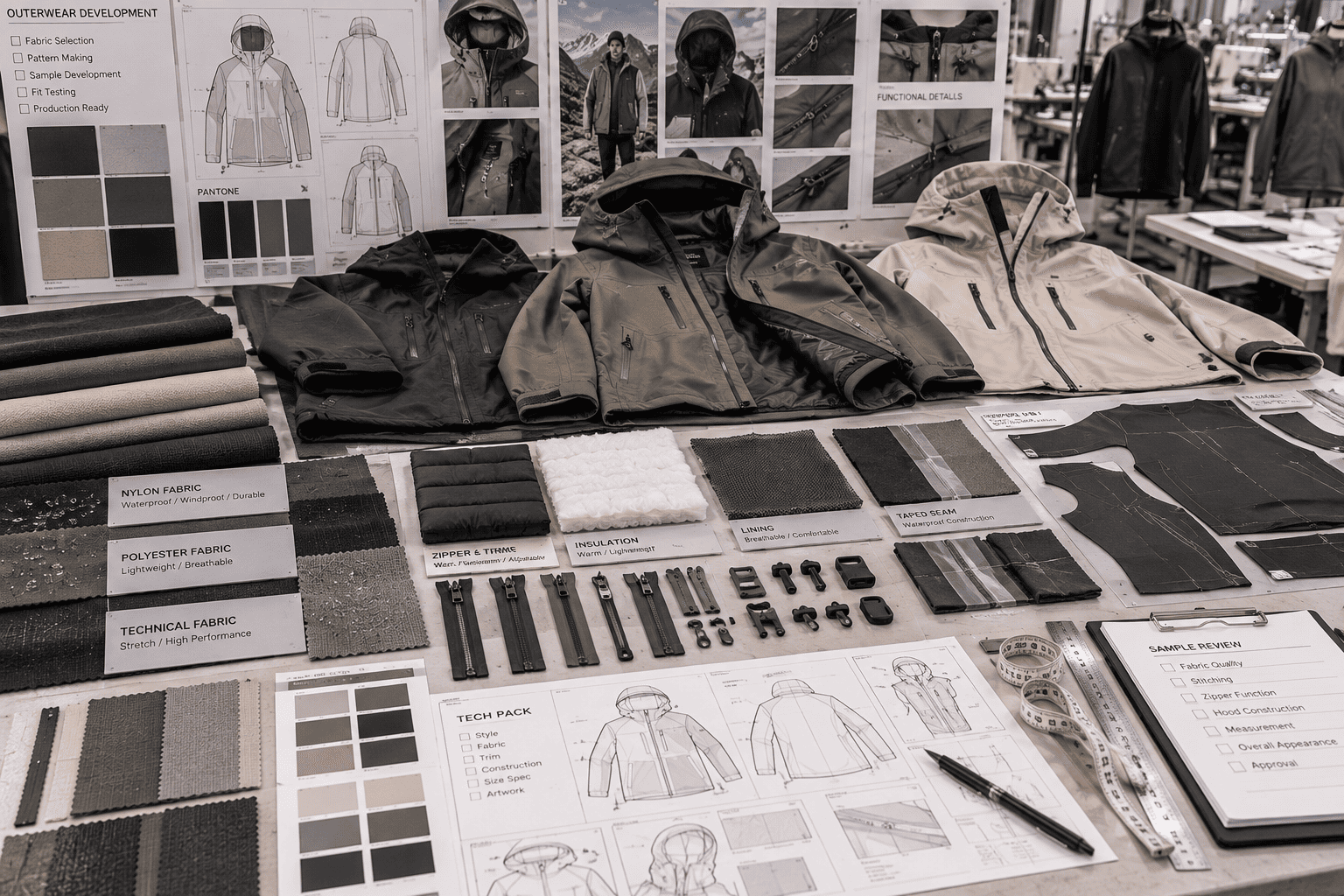
A good jacket manufacturer develops outerwear as a complete system. Shell fabric, coating or membrane, durable water-repellent finish, seams, seam sealing, zipper construction, lining, insulation, ventilation, pattern, and care requirements all affect the finished product. A waterproof fabric rating alone does not prove that the finished jacket is waterproof.
I work with custom garment development in Dongguan, and jackets are among the products where I want much more information before giving a final quotation.
I need to know whether you are making:
- A fashion windbreaker
- A coach jacket
- A bomber
- A fleece jacket
- A padded jacket
- A puffer
- A softshell
- A rain shell
- A ski jacket
- A technical waterproof shell
They may all be called “jackets.”
But they are not the same manufacturing job.
Table of Contents
- What Does a Jacket and Outerwear Manufacturer Make?
- How Do You Match the Factory to the Jacket Type?
- Which Shell Fabric Should You Choose?
- What Does Denier Actually Tell You?
- What Is the Difference Between Water-Resistant, Water-Repellent, and Waterproof?
- How Is Waterproof Fabric Tested?
- Does 10,000 mm Automatically Mean a Waterproof Jacket?
- What Is DWR and Why Is It Different From Waterproofing?
- Why Does Seam Sealing Matter?
- Do You Need a Waterproof Zipper?
- How Should You Compare Breathability Ratings?
- What Insulation Should You Choose?
- What Do Fill Power and Fill Weight Mean?
- What Trims Decide Jacket Quality?
- What Should Brands Know About PFAS and DWR?
- How Should You Test a Jacket Sample?
- What MOQ Should You Expect for Custom Jackets?
- What Affects Custom Jacket Cost?
- What Should You Send a Jacket Manufacturer?
- How Do You Choose a Reliable Jacket Manufacturer?
- Conclusion
- Footnotes & References
What Does a Jacket and Outerwear Manufacturer Make?
“Jacket manufacturer” covers a very wide range of factories.
A supplier may specialize in:
- Knit jackets
- Lightweight woven jackets
- Fashion outerwear
- Puffer jackets
- Softshell
- Technical rainwear
Those factories may use very different equipment and supply chains.
A useful starting comparison is:
| Jacket Type | Common Fabric Direction | Main Production Challenge |
|---|---|---|
| Windbreaker | Nylon / polyester woven | Lightweight sewing and zipper control |
| Track jacket | Polyester knit / woven | Panels, piping, zipper |
| Bomber | Nylon / satin / twill | Rib, lining, padding |
| Coach jacket | Nylon / polyester / cotton | Clean woven construction |
| Puffer | Nylon / polyester shell | Quilting and insulation distribution |
| Softshell | Bonded stretch fabric | Bulk, seam construction, stretch |
| Rain shell | Laminated/coated textile | Seam sealing and weather protection |
| Ski/snow jacket | Technical shell + insulation | Waterproofing, insulation and trims |
| Knit jacket | Fleece / French terry | Heavy knit construction |
The first sourcing question should therefore be:
What type of jacket are we actually developing?
How Do You Match the Factory to the Jacket Type?
A factory can be excellent at heavyweight streetwear jackets and still not be the right supplier for a fully seam-taped alpine shell.
Likewise, a technical rainwear factory may understand seam sealing extremely well but have less experience developing an oversized streetwear silhouette.
That is why I recommend asking:
Which jacket styles do you produce regularly?
Then ask to see:
- Real samples
- Production-line photos
- Inside construction
- Seam finishing
- Zipper installation
- Lining
- Pocket construction
Do not judge only from an attractive finished front view.
With jackets, some of the most important quality details are inside.
Which Shell Fabric Should You Choose?
The shell controls much of the:
- Appearance
- Hand feel
- Weight
- Weather resistance
- Durability
Common choices include:
Nylon
Useful for:
- Windbreakers
- Puffers
- Lightweight shells
- Outdoor jackets
It can create a:
- Crisp
- Lightweight
- Technical
feel depending on the yarn and finish.
Polyester
Very versatile for:
- Track jackets
- Rain shells
- Uniform outerwear
- Fashion jackets
It can offer good:
- Color consistency
- Durability
- Cost control
depending on specification.
Cotton Twill or Canvas
Useful for:
- Workwear
- Coach jackets
- Chore jackets
- Heritage outerwear
This gives a more natural and structured appearance.
Softshell
Softshell is normally a more complex textile construction and may combine:
- Woven face
- Stretch
- Membrane or film
- Fleece or brushed backing
depending on the fabric.
Laminated Technical Fabrics
Technical rainwear may use:
- 2-layer
- 2.5-layer
- 3-layer
laminated constructions.
These need more than normal garment-sewing knowledge.
What Does Denier Actually Tell You?
Denier is often misunderstood in outdoor apparel.
You may see specifications such as:
20D nylon
40D nylon
70D nylon
300D polyester
Denier describes linear mass density of the yarn.
It does not directly tell you:
This fabric is twice as strong.
Within similar material and yarn systems, higher-denier yarns are often heavier or more substantial.
But final fabric durability also depends on:
- Fiber
- Yarn construction
- Yarn count
- Weave
- Fabric density
- Ripstop structure
- Coating
- Finishing
So:
300D
is useful information.
But it is not a complete fabric specification.
What Is the Difference Between Water-Resistant, Water-Repellent, and Waterproof?
These terms are often mixed together.
They should not be.
Water-Repellent
Usually describes how well water beads and rolls from the textile surface instead of immediately wetting it.
A surface treatment such as DWR can contribute to this.
Water-Resistant
A broader term indicating some resistance to water penetration.
The level of resistance can vary dramatically.
Waterproof
For technical apparel, this normally implies a substantially higher level of resistance to water penetration and should be supported by appropriate specifications and testing.
But the key point is:
A waterproof fabric does not automatically create a waterproof finished garment.
The garment also has:
- Needle holes
- Seams
- Zippers
- Pockets
- Hood openings
- Ventilation openings
Every one can become a water-entry point.
How Is Waterproof Fabric Tested?
One widely used textile method is hydrostatic-pressure testing.
AATCC TM127, Water Resistance: Hydrostatic Pressure[^1] measures a fabric's resistance to water penetration under hydrostatic pressure.
The test can be used on fabrics including those with water-resistant or water-repellent finishes.
This gives us a measurable fabric property.
What Does the “mm” Number Mean?
When buyers talk about:
5,000 mm
10,000 mm
20,000 mm
they are generally referring to a hydrostatic-head type of measurement.
The higher value generally indicates greater resistance to hydrostatic water pressure under the specific test conditions.
But I would not create a universal rule such as:
5,000 mm = light rain
10,000 mm = heavy rain
20,000 mm = mountain use
and treat it as an official industry classification.
Real use also depends on:
- Test method
- Fabric condition
- Garment construction
- Seam sealing
- Wear
- Pressure from backpacks or sitting
- Exposure time
The number is useful.
But it needs context.
Does 10,000 mm Automatically Mean a Waterproof Jacket?
No.
Imagine a shell fabric has a strong hydrostatic-pressure result.
Then we cut it into 30 pieces.
Every time a sewing needle passes through the material, it creates another potential pathway for water.
That is why the finished garment construction matters.
A technical specification should separate:
Fabric Performance
For example:
Hydrostatic pressure result
from:
Garment Construction
For example:
Fully seam taped
or:
Critical seams taped
Those are different specifications.

What Is DWR and Why Is It Different From Waterproofing?
DWR means:
Durable Water Repellent
It is normally a surface treatment designed to help water bead rather than immediately wet the face fabric.
That is not the same thing as the waterproof barrier itself.
A waterproof shell may combine:
- Face textile
- DWR
- Membrane or coating
- Backer or lining
Each component serves a different function.
Why Does DWR Matter?
If the face fabric becomes saturated with water, a jacket may:
- Feel heavier
- Feel colder
- Lose some perceived breathability
even if the waterproof membrane beneath it is still resisting water penetration.
Water Repellency Can Be Tested Separately
AATCC TM22, Water Repellency: Spray Test[^1] measures resistance of a textile surface to wetting under a controlled spray test.
That is different from TM127 hydrostatic-pressure testing.
This distinction is useful:
TM22-type repellency testing and TM127-type water-resistance testing measure different performance characteristics.
So I would never use a DWR spray rating alone as proof that a jacket is waterproof.
Why Does Seam Sealing Matter?
Sewing creates holes.
Technical shells often use seam-sealing tape over sewn seams to help control water penetration.
Depending on the product, construction may include:
Fully Seam Taped
All relevant seams are sealed.
Common for more technical rain and snow shells.
Critical Seam Taping
Only selected high-exposure areas are sealed.
For example:
- Shoulders
- Hood
- Upper body
This can reduce:
- Cost
- Weight
- Production time
but provides a different level of protection.
Seam Tape Must Match the Fabric
The tape system needs to work with:
- Fabric
- Membrane
- Coating
- Seam
- Application temperature
- Pressure
Poor tape application can create:
- Peeling
- Bubbling
- Wavy seams
- Delamination
So when approving a technical shell, turn it inside out.
Look at the tape.
Do You Need a Waterproof Zipper?
This is another area where wording matters.
Many buyers ask:
Do you use waterproof YKK zippers?
But some well-known technical zippers are officially described as water-repellent, not watertight.
For example, YKK AquaGuard®[^2] uses a polyurethane-laminated zipper tape, but YKK explicitly states that AquaGuard® is:
water repellent, not waterproof/watertight.
That is a very useful distinction.
A Jacket Can Control Water Around the Zipper in Different Ways
Options include:
- Water-repellent zipper
- Storm flap
- Internal flap
- Covered zipper construction
- More specialized watertight zipper systems
The right choice depends on:
- Product use
- Required protection
- Budget
- Styling
Do not select a zipper only because its marketing name sounds technical.
Read the supplier specification.
How Should You Compare Breathability Ratings?
Breathability is another number that gets oversimplified.
You may see:
5,000 g/m²/24h
10,000 g/m²/24h
20,000 g/m²/24h
These numbers may represent water-vapor transmission under a specific test method.
But you cannot safely compare two breathability numbers unless you know how both were tested.
ASTM E96/E96M[^3] covers gravimetric determination of water-vapor transmission rate and specifically warns that a result obtained under one set of test conditions cannot automatically predict a result under different conditions or another procedure.
That is extremely important for buyers.
Ask for the Test Method
Do not accept only:
Breathability: 10K.
Ask:
Which test method?
Which conditions?
Is this fabric-only data?
Then you can compare correctly.
Garment Ventilation Matters Too
A highly breathable fabric can still feel uncomfortable if the jacket has poor garment ventilation.
Technical designs may add:
- Pit zips
- Mesh-lined pockets
- Back vents
depending on intended use.
Fabric breathability is only one part of comfort.
What Insulation Should You Choose?
Insulated jackets commonly use:
- Down
- Synthetic insulation
- Polyester wadding
Each creates a different product.
Down
Down is valued for its high warmth-to-weight ratio and compressibility.
Textile Exchange's Responsible Down Standard[^4] provides a voluntary certification framework addressing animal welfare and chain of custody for certified down.
RDS includes requirements relating to areas such as:
- Animal welfare
- No live plucking
- No force feeding
- Chain of custody
If your brand intends to market a product as RDS certified, the supply chain and claim requirements need to be satisfied.
Using down from somewhere in the supply chain does not automatically authorize an RDS garment-level claim.
Synthetic Insulation
Synthetic insulation may offer advantages such as:
- Simpler care
- More stable performance in damp conditions
- Different cost options
There are many constructions.
Do not judge only by:
100% polyester filling.
The actual insulation structure and weight matter.
What Do Fill Power and Fill Weight Mean?
These two terms are often confused.
Fill Power
Fill power describes the lofting ability of down.
Higher fill power generally indicates greater loft per unit weight.
It is mainly a quality/loft characteristic.
Fill Weight
Fill weight tells you how much insulation is actually put into the garment.
For example:
700-fill-power down
does not tell you how warm the jacket is by itself.
You still need to know how much down is inside.
Baffle Distribution Matters
Even good insulation performs poorly if filling is uneven.
For a puffer, QC may need to control:
- Total fill weight
- Fill by panel/baffle
- Distribution
- Migration
- Stitching
A jacket with one overfilled baffle and one underfilled baffle can look uneven and create inconsistent insulation.
What Trims Decide Jacket Quality?
Jackets contain more components than most basic garments.
Common trims include:
- Main zipper
- Pocket zipper
- Snaps
- Buttons
- Drawcord
- Cord locks
- Velcro/hook-and-loop
- Elastic
- Rib
- Lining
- Cuffs
- Hood adjusters
The customer touches these components constantly.
Zippers
Check:
- Smooth movement
- Slider
- Bottom stop
- Tape
- Strength
- Appearance
Snaps
Check:
- Setting
- Alignment
- Pull
- Surface finish
Drawcords and Adjusters
Check whether they work smoothly and remain secure.
Custom Hardware
Branding options may include:
- Custom pullers
- Embossed snaps
- Logo badges
But these can require separate:
- MOQ
- Mold fee
- Lead time
So custom hardware should be confirmed early, not three days before bulk sewing starts.
What Should Brands Know About PFAS and DWR?
This is now an important sourcing question for performance apparel.
PFAS have historically been used in some textile treatments for functions including:
- Water repellency
- Oil repellency
- Stain resistance
Regulation is changing quickly.
California
California's AB 1817 rules began restricting regulated PFAS in textile articles from January 1, 2025.
California's official DTSC legislative summary explains that the law also requires manufacturers to use the least toxic alternative when replacing PFAS and includes manufacturer compliance-certificate requirements.[^5]
New York
New York State Department of Environmental Conservation[^5] states that intentionally added PFAS in covered apparel has been prohibited since January 1, 2025.
New York separately provides a later date—January 1, 2028—for its restriction covering outdoor apparel for severe wet conditions.[^5]
What Should a Brand Ask the Mill?
Instead of simply asking:
Is this DWR?
ask:
Is PFAS intentionally added?
Can the supplier provide documentation?
Which market is this fabric compliant for?
This needs to be checked for the specific fabric and market.
I would not use the phrase:
PFAS-free
only because a supplier casually says so.
Ask for documentation supporting the claim.
How Should You Test a Jacket Sample?
A jacket sample should be evaluated as a complete product.
1. Check the Fabric
Confirm:
- Composition
- Weight
- Denier where relevant
- Coating/membrane
- Finish
- Color
2. Check Waterproof Specifications
If weather protection matters, request relevant:
- Hydrostatic-pressure report
- Water-repellency data
- Other specified test results
3. Inspect Seam Sealing
Turn the garment inside out.
Look for:
- Gaps
- Peeling
- Wrinkling
- Poor adhesion
4. Check Zippers
Open and close them repeatedly.
Check:
- Main zipper
- Pocket zipper
- Pit zips
if present.
5. Check the Hood
For technical jackets, test:
- Coverage
- Opening
- Adjustment
- Visibility
- Movement
6. Check Movement
Raise the arms.
Bend.
Reach forward.
Wear a layer underneath if that reflects real use.
7. Test Care
Wash or clean according to the intended care instructions.
Then inspect:
- Lamination
- Seam tape
- Zippers
- DWR behavior
- Insulation
- Measurements
8. Test the Finished Garment When Required
Fabric reports are useful.
But if your marketing promise refers to the jacket, you may need appropriate finished-product evaluation rather than relying only on raw-fabric data.
What MOQ Should You Expect for Custom Jackets?
For our custom outerwear projects, a practical starting MOQ can be around:
50 pieces per style
depending on the jacket.
A simple:
Coach jacket
is very different from:
3-layer seam-taped technical shell.
Hidden Minimums Matter
Even if garment MOQ is 50 pieces, other suppliers may have their own minimums for:
- Custom shell fabric
- Lamination
- Custom dye
- Insulation
- Special zipper
- Custom zipper pull
- Custom snaps
- Lining
- Seam tape
That is why jacket MOQ needs to be evaluated as a supply-chain question.
Stock Materials Help
This:
50 black jackets
Stock shell
Standard zipper
is much easier than:
50 jackets
Custom laminated shell
Custom Pantone
Custom waterproof zipper
Logo hardware
even though both orders contain 50 garments.
What Affects Custom Jacket Cost?
Jacket price can change dramatically because of construction.
Main variables include:
- Shell fabric
- Lining
- Membrane/coating
- DWR
- Seam sealing
- Insulation
- Zippers
- Hardware
- Hood
- Pockets
- Panels
- Decoration
- Quantity
Compare Two Jackets
Jacket A
Lightweight polyester coach jacket
Standard zipper
Simple lining
Two pockets
Jacket B
Waterproof technical shell
Laminated fabric
Fully taped seams
Water-repellent zippers
Adjustable hood
Pit zips
Multiple technical pockets
Both are jackets.
They cannot be priced by the same formula.
More Panels Mean More Labor
Technical styling may add:
- Curved panels
- Articulated sleeves
- Storm flaps
- Pocket bags
- Hood components
- Ventilation
Every piece needs:
- Cutting
- Sewing
- Alignment
- Inspection
Bulk Payment
For our new bulk orders, a common structure is:
50% deposit before production
50% balance before shipment
Sample development is paid before sampling.
Any sample-credit arrangement should be confirmed for the individual project instead of assumed automatically.
What Should You Send a Jacket Manufacturer?
A useful inquiry might look like this:
| Item | Requirement |
|---|---|
| Product | Men's lightweight rain shell |
| Quantity | 100 pcs |
| Market | United States |
| Shell | Nylon |
| Construction | Laminated technical fabric |
| Waterproof target | Provide test requirement |
| DWR | No intentionally added PFAS requested |
| Seam sealing | Full |
| Main zipper | Water-repellent zipper |
| Hood | Adjustable |
| Lining | None / 3-layer construction |
| Pockets | Two zip hand pockets |
| Sizes | S–XXL |
| Color | Black |
| Logo | Small chest heat transfer |
| Packaging | Individual polybag |
Now the manufacturer can evaluate:
- Fabric availability
- Test data
- Seam tape
- Zipper
- Pattern
- Sample cost
- MOQ
- Production price
- Lead time
Tell the Factory the Real Use
Instead of:
Waterproof jacket.
write:
Lightweight commuting rain shell for frequent city rain.
or:
Ski jacket for cold and snowy conditions.
or:
Fashion windbreaker with light shower resistance.
Those are three different products.
How Do You Choose a Reliable Jacket Manufacturer?
Start with technical questions.
Ask:
What makes this jacket waterproof?
A good answer may discuss:
- Shell
- Membrane/coating
- Hydrostatic pressure
- Seam sealing
- Zippers/openings
A weak answer is:
Nylon is waterproof.
Ask for the Test Method
If a supplier says:
10,000 mm waterproof.
ask:
Which test method?
AATCC TM127[^1] is one recognized method for hydrostatic-pressure testing.
The method matters.
Ask About Breathability
If the supplier says:
10K breathable.
ask again:
Which method and conditions?
ASTM specifically warns that water-vapor-transmission results from different conditions should not automatically be treated as equivalent.[^3]
Ask About Zippers
If somebody tells you:
AquaGuard is completely waterproof.
check the actual supplier documentation.
YKK itself describes AquaGuard® as water-repellent rather than waterproof/watertight.[^2]
That is the type of technical accuracy I want from a supplier.
Ask About Down Claims
If you want:
RDS-certified down
ask for documentation that supports the applicable supply-chain and product claim requirements.[^4]
Do not assume that buying down described as “responsible” gives automatic permission to use an RDS logo.
Ask About PFAS
For U.S. distribution, especially California and New York, ask the fabric and finish supplier for current compliance information relevant to the target market.[^5]
Check General Apparel Compliance
For apparel sold in the U.S., the CPSC's Flammable Fabrics Act guidance[^6] explains the general wearing-apparel flammability framework under 16 CFR Part 1610.
Some textiles receive testing exemptions under the rule.
But a supplier should understand the difference between:
the regulation applies
and:
a specific textile is exempt from testing.
Those are not the same statement.
Green Flags and Red Flags
| Green Flag | Red Flag |
|---|---|
| Asks what conditions the jacket is for | Says every jacket is “waterproof” |
| Gives actual fabric test method | Gives only a marketing number |
| Distinguishes DWR from waterproofing | Says DWR means waterproof |
| Explains full vs critical seam taping | Says waterproof fabric is enough |
| Uses correct zipper terminology | Calls every coated zipper waterproof |
| Gives breathability test method | Compares all “10K” ratings directly |
| Documents PFAS-related material claims | Says “PFAS-free” with no support |
| Controls insulation distribution | Quotes only fill power |
| Shows inside construction | Only shows exterior photos |
| Samples before bulk | Pushes directly to production |
A good outerwear manufacturer should sometimes tell you:
This construction is water-resistant, but I would not market it as a fully waterproof technical shell.
That is a useful answer.
The worst answer is:
Waterproof? Yes, no problem.
before the supplier even knows the fabric and construction.
Conclusion
A jacket is a system.
That is the main thing I want a buyer to understand.
You cannot judge technical outerwear from one fabric swatch.
The final performance can depend on:
- Shell fabric
- Membrane or coating
- DWR
- Hydrostatic-pressure performance
- Seam construction
- Seam sealing
- Zippers and openings
- Breathability
- Insulation
- Fit and movement
And these specifications need to match the actual end use.
A city windbreaker does not need to be developed like a mountaineering shell.
A streetwear puffer does not need the same construction as a ski jacket.
A lightweight rain jacket does not need the same insulation system as winter workwear.
Start with the use case.
Then choose the fabric.
Then choose the construction.
Then make a sample.
Turn the jacket inside out.
Check the tape.
Operate every zipper.
Wear it with the intended layers underneath.
Test the fabric claims using the correct methods.
Wash it according to the proposed care instructions.
Then decide whether it is ready for bulk.
And be careful with performance language.
Water-repellent is not the same as waterproof.
DWR is not the same as a waterproof membrane.
A waterproof fabric does not automatically create a waterproof garment.
A 10,000 mm rating has little meaning without knowing the test method and garment construction.
A breathability number should not be compared blindly with a number produced under another test method.
The best jacket manufacturer is not the supplier with the longest list of technical terms.
It is the one that can explain what each term actually means, show how the different components work together, provide supporting information where needed, and reproduce the approved construction consistently in bulk.
That is how you turn a jacket that merely looks technical into outerwear that performs the way your customer expects.
Footnotes & References
[^1]: AATCC — Water Resistance and Water Repellency Test Methods. AATCC TM127 measures resistance of textile fabrics to water penetration under hydrostatic pressure. AATCC TM22 measures resistance of the textile surface to wetting under a controlled spray test. The two methods evaluate different water-performance characteristics.
https://members.aatcc.org/store/tm127/535/
https://members.aatcc.org/store/tm22/487/
[^2]: YKK Fastening Products Group — AquaGuard® Coil Zipper. YKK describes AquaGuard® as a polyurethane-film laminated zipper designed for water repellency and explicitly states that the product is water-repellent, not waterproof/watertight.
https://www.ykkfastening.com/products/search/detail.html?pdid1=AquaGuard%28R%29+%28Coil%29
[^3]: ASTM International — ASTM E96/E96M, Water Vapor Transmission of Materials. ASTM's active E96/E96M method measures water-vapor transmission and cautions that results produced under different methods or test conditions should not automatically be treated as equivalent.
https://store.astm.org/e0096_e0096m-24a.html
[^4]: Textile Exchange — Responsible Down Standard (RDS). The voluntary RDS addresses animal welfare and chain of custody for certified down and feather materials, including prohibitions on live plucking and force feeding and requirements supporting certified material claims.
https://textileexchange.org/responsible-down-standard/
[^5]: California Department of Toxic Substances Control / New York State Department of Environmental Conservation — PFAS in Textile and Apparel Requirements. California's AB 1817 restrictions on regulated PFAS in textile articles took effect January 1, 2025 and include manufacturer compliance-documentation provisions. New York prohibits intentionally added PFAS in covered apparel from January 1, 2025 and has a separate January 1, 2028 restriction for outdoor apparel for severe wet conditions.
https://dtsc.ca.gov/wp-content/uploads/sites/31/2022/12/Legislative-Mandates-Report-for-2022-Accessible.pdf
https://dec.ny.gov/environmental-protection/pollution-prevention/pfas-in-apparel-law
[^6]: U.S. Consumer Product Safety Commission — Flammable Fabrics Act / Clothing Guidance. CPSC explains the U.S. general wearing-apparel flammability requirements under 16 CFR Part 1610, including the distinction between apparel covered by the standard and specified textiles that may qualify for testing exemptions.
https://www.cpsc.gov/Business--Manufacturing/Business-Education/Business-Guidance/Flammable-Fabrics-Act