Is It Possible to Change Designs During Mass Clothing Production?
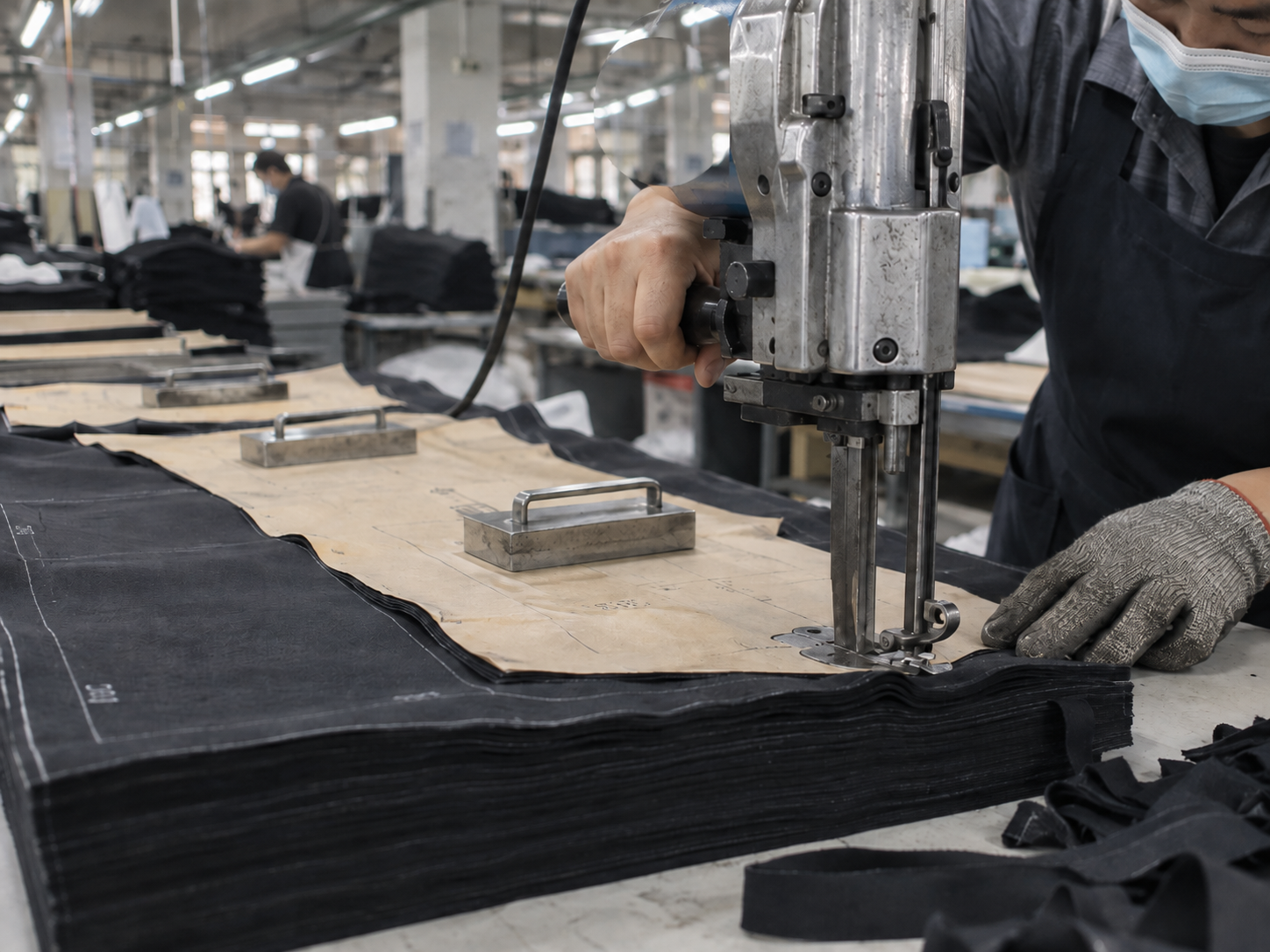
A buyer may approve the sample, place the bulk order, and then suddenly notice something they want to change.
Maybe the logo feels too large.
Maybe the pocket should move.
Maybe the zipper color looks wrong.
Some changes are still possible, but once production starts, every change becomes more difficult, expensive, and risky.
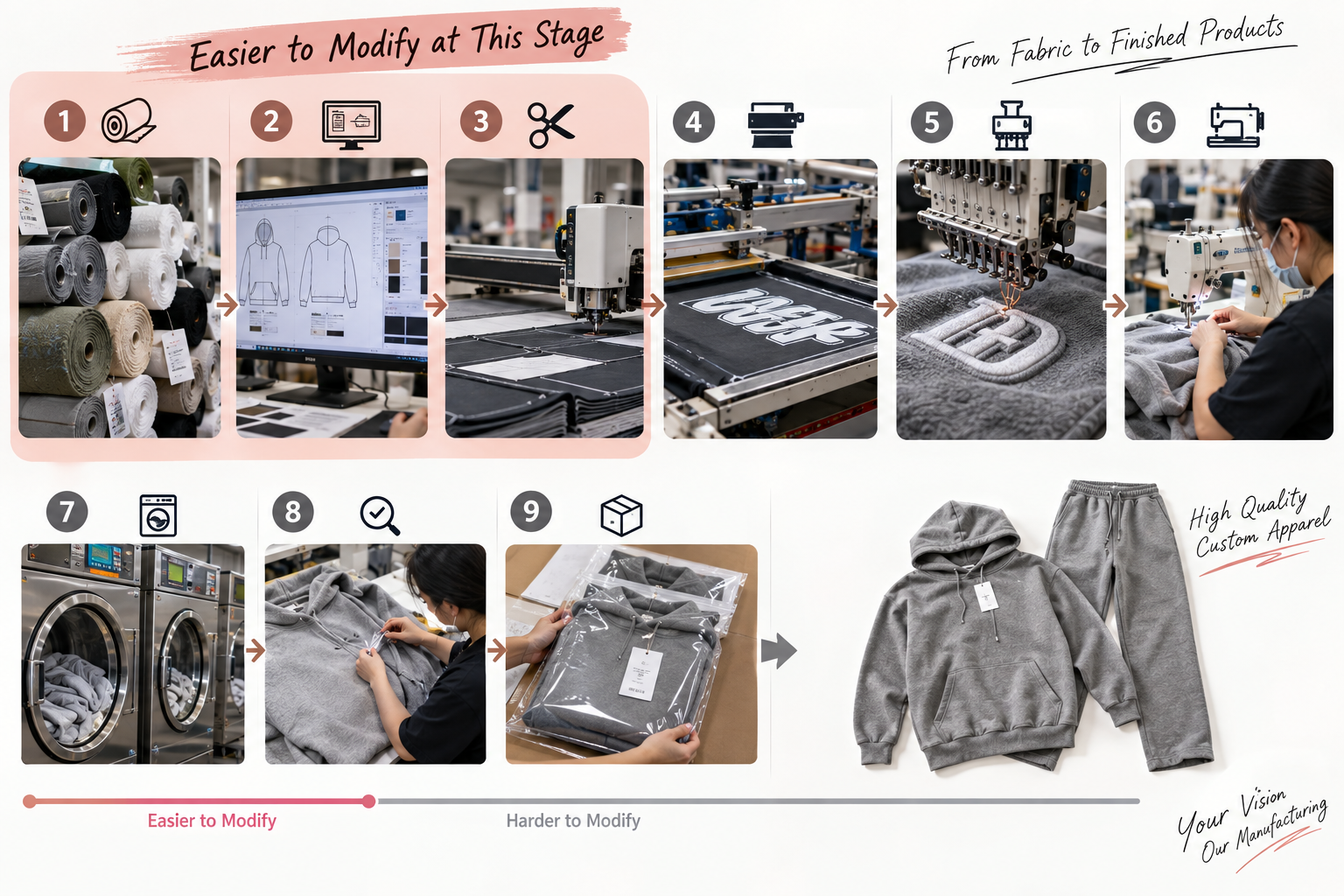
Yes, clothing designs can sometimes be changed during mass production, but it depends on the production stage. Changes made before fabric cutting are usually easier. After cutting, printing, embroidery, sewing, washing, or finishing begins, options become limited. Late changes may cause extra costs, material waste, production delays, or even require remaking part of the order.
In my experience, the key question is not simply:
Can we change it?
I first ask:
What has already been completed?
If the fabric is only purchased, there may still be many options.
If 500 garments are already printed and sewn, the same request becomes a completely different problem.
Table of Contents
- Can Clothing Designs Be Changed After Bulk Production Starts?
- Why Does the Production Stage Matter?
- What Can Be Changed Before Fabric Cutting?
- What Happens If a Design Changes After Fabric Has Been Cut?
- Can Logos or Printing Be Changed During Production?
- Can Embroidery Be Changed After Production Starts?
- Can Garment Measurements or Fit Be Changed?
- Can Fabric or Color Be Changed During Bulk Production?
- Can Zippers, Labels, and Trims Still Be Changed?
- Can Packaging Be Changed During Production?
- What Happens If the Buyer Changes the Design After Sewing?
- How Much Do Late Design Changes Cost?
- How Do Design Changes Affect Production Lead Time?
- Who Should Pay for Changes During Bulk Production?
- How Can Brands Avoid Design Changes After Production Starts?
- What Should Buyers Do When a Late Change Is Unavoidable?
- Conclusion
- Footnotes & References
Can Clothing Designs Be Changed After Bulk Production Starts?
I never like to answer this question with only yes or no.
Some design changes are possible after bulk production starts, but the level of flexibility depends on what has already been completed. Before cutting, most details can still be adjusted. After cutting, printing, embroidery, sewing, or washing, changes may require rework or replacement materials. Once finished garments are completed, major structural changes are usually impractical.
The same request can be easy on Monday and very difficult on Friday.
For example:
Please make the back logo 3 cm smaller.
If printing has not started, this may be easy.
If 300 back panels are already printed, the factory may need to replace those panels.
If 300 finished hoodies are already sewn, the options become even more limited.
Production Stage Controls Flexibility
I normally think about bulk production in these stages:
| Production Stage | Flexibility to Change |
|---|---|
| Before fabric purchase | Very high |
| After fabric purchase | High |
| Before cutting | High |
| After cutting | Medium |
| After printing / embroidery | Low to medium |
| During sewing | Low |
| After garment washing | Very low |
| After finishing and packing | Very low |
This is why final approval before production is so important.
Why Does the Production Stage Matter?
Garment production is a sequence.
Each step depends on the previous step.
The production stage matters because every completed process reduces the number of practical changes available. A factory can change a pattern before cutting, but cannot easily change that pattern after hundreds of panels are cut. The same applies to printing, embroidery, washing, and trims. Earlier changes affect planning. Later changes affect physical goods.
A bulk order may move through:
- Fabric purchase
- Fabric inspection
- Fabric relaxation
- Cutting
- Printing or embroidery
- Sewing
- Washing
- Finishing
- Quality control
- Packing
Once a stage is completed, changing the design may mean going backward.
Going backward creates:
- Extra labor
- New material costs
- Waste
- Rework
- New supplier scheduling
- Delays
A Small Change Can Affect Several Departments
Imagine the buyer wants to move a pocket 2 cm higher.
It sounds simple.
But if the garment is already cut, the factory may need to check:
- Pocket pattern
- Placement marks
- Front panel cutting
- Stitching instructions
- QC measurement points
If sewing has already started, some garments may have the old pocket placement and others may have the new one.
Now consistency becomes a problem.
That is why I prefer to stop and evaluate the full impact before accepting any production change.
What Can Be Changed Before Fabric Cutting?
This is the safest stage for design changes.
Before fabric cutting begins, buyers can usually still change measurements, logo placement, pocket position, some construction details, print dimensions, embroidery placement, labels, and trims. The factory may need to update patterns, markers, artwork, or material orders, but physical garment waste is still limited.
For example, before cutting I may still be able to change:
- Body length
- Chest width
- Sleeve length
- Pocket position
- Hood size
- Logo placement
- Label placement
- Stitch details
Pattern Changes Need New Confirmation
If a buyer changes measurements, I normally want to update:
- Pattern
- Size chart
- Grading
- Cutting marker
If the change is important, I may recommend another sample or pre-production sample.
This adds time.
But it is much safer than discovering the problem after 500 garments are made.
Fabric Quantity May Also Change
A pattern change can affect fabric consumption.
For example:
Increase body length by 4 cm.
That sounds simple.
But across 1,000 garments, the factory may need significantly more fabric.
If the original fabric quantity has already been purchased exactly, extra fabric may need to be ordered.
So even before cutting, not every change is free.
What Happens If a Design Changes After Fabric Has Been Cut?
After cutting, structural changes become more difficult.
Once fabric has been cut, changes to garment shape, length, width, pocket structure, sleeves, or panels may require replacement pieces. Small changes may still be possible if enough seam allowance or spare fabric exists, but major measurement or pattern changes often mean recutting part or all of the order.
For example, if the buyer wants:
Make the hoodie body 5 cm longer.
I cannot add fabric back to a panel that has already been cut.
The main body pieces would need to be cut again.
Spare Fabric Can Help
Factories normally keep some extra fabric for:
- Defects
- Replacements
- Testing
- Cutting loss
But this extra fabric is limited.
It may not be enough to remake hundreds of panels.
Custom-Dyed Fabric Creates Another Problem
If all custom-dyed fabric has already been used, new fabric may need to be dyed.
The new dye lot may have a slight shade difference.
This is especially important for:
- Black
- Navy
- Brown
- Olive
- Special Pantone colors
Now the design change creates both a time problem and a color consistency problem.
For apparel and textile development, I prefer approving color against a physical textile standard instead of relying only on a phone or computer screen. Pantone's official Fashion, Home + Interiors system[^1] identifies TCX as the system intended for soft surfaces such as textiles and apparel.
Can Logos or Printing Be Changed During Production?
Sometimes yes, especially if printing has not started.
Logo size, artwork, placement, or printing method can usually be changed before the printing process begins. After fabric panels have already been printed, changing the design may require recutting and reprinting those panels. Trying to print over an incorrect logo is rarely a clean solution, especially on premium garments.
Before Printing
This is the easiest situation.
I can update:
- Logo size
- Artwork
- Pantone color
- Print position
- Technique
The print supplier may need:
- New screens
- New artwork
- New setup
There may still be extra cost.
But the garments themselves are not damaged.
Use a Clear New Artwork Version
If artwork changes during production, I do not want the print supplier receiving:
logo-final.ailogo-final2.ailogo-new.ailogo-new-final.ai
without knowing which file is approved.
The revised artwork should have a clear version number or approval date.
I also prefer original scalable artwork whenever possible. Adobe's official Illustrator supported file formats documentation[^2] includes common production formats such as AI, PDF, EPS, and SVG.
A clear production file reduces the risk of somebody accidentally using an old screenshot or outdated logo.
After Printing
This becomes more difficult.
Suppose the back print is already 35 cm wide.
The buyer now wants 30 cm.
I cannot simply shrink the existing print.
The realistic options may be:
- Accept the current size
- Replace the printed panels
- Remake the garment
Printing Over the Original Is Risky
Sometimes buyers ask:
Can you cover the old logo with a new one?
Technically, some cases are possible.
But I rarely recommend it for a high-quality garment.
The result may look:
- Too thick
- Uneven
- Darker
- Misaligned
For premium private label products, remaking the panel is usually safer.
Can Embroidery Be Changed After Production Starts?
Embroidery is similar to printing, but it can be even harder to remove.
Embroidery can be changed easily before stitching starts by updating the embroidery file, thread color, size, or placement. Once embroidery is completed, removing it may damage the fabric, leave needle holes, or distort the surface. Large or dense embroidery is especially difficult to correct cleanly.
Before Embroidery
I can still change:
- Thread color
- Logo width
- Placement
- Stitch density
- Embroidery file
This may require a new embroidery setup.
After Embroidery
Removing embroidery thread by thread is possible in some cases.
But the fabric may show:
- Needle marks
- Stretching
- Small holes
- Surface damage
On a thick hoodie, a small embroidery may sometimes be repaired.
On lightweight activewear, the risk is much higher.
Appliqué Is Even More Complex
Appliqué often uses:
- Fabric pieces
- Embroidery
- Templates
- Adhesive
- Stitching
If a large appliqué has already been attached, replacing it may require a new garment panel.
This is why I like to confirm large embroidery and appliqué placements before bulk production.
Can Garment Measurements or Fit Be Changed?
Fit changes are among the most difficult changes once cutting starts.
Garment measurements can be changed before cutting by adjusting the pattern and grading. After cutting, only small adjustments may be possible. Increasing garment dimensions is usually harder than reducing them because the missing fabric cannot be added back. Major fit changes after sewing normally require remaking the garments.
Some Reductions May Be Possible
For example, if a T-shirt is slightly too wide, the side seam may sometimes be adjusted.
But this can affect:
- Armhole shape
- Sleeve fit
- Hem width
- Side seam position
So even a simple reduction must be reviewed carefully.
Increasing Size Is Much Harder
If the buyer wants:
Make the chest 4 cm wider.
After cutting, there may be no practical way to do that.
The panels need to be replaced.
Washed Garments Are More Complicated
Garment washing can change dimensions.
That includes:
- Acid wash
- Enzyme wash
- Vintage wash
- Garment dye
- Stone wash
If the buyer changes measurements after the washing process, I cannot simply adjust the pattern and expect the same result.
Shrinkage and finishing have already happened.
Can Fabric or Color Be Changed During Bulk Production?
Fabric changes are possible only in the early stages.
Fabric composition, GSM, structure, or color can usually be changed before cutting, but once production fabric has been cut or decorated, changing the material may require restarting the order. Custom colors also create dye-lot concerns, so buyers should approve fabric quality, hand feel, GSM, and color before bulk cutting begins.
Changing GSM Changes More Than Weight
Imagine the order starts with:
320 GSM French terry.
Then the buyer wants:
500 GSM fleece.
That is almost a new product.
The change may affect:
- Fit
- Pattern
- Seam thickness
- Needle choice
- Rib
- Washing
- Shipping weight
This is not simply replacing one fabric.
Color Changes Can Be Expensive
If 500 meters of custom brown fabric are already dyed and the buyer changes to black, the original fabric may no longer be usable.
Someone must pay for that material.
That is why Pantone approval should happen early.
Can Zippers, Labels, and Trims Still Be Changed?
Trims sometimes offer more flexibility than the main garment, but timing still matters.
Zippers, drawcords, labels, buttons, snaps, hangtags, and other trims can often be changed if they have not yet been installed. Once they are sewn or attached to the garment, replacement becomes more labor-intensive and may leave visible marks. Custom trims may also require new production time or minimum quantities.
Labels Are Usually Easier to Change
If the woven neck label has not been sewn in, replacing it may be simple.
If 1,000 garments already have the old label, workers must:
- Remove the label
- Check for damage
- Sew the new label
- Recheck quality
That creates extra labor.
If the product will be sold in the United States, some label information is also regulatory rather than purely cosmetic. The U.S. Federal Trade Commission's Apparel and Labeling guidance[^3] explains requirements covering information such as fiber content, country of origin, and identification of the responsible business for most textile products.
Care instructions are also subject to separate rules. The FTC's Care Labeling Rule[^4] requires covered textile apparel to carry appropriate care information.
For this reason, changing a label should not only be checked visually.
The new content should also be checked against the requirements of the target market.
Zippers Are Much Harder
A full front zipper is part of the garment construction.
Changing it after sewing may require reopening:
- Front seam
- Facing
- Topstitching
- Collar
- Hem
This can take significant time.
A zipper specification can also be much more detailed than simply writing a brand name.
YKK's official fastening product search[^5] includes metal, coil, VISLON®, sliders, plastic hardware, snaps, buttons, and many other product options.
If a buyer changes from one zipper type or finish to another during production, I first check whether the replacement works with the original construction.
Custom Hardware Can Delay the Entire Order
A custom zipper pull or metal logo may need:
- Mold development
- Plating
- Production
- Delivery
A last-minute hardware change can delay finished garments even when the sewing is complete.
Can Packaging Be Changed During Production?
Packaging is usually one of the easiest late changes.
Packaging can often be changed later than garment construction because polybags, hangtags, barcode stickers, tissue paper, boxes, and shipping cartons are normally used near the end of production. However, custom packaging may have its own manufacturing lead time and MOQ, so late changes can still delay final shipment.
For example, a buyer may change:
- Polybag design
- Barcode label
- Size sticker
- Hangtag
- Thank-you card
- Box design
This usually does not require remaking the garment.
Packaging Changes Can Still Block Shipping
Imagine all garments are complete.
But the new custom box needs another 10 days.
The garments cannot ship in the approved packaging until the boxes arrive.
So the clothing production may be finished, but the order is still delayed.
What Happens If the Buyer Changes the Design After Sewing?
This is where I become much more cautious.
After garments are sewn, small finishing changes may still be possible, but structural changes usually become expensive or impractical. Moving pockets, changing fit, replacing large prints, altering sleeve construction, or changing zippers may require opening seams or remaking garments. The risk of visible damage also increases.
I normally separate changes into three categories.
Easy Changes
These may include:
- Hangtag replacement
- Packaging change
- Some label changes
- Small loose-thread corrections
Possible but Risky Changes
These may include:
- Small embroidery replacement
- Some seam adjustments
- Changing simple buttons
- Minor shortening
Usually Better to Remake
These include:
- Major fit change
- Large logo replacement
- Pocket relocation
- Full zipper replacement
- New panel structure
- Fabric change
At some point, repairing the garment costs more than remaking it correctly.
How Much Do Late Design Changes Cost?
There is no fixed price because every change affects production differently.
Late design changes can create costs for new materials, replacement panels, additional labor, new printing screens, embroidery setup, pattern changes, recutting, reinspection, and production-line delays. The later the change happens, the higher the potential cost because more completed work may need to be discarded or repeated.
A simple cost breakdown might look like this:
| Change | Possible Extra Cost |
|---|---|
| Artwork update before printing | Low |
| New print screen | Low to medium |
| Pattern update before cutting | Low to medium |
| Recut 100 panels | Medium |
| Remove and replace labels | Medium |
| Replace full zipper | High |
| Remake printed panels | High |
| Remake finished garments | Very high |
Material Waste Is Real
If incorrect fabric panels cannot be reused, they become production loss.
The same applies to:
- Wrong printed panels
- Incorrect embroidery
- Old labels
- Custom trims
This is why factories normally charge for buyer-requested changes after approval.
How Do Design Changes Affect Production Lead Time?
Late changes almost always create some delay.
Design changes can delay mass production from a few days to several weeks depending on the stage and the materials involved. A simple artwork update may add only a short delay, while new fabric, custom dyeing, recutting, special trims, or remaking finished garments can significantly change the original delivery schedule.
The biggest delay often comes from outside suppliers.
For example:
- Embroidery supplier needs a new queue
- Fabric mill needs to redye fabric
- Zipper supplier needs new hardware
- Washing factory needs a second process
- Printing factory needs new screens
The main garment factory cannot always control these queues.
One Change Can Move the Whole Schedule
Suppose sewing is scheduled for this week.
A print correction delays printed panels by four days.
The sewing line may already be assigned to another order by the time those panels return.
Now the delay may become longer than four days.
This is why late changes can affect the schedule in ways buyers do not expect.
Who Should Pay for Changes During Bulk Production?
This depends on why the change is needed.
If the buyer changes an already approved design, the buyer normally pays the extra material and labor costs. If the factory did not follow the approved sample, tech pack, or confirmed specification, the factory should normally be responsible for correcting its production error. Clear written approvals are essential for deciding responsibility fairly.
I always go back to the approved reference.
That may be:
- Approved sample
- Tech pack
- Size chart
- Artwork approval
- Pantone approval
- Written confirmation
Buyer-Initiated Change
Example:
The approved back logo is 35 cm.
During production, the buyer decides it should be 30 cm.
That is a new request.
Factory Error
Example:
The approved back logo is 30 cm.
The factory produces it at 35 cm.
That is not a design change.
That is a production mistake.
The two situations should not be treated the same.
How Can Brands Avoid Design Changes After Production Starts?
The best late-production change is the one that never needs to happen.
Brands can reduce design changes by approving a final pre-production sample, locking the tech pack, confirming fabric and Pantone colors, checking print and embroidery strike-offs, approving labels and trims, and reviewing final measurements before bulk cutting. One controlled approval stage can prevent much larger problems later.
Use a Final Tech Pack
I prefer one final version.
Not:
- Tech Pack V2
- WhatsApp correction
- Email correction
- Screenshot correction
- Verbal change
Everything should be updated into one master file.
Approve the Pre-Production Sample
Before bulk production, I want the buyer to check:
- Fabric
- Fit
- Measurements
- Logo
- Placement
- Stitching
- Labels
- Trims
This becomes the production reference.
Confirm Artwork Separately
For difficult decoration, I may also send:
- Print strike-off
- Embroidery sample
- Color swatch
A small test is much cheaper than correcting hundreds of garments.
What Should Buyers Do When a Late Change Is Unavoidable?
Sometimes a change is necessary.
In that case, speed and clarity matter.
When a late design change is unavoidable, buyers should tell the factory immediately, identify exactly what must change, stop the affected production stage if possible, and ask for the cost, delay, and quantity impact before giving final approval. The factory should separate finished, in-progress, and untouched units before deciding the best solution.
I normally want the buyer to provide one clear instruction.
For example:
Stop the back print. Change the width from 35 cm to 30 cm. All other artwork and placements remain unchanged.
That is much better than:
The logo looks too big. Can you fix it?
First Check How Many Units Are Affected
The order may be:
- 500 total
- 100 already printed
- 150 cut but not printed
- 250 not yet cut
Now we can build a solution.
Maybe:
- Remake 100 printed panels
- Use the new artwork for the remaining 400
This is much better than assuming all 500 garments need to be remade.
Ask for Photos or a New Approval Sample
If the change is important, I like to confirm the revised result before continuing all production.
That extra approval may cost one day.
But it can save another mistake.
One Lesson I Have Learned From Bulk Production
One of the most difficult situations in garment manufacturing is when a buyer makes a change but the factory does not clearly stop the old instruction.
For example, production already has:
- Original artwork
- Original pattern
- Original measurement sheet
Then a salesperson receives a message:
Make the logo slightly smaller.
If that message never becomes a clear new production file, different departments may follow different instructions.
The print supplier may use the new logo.
The sewing team may still use the old placement marks.
QC may check against the old tech pack.
Now the problem is not only the design change.
The problem is version control.
This is why I always prefer one clear rule:
Once a bulk change is approved, the old instruction should be replaced everywhere.
A revised design needs:
- New file version
- New approval
- Clear affected quantity
- Clear effective production stage
- Confirmation that the old version is no longer valid
This type of documented process is also consistent with the broader quality-management principles behind ISO 9001[^6], which emphasizes controlled processes, documented information, consistent execution, monitoring, and continual improvement.
That does not mean a clothing brand needs to study an ISO standard before changing a logo.
The practical lesson is much simpler:
Production should never have two active versions of the same instruction.
That sounds obvious.
But in real garment manufacturing, it prevents a lot of expensive mistakes.
Conclusion
Yes, clothing designs can sometimes be changed during mass production.
But the important question is not only:
Can we change it?
The better question is:
What production stage has already been completed, how many units are affected, and what will need to be repeated?
Before fabric cutting, there is still relatively high flexibility.
After cutting, structural changes become harder.
After printing or embroidery, logo changes may require replacement panels.
After sewing, major fit, pocket, zipper, or construction changes become expensive.
After washing and finishing, the practical options become even more limited.
That is why I recommend locking the important product details before bulk production begins:
- Final tech pack
- Final measurements
- Fabric
- GSM
- Pantone color
- Artwork
- Logo size
- Logo placement
- Embroidery
- Printing
- Zippers
- Labels
- Trims
If something must change later, I treat it as a controlled production revision.
First, stop the affected process if possible.
Second, identify which quantities are already finished, in progress, or untouched.
Third, calculate the new material cost, labor cost, waste, and delay.
Fourth, create one revised instruction and make sure every department stops using the old version.
For me, this last step is one of the most important.
A late design change is difficult.
But a late design change with poor version control is much worse.
The safest bulk-production system is one where the buyer and factory always know which version is approved, which quantity it applies to, and from exactly which production stage the new instruction takes effect.
Footnotes & References
[^1]: Pantone — Fashion, Home + Interiors (FHI). Official Pantone color system for fashion, textiles, apparel, and other soft goods. Pantone identifies TCX as the system intended for textile and apparel surfaces.
https://www.pantone.com/na/en-us/fashion-home-interiors
[^2]: Adobe — Supported File Formats in Illustrator. Official Adobe documentation covering AI, PDF, EPS, SVG, and other artwork formats commonly used in design and production workflows.
https://helpx.adobe.com/illustrator/desktop/get-started/learn-the-basics/supported-file-formats.html
[^3]: U.S. Federal Trade Commission — Apparel and Labeling. Official FTC guidance covering textile and apparel labeling requirements including fiber content, country of origin, and identification of the responsible manufacturer or marketer.
https://www.ftc.gov/news-events/topics/tools-consumers/apparel-labeling
[^4]: U.S. Federal Trade Commission — Care Labeling Rule. Official U.S. requirements concerning care instructions for covered textile wearing apparel and certain textile goods.
https://www.ftc.gov/legal-library/browse/rules/care-labeling-textile-wearing-apparel-certain-piece-goods
[^5]: YKK Fastening Products Group — Product Search. Official YKK database covering metal, coil and VISLON® zippers, sliders, plastic hardware, snaps, buttons, and other fastening components.
https://www.ykkfastening.com/products/search/?cl=on
[^6]: ISO — ISO 9001 Quality Management Systems. Official ISO information on quality management systems, including process control, documented information, performance evaluation, consistency, and continual improvement.
https://www.iso.org/standard/9001