
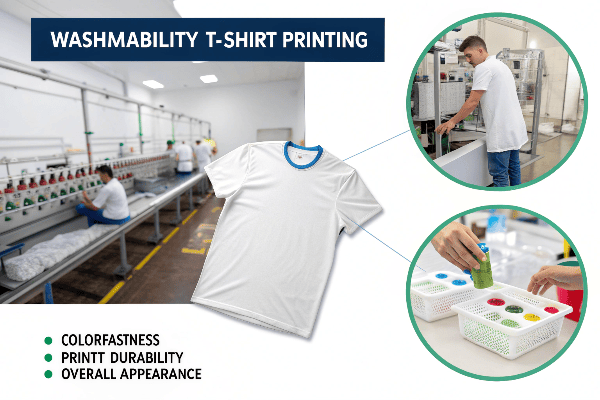
A T-shirt might look perfect when it's new, but the real test comes after washing. If the print fades, cracks, or peels within a few washes—it’s a clear sign of poor quality. So how can you evaluate the washability of printed T-shirts?
To judge whether the washability of T-shirt printing is qualified, check for colorfastness, cracking, peeling, and adhesion after multiple standardized wash cycles. A quality print should retain color, stay smooth, and remain intact after at least 5–10 washes.
In manufacturing, I’ve seen beautifully printed samples fail post-wash checks just because the ink wasn’t cured properly. Washability is not just about visuals—it’s about durability.
Table of Contents
- What are the key signs of good washability?
- How are professional wash tests conducted?
- What affects the wash durability of a print?
- Can you test washability at home?
- Conclusion
What are the key signs of good washability?
Look at how the print holds up after washing.
A print with qualified washability will retain its color, stay flexible without cracks, and adhere firmly to the fabric even after repeated washing and drying.
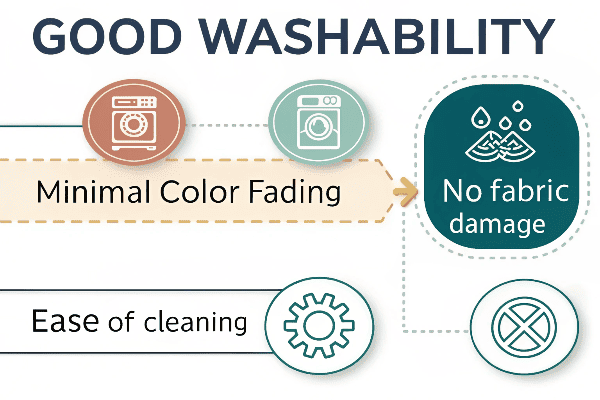
Post-wash inspection checklist
| Criteria | What to Check |
|---|---|
| Color retention | No significant fading or discoloration |
| No cracking | Print surface remains smooth, not broken |
| No peeling | Edges stay firmly bonded to fabric |
| Print softness | Still feels soft—not overly stiff or rubbery |
| Shape stability | Print doesn’t deform or distort |
Use side-by-side comparison and a controlled light box to inspect subtle degradation. Read Printwear Magazine's QC tips for evaluating post-wash prints.
How are professional wash tests conducted?
Labs use controlled procedures to simulate real-world washing.
Standard tests like ISO 6330 or AATCC 61/101 simulate home laundry conditions—including water temp, detergent, cycle time, and drying—to assess print durability.
Common wash test standards
| Standard | Description | Wash Conditions Example |
|---|---|---|
| ISO 6330 | Domestic washing and drying procedures | 60°C for 30 min, tumble dry |
| AATCC 61 | Colorfastness to laundering (accelerated) | 5 cycles in 45 min with steel balls |
| AATCC 135 | Dimensional changes after laundering | Shrinkage + print impact |
These standards are recognized globally in textile testing and used by brands like Nike and Adidas for quality control benchmarks.
In mass production, even small factories run internal 3–5 cycle wash tests before final delivery.
What affects the wash durability of a print?
It’s a mix of materials, methods, and settings.
Ink type, fabric content, print method, and curing all play a role in how well a print survives washing. Poor curing is one of the most common reasons for cracking or peeling.
Influencing factors
| Factor | Impact on Washability |
|---|---|
| Ink type | Water-based inks fade faster than plastisol |
| Fabric quality | Blends and low-thread-count fabrics may shed ink |
| Heat curing | Under-cured prints will peel or crack |
| Pretreatment (for DTG) | Affects ink bonding to fibers |
Kornit Digital explains why curing time and temperature calibration are critical for long-lasting prints.
If your print method is DTG or heat transfer, follow exact temperature and time guidelines—especially for curing and pressing.
Can you test washability at home?
Yes—with a few smart steps.
Wash the printed T-shirt inside out in warm water, then tumble dry on medium. Repeat this process 3–5 times. Observe any visible changes in the print.
DIY wash test steps
- Take pre-wash photo of the print
- Wash inside out with mild detergent (no bleach)
- Tumble dry or line dry after each wash
- Compare after 3–5 cycles: check for fading, cracks, peel
- Rub gently by hand after drying—does the ink flake?
Use this approach to compare supplier samples before approving bulk orders.
This test is especially useful if you're evaluating supplier samples before placing bulk orders.
Conclusion
To judge whether T-shirt printing is washable and durable, check for fading, cracking, and peeling after repeated wash cycles. Whether you're a buyer, brand owner, or quality control manager, proper testing ensures your prints survive real-world wear.
- ISO 6330 and AATCC 61 are the most widely accepted global standards for textile wash testing.
- Under-cured plastisol prints often feel tacky and begin cracking within 2–3 washes.
- Water-based inks are eco-friendly but require proper curing and better cotton content to achieve long-lasting results.
- T-shirts with tight-knit, high-thread-count cotton fabrics retain ink better during laundering.
- DIY testing is not standardized but can reveal practical durability issues in the field.