
You see two sweatshirts—same color, similar price—but one feels softer, sturdier, just better. So how do you tell if a sweatshirt is truly good quality?
A high-quality sweatshirt has dense, well-knit fabric, smooth seams, reinforced stitching, and holds its shape after washing. Feel, fit, and durability are the best signs of quality—along with trusted fabric content like combed cotton or cotton-poly blends.[^1]
I’ve sourced hundreds of sweatshirts for brands and factories. The best ones always have that balance of weight, comfort, and structure that cheaper ones simply don’t.
Table of Contents
- What fabric indicates a high-quality sweatshirt?
- How can you tell if the stitching is high quality?
- Does the weight of a sweatshirt matter?
- How does a good sweatshirt hold up over time?
- Conclusion
What fabric indicates a high-quality sweatshirt?
Start with material—it’s the foundation.
Look for heavyweight cotton (like 100% combed cotton or 80/20 cotton-poly blends), French terry, or fleece with a tight weave. Higher GSM (grams per square meter) generally means better quality.[^2]
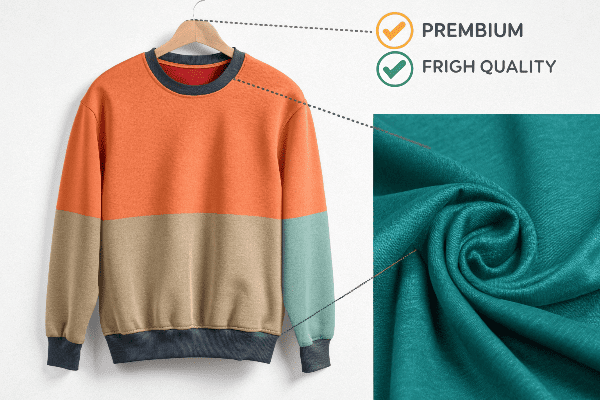
Sweatshirt fabric comparison
| Fabric Type | Quality Indicator |
|---|---|
| 100% Combed Cotton | Soft, breathable, no pilling |
| Cotton-Poly Blend | Durable, shrink-resistant |
| French Terry | Lightweight, looped interior |
| Fleece (brushed) | Warm, fluffy, good structure |
| Ring-Spun Cotton | Stronger, smoother fibers[^3] |
Avoid thin, see-through fabrics or high polyester percentages that feel scratchy or synthetic.
How can you tell if the stitching is high quality?
Check seams and structure—it tells all.
High-quality sweatshirts have clean, even stitching with no loose threads. Look for double-needle seams, coverstitching, and well-attached ribbing around the cuffs and hem.
What to look for in construction
- Flatlock or coverstitch seams → Less irritation, stronger finish[^4]
- Double-needle stitching → Extra reinforcement, longevity
- Bar-tacks at stress points → Durability at pocket corners or cuffs
- Rib-knit cuffs and waistband → Prevents stretching over time
When in doubt, turn the sweatshirt inside out and inspect how clean the inside looks.
Does the weight of a sweatshirt matter?
Yes—heaviness = better durability and structure.
Sweatshirt quality often relates to GSM (grams per square meter). 300–400 GSM is standard for mid- to heavyweight. Anything over 450 GSM is premium and ideal for streetwear or cold weather.[^5]
Sweatshirt weight scale
| GSM Range | Feel | Use Case |
|---|---|---|
| 180–250 | Lightweight | Spring, layering |
| 260–350 | Midweight | Everyday comfort |
| 360–450 | Heavyweight | Warmth + structured fit |
| 460+ | Premium/Streetwear | Durable, thick, oversize |
A quality heavyweight sweatshirt feels solid without being stiff.
How does a good sweatshirt hold up over time?
It keeps its shape and feel—wash after wash.
A good sweatshirt resists fading, stretching, and pilling. It returns to shape after washing, and the cuffs and hem don’t become wavy or loose.
Post-wash performance signs
- Color stays rich after multiple washes
- Fabric doesn’t pill or become fuzzy
- Neck and sleeves don’t stretch out
- Ribbing maintains elasticity
- Side seams don’t twist or warp
Try washing once and checking how it looks after drying—real quality will show.
Conclusion
To spot a high-quality sweatshirt, look at the fabric type, weight, construction, and how it performs after washing. Dense material, clean stitching, and solid structure are your best indicators of long-lasting quality.
[^1]: How to Identify Quality Garment Construction – Threads Magazine
[^2]: GSM Fabric Weight Explained – Sewport
[^3]: What Is Ring-Spun Cotton? – FabricTech
[^4]: Flatlock vs Overlock Seams – Mood Fabrics Guide
[^5]: How to Choose the Right Sweatshirt GSM – ShirtSpace