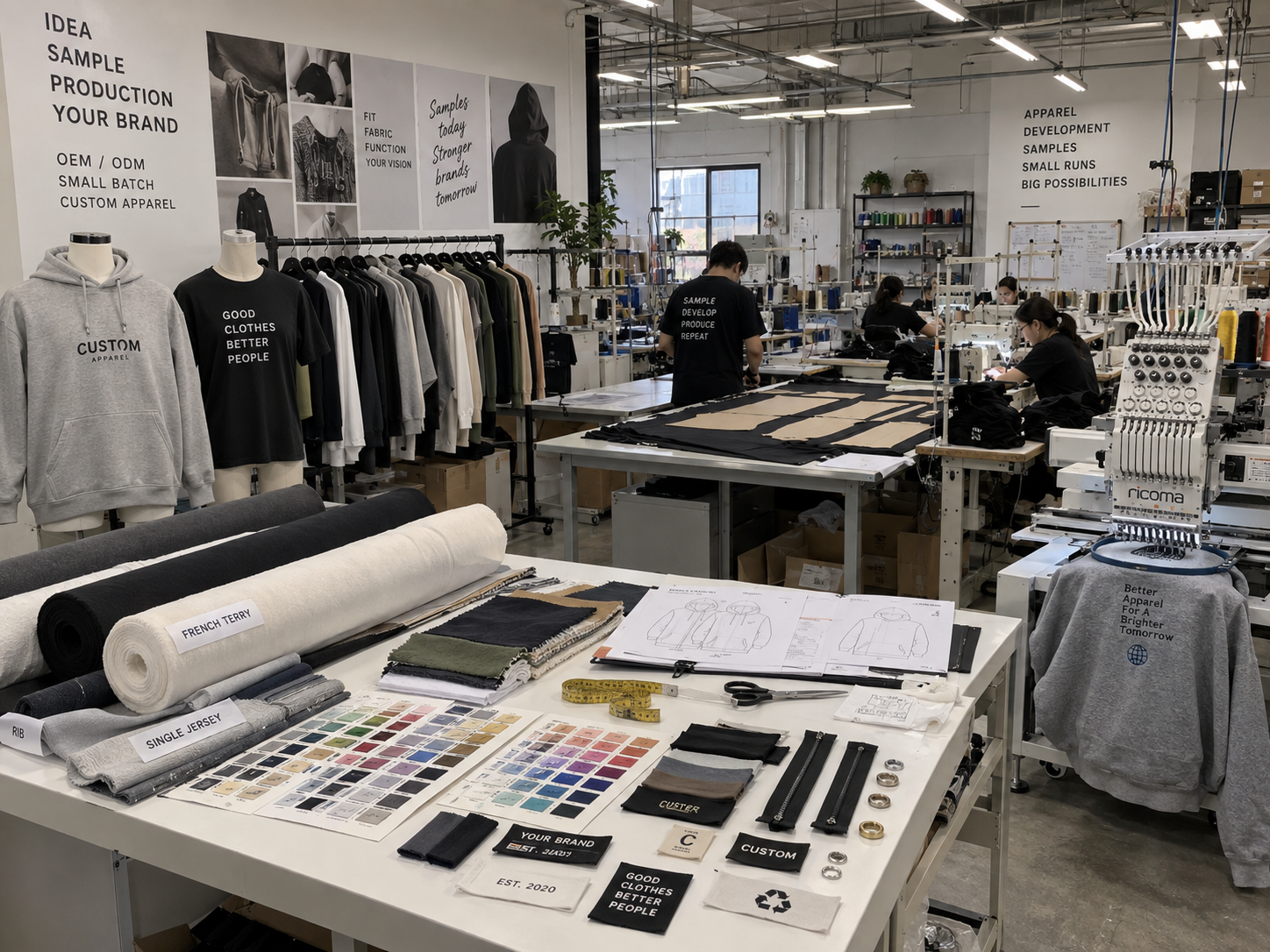
For a startup clothing brand, two things usually matter at the beginning: low inventory risk and fast product development. The problem is that low MOQ and fast sampling do not always come from the same supplier. Some factories are fast but require large orders. Others accept small quantities but move too slowly.
A good small MOQ custom clothing manufacturer should normally support orders around 50–100 pieces for selected styles and complete standard samples in about 5–14 days after specifications are confirmed. The best supplier should also offer flexible fabric sourcing, clear sample pricing, fast communication, and the ability to move from approved samples into stable bulk production.
I work with buyers who are testing a new brand, launching a new collection, or trying a new design before committing to larger quantities. In those projects, speed matters.
But I have also learned that the fastest promise is not always the safest choice.
A useful supplier needs to balance speed, flexibility, and repeatable quality.
Table of Contents
- What Does Small MOQ Mean in Custom Clothing Manufacturing?
- What Is a Realistic MOQ for Startup Clothing Brands?
- How Fast Can a Custom Clothing Sample Be Made?
- Why Do Some Factories Offer Faster Sampling?
- Which Clothing Products Are Easiest for Low MOQ Production?
- How Does Fabric Choice Affect MOQ and Sample Speed?
- Can Low MOQ Orders Still Use Custom Printing and Embroidery?
- How Do Labels and Packaging Affect Low MOQ?
- Why Do Low MOQ Orders Cost More Per Piece?
- How Can Buyers Speed Up Sample Development?
- What Are the Warning Signs of Unrealistic Fast Sampling?
- Should a Startup Choose Speed or Quality First?
- How Do You Compare Small MOQ Clothing Manufacturers?
- What Information Should Buyers Send Before Asking for a Quote?
- How Can a Small First Order Grow Into Long-Term Production?
- Conclusion
- Footnotes & References
What Does Small MOQ Mean in Custom Clothing Manufacturing?
MOQ means minimum order quantity, but “small MOQ” does not have one fixed number across the clothing industry.
In custom clothing manufacturing, small MOQ usually means the factory can accept lower production quantities than traditional mass-production factories. For common knit garments such as hoodies, sweatshirts, T-shirts, joggers, and sets, a flexible small-batch manufacturer may start around 50–100 pieces per style, depending on fabric, colors, sizes, and customization.
A factory may say:
MOQ: 50 pieces.
That sounds simple.
But buyers should still ask:
- Is that 50 pieces per style?
- Is it 50 pieces per color?
- How many sizes are allowed?
- Can I use two colors?
- Is custom fabric included?
- Can I add labels and packaging?
The answers matter more than the headline number.
Small MOQ Is a Production Structure, Not Just a Sales Number
A real small-batch factory needs more than a low MOQ policy.
It also needs:
- Flexible cutting
- Flexible sewing lines
- Fast style changeovers
- Small fabric sourcing
- Strong sample-room support
- Good coordination with printing and embroidery suppliers
If the production system is built only for large volume, a 50-piece order can become difficult even if the salesperson accepts it.
This is one reason I do not think buyers should search only for the phrase “low MOQ clothing factory.”
They should look at how the factory actually produces.
What Is a Realistic MOQ for Startup Clothing Brands?
For most startup brands, 50–100 pieces is a practical range for testing a style.
A realistic startup MOQ is often around 50 pieces for selected hoodies, sweatshirts, zip hoodies, or sets, and around 100 pieces for many T-shirts, shorts, and other garments. The exact quantity depends on whether the factory can use stock fabric and whether the design uses standard trims and decoration.
A practical reference looks like this:
| Product | Possible Small MOQ |
|---|---|
| Pullover hoodie | 50–100 pcs |
| Sweatshirt | 50–100 pcs |
| Zip hoodie | 50–100 pcs |
| Hoodie + jogger set | Around 50 sets |
| T-shirt | Around 100 pcs |
| Heavyweight T-shirt | Around 100 pcs |
| Joggers | 50–100 pcs |
| Shorts | Around 100 pcs |
| Activewear | 100–200 pcs |
| Kidswear | Around 150 pcs or more |
These are not universal rules.
They are working ranges.
Why 50 Pieces Can Be Easier for Hoodies Than Some T-Shirts
This surprises some buyers.
A hoodie may have a lower MOQ even though it is more expensive.
The reason is not always sewing difficulty.
It can be about production economics.
A heavyweight hoodie has a higher unit value, so the factory can sometimes manage a smaller quantity.
Basic T-shirts are often more price-sensitive and depend heavily on fabric efficiency.
That is why MOQ should be discussed product by product.
How Fast Can a Custom Clothing Sample Be Made?
Sample speed depends on how much of the product already exists.
A standard custom clothing sample can often be completed in about 5–14 days after fabric, measurements, artwork, and construction details are confirmed. Simple T-shirts may be finished faster, while heavyweight hoodies, garment-washed products, embroidery, special trims, and custom fabrics can require 10–20 days or more.
For many normal projects, I think of sample development like this:
| Sample Type | Typical Time |
|---|---|
| Basic T-shirt | 5–10 days |
| Heavyweight T-shirt | 7–12 days |
| Sweatshirt | 7–12 days |
| Hoodie | 7–14 days |
| Zip hoodie | 8–15 days |
| Joggers | 7–12 days |
| Hoodie set | 10–15 days |
| Activewear set | 10–15 days |
| Washed streetwear | 10–20 days |
| Complex embroidery | 12–20 days |
The most important phrase is:
after all details are confirmed.
If the buyer is still changing the logo, color, measurements, or fabric, the sample clock has not really started.
Why Do Some Factories Offer Faster Sampling?
Fast sampling is usually the result of preparation, not magic.
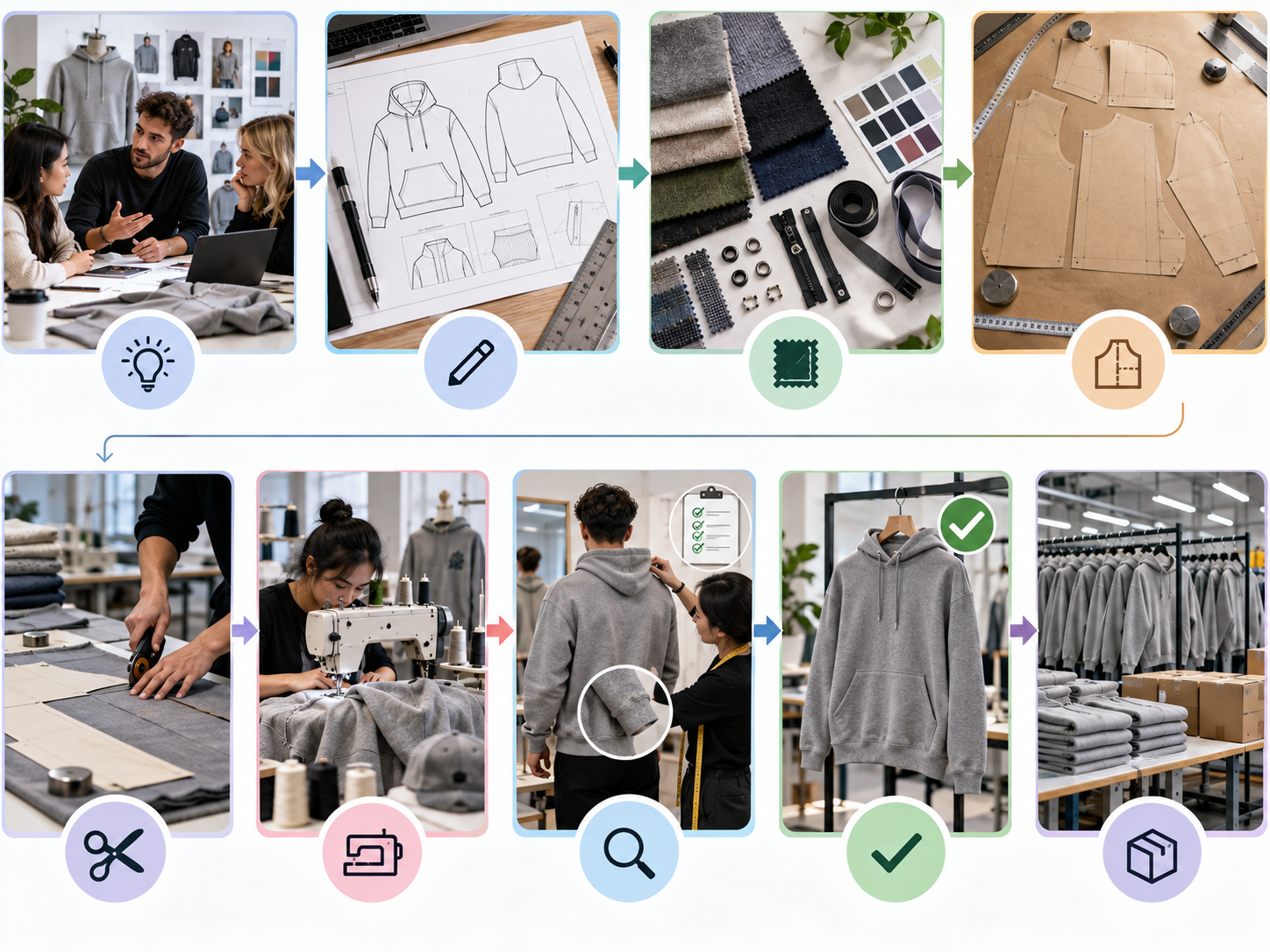
Factories can sample faster when they have an experienced sample room, available fabric, in-house pattern making, nearby decoration suppliers, clear development procedures, and fast communication. Sampling slows down when the factory must wait for custom fabric, special trims, outside suppliers, or missing buyer approvals.
In-House Pattern Making Helps
If the pattern maker is part of the factory team, changes can move quickly.
The factory does not need to send every measurement update to an outside company.
That can save time.
Fabric Availability Matters Even More
If I already have access to:
- 320 GSM French terry
- 400 GSM fleece
- 500 GSM heavyweight fleece
- Cotton jersey
- Polyester-spandex activewear fabric
I can begin quickly.
If the buyer wants a completely new fabric, the project slows down before cutting even starts.
Nearby Printing and Embroidery Suppliers Also Matter
Custom garments often involve several suppliers.
A fast factory normally has stable partners for:
- Screen printing
- DTG
- DTF
- Embroidery
- Appliqué
- Washing
- Labels
- Packaging
Strong local supplier relationships can reduce waiting time.
The important thing is not whether every process happens inside one building.
What matters is whether the manufacturer can control the whole development schedule.
Which Clothing Products Are Easiest for Low MOQ Production?
Not all garments are equally suitable for small-batch production.
Basic knitwear is usually easier for low MOQ production because the materials and construction are common. Hoodies, sweatshirts, T-shirts, joggers, shorts, and simple sets are often more flexible than structured jackets, highly technical sportswear, or products using custom-developed fabrics and hardware.
For low MOQ, I prefer products with:
- Common knit fabrics
- Simple construction
- Standard trims
- Limited colors
- Common decoration methods
Good Low-MOQ Starting Products
Startup brands often begin with:
- Heavyweight T-shirts
- Oversized hoodies
- Crewneck sweatshirts
- Joggers
- Shorts
- Hoodie sets
- Simple activewear sets
These products can still feel premium without requiring too many custom components.
More Complex Products Need More Planning
The following can still be done, but they may require higher MOQ:
- Technical jackets
- Multi-layer outerwear
- Fully custom activewear fabrics
- Complex kidswear
- Heavy hardware
- Custom molded trims
- Large mixed embroidery programs
The product itself determines how flexible the factory can be.
How Does Fabric Choice Affect MOQ and Sample Speed?
Fabric is often the single biggest factor behind both MOQ and sample lead time.
Stock fabric supports lower MOQ and faster sampling because the factory can buy a small quantity immediately. Custom fabric increases both MOQ and development time because the mill may need to knit, dye, finish, and test the fabric before the garment factory can begin sampling.
Stock Fabric Is the Fastest Route
If a buyer accepts an existing fabric such as:
400 GSM 100% cotton French terry, black
I may be able to source it quickly.
Then pattern making and cutting can begin.
Custom Color Adds Time
A buyer may want:
Pantone 18-1028 TCX.
If that exact color is not available, the fabric needs dyeing.
For textile development, I prefer using a standardized textile color rather than trying to match a color from a phone screen. Pantone's official Fashion, Home + Interiors system[^1] explains that TCX references are intended for soft surfaces such as textiles and apparel.
The dyeing process may require:
- Color lab dip
- Buyer approval
- Minimum fabric quantity
- Production dyeing
- Finishing
This can turn a fast sample into a slower development.
Fully Custom Fabric Has the Biggest Impact
Custom fabric may involve:
- Yarn sourcing
- Knitting
- Dyeing
- Brushing
- Finishing
- Washing
- GSM testing
- Shrinkage testing
This is why I always tell startup brands to decide whether exact custom fabric is necessary for the first sample.
Sometimes a similar stock fabric can be used to test fit first.
The exact fabric can then be confirmed for the next sample or bulk order.
Can Low MOQ Orders Still Use Custom Printing and Embroidery?
Yes. Low quantity does not mean the garment must look generic.
Small-batch clothing orders can still use screen printing, DTG, DTF, standard embroidery, puff print, appliqué, and other decoration techniques. The main difference is cost. Some techniques require setup fees, templates, or programming, so the unit cost is higher when those charges are divided across only 50 or 100 garments.
For low MOQ, these are often practical:
| Decoration | Small-Batch Suitability |
|---|---|
| Standard embroidery | Good |
| DTF | Very good |
| DTG | Very good |
| Screen print | Good |
| Puff print | Good |
| Appliqué | Possible, higher setup |
| Chenille | Possible, higher cost |
| Silicone print | Possible, setup may increase |
| Custom metal logo | Less flexible |
Simple Branding Is Often Better for First Orders
For a first drop, I often like combinations such as:
- Small chest embroidery
- Large back screen print
or:
- Small silicone logo
- Sleeve print
This gives the product brand identity without creating too many suppliers and setup fees.
A clean design that can be reproduced consistently is often more useful than a first collection using five complicated decoration techniques.
How Do Labels and Packaging Affect Low MOQ?
Garment MOQ and accessory MOQ are not always the same.
A factory may accept 50 garments while the woven-label supplier requires 100 labels and the hangtag supplier requires 500 pieces. Custom packaging may also have its own minimum. Buyers can often purchase the minimum accessory quantity and store unused labels, tags, or bags for future orders.
For example:
- Garment order: 50 pcs
- Woven labels: 100 pcs
- Hangtags: 500 pcs
- Custom boxes: 100 pcs
These numbers can all exist in the same project.
Keep Early Packaging Practical
For startup brands, I usually prefer:
- Standard polybag
- Custom sticker
- Woven neck label
- Care label
- Hangtag
This gives the product a professional brand identity without creating unnecessary packaging cost.
Custom rigid boxes can come later.
Target Market Matters When Preparing Labels
Labels are not only decorative branding.
If a brand plans to sell in the United States, the U.S. Federal Trade Commission's official Apparel and Labeling guidance[^2] explains that most textile products need information such as fiber content, country of origin, and the identity of the responsible manufacturer or marketer. Care instructions are also covered by U.S. labeling rules.
For this reason, I prefer knowing the target market early instead of designing a care label first and correcting it later.
Why Do Low MOQ Orders Cost More Per Piece?
Low MOQ helps reduce inventory risk, but it increases unit cost.
Low MOQ clothing costs more per piece because fixed costs such as pattern development, cutting setup, printing screens, embroidery programming, line preparation, and quality control are divided across fewer garments. Small fabric and trim purchases also usually cost more than bulk purchasing.
A simple example:
If setup costs are $200:
At 50 pieces:
$200 ÷ 50 = $4 per piece
At 500 pieces:
$200 ÷ 500 = $0.40 per piece
The same setup work happened.
Only the quantity changed.
Flexible Production Has a Cost
A factory that frequently switches between styles loses some efficiency.
A 50-piece hoodie may require:
- Production setup
- Sewing
- QC
- Packing
Then the line changes again.
Large-volume factories avoid this by producing thousands of the same item.
Small-batch factories accept more changes, but the price reflects that flexibility.
How Can Buyers Speed Up Sample Development?
Buyers have much more control over sampling speed than they sometimes realize.
The fastest way to shorten clothing sample time is to provide complete specifications before production begins. Buyers should confirm measurements, fabric, GSM, color, logo size, artwork, decoration method, labels, trims, and sample size early. Fast replies to factory questions can also save several days.
Send One Clear Tech Pack
I prefer one complete document over information spread across:
- Screenshots
- Voice messages
A good tech pack should include:
- Front and back design
- Measurements
- Fabric
- GSM
- Color
- Logo sizes
- Logo locations
- Construction
- Labels
- Packaging
Send Vector Artwork
Useful formats include:
- AI
- EPS
- SVG
- Vector PDF
Adobe's official Illustrator supported file formats documentation[^3] confirms support for formats including AI, PDF, EPS, and SVG in common design workflows.
A blurry screenshot may need redrawing before printing or embroidery.
That costs time.
Confirm the Sample Size
Do not forget this.
A factory needs to know whether to make:
- S
- M
- L
- XL
For new streetwear projects, size L is often used as a development size, but the buyer should confirm it.
Confirm Important Trims Early
A zip hoodie can stop because one small zipper detail is unclear.
For example:
- Metal or plastic?
-
5 or #8?
- Silver or gunmetal?
- Black or matching zipper tape?
- Standard or custom puller?
YKK's official fastening product search[^4] shows how many zipper, slider, plastic hardware, snap, and button options exist.
This is why simply writing “YKK zipper” may still leave several questions unanswered.
Reply Quickly
If I ask:
Do you want matte black or gunmetal zipper?
and the buyer answers three days later, the project loses three days.
Fast sampling requires fast decisions from both sides.
What Are the Warning Signs of Unrealistic Fast Sampling?
Fast is useful, but unrealistic promises can create quality problems.
A supplier promising every fully custom sample in two or three days should be questioned carefully. Genuine fast sampling depends on material availability and product complexity. If custom fabric, embroidery, washing, and special trims are involved, the factory needs enough time to complete each process properly.
Ask What Is Actually Included
A factory may say:
Sample in 3 days.
But ask:
- Is it the correct fabric?
- Is the correct Pantone color included?
- Is the embroidery final?
- Are custom labels included?
- Is the garment wash included?
Sometimes a “fast sample” is only a fit prototype.
That can still be useful.
But the buyer should know what they are approving.
Similar Material Is Not Exact Material
A factory may use stock fabric to move faster.
I do this sometimes when it makes sense.
But I tell the buyer clearly:
This first sample uses similar stock fabric for fit approval. Final bulk fabric will be different.
Transparency matters.
Should a Startup Choose Speed or Quality First?
I do not think buyers should treat speed and quality as complete opposites.
A startup should look for the fastest process that still protects product quality. A realistic 7–12 day sample that uses the right fabric and construction is often more useful than a rushed 3-day sample made with incorrect materials. The goal should be fast decision-making, not simply the shortest calendar time.
Fast Mistakes Are Still Mistakes
A sample is supposed to remove risk.
If the factory rushes:
- Pattern checking
- Logo placement
- Embroidery
- Finishing
- Measurement QC
the buyer may receive the wrong product faster.
That does not help the launch.
I Prefer Controlled Speed
I try to speed up parts that can safely move faster.
For example:
- Pattern development can start while fabric arrives.
- Labels can be prepared during sewing.
- Packaging can be confirmed during sample review.
This shortens the total timeline without cutting quality steps.
How Do You Compare Small MOQ Clothing Manufacturers?
The lowest MOQ and fastest quote are not enough to evaluate a factory.
Buyers should compare small MOQ manufacturers based on sample quality, communication, fabric sourcing, customization ability, quality control, realistic lead time, production capacity, certification or audit documentation, and ability to repeat the approved sample in bulk. A supplier should be flexible at low quantity without losing control when the order grows.
I would compare these areas:
| Area | What to Check |
|---|---|
| MOQ | Per style or per color? |
| Sampling | Realistic timeline? |
| Fabric | Stock + custom options? |
| Pattern making | In-house capability? |
| Decoration | Printing and embroidery options? |
| QC | How are measurements checked? |
| Bulk production | Can quality match the sample? |
| Communication | Fast and clear? |
| Certification / audits | Can documents be verified? |
| Scaling | Can the factory handle larger reorders? |
Verify Certification and Audit Claims
I do not recommend choosing a supplier simply because several logos appear on its website.
The buyer should understand what each document actually means.
For example, OEKO-TEX® STANDARD 100[^5] is a textile certification for products tested for harmful substances. OEKO-TEX explains that the testing can apply from yarn and fabric through finished textile products and accessories.
SMETA is different.
Sedex describes SMETA[^6] as a social-audit methodology covering areas such as labour standards, health and safety, environmental performance, and business ethics.
Importantly, Sedex itself states that SMETA is an audit methodology, not a certification or a Sedex stamp of approval.
That distinction matters.
A serious buyer should ask for the actual relevant certificate or audit information and check whether it applies to the factory, product, or production site involved.
Ask About Reorders
A startup may begin with 50 pieces.
But what happens if the style sells well?
Can the same factory make:
- 200 pieces?
- 500 pieces?
- 2,000 pieces?
Can it reproduce:
- The same fabric?
- The same color?
- The same print?
- The same measurements?
A good small-batch supplier should also have a path to scale.
What Information Should Buyers Send Before Asking for a Quote?
A detailed inquiry allows the factory to give a more accurate MOQ, sample price, and lead time.
Before asking for a quotation, buyers should send the product type, quantity, size range, fabric composition, GSM, color, artwork, logo dimensions, decoration method, labels, packaging needs, sample size, destination country, and any required delivery date. A tech pack or physical reference sample can improve accuracy even further.
A useful first inquiry may look like this:
| Item | Requirement |
|---|---|
| Product | Oversized hoodie |
| Quantity | 50 pcs |
| Fabric | 100% cotton French terry |
| GSM | 400–450 GSM |
| Color | Black |
| Sizes | S–XL |
| Front logo | 8 cm embroidery |
| Back logo | 30 cm screen print |
| Sample size | L |
| Label | Custom woven neck label |
| Packaging | Individual polybag |
| Target market | United States |
Now I can quickly evaluate:
- MOQ
- Fabric availability
- Sample cost
- Sample time
- Bulk price
Tell the Factory What Is Flexible
This is very useful.
For example:
I prefer 450 GSM, but 420–480 GSM is acceptable if stock fabric is available.
That gives me room to find a faster and more economical option.
The same approach can work with:
- Zipper brand
- Rib specification
- Packaging
- Fabric color
- Decoration technique
The buyer should clearly separate what is fixed from what is flexible.
How Can a Small First Order Grow Into Long-Term Production?
I think the first small batch should be treated as both a sales test and a supply-chain test.
A small first order allows a brand to test customer demand, sizing, product quality, packaging, supplier communication, and delivery performance before increasing volume. If the product sells well, the approved sample, patterns, artwork, and production records can become the base for larger repeat orders.
This is one reason low MOQ is useful.
The brand can learn before taking a large inventory risk.
Track What Happens After the First Drop
I recommend reviewing:
- Which sizes sold fastest?
- Which colors sold best?
- Were there fit complaints?
- Did customers like the fabric?
- Did the print survive washing?
- Was the packaging good enough?
- Did the factory deliver on time?
The second order should use this information.
Do Not Change Everything on Every Reorder
Startup brands sometimes make a successful first product and then completely redesign it.
That removes the benefit of learning.
If customers like the fit, keep it.
If the fabric works, keep it.
Improve only what needs improvement.
That makes repeat production faster and more stable.
One Thing I Have Learned From Small-Batch Buyers
A new buyer often begins by asking me only two questions:
What is your MOQ?
and:
How fast can you make the sample?
Those questions are important.
But after we discuss the project, I usually find that the real goal is different.
The buyer wants to launch without taking too much risk.
That means the best answer is not always the lowest possible MOQ or the fastest possible sample.
The better solution may be:
- One strong style
- One or two colors
- Four sizes
- Available premium fabric
- Clear branding
- One approved sample
- A manageable first production run
That gives the brand something it can actually sell and learn from.
Then we can improve the next order based on real feedback.
Conclusion
A small MOQ custom clothing manufacturer with fast sampling should combine flexible production with realistic development control.
For many knit garments, around 50–100 pieces can be a practical starting point, while a standard sample may take around 5–14 days after the important specifications are confirmed.
But those numbers should not be evaluated alone.
Low MOQ depends on:
- Fabric availability
- Color quantity
- Size distribution
- Printing and embroidery
- Trims
- Labels
- Packaging
- Production complexity
Fast sampling depends on:
- Clear specifications
- Available materials
- Pattern-making capability
- Supplier coordination
- Buyer response speed
- Realistic approval procedures
For a startup brand, I would not choose a manufacturer only because it advertises:
MOQ 30 pcs.
or:
Sample in 3 days.
I would ask what is actually included.
Is the fabric correct?
Is the color final?
Are the logos made with the real technique?
Are the measurements checked?
Can the factory reproduce the approved sample when the order grows from 50 pieces to 500 or 2,000?
That is the bigger question.
The best small-MOQ manufacturer is not simply the factory willing to make the fewest garments.
And the best fast-sampling factory is not simply the factory promising the shortest number of days.
The better partner is one that can help a brand start small, develop quickly, control quality, and scale the same product successfully when demand grows.
Footnotes & References
[^1]: Pantone — Fashion, Home + Interiors (FHI). Official Pantone color system explaining the use of TCX for soft surfaces including textiles and apparel.
https://www.pantone.com/na/en-us/fashion-home-interiors
[^2]: U.S. Federal Trade Commission — Apparel and Labeling. Official FTC information covering textile and apparel labeling requirements, including fiber content, country of origin, responsible business identification, and care labeling.
https://www.ftc.gov/news-events/topics/tools-consumers/apparel-labeling
[^3]: Adobe — Supported File Formats in Illustrator. Official Adobe documentation covering AI, PDF, EPS, SVG, and other artwork formats used in design and production workflows.
https://helpx.adobe.com/illustrator/desktop/get-started/learn-the-basics/supported-file-formats.html
[^4]: YKK Fastening Products Group — Product Search. Official YKK database covering metal, coil and VISLON® zippers, sliders, plastic hardware, snaps, buttons, and other fastening components.
https://www.ykkfastening.com/products/search/?cl=on
[^5]: OEKO-TEX® — STANDARD 100. Official information about STANDARD 100 certification and testing of textile products and components for harmful substances.
https://www.oeko-tex.com/en/our-standards/oeko-tex-standard-100
[^6]: Sedex — SMETA Audit. Official Sedex information explaining SMETA as a social-audit methodology covering labour standards, health and safety, environmental performance, and business ethics. Sedex also clarifies that SMETA is an audit methodology rather than a certification.
https://www.sedex.com/solutions/smeta-audit/