



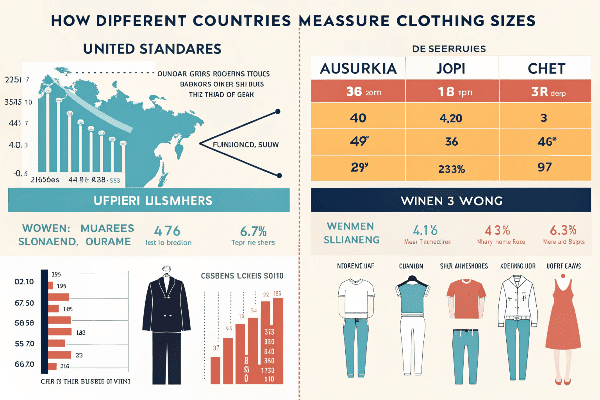
Ever ordered a shirt from another country and found it either too big or too small? That’s because clothing sizes aren’t universal. Each region has its own way of measuring and labeling clothes.
Different countries use different sizing systems based on body measurements, fit standards, and even cultural preferences. The same size label (like “M”) can vary by several centimeters or inches between the US, UK, Europe, and Asia.
I’ve seen this issue often when making clothing for global brands. Understanding these systems is key for anyone who buys or manufactures clothing internationally.
Table of Contents
- Why do countries have different clothing sizes?
- How does the US measure clothing?
- How does the UK and EU measure clothing?
- How does Asia measure clothing?
- Are there international size conversion charts?
- How to avoid sizing mistakes when buying globally?
- Conclusion
Why do countries have different clothing sizes?
Because body measurements, units, and fit expectations vary.
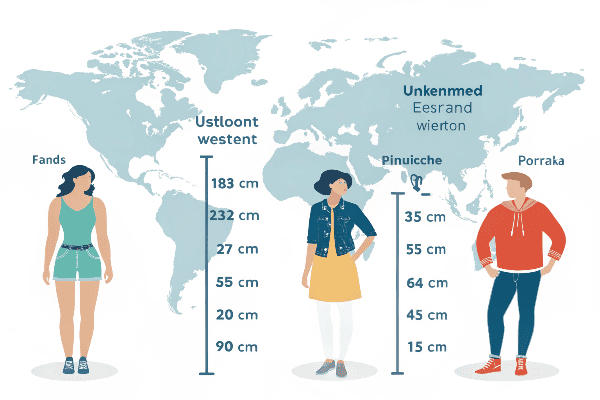
Countries develop sizing standards based on local body shapes, preferred fits (loose vs. fitted), and whether they use inches or centimeters. Even within one country, brands can size differently.
Main reasons for differences
- Measurement unit: US uses inches, most others use centimeters
- Body shape data: Based on average body shapes from local studies
- Style preference: Slim vs. oversized fits differ by market
- Brand positioning: Luxury brands often cut slimmer than casual brands
This is why a US “Medium” often feels bigger than a European “Medium.”
For a detailed explanation, see Size Guide by ASTM International[^1].
How does the US measure clothing?
The US system uses letters or numbers, based on inches.
Sizes like S, M, L or 4, 6, 8 are based on chest, waist, or hip measurements in inches. Men’s pants, for example, use waist and inseam (e.g., 32×30).
Typical US size approach:
- Women: Numeric (2, 4, 6) or lettered (S, M, L)
- Men: Chest size for shirts, waist × inseam for pants
- Units: Inches
US sizes are known for running larger compared to Europe or Asia.
See also: US Apparel Sizing Standards[^2].
How does the UK and EU measure clothing?
The UK and Europe mainly use numeric systems in centimeters.
European sizes (EU) are usually 6–8 numbers higher than UK sizes for women. Men’s sizes may be listed as chest circumference in centimeters.
| Women’s Size | UK | EU (approx.) |
|---|---|---|
| XS | 6 | 34 |
| S | 8 | 36 |
| M | 10 | 38 |
| L | 12 | 40 |
Men’s suits in Europe use chest measurement in cm (e.g., 50 = ~40” chest).
How does Asia measure clothing?
Asian sizes tend to run smaller.
Many Asian brands size garments smaller because average body dimensions are slimmer. They may use a mix of centimeters and letters but with smaller cut patterns.
Key notes:
- Japanese sizes often use height + chest in cm
- Korean and Chinese labels often use numbers (90, 95, 100)
- A “Large” in Asia can be close to a “Small” in the US
Always check the brand’s size chart before buying.
Useful resource: Japan Clothing Size Conversion Guide[^3].
Are there international size conversion charts?
Yes—but they’re only a guide.
Size conversion charts help compare labels across regions, but actual fit still depends on brand patterns. Always confirm garment measurements instead of relying only on labels.
| Region | Women’s Medium | Men’s Medium (Chest) |
|---|---|---|
| US | 8–10 | 38–40 in (96–102 cm) |
| UK | 10–12 | 38–40 in |
| EU | 38–40 | 48–50 cm label |
| Asia | L | 95–100 cm |
These are approximate—every brand tweaks their fit.
How to avoid sizing mistakes when buying globally?
Always check measurements, not just letters.
Look for size charts with actual garment dimensions or body measurements. Pay attention to notes like “oversized fit” or “slim fit.” When in doubt, measure your favorite piece and compare.
Platforms like ASOS size guide[^4] can help you find accurate sizing before you order.
Conclusion
Different countries measure clothing differently due to local standards, units, and fit preferences. To shop globally with confidence, rely on detailed size charts and actual measurements—not just size labels like S, M, or L.
[^1]: ASTM International – Standards for sizing and fit
[^2]: ISO – International sizing standards
[^3]: Japan Guide – Clothing size conversion
[^4]: ASOS – Online size guide