
Heavyweight T-Shirt Manufacturer: How Heavy Should Your Tee Actually Be?
You want a T-shirt that feels premium, structured, and substantial.
Then you start talking to manufacturers and everybody says the same thing:
We can make heavyweight T-shirts.
But what does “heavyweight” actually mean?
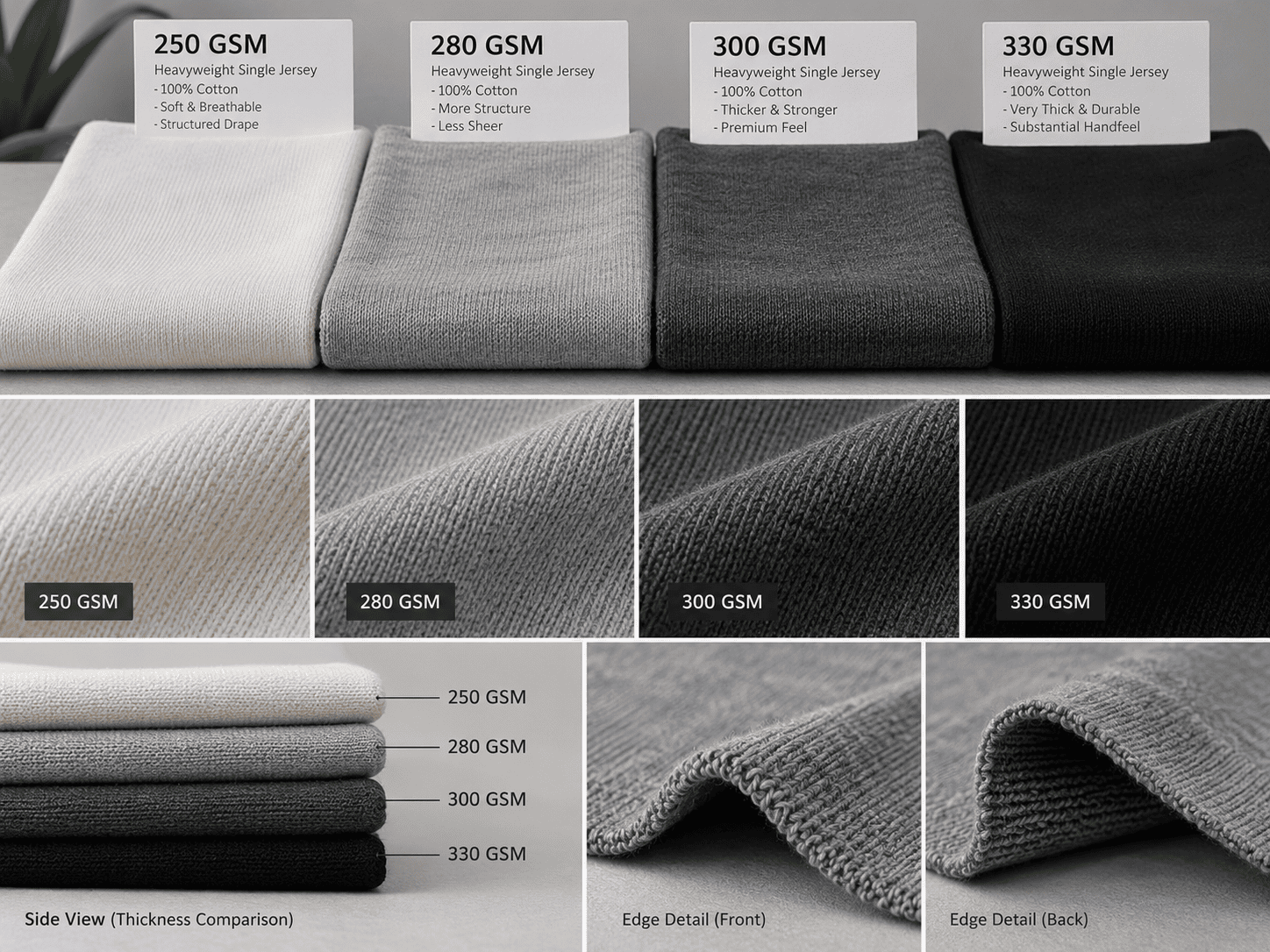
Is 220 GSM heavy?
Is 280 GSM better?
Do you really need 330 GSM?
And why can two T-shirts with the same GSM feel completely different?
For custom T-shirt sourcing, I usually treat around 220–250 GSM as an entry heavyweight range, 250–330 GSM as premium heavyweight, and 330 GSM or above as ultra-heavy or highly structured. These are practical sourcing ranges rather than an official global standard. Fabric composition, yarn quality, knitting density, finishing, and garment pattern all affect how heavy and premium the final T-shirt actually feels.
I work with knit garments in Dongguan, and heavyweight T-shirts are one of the products where buyers often focus too much on one number.
GSM matters.
But GSM is only the beginning.
A good heavyweight tee needs the right combination of:
- Fabric
- Yarn
- GSM
- Knitting
- Collar
- Pattern
- Fit
- Finishing
- Decoration
Get those right, and a relatively simple T-shirt can feel like a premium product.
Get them wrong, and even a 330 GSM tee can feel stiff, cheap, or badly proportioned.
Table of Contents
- What Makes a T-Shirt Heavyweight?
- Is There an Official Heavyweight T-Shirt GSM Standard?
- What Is the Difference Between 220, 250, 280, and 330 GSM?
- What Fabric Makes the Best Heavyweight T-Shirt?
- Does Ring-Spun and Combed Cotton Really Matter?
- Does Higher GSM Always Mean Better Quality?
- What Fit Works Best for Heavyweight T-Shirts?
- What Collar Construction Should a Heavyweight Tee Use?
- What Printing and Embroidery Can Be Used on Heavyweight Tees?
- What MOQ Should You Expect for Custom Heavyweight T-Shirts?
- What Affects the Cost of a Heavyweight T-Shirt?
- Why Should You Make a Sample Before Bulk Production?
- What Should You Send a Heavyweight T-Shirt Manufacturer?
- How Do You Choose a Heavyweight T-Shirt Manufacturer?
- Conclusion
- Footnotes & References
What Makes a T-Shirt Heavyweight?
The first thing I look at is GSM.
GSM means grams per square meter. It measures the weight of the fabric, not the finished garment. Higher GSM normally creates a denser, heavier T-shirt, but it does not automatically mean better cotton or better quality.
For sourcing purposes, I usually think about T-shirt weights like this:
| Fabric Weight | Practical Category | Typical Result |
|---|---|---|
| 140–180 GSM | Lightweight | Soft, breathable, basic summer tee |
| 180–220 GSM | Standard / substantial | Everyday retail T-shirt |
| 220–250 GSM | Entry heavyweight | More structure and body |
| 250–300 GSM | Premium heavyweight | Dense, streetwear-friendly drape |
| 300–330 GSM | Very heavyweight | Strong boxy structure |
| 330 GSM+ | Ultra-heavy | Dense, sculptural, niche premium feel |
These are practical factory sourcing ranges, not an official industry classification.
Two manufacturers may describe the same 230 GSM fabric differently.
One may call it:
Heavyweight.
Another may call it:
Medium-heavy.
That is why I do not recommend relying on marketing words.
Ask for the number.
Is There an Official Heavyweight T-Shirt GSM Standard?
No universal rule says:
219 GSM is standard and 220 GSM is officially heavyweight.
There is no globally fixed boundary like that.
“Heavyweight” is a market description.
That means the safest way to buy fabric is to specify:
- Composition
- GSM
- Yarn
- Knit construction
- Finish
instead of writing only:
Premium heavyweight cotton.
For example:
100% cotton
280 GSM
Combed ring-spun yarn
Single jersey
Enzyme wash
Soft hand feel
gives a manufacturer much more useful information.
This distinction matters for B2B sourcing.
A supplier can interpret “heavyweight” differently.
A supplier cannot interpret 280 GSM as 180 GSM.
What Is the Difference Between 220, 250, 280, and 330 GSM?
The difference becomes very noticeable once you physically handle the samples.
220–250 GSM
This is a good starting range when a buyer wants:
- More structure than a basic tee
- Comfortable year-round wear
- Lower shipping weight
- Strong print performance
- A premium feel without extreme thickness
For many brands, this is already enough.
250–280 GSM
This is where heavyweight streetwear becomes more obvious.
The garment normally:
- Holds its shape better
- Feels more substantial
- Works well with oversized patterns
- Supports larger prints
- Gives a more premium hand feel
A 260 or 280 GSM T-shirt can be a good balance between weight and wearability.
300–330 GSM
At this level, the garment becomes much more structured.
It works well for:
- Boxy fits
- Drop shoulders
- Luxury basics
- Streetwear
- Large graphic tees
- Minimal premium T-shirts
Our stock heavyweight tee fabric can reach around 330 GSM, which gives buyers a very dense option without necessarily developing a new fabric from zero.
Above 330 GSM
It is possible.
But heavier is not automatically better.
A very heavy T-shirt can become:
- Stiff
- Hot
- Difficult to drape
- More expensive
- More expensive to ship
If the buyer wants 360 or 400 GSM simply because the number sounds premium, I normally ask what result they are trying to achieve.
Sometimes a well-made 300–330 GSM fabric gives a better garment.
What Fabric Makes the Best Heavyweight T-Shirt?
For many premium heavyweight tees, cotton single jersey is the most common starting point.
But saying “100% cotton” still does not tell me enough.
The cotton can differ in:
- Fiber length
- Yarn spinning method
- Combing
- Yarn count
- Knitting density
- Finishing
That is why two 280 GSM 100% cotton T-shirts can feel completely different.
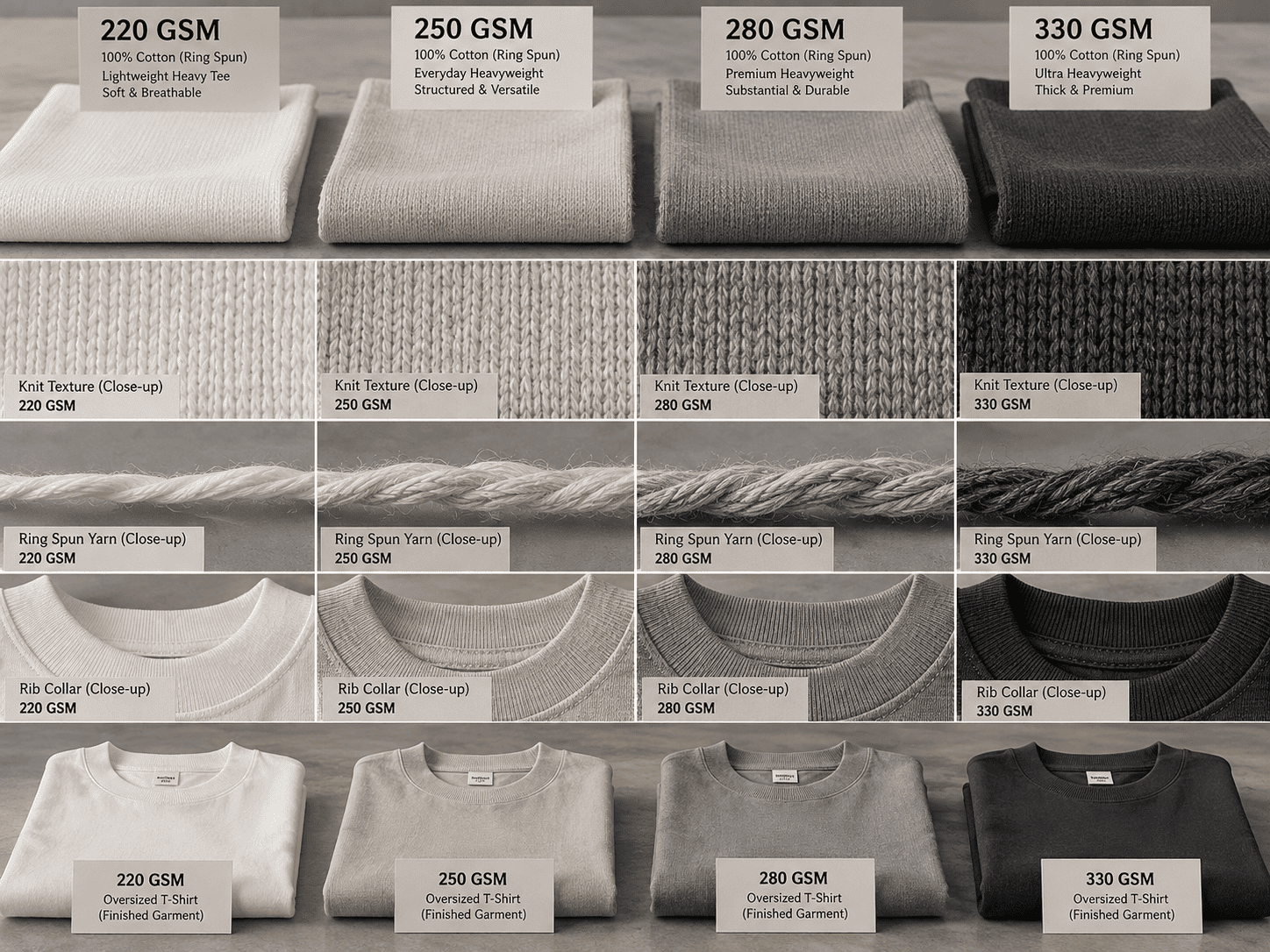
Common options include:
| Fabric | Typical Result |
|---|---|
| Carded cotton | More economical, rougher hand |
| Ring-spun cotton | Smoother, softer yarn |
| Combed cotton | Cleaner, softer yarn preparation |
| Combed ring-spun cotton | Premium smooth hand and cleaner appearance |
| Cotton/poly blend | Can add stability or reduce cost |
| Cotton/spandex | Adds stretch where required |
For premium streetwear, buyers frequently ask me for 100% cotton combed ring-spun fabric.
There is a reason.
Does Ring-Spun and Combed Cotton Really Matter?
Yes, but these are two different parts of yarn production.
Ring-Spun Cotton
Ring spinning describes how prepared fibers are spun into yarn.
CottonWorks explains that ring spinning remains an important benchmark for cotton yarn quality and notes that fabrics made from ring-spun yarn are known for a particularly soft hand.[^1]
Compared with some faster spinning systems, ring spinning requires more production steps.
That can affect cost.
But it can also create a finer, smoother yarn suitable for premium garments.
Combed Cotton
Combing happens during fiber preparation.
It removes shorter fibers before yarn production.
CottonWorks explains that combing can produce finer yarn and that combed cotton products tend to have improved hand, drape, softness, and durability.[^2]
That is why:
100% cotton
and:
100% combed ring-spun cotton
are not necessarily equivalent specifications.
Do You Always Need It?
No.
Open-end cotton can also be useful.
It can create a more:
- Dry
- Vintage
- Rough
- Authentic
- Old-school
hand feel.
That may actually suit a vintage streetwear T-shirt better.
The right yarn depends on the desired product.
Premium does not always mean “as soft as possible.”
Sometimes the buyer wants structure and character.
Does Higher GSM Always Mean Better Quality?
No.
This is one of the most important things I tell buyers.
GSM measures weight. It does not directly measure cotton quality, shrinkage, colorfastness, pilling, sewing quality, or garment fit.
Imagine two fabrics:
Fabric A
330 GSM
Poor yarn
Loose knitting
Rough finish
High shrinkage
Fabric B
280 GSM
Better yarn
Dense knitting
Controlled finishing
Stable shrinkage
I would not automatically call Fabric A the better fabric.
When evaluating heavyweight T-shirt fabric, I look at:
- GSM
- Composition
- Yarn
- Surface
- Knitting density
- Stretch
- Recovery
- Shrinkage
- Hand feel
- Color
- Washing result
A sample is much more useful than a GSM number alone.
What Fit Works Best for Heavyweight T-Shirts?
Heavyweight fabric works especially well with structured silhouettes.
Common options include:
- Regular
- Oversized
- Boxy
- Drop shoulder
- Cropped
- Wide body
- Longer sleeve
But the fit comes from the pattern.
Not the GSM.
A buyer may send me a 330 GSM fabric and say:
Make it oversized.
I still need measurements.
For example:
| Measurement | Example |
|---|---|
| Chest | 62 cm |
| Body length | 72 cm |
| Shoulder | 60 cm |
| Sleeve | 24 cm |
| Bottom width | 62 cm |
The exact numbers depend on the design.
Boxy Does Not Mean Simply Making Everything Bigger
A true boxy pattern may involve adjusting:
- Body length
- Chest width
- Shoulder
- Sleeve opening
- Armhole
- Bottom width
If I simply grade a normal T-shirt two sizes bigger, it may look oversized but not intentionally designed.
That difference matters for premium streetwear.
What Collar Construction Should a Heavyweight Tee Use?
The collar is one of the easiest places to make a heavyweight tee look cheap.
A dense body fabric with a weak neck rib does not feel balanced.
For heavyweight tees, buyers may specify:
- Rib composition
- Rib width
- Rib thickness
- Collar height
- Neck opening
- Single or double stitching
A heavier body may need a stronger rib to maintain shape.
Collar Recovery Matters
The collar stretches every time the customer puts the T-shirt on.
If recovery is poor, the neckline becomes loose.
That is why I check:
- Rib elasticity
- Recovery
- Stitching
- Neck opening
during sampling.
A premium T-shirt should still look good after repeated wear and washing.
What Printing and Embroidery Can Be Used on Heavyweight Tees?
Heavyweight cotton gives brands many decoration options.
Common techniques include:
- Screen printing
- DTG
- DTF
- Puff print
- High-density print
- Embroidery
- Appliqué
- Rhinestones
- Silicone
- Distressed printing
Screen Printing
This works very well for:
- Large graphics
- Bold colors
- Streetwear
- Medium and large quantities
DTG
Useful for:
- Fine detail
- Gradients
- Multi-color graphics
- Smaller runs
The fabric surface still matters.
Puff Print
Heavyweight tees can work especially well with puff because the structured fabric supports a dimensional graphic.
Bold lettering normally works better than extremely fine lines.
Embroidery
Heavyweight fabric can support embroidery better than a thin 140 GSM tee.
But very large dense embroidery can still:
- Add stiffness
- Pull the fabric
- Increase cost
I always match the decoration weight to the garment.
What MOQ Should You Expect for Custom Heavyweight T-Shirts?
For our type of custom production, around 100 pieces per style is a practical starting MOQ for T-shirts.
That does not mean every possible fabric or color can be produced at 100 pieces.
The garment factory and fabric supplier have different minimums.
Stock Fabric
If the buyer chooses:
330 GSM stock black cotton jersey
a 100-piece order is easier.
Custom Fabric
If the buyer wants:
365 GSM custom-knitted fabric
Special yarn
Custom Pantone green
the fabric mill may require a separate minimum.
This can become the real MOQ.
Colors Matter Too
100 pieces divided into:
50 black + 50 white
is easier than:
20 black
20 white
20 green
20 brown
20 blue
especially if the colors need custom dyeing.
For textile colors, Pantone's Fashion, Home + Interiors system uses TCX for soft surfaces such as textiles and apparel.[^3]
For production, I prefer a physical textile color standard rather than relying only on a phone screen.
What Affects the Cost of a Heavyweight T-Shirt?
There is no universal heavyweight T-shirt price.
The cost changes with:
- GSM
- Cotton quality
- Yarn
- Quantity
- Dyeing
- Washing
- Fit
- Collar
- Printing
- Embroidery
- Labels
- Packaging
A 330 GSM combed ring-spun cotton tee with an oversized pattern and large screen print should not be compared directly with a 180 GSM basic promotional T-shirt.
They are different products.
Small Orders Cost More Per Piece
Imagine one development/setup cost is $100.
At 100 pieces:
$100 ÷ 100 = $1 per garment
At 1,000 pieces:
$100 ÷ 1,000 = $0.10 per garment
The setup did not disappear.
It was simply spread across more garments.
Sample Cost Is Separate
A sample may include:
- Pattern development
- Fabric sourcing
- Cutting
- Sewing
- Printing setup
- Embroidery setup
- Finishing
- QC
That is why one sample costs much more per garment than bulk production.
For new customers, bulk payment may commonly be structured as:
50% deposit before production
50% balance before shipment
Specific terms should always be confirmed before the order begins.
Why Should You Make a Sample Before Bulk Production?
I would never recommend selecting a heavyweight T-shirt based only on:
300 GSM, 100% cotton.
That does not tell you enough.
A physical sample allows you to check:
- Real weight
- Fabric hand feel
- Drape
- Fit
- Neck opening
- Collar quality
- Shoulder width
- Sleeve shape
- Print size
- Embroidery
- Shrinkage
Wash the Sample
This is especially useful.
After washing, check:
- Body length
- Chest
- Collar
- Twisting
- Shrinkage
- Hand feel
A T-shirt may look excellent before washing and very different afterward.
The customer will eventually wash it.
So sampling should consider real use.
What Should You Send a Heavyweight T-Shirt Manufacturer?
The more information you provide, the more accurate the quotation becomes.
A useful inquiry might include:
| Item | Requirement |
|---|---|
| Product | Heavyweight oversized T-shirt |
| Quantity | 100 pcs |
| Composition | 100% cotton |
| GSM | 280–330 GSM |
| Yarn | Combed ring-spun preferred |
| Color | Black |
| Fit | Oversized / boxy |
| Sizes | S–XL |
| Sample size | L |
| Front logo | 8 cm embroidery |
| Back | 32 cm screen print |
| Collar | Heavy rib |
| Neck label | Custom woven |
| Care label | Custom |
| Packaging | Individual polybag |
| Market | United States |
Now I can check:
- Fabric availability
- MOQ
- Sample price
- Bulk price
- Sample lead time
- Production time
Give the Factory a GSM Range When Possible
Instead of:
Must be exactly 287 GSM.
you may say:
I want approximately 280–300 GSM with a dense, structured hand feel.
That can give the manufacturer room to find an existing fabric that achieves your goal.
Sometimes this reduces:
- MOQ
- Cost
- Sampling time
without changing the final feel you want.
How Do You Choose a Heavyweight T-Shirt Manufacturer?
The first question I would ask is simple:
What is the exact GSM of your stock heavyweight T-shirt fabric?
A specialist should be able to discuss:
- GSM
- Composition
- Yarn
- Knitting
- Shrinkage
- Finish
- MOQ
not only repeat:
Premium heavyweight.
Check the Fabric Knowledge
Ask:
Ring-spun or open-end?
Combed or carded?
What GSM?
What shrinkage?
What stock colors?
What is the fabric width?
Good fabric knowledge is a strong signal when buying knitwear.
Check Real Production
Ask to see:
- Fabric rolls
- Cutting
- Sewing
- Collar construction
- Printing
- QC
- Finished T-shirts
Check Compliance Claims Properly
Sedex describes SMETA as a social-audit methodology covering areas including labor standards, health and safety, environmental performance, and business ethics.[^4]
It should not be presented as a textile product certification.
OEKO-TEX® STANDARD 100 has a different purpose: it covers testing and certification of textile products and components for harmful substances.[^5]
Those documents answer different questions.
Check Label Requirements for Your Market
If the product will be sold in the United States, the FTC requires most covered textile products to carry information including fiber content, country of origin, and identification of the manufacturer or responsible marketer.[^6]
Care instructions also need to be considered.
That is why target market should be discussed during product development, not only when bulk goods are ready to ship.
Green Flags and Red Flags
| Green Flag | Red Flag |
|---|---|
| Gives exact GSM | Only says “heavyweight” |
| Explains yarn and fabric | Cannot explain material |
| Regularly produces knit tees | Product is outside core specialty |
| Offers sample development | Pushes directly into bulk |
| Explains stock vs custom fabric | Promises every fabric at low MOQ |
| Shows production evidence | Only stock catalog images |
| Provides relevant documents | Uses logos with no proof |
| Gives detailed answers | Says yes to everything |
A supplier saying:
We cannot do that at 100 pieces with this custom fabric.
may actually be giving you a more useful answer than one saying:
No problem, everything possible.
Conclusion
A heavyweight T-shirt is not defined by one marketing word.
And it is not defined by GSM alone.
For practical sourcing, I usually think of:
- 220–250 GSM as entry heavyweight
- 250–300 GSM as premium heavyweight
- 300–330 GSM as very heavyweight
- 330 GSM+ as ultra-heavy and highly structured
But these are sourcing ranges, not an official global standard.
A great heavyweight tee still depends on:
- Cotton quality
- Yarn
- Knitting density
- Fabric finish
- Shrinkage
- Collar
- Pattern
- Fit
- Construction
- Decoration
For a premium brand, I would rather have a very good 280 GSM combed ring-spun cotton tee than a poor-quality 350 GSM fabric chosen only because the number looks impressive.
Start by deciding what you want the customer to feel.
Do you want:
Soft and substantial?
Dry and vintage?
Dense and boxy?
Extremely structured?
Then choose the fabric that creates that result.
After that, develop the pattern around the material.
Check the collar.
Approve the sample.
Wash it.
Measure it again.
Only then move into bulk production.
If a manufacturer can explain the difference between GSM, yarn, knitting, fit, and finishing, that tells me much more than a website saying:
We specialize in premium heavyweight T-shirts.
A good heavyweight T-shirt manufacturer should not only give you a heavier fabric.
It should help you turn that fabric into a garment that holds its shape, matches your brand's fit, survives washing, and can be reproduced consistently when your order grows.
Footnotes & References
[^1]: CottonWorks™ — Yarn Spinning. Technical resource from Cotton Incorporated explaining ring spinning, rotor/open-end spinning, and air-jet spinning. CottonWorks notes the soft hand and quality associated with ring-spun yarns.
https://cottonworks.com/learning-hub/yarn-manufacturing/yarn-spinning/
[^2]: CottonWorks™ — Cotton Varieties Explained. Cotton Incorporated resource explaining carding, combing, cotton fiber preparation, and how combing removes shorter fibers and can improve softness, drape, and durability.
https://cottonworks.com/fiber/fiber-science/cotton-varieties-explained/
[^3]: Pantone — Fashion, Home + Interiors (FHI). Official Pantone information explaining that TCX is intended for soft surfaces such as textiles and apparel.
https://www.pantone.com/na/en-us/fashion-home-interiors
[^4]: Sedex — SMETA. Official Sedex information on the SMETA social-audit methodology covering labour standards, health and safety, environmental performance, and business ethics.
https://www.sedex.com/solutions/smeta-audit/
[^5]: OEKO-TEX® — STANDARD 100. Official information on testing and certification of textile products and components for harmful substances.
https://www.oeko-tex.com/en/our-standards/oeko-tex-standard-100
[^6]: U.S. Federal Trade Commission — Apparel and Labeling. Official FTC guidance covering textile fiber content, country of origin, responsible business identification, and care-label requirements for covered apparel.
https://www.ftc.gov/news-events/topics/tools-consumers/apparel-labeling