

Garment Dyed and Vintage Wash Clothing: How Do You Get the Worn-In Look Right?
You saw a faded heavyweight hoodie with soft, uneven color and a broken-in feel.
You sent the photo to a factory and said:
"I want this wash."
The bulk arrives.
Either the color is too flat and clean, or every piece looks like a different shade.
That is the problem with vintage-wash clothing.
The finished look feels effortless.
The production process is not.
Garment dyeing adds color after the garment has been cut and sewn, while vintage washing and finishing processes are used to soften, fade, distress, or change the surface of the finished garment. These processes can create a natural worn-in appearance, but they also affect shade consistency, shrinkage, trims, decoration, lead time, and cost.
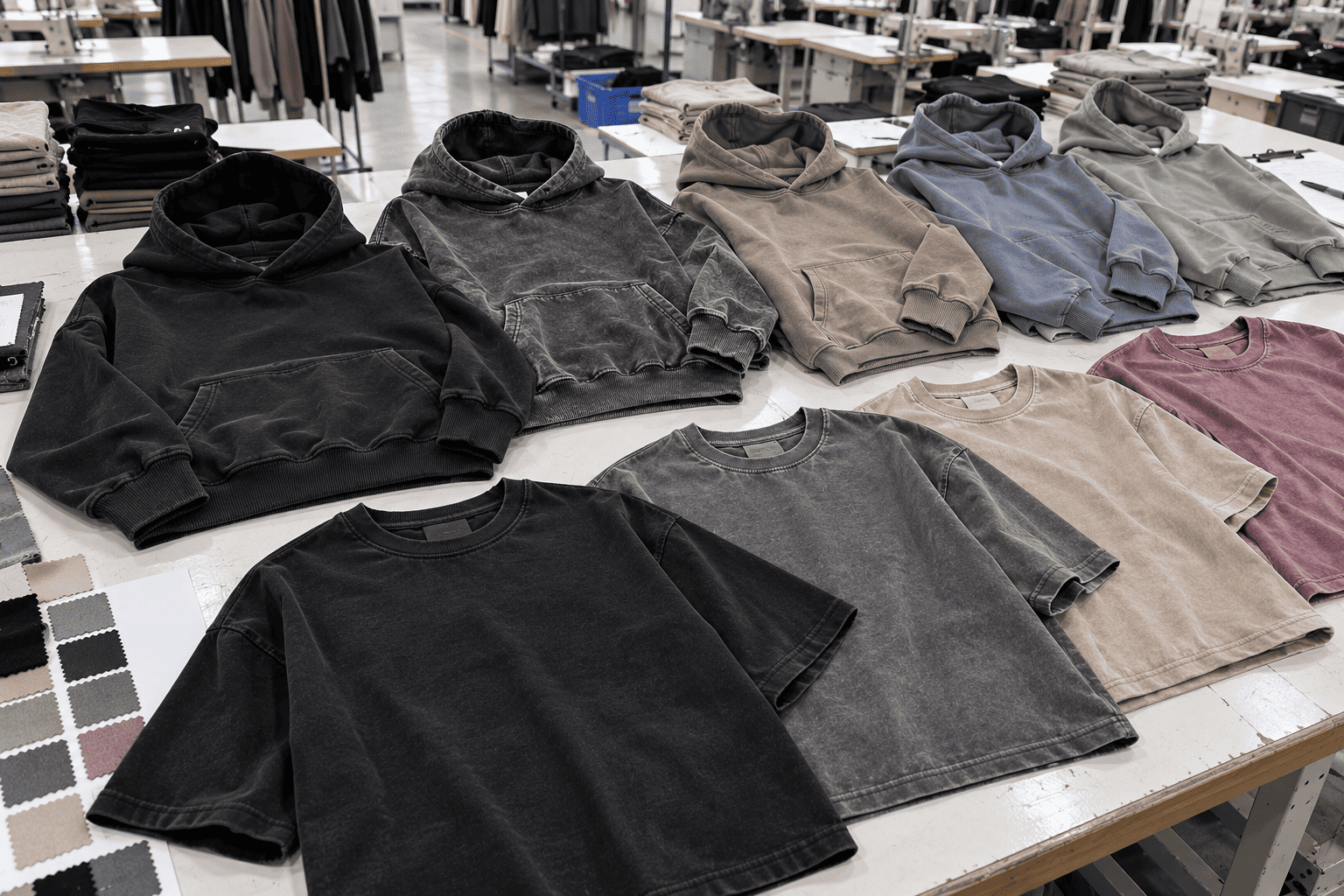
CottonWorks defines garment dyeing[^1] simply as the process in which a garment is dyed or tinted after it has already been cut and sewn.
That order matters.
When you dye the completed garment instead of the fabric roll, you change much more than color.
You change how:
- Seams react
- Rib reacts
- Thread reacts
- Labels react
- Measurements change
- Shade variation appears
That is why a garment-dyed hoodie needs to be developed as a garment-dyed hoodie from the beginning.
You cannot always take a normal hoodie pattern, send the finished bulk to a wash house, and expect the same result.
Table of Contents
- What Is Garment Dyeing and How Is It Different?
- Which Wash and Dye Effects Can You Choose?
- Why Does Every Garment-Dyed Piece Look Slightly Different?
- How Does Garment Dyeing Affect Fit and Shrinkage?
- What Happens to Prints, Embroidery, and Trims?
- What MOQ, Cost, and Timing Should You Expect?
- Conclusion
What Is Garment Dyeing and How Is It Different?
Most clothing starts with fabric that has already been dyed.
The mill dyes the fabric.
The garment factory then cuts and sews it.
Garment dyeing reverses those last steps.
The garment is first cut and sewn in prepared fabric, then the finished piece goes through the dyeing and finishing process.
Piece Dyeing vs Garment Dyeing
| Factor | Piece dyed | Garment dyed |
|---|---|---|
| Color applied | Before cutting | After sewing |
| Dye unit | Fabric roll | Finished garment |
| Shade | Usually more uniform | More natural variation possible |
| Seams / edges | Built after dyeing | Go through dye bath with garment |
| Shrinkage planning | Mainly fabric stage | Must consider complete garment process |
| Flexibility | Color fixed earlier | Color can be decided later in production |
| Development | More conventional | More post-sewing testing required |
Garment dyeing can create a different visual character because the complete sewn product goes through wet processing.
That includes:
- Body fabric
- Collar rib
- Cuffs
- Hem rib
- Sewing thread
- Hood
- Drawcord, if left attached
- Labels and trims, if added before dyeing
Each component can respond differently.
Not Every Garment-Dyed Product Has to Look Uneven
This is important.
Garment dyeing does not automatically mean:
dirty, patchy, heavily faded color.
You can produce relatively clean garment-dyed colors.
Or you can deliberately develop:
- Washed black
- Dusty grey
- Faded navy
- Vintage brown
- Muted green
- Pigment-washed pastels
- High-contrast mineral effects
The final result depends on:
- Fiber
- Dye class
- Preparation
- Recipe
- Temperature
- Time
- Mechanical action
- Afterwashing
- Finishing
CottonWorks' Dyeing Basics[^2] explains that different colorant classes interact with fibers in different ways.
Reactive dyes, for example, are widely used for cotton and form a strong chemical bond with cellulose, which can provide very good wash fastness when processed correctly.[^2]
Pigments behave differently.
They do not chemically penetrate the fiber in the same way.
That difference is important when you are chasing a washed vintage look.
Fabric Composition Matters
If your garment is mostly cotton, it can usually be developed around cotton-compatible dye systems.
But a blend creates additional complexity.
For example:
80% cotton / 20% polyester
contains two different fiber types.
One dye system may color the cotton portion while the polyester behaves differently.
That can be used intentionally to create:
- Heather effects
- Contrast effects
- Washed-down appearance
but it needs to be planned.
Do not assume:
"It's mostly cotton, so everything will dye exactly the same."
Ask the wash house what result to expect from the actual composition.
Which Wash and Dye Effects Can You Choose?
"Vintage wash" is not one technical process.
It is a visual description.
Two buyers can both say:
"I want vintage black."
One means soft charcoal.
The other means a dramatic marbled acid-wash effect.
So a reference image or physical sample is extremely important.
Common garment-finishing directions include reactive garment dye, pigment coloration, enzyme treatments, stone or abrasion effects, mineral or high-contrast washes, overdyeing, tie-dye, and other faded finishes. Each creates a different surface, softness, and degree of variation.
Common Vintage Directions
| Effect | Typical appearance | Main characteristic |
|---|---|---|
| Reactive garment dye | Rich to softly washed color | Dye suited to cotton |
| Pigment coloration | Chalky, faded, dry vintage look | Color mainly held at surface |
| Enzyme treatment | Cleaner / softer surface | Biological finishing process |
| Stone / abrasion wash | Worn edges and softened surface | Mechanical abrasion |
| Mineral / acid-style effect | High contrast, irregular | Deliberate dramatic variation |
| Overdye / tint | Secondary tone over existing base | Alters overall cast |
| Tie-dye | Patterned irregular color | Deliberately unique placement |
Why Pigment Looks Different
Pigment is technically not the same as a fiber-specific dye.
CottonWorks explains that pigments[^2] are insoluble colorants that do not have their own affinity for the fiber.
They normally require a binder to attach the pigment to the textile surface.
That is why pigment-based finishes can create a different visual and tactile effect from reactive dyeing.
They can look:
- Powdery
- Chalky
- Faded
- Dry
- Broken-in
which is exactly what many streetwear brands want.
But the surface nature of pigment systems also means the appearance can evolve with friction and washing.
That evolution may be part of the product concept.
Do Not Promise a Pigment Garment Will Stay Identical Forever
If the whole selling point is:
faded vintage pigment black
then some visual change during use may be expected.
That is different from a brand selling:
perfect deep black that never changes.
The care instructions and product description should reflect the intended product.
For example, some brands deliberately explain:
"This garment has been individually dyed and may continue to develop character with wear and washing."
That turns natural variation into part of the brand story rather than allowing the customer to assume it is a defect.
Enzyme Wash
Enzyme treatments are often used during textile and garment finishing to modify the surface and hand.
CottonWorks includes enzyme treatments as part of its professional garment wet-processing curriculum alongside garment dyeing, softeners, and other finishing technologies.[^1]
The exact result depends on:
- Enzyme type
- Concentration
- Temperature
- Time
- Fabric
- Prior dyeing
So do not specify simply:
"enzyme wash"
and assume every wash house will create the same result.
Your reference standard still matters.
Approve the Actual Wash Recipe
Before bulk, we prefer to develop the desired look using:
- Fabric swatches
- Test garments
- Wash samples
The wash house adjusts the process until the result is close to the customer's reference.
Only after approval should the bulk recipe be locked.
We sew the garments ourselves, while garment dyeing and specialist washing are carried out by long-term partner wash houses that we manage directly.
That allows us to coordinate the pattern, garment construction, wash test, and final inspection instead of treating the wash as a completely separate order.
Why Does Every Garment-Dyed Piece Look Slightly Different?
This is where expectations need to be managed early.
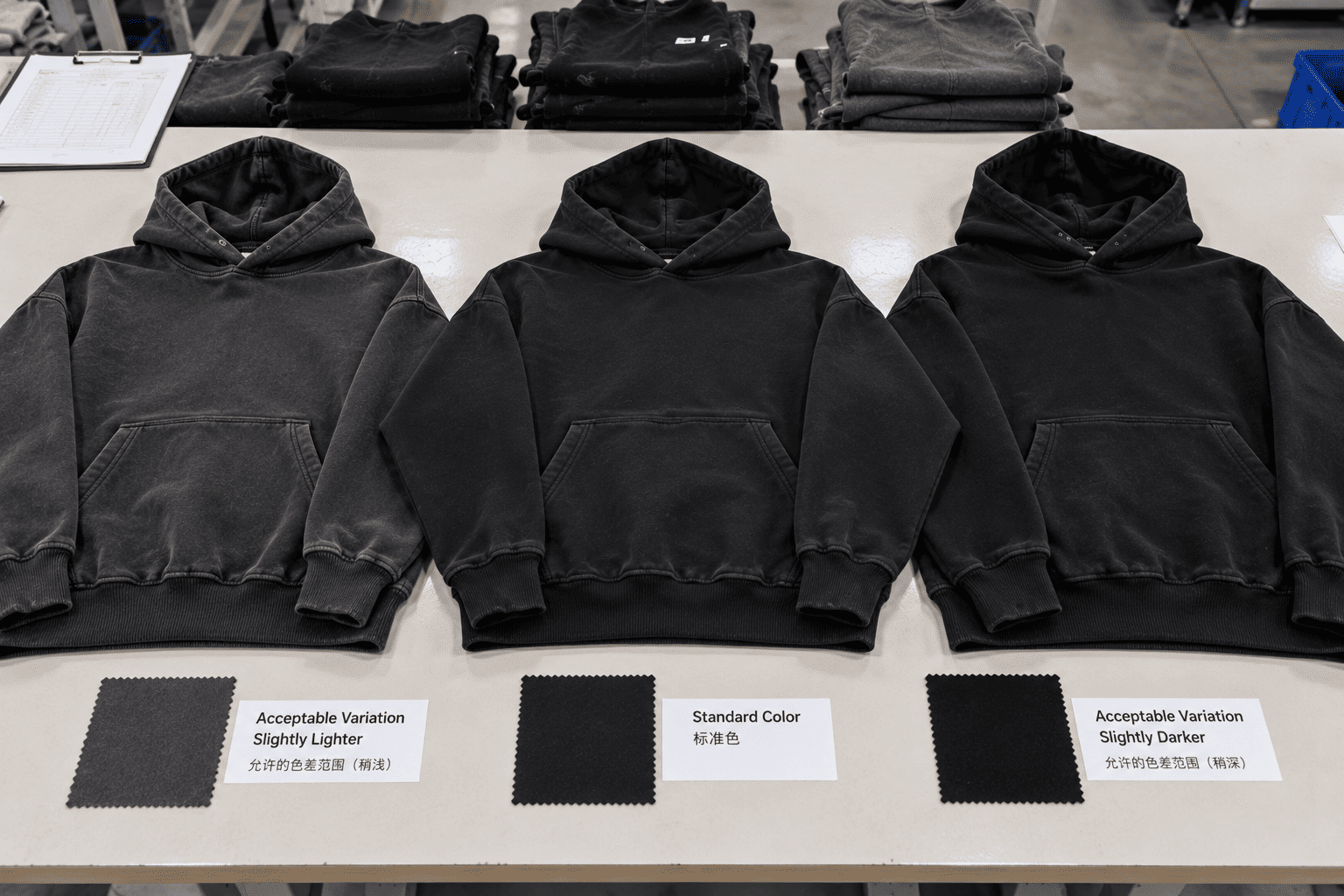
Garment-dyed and heavily washed garments can show natural variation from piece to piece and between processing batches. The solution is not to promise zero variation. It is to agree on an acceptable visual standard before bulk.
Where Shade Variation Comes From
| Source | Possible effect |
|---|---|
| Batch-to-batch processing | Slight shade difference |
| Fiber / fabric lot | Different dye response |
| Garment size and weight | Different liquor interaction |
| Seams and folds | Local visual variation |
| Mechanical abrasion | Different fade intensity |
| Wash time | Lighter or darker finished effect |
| Chemical concentration | Changes final look |
Not every variable creates visible differences every time.
But the more intentionally distressed the finish becomes, the less realistic it is to expect every piece to look digitally identical.
Approve a Standard and an Acceptable Range
Instead of approving only one perfect garment, a better approach for some vintage finishes is:
- Target / center standard
- Acceptable lighter limit
- Acceptable darker limit
Then QC has something practical to compare against.
Without a defined range, one person may consider a garment acceptable while another calls it defective.
Color Approval Should Use a Real Physical Standard
Digital photos are useful for communication.
They are not ideal as the only color standard.
Lighting, screen calibration, camera exposure, and phone settings all change appearance.
CottonWorks' Lab Dip Process[^3] explains that professional color development typically uses a physical or electronic color standard and, where appropriate, spectrophotometric measurement.
Garment vintage finishes can be harder to define than a solid lab dip, but the principle is the same:
approve something physical whenever possible.
Pack by Processing Lot Where Practical
If one large order is washed in several batches and there is a visible difference, separating lots during packing can help.
For example:
Retail carton A = Batch 1
Retail carton B = Batch 2
That can reduce the chance of obviously different shades appearing next to each other in the same store delivery.
The exact packing strategy depends on the size of the order and how much variation exists.
How Does Garment Dyeing Affect Fit and Shrinkage?
This is one of the most important technical differences.
Garment dyeing and wet finishing expose the fully assembled product to water, heat, chemistry, agitation, and drying. Those processes can change the final dimensions, so the pattern must be developed from real post-process measurements rather than assumptions.
The original pattern may therefore need compensation.
But the amount is not universal.
There is no rule such as:
"Always add 5% to garment-dyed patterns."
It depends on:
- Fabric
- Knit structure
- Composition
- Dye process
- Wash recipe
- Drying method
- Rib
- Garment construction
A Better Development Process
| Step | What to do |
|---|---|
| 1 | Confirm actual fabric and composition |
| 2 | Run the intended dye / wash process |
| 3 | Measure dimensional change |
| 4 | Adjust pattern where required |
| 5 | Make a complete garment sample |
| 6 | Put sample through full bulk-equivalent process |
| 7 | Measure final garment |
| 8 | Correct pattern before bulk |
ISO 5077[^4] specifies a recognized method for determining dimensional change in fabrics, garments, and other textile articles after washing and drying.
The standard remains current after ISO's review.
For standardized domestic laundering in textile testing, ISO 6330:2021[^5] defines washing and drying procedures that can be used together with dimensional-change testing.
These standards are useful because saying:
"It shrank a little."
is not technical.
A better statement is:
"Body length changed from X cm to Y cm under the agreed test process."
Do Not Measure the Sample Only Before Dyeing
A garment waiting to be dyed is not yet the finished product.
If the final product is:
- Garment dyed
- Enzyme washed
- Softened
- Tumble dried
then the approval sample should ideally go through those same critical steps before final measurement approval.
Otherwise you may approve:
72 cm body length before wash
and receive:
69 cm after finishing.
For a boxy hoodie or oversized tee, 3 cm can make a very visible difference.
Body Fabric and Rib May Move Differently
This is another common problem.
The body may use:
100% cotton French terry
while the rib uses:
cotton + elastane
Those structures do not necessarily respond identically during dyeing and washing.
Possible problems include:
- Collar waves
- Hem flare
- Cuff distortion
- Rib/body length imbalance
The factory needs to test the complete combination.
Pattern Compensation Is Not Simply Making Everything Bigger
If length shrinks more than width, the pattern adjustment should reflect that.
Do not just enlarge every measurement by the same percentage.
Pattern compensation can be directional.
That is why real testing matters before bulk.
What Happens to Prints, Embroidery, and Trims?
Everything attached before the wet process needs to be considered.
Decoration can be added before or after garment dyeing depending on the intended look. Thread, labels, rib, drawcords, zippers, snaps, patches, and other components must also be selected with the dye and wash process in mind.
Before or After Dyeing?
| Element | Before dye / wash | After dye / wash |
|---|---|---|
| Screen print | May become washed / distressed | Cleaner and sharper |
| Embroidery | May change appearance depending on thread | More controlled thread color |
| Label | Must survive wet processing | Easier to keep clean/crisp |
| Patch | May distress with garment | Maintains newer appearance |
| Zipper / metal trim | Must tolerate chemistry and heat | Avoids wash exposure |
| Artwork placement | Goes through full treatment | Added to final washed garment |
There is no one correct order.
It depends on the design.
Vintage Print Before Wash
If you want the graphic to feel integrated into an old garment, printing before the wash may help produce:
- Softer appearance
- Broken print surface
- More aged character
But the exact effect depends on the ink and finishing recipe.
Always make a physical test.
Crisp Print After Wash
If you want:
washed black body + bright clean white logo
then printing after the garment wash can give stronger contrast.
Again, the final process depends on:
- Ink type
- Fabric
- Surface after washing
- Required adhesion
Sewing Thread Needs to Be Planned
The original article said:
"Polyester thread will stay white, so use cotton thread."
That is too simple.
What matters is whether the thread is compatible with the chosen post-dye process and intended final appearance.
Coats produces Dymax mercerised cotton sewing thread[^6] specifically for garment-dye applications.
Coats explains that the mercerised cotton construction has strong affinity for dyestuffs used in post-dyeing and can take up color consistently.[^6]
There are also engineered hybrid threads for post-dyed garments that combine a polyester core with a cotton-rich cover.
So the decision is not simply:
cotton = good, polyester = bad.
The better question is:
"Which sewing thread is suitable for this exact post-dye process?"
Labels
A label added before dyeing may:
- Change shade
- Shrink
- Distort
- Lose print clarity
If you want a crisp white brand label inside a heavily washed black hoodie, it may make more sense to attach it after wet processing.
But this affects the sewing sequence.
So decide early.
Zippers and Hardware
Quarter-zips, full-zip hoodies, snaps, metal eyelets, drawcord tips, and other trims need to tolerate:
- Heat
- Water
- Chemicals
- Mechanical movement
Some metal finishes may change during aggressive washing.
Some plastic materials may not respond well to high processing temperatures.
That is why a wash house needs to see the actual trim specification before bulk.
What MOQ, Cost, and Timing Should You Expect?
Garment dyeing and vintage washing add a separate production stage.
That means more time and more cost.
The final price depends on the garment, dye or wash recipe, number of colors, quantity per batch, shrinkage allowance, decoration timing, and the amount of shade sorting or QC required.
Main Cost Drivers
| Cost factor | Why it matters |
|---|---|
| Wash / dye process | More complex effects require more processing |
| Number of colors | Each color normally needs separate processing |
| Quantity per color | Affects batch efficiency |
| Wash development | Samples / tests needed |
| Shrinkage allowance | Can increase fabric consumption |
| Decoration timing | Adds process sequencing |
| Special trims | Must survive wash or be attached later |
| Sorting | Vintage effects may need shade QC |
| Reject rate | Heavy effects can create more variation |
Our Normal Garment MOQ Still Applies
For our normal programs, typical starting quantities remain around:
- Hoodies / sweatshirts: 50 pcs per style
- T-shirts: 100 pcs per style
But garment dyeing introduces another practical minimum:
the wash house batch.
If you want:
50 hoodies total
split into:
10 black
10 brown
10 green
10 blue
10 red
the garment sewing MOQ may be possible.
The wash-house color quantities may not be economical.
So always confirm the quantity per wash color, not just per garment style.
Color Splits Increase Development
Five colors means five separate color developments.
Each may require:
- Color sample
- Recipe
- Approval
- Bulk batch
- Shade inspection
That is why one washed color is much easier for a first order than six.
Vintage Effects Need More Time
A standard production sequence might look like:
Fabric → Cut → Sew → QC → Pack
A garment-dyed order may look more like:
Fabric
→ Cut
→ Sew
→ Dye / wash sample
→ Review
→ Adjust
→ Bulk wet processing
→ Dry / finish
→ Post-wash decoration if needed
→ Measure
→ Shade sort
→ QC
→ Pack
That extra process should be included in the launch timeline from the beginning.
Care Instructions Need a Real Basis
Vintage products are exactly the kind of garments where generic care labels can create problems.
A pigment-style faded garment may behave differently from a standard reactive-dyed product.
The U.S. Federal Trade Commission Care Labeling Rule[^7] requires covered apparel manufacturers and importers to provide regular care instructions and to have a reasonable basis for those instructions.
FTC guidance specifically says manufacturers need reliable evidence supporting the care information they provide.[^7]
For garment-dyed products, the care label may need to consider:
- Color transfer
- Continued fading
- Wash temperature
- Drying method
- Decoration
- Trim
- Washing with similar colors
So test the actual finished product.
Not just the fabric before garment dyeing.
How Do You Choose a Garment-Dyed Clothing Manufacturer?
A normal cut-and-sew factory is only one part of this project.
The wash house matters too.
Green Flags and Red Flags
| Green flag | Red flag |
|---|---|
| Asks for a physical wash reference | Says "vintage wash no problem" immediately |
| Makes wash samples before bulk | Goes directly to full production |
| Measures after full wet processing | Approves measurements before dyeing |
| Explains shade variation | Guarantees every piece identical |
| Checks trims for wash compatibility | Uses trims without testing |
| Plans sewing thread for post-dyeing | Ignores thread behavior |
| Agrees a shade standard / range | No visual QC standard |
| Explains which processes are partner-managed | Hides the wash-house setup |
We manufacture the base garments ourselves and manage garment dyeing and specialist washing through long-term partner wash houses.
For us, the important thing is that one production team controls the project from:
- Fabric
- Pattern
- Sewing
- Wash development
- Final size
- Decoration
- QC
rather than sending garments out and hoping the finish comes back correctly.
Conclusion
Garment dyeing gives clothing something a standard solid color often cannot.
Character.
A washed black hoodie can look as if it has already been worn for years.
A pigment-dyed T-shirt can feel more personal than a perfectly uniform factory color.
But the worn-in look is not random.
It has to be controlled.
Start by defining the exact visual target.
Do not say only:
"vintage."
Show the factory:
- Color
- Fade level
- Contrast
- Surface
- Softness
- Reference garment
Then test the real process.
Check:
What dye or finish is being used?
What happens to the fabric?
What happens to the rib?
What happens to the thread?
What happens to the labels?
What happens to the measurements?
Approve the wash.
Measure the garment after processing.
Agree on an acceptable shade range.
Decide whether prints and embroidery should go on before or after the wash.
Then move to bulk.
Garment-dyed clothing should look imperfect.
But the production process should not be.
Footnotes & References
[^1]: CottonWorks / Cotton Incorporated — Garment Dyeing and Garment Wet Processing. CottonWorks defines garment dyeing as dyeing or tinting a garment after it has been cut and sewn. Its garment wet-processing training covers garment assembly requirements, dyeing, enzyme treatments, softeners, and other finishing technologies.
https://cottonworks.com/encyclopedia-item/garment-dyeing/
https://cottonworks.com/workshops/garment-wet-processing-3/
[^2]: CottonWorks / Cotton Incorporated — Dyeing Basics. Technical guidance explaining major textile dye and colorant classes. CottonWorks notes that reactive dyes chemically bond with cellulose and generally provide strong washfastness, while pigments are insoluble colorants that require binders and primarily color the textile surface.
https://cottonworks.com/learning-hub/dyeing/dyeing-basics/
[^3]: CottonWorks / Cotton Incorporated — Lab Dip Process. Explains professional color-development and approval using specified substrates, physical/electronic color standards, dye formulation, and spectrophotometric measurement.
https://cottonworks.com/learning-hub/dyeing/lab-dip-process/
[^4]: International Organization for Standardization — ISO 5077:2007, Textiles — Determination of Dimensional Change in Washing and Drying. Specifies a method for determining dimensional change in fabrics, garments, and other textile articles after defined washing and drying procedures. This edition was reviewed and confirmed in 2022 and remains current.
https://www.iso.org/standard/41877.html
[^5]: International Organization for Standardization — ISO 6330:2021, Textiles — Domestic Washing and Drying Procedures for Textile Testing. Specifies standardized washing and drying procedures for textile testing and can be used together with dimensional-change assessment.
https://www.iso.org/standard/75934.html
[^6]: Coats — Dymax™ Garment-Dye Sewing Thread. Coats Dymax is a mercerised 100% cotton sewing thread developed specifically for garment-dye applications. Coats states that its mercerised construction provides high affinity for post-dye dyestuffs and consistent color uptake. Coats also offers engineered corespun options for post-dyed garments.
https://www.coats.com/en-us/products/threads/dymax/dymax/
https://www.coats.com/en-us/products/threads/dual-duty/dual-duty-ecoverde-supercotton/
[^7]: U.S. Federal Trade Commission — Care Labeling Rule. Requires covered textile-apparel manufacturers and importers to provide regular care instructions and maintain a reasonable basis supporting those instructions, including warnings when expected care procedures could damage the garment.
https://www.ftc.gov/legal-library/browse/rules/care-labeling-textile-wearing-apparel-certain-piece-goods