

French Terry vs Fleece: Which Fabric Is Right for Your Hoodies and Sweatpants?
You approved a "heavy hoodie fabric" from a photo.
The sample arrives fluffy inside, and you wanted the smooth looped kind.
Now you are one sample round behind because of one fabric word.
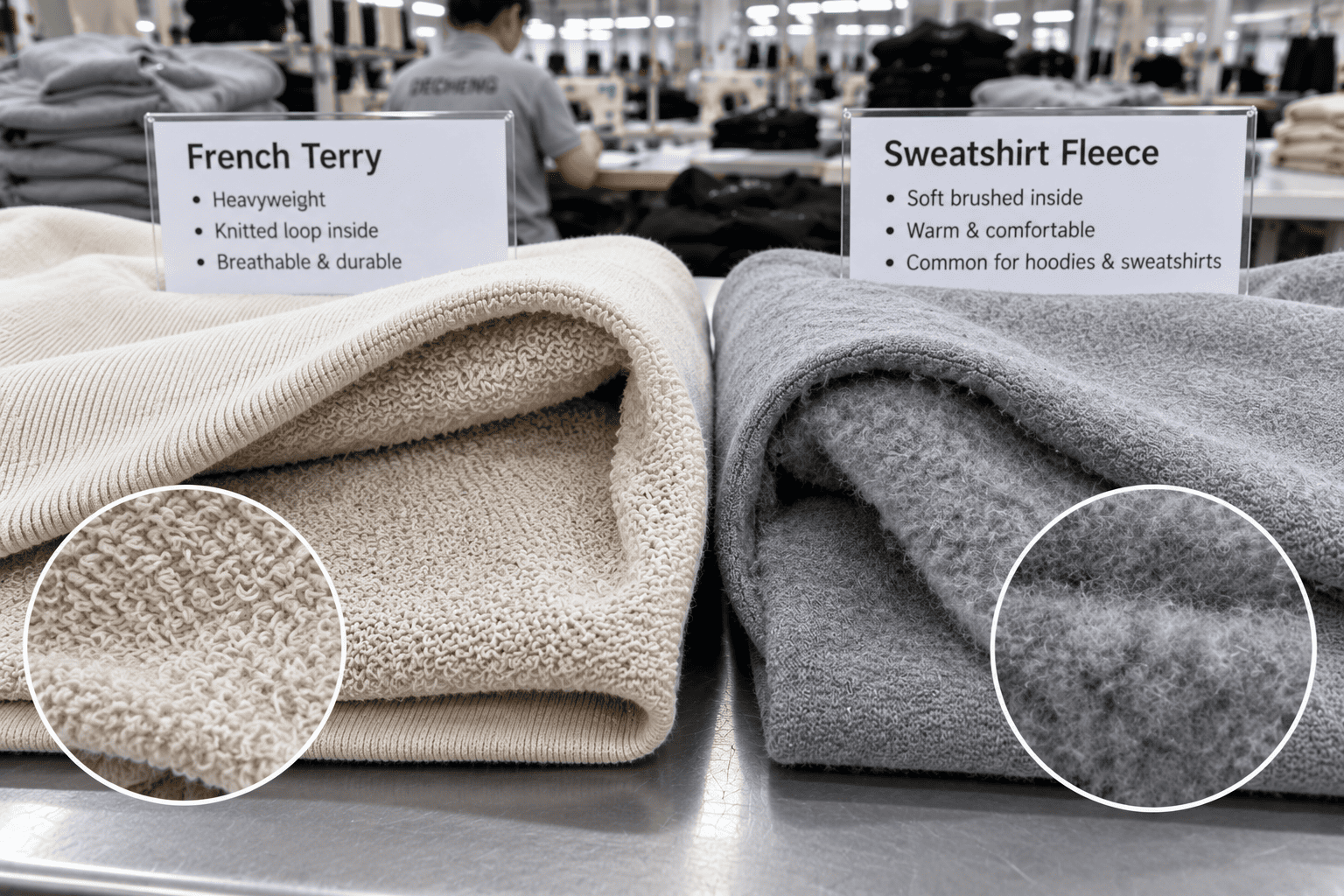
French terry has a smooth outer face and visible loops or floats on the inside. Sweatshirt fleece uses a similar knit construction, but the inner surface is brushed or napped to create a soft, fuzzy pile. That one finishing step changes warmth, hand feel, thickness, and how the garment wears.
This choice matters because hoodies and sweatshirts are a huge global apparel category.
According to Mordor Intelligence[^1], the global hoodies and sweatshirts market is estimated at approximately USD 221.09 billion in 2026 and is projected to reach about USD 303.62 billion by 2031, with a CAGR of roughly 6.55%.
So which fabric fits your product?
Let me break it down.
Table of Contents
- What Is the Difference Between French Terry and Fleece?
- Which Is Warmer and Which Breathes Better?
- Which Looks and Wears Better Over Time?
- Which Works Better for Prints and Embroidery?
- How Do Weight and Composition Change the Choice?
- Which Should You Choose for Your Product?
- Conclusion
What Is the Difference Between French Terry and Fleece?
From the outside, the two fabrics can look almost identical.
Turn them inside out and the difference becomes obvious.
French terry keeps the looped or floated yarn structure visible on the back of the fabric. Fleece takes a similar sweatshirt knit and brushes or naps the inside, opening the yarn surface into a soft pile.
Cotton Incorporated's technical education platform CottonWorks[^2] describes French terry as an un-napped fleece construction and explains that brushing or napping the interior yarns is what differentiates it from fleece.
That distinction is much more useful than simply saying one fabric is "thin" and one is "thick."
The Basics Side by Side
| Feature | French Terry | Sweatshirt Fleece |
|---|---|---|
| Inside surface | Visible loops / floats | Brushed, fuzzy pile |
| Outside surface | Usually smooth knit | Usually smooth knit |
| Hand feel inside | Smooth, dry, slightly textured | Soft, plush, warm |
| Loft at similar GSM | Lower | Higher |
| Typical season | Transitional / year-round | Cooler seasons |
| Other names | Loopback, unbrushed terry | Brushed fleece, brushed-back fleece |
Both fabrics can be made from:
- 100% cotton
- Cotton/polyester blends
- Polyester-rich blends
- Other fiber combinations
So the fabric name alone does not tell you the complete composition.
One Important Naming Trap
"Fleece" can mean different things.
In custom hoodies and sweatpants, factories often use the word to mean brushed sweatshirt fleece.
But outdoor clothing brands also use "fleece" for fabrics such as polyester polar fleece.
Those are not the same product.
So when talking to a clothing factory, do not simply write:
"I need fleece."
Write something more specific, such as:
"400 GSM cotton-rich brushed sweatshirt fleece."
Or:
"330 GSM 100% cotton French terry, unbrushed."
That one sentence prevents a lot of sampling mistakes.
Our fabric GSM guide explains how to specify fabric weight correctly.
Which Is Warmer and Which Breathes Better?
This is usually the first question buyers ask.
Brushed fleece generally feels warmer and more insulating because the napped inner surface creates more loft and traps more air. French terry generally feels less bulky and more breathable because its back loops remain open rather than being brushed into a pile.
CottonWorks notes that French terry performs well across seasons because of its lack of napping, while fleece fabrics tend to be heavier and more suited to cold-weather garments.[^2]
That matches what we see in actual hoodie development.
At the same nominal GSM, brushed fleece usually feels:
- Softer inside
- Fuller
- Warmer
- More winter-oriented
French terry usually feels:
- Cleaner
- Less bulky
- Easier to layer
- Better for mild or transitional weather
Comfort Compared
| Factor | French Terry | Fleece |
|---|---|---|
| Warmth | Moderate | Higher |
| Breathability | Generally higher | Generally lower |
| Interior feel | Looped, dry hand | Plush and soft |
| Bulk | Lower | Higher |
| Best seasons | Spring, autumn, mild weather | Autumn, winter |
| Layering | Easier | Bulkier |
| Warm-climate suitability | Better | More limited |
Climate should influence the decision.
A brand selling into:
- UAE
- Saudi Arabia
- Southern California
- Southeast Asia
- Southern Europe
may find French terry more practical for much of the year.
A brand selling winter drops into:
- Canada
- Northern Europe
- Northern United States
- Cold mountain regions
may prefer brushed fleece.
But GSM still matters.
A 420 GSM French terry can feel more substantial than a lightweight 280 GSM fleece.
So do not compare fabric type without comparing weight.
Think About Indoor Wear Too
A hoodie is not always worn outdoors.
Many customers wear hoodies:
- At home
- In offices
- While traveling
- In shopping malls
- On flights
- While driving
A thick brushed 500 GSM fleece may feel amazing for five minutes in a showroom.
It may also be too warm for all-day indoor use.
The correct fabric is the one that fits the customer's real wearing situation.
Which Looks and Wears Better Over Time?
A fabric that feels premium when new also needs to stay attractive after repeated use.
French terry and fleece age differently.
French terry tends to maintain a cleaner looped interior because the yarns remain unbrushed. Fleece starts softer and loftier, but the brushed surface can flatten, shed some loose fibers, or develop pilling depending on yarn quality, fiber composition, and finishing.
Brushing is what creates the soft fleece surface.
But brushing also changes the yarn surface.
That is why a new fleece garment can sometimes release loose lint during the first few washes.
Over time, repeated wear and laundering can compress the pile.
Appearance and Wear
| Factor | French Terry | Fleece |
|---|---|---|
| Drape | Cleaner, more fluid | Fuller, more structured |
| Interior surface | Stable loops | Brushed pile |
| Initial softness | Moderate | High |
| Lint risk | Usually lower | Can occur, especially initially |
| Pilling risk | Depends on yarn and blend | Depends on yarn, blend and brushing |
| Long-term interior appearance | Loops remain visible | Pile may flatten with wear |
Pilling Is Not Only a Fleece Problem
This is important.
A buyer sometimes sees pilling and says:
"Fleece is bad quality."
That is too simple.
Pilling depends on multiple factors:
- Fiber length
- Yarn structure
- Twist
- Fiber blend
- Fabric construction
- Brushing
- Surface friction
- Finishing
International testing methods exist specifically to measure this.
ISO 12945-2:2020[^3] specifies a modified Martindale method for determining a textile fabric's tendency toward pilling, fuzzing, and matting.
So if pilling performance is especially important to your brand, you can ask your fabric supplier or laboratory about pilling-test results rather than relying only on hand feel.
Polyester Blends Need Context
Cotton/poly fleece is extremely common.
That does not automatically make it low quality.
Polyester can help with:
- Dimensional stability
- Strength
- Faster drying
- Cost control
- Shape retention
But fiber choice changes surface behavior.
This is why composition should always be confirmed in writing rather than guessed from touch.
If your product is sold in the United States, the FTC Textile Fiber Rule[^4] requires covered textile products to disclose the generic fiber names and percentages by weight, along with other required labeling information.
So "cotton fleece" and "80% cotton / 20% polyester fleece" should never be treated as interchangeable descriptions.
Which Works Better for Prints and Embroidery?
Both fabrics can handle decoration very well.
The important surface is mainly the outside face, because that is where most printing and embroidery sits.
French terry and fleece can both support screen printing, embroidery, puff print, appliqué, and rhinestone decoration. A dense, smooth outer face matters more than whether the back is looped or brushed.
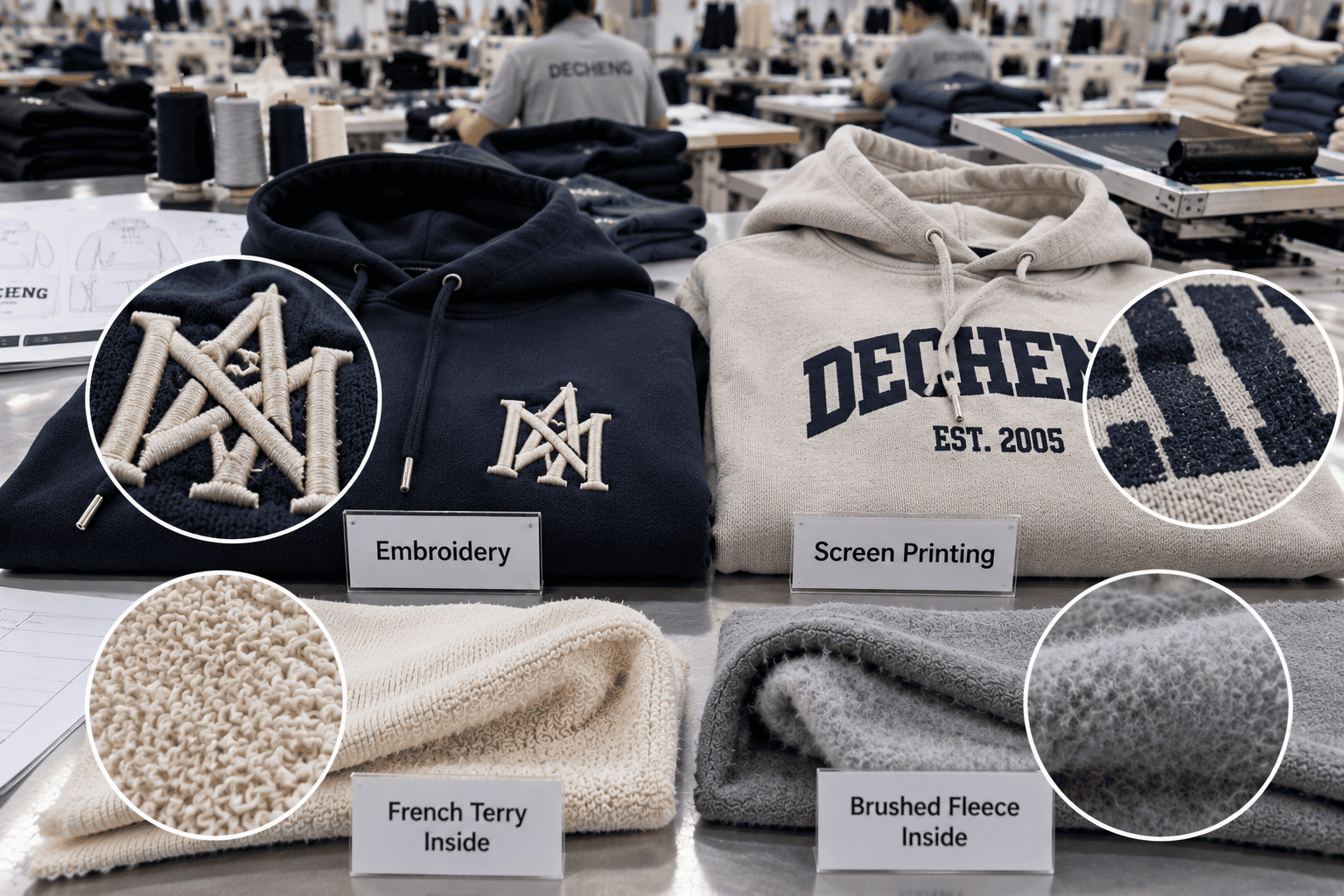
Decoration Compared
| Method | French Terry | Fleece |
|---|---|---|
| Screen printing | Very good on a smooth face | Very good on a smooth face |
| Puff print | Good | Good, especially on structured weights |
| Embroidery | Good with proper stabilization | Very good on heavier stable fabrics |
| Appliqué | Good | Very good |
| Rhinestones | Good on suitable dense fabric | Good on suitable dense fabric |
| Large back graphics | Cleaner drape on moderate weights | Can become stiff on very heavy fabric |
| Garment wash | Often works well | Needs testing because brushing may change |
A dense fabric face produces cleaner print edges.
A loose, hairy, or unstable surface can make printing more difficult regardless of whether the inside is terry or fleece.
Heavy Embroidery Needs Stability
Dense embroidery puts tension into the fabric.
A light 260 GSM fabric may distort around a large stitched logo if the backing and stitch density are not controlled correctly.
A 400 GSM sweatshirt fabric has more structure.
But that does not mean you can ignore embroidery settings.
The factory still needs to test:
- Backing
- Stitch density
- Thread tension
- Logo size
- Fabric stretch
- Placement
before bulk.
Washed and Vintage Effects
French terry often works very well for:
- Garment dye
- Enzyme wash
- Vintage wash
- Faded streetwear effects
because the unbrushed construction gives the garment a clean loopback interior and a flexible hand.
Fleece can also be washed.
But aggressive garment processing may affect the brushed pile.
So if your collection depends on a heavy acid wash or vintage finish, test the exact fabric and wash recipe before bulk.
Our embroidery and screen-printing guide explains decoration choices in more detail.
How Do Weight and Composition Change the Choice?
"French terry" and "fleece" describe construction and finishing.
They do not tell you everything.
GSM and fiber composition can change the fabric just as much as the choice between terry and fleece. A heavy French terry can feel more substantial than a light fleece, while cotton and cotton-poly blends behave differently in shrinkage, hand feel, stability, and cost.
Typical Weight Ranges
In our work, French terry and fleece often overlap considerably in GSM.
Practical sourcing ranges may look like this:
| Weight | Typical positioning |
|---|---|
| 250–300 GSM | Light sweatshirt / transitional |
| 300–350 GSM | Standard premium hoodie |
| 360–400 GSM | Heavyweight streetwear |
| 400–450 GSM | Very heavy, structured |
| 450–500+ GSM | Ultra-heavy statement pieces |
These are not legal or universal industry classifications.
They are practical sourcing ranges.
A mill can produce French terry above 400 GSM.
A fleece can also be made below 300 GSM.
That is why you need the full specification.
Composition Options
| Composition | What it gives you | Trade-off |
|---|---|---|
| 100% cotton | Natural hand, strong cotton story | More shrinkage risk, often higher cost |
| Cotton-rich blend | Balance of hand feel and stability | Not a pure-cotton product |
| 80/20 cotton-poly | Common sweatshirt blend, good stability | Slightly more synthetic feel |
| Polyester-rich blend | Stability and lower cost | Different hand and brand positioning |
There is no rule saying 100% cotton is automatically superior.
The right composition depends on:
- Customer
- Climate
- Price
- Wash
- Fit
- End use
But whatever composition you choose, document it correctly.
For U.S. sales, FTC guidance explains that most covered textile products must disclose their fiber content, country of origin, and manufacturer or responsible dealer identity. FTC clothing and textile guidance[^4] provides the official requirements.
Shrinkage Matters
Cotton-rich sweatshirt fabric can change dimension after washing.
That affects:
- Body length
- Chest width
- Sleeve length
- Pant inseam
- Waist
- Matching sets
This should be checked during sample development.
ISO 5077:2007[^5] specifies a method for determining dimensional change in fabrics, garments, and other textile products after specified washing and drying procedures.
The standard remains current after review.
That is why we do not judge a hoodie only before washing.
We need to know how it behaves afterward.
What About OEKO-TEX?
Material safety is separate from fabric weight and construction.
A 500 GSM fleece is not automatically safer than a 300 GSM French terry.
If chemical testing matters to your brand, certifications such as OEKO-TEX® STANDARD 100[^6] can provide additional information about certified textile products and components tested for harmful substances.
But always verify what the certificate actually covers.
Do not assume a finished hoodie is certified simply because one yarn or fabric supplier has an OEKO-TEX certificate.
Which Should You Choose for Your Product?
Now we get to the practical decision.
Choose French terry when you want a cleaner, less bulky, more breathable, versatile sweatshirt fabric. Choose brushed fleece when warmth, softness, loft, and a cozy winter hand are more important.
Neither is automatically better.
Decision Guide
| Your situation | Better starting point |
|---|---|
| Warm climate | French terry |
| Spring collection | French terry |
| Year-round core hoodie | 300–350 GSM French terry or light fleece |
| Cold winter drop | Brushed fleece |
| Cozy loungewear | Fleece |
| Heavy boxy streetwear | Heavy fleece or heavy French terry |
| Vintage washed hoodie | French terry is worth testing first |
| Indoor / travel wear | French terry |
| Maximum soft interior feel | Fleece |
| Gym or training-inspired set | French terry often works better |
Do Not Choose From a Photo
This is the biggest practical lesson.
French terry and fleece can have almost identical outer faces.
A product photo does not tell you what is happening inside.
Ask for:
- Front photo
- Back / inside photo
- GSM
- Composition
- Fabric swatch
- Stretch
- Wash result
Then compare the fabrics physically.
Turn them inside out.
Feel the pile.
Stretch them.
Fold them.
Wash them.
Only then approve the fabric.
Keep Matching Sets Consistent
If a hoodie and sweatpants are sold together, the safest approach is usually to produce both from the same approved body fabric and dye lot.
Otherwise you can end up with:
- Different shades
- Different hand feel
- Different shrinkage
- Different surface appearance
A fleece hoodie with lighter French terry pants can be intentional.
But if it is not intentional, the set often looks like two unrelated garments.
Our tracksuit and sweatsuit guide explains how to control matching sets.
Stock Fabric or Custom Fabric?
Stock fabric is usually the easier choice for low-MOQ programs.
It gives you:
- Faster sampling
- Lower fabric minimums
- Proven fabric behavior
- Easier repeat orders
Custom fabric gives you more control over:
- Weight
- Composition
- Yarn
- Knit structure
- Brushing
- Color
- Finish
But the mill needs to set up a dedicated production run.
That means higher fabric minimums and longer lead times.
For many startup brands, the smartest first question is not:
"Can you knit me exactly 385 GSM?"
It is:
"What good stock fabrics do you already have near my target?"
A strong existing 380 GSM fabric may be a better business choice than developing a custom 385 GSM fabric for a 50-piece order.
Our core is heavyweight knitwear, and we regularly work with both French terry and brushed fleece.
For hoodies, sweatpants, and matching sets, our minimum can start from 50 pieces per style depending on the specification.
Our low MOQ hoodie guide, sweatpants and joggers guide, and custom clothing manufacturer guide explain the full production process in more detail.
Conclusion
French terry and fleece can look similar from the outside.
Inside, they are very different.
French terry keeps the looped back unbrushed. Fleece brushes or naps that interior yarn structure to create a soft pile.
That changes:
- Warmth
- Breathability
- Bulk
- Hand feel
- Surface aging
- Seasonal use
French terry is often the stronger choice for breathable, year-round, clean-looking hoodies and sweatpants.
Fleece is often the stronger choice for winter products, cozy loungewear, and garments where warmth and softness are the priority.
But do not stop at the fabric name.
Always confirm:
French terry or fleece?
What GSM?
What fiber composition?
What yarn?
What finish?
How much shrinkage?
What happens after washing?
Then ask for a real fabric swatch.
Turn it inside out.
Feel it.
Wash it.
Compare it.
That simple process tells you more than any product photo or fabric name ever will.
Footnotes & References
[^1]: Mordor Intelligence — Hoodies and Sweatshirts Market Size & Share Analysis. The market is estimated at approximately USD 221.09 billion in 2026 and projected to reach USD 303.62 billion by 2031, representing a CAGR of around 6.55%.
https://www.mordorintelligence.com/industry-reports/hoodies-and-sweatshirts-market
[^2]: CottonWorks / Cotton Incorporated — Single & Double Knits. Technical textile education covering French terry, 2-end fleece, and 3-end fleece. CottonWorks explains that French terry is an un-napped fleece construction and that brushing or napping the interior yarn distinguishes fleece from French terry.
https://cottonworks.com/learning-hub/knitting/single-and-double-knits/
[^3]: International Organization for Standardization — ISO 12945-2:2020. Specifies the modified Martindale method for determining a textile fabric's propensity to surface pilling, fuzzing, or matting.
https://www.iso.org/standard/75375.html
[^4]: U.S. Federal Trade Commission — Textile Fiber Rule / Clothing and Textiles Guidance. Requires covered textile products sold in the United States to disclose fiber content using generic fiber names and percentages by weight, together with other required labeling information.
https://www.ftc.gov/legal-library/browse/rules/textile-fiber-rule
https://www.ftc.gov/business-guidance/industry/clothing-and-textiles
[^5]: International Organization for Standardization — ISO 5077:2007, Textiles — Determination of Dimensional Change in Washing and Drying. Specifies a method for determining dimensional changes in fabrics, garments, and other textile products after specified washing and drying procedures.
https://www.iso.org/standard/41877.html
[^6]: OEKO-TEX® — STANDARD 100. Official information on the certification system for textile products and components tested for harmful substances.
https://www.oeko-tex.com/en/our-standards/oeko-tex-standard-100/