
Denim Jeans Manufacturer: How Do You Make Custom Jeans That Fit and Wash Right?
Your jeans sample fits perfectly before washing.
Then the washed sample comes back.
The waist is tighter.
The inseam is shorter.
The side seam twists toward the front.
And the blue is two shades lighter than the reference.
That is the reality of denim development.
The sewing matters.
But the fabric and wash can change almost everything afterward.
A denim jeans manufacturer makes custom jeans, denim trousers, shorts, jackets, skirts, and other woven denim garments. The final product depends on fabric weight, construction, fit, shrinkage, wash recipe, trims, and post-wash measurement—not sewing alone.
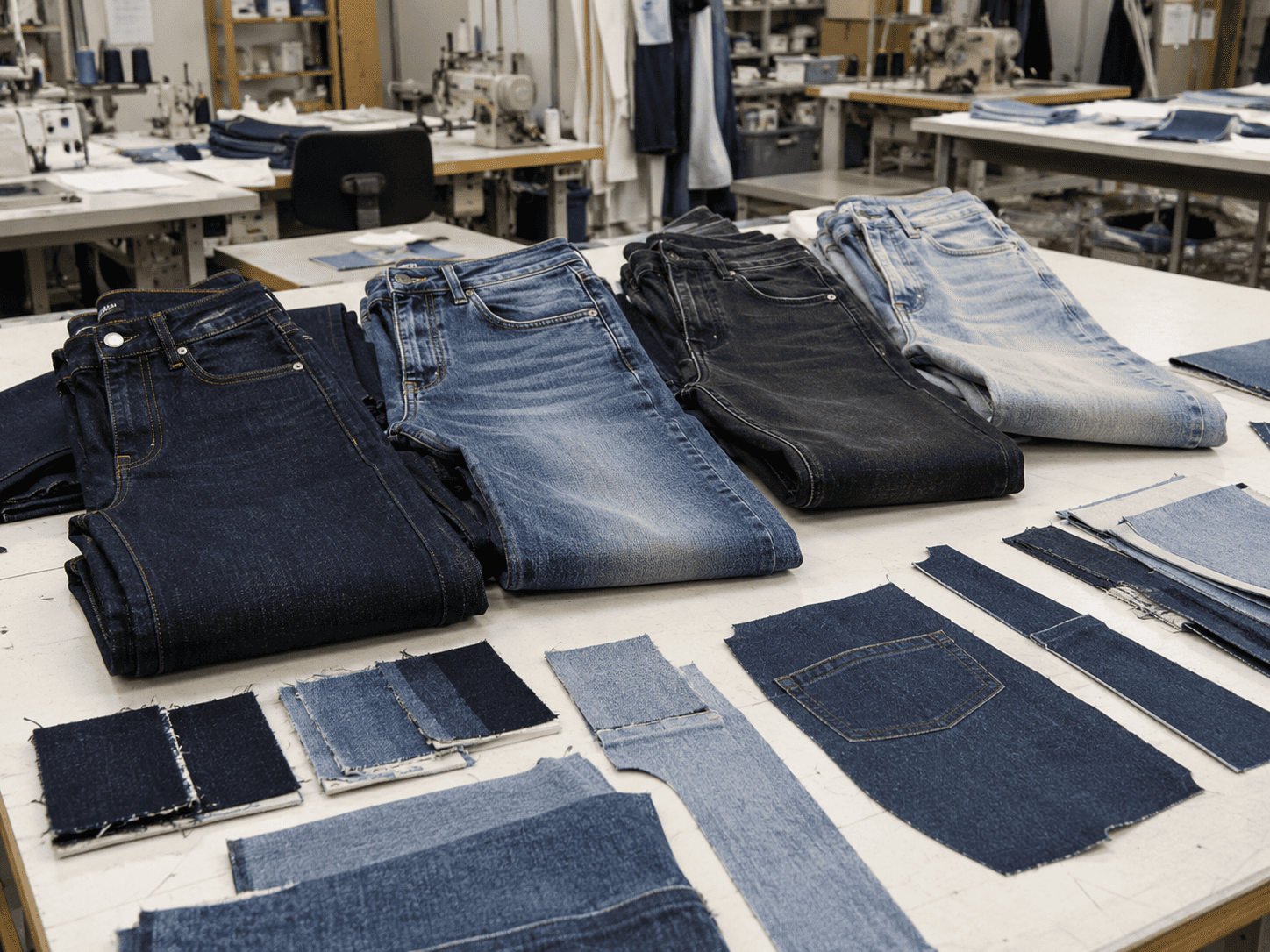
Denim remains one of the world's largest apparel categories.
According to Grand View Research[^1], the global denim jeans market was valued at approximately USD 91.2 billion in 2025, is estimated at USD 96.1 billion in 2026, and is projected to reach around USD 146.3 billion by 2033.
But from a manufacturing point of view, jeans are more complicated than the finished product suggests.
A buyer may think:
fabric + pattern + sewing = jeans
In reality, it is closer to:
fabric + pattern + sewing + wash + shrinkage + shade + torque + trims + final measurement = jeans
That is why the wash sample matters so much.
Table of Contents
- What Does a Denim Jeans Manufacturer Make?
- Which Denim Fabric Should You Choose?
- Why Does the Wash Decide How Your Jeans Look?
- How Do You Get the Fit Right in Denim?
- Which Trims and Construction Details Matter?
- What MOQ, Cost, and Timing Should You Expect?
- Conclusion
What Does a Denim Jeans Manufacturer Make?
Denim is normally a woven fabric.
So denim products are developed more like woven trousers and jackets than sweatpants or hoodies.
A denim manufacturer can produce slim, straight, relaxed, wide-leg, baggy and workwear jeans, along with denim shorts, jackets, skirts, dresses, carpenter pants, and colored or patterned denim products.
Common Denim Products
| Product | Typical direction | Main development issue |
|---|---|---|
| Jeans | Slim, straight, relaxed, wide, baggy | Fit and wash shrinkage |
| Carpenter jeans | Relaxed with utility pockets | Reinforcement and trims |
| Denim shorts | Hemmed or raw edge | Wash and leg opening |
| Trucker jacket | Classic or oversized | Wash, hardware and structure |
| Denim skirt | Mini, midi, long | Fit and movement |
| Colored denim | Black, brown, grey, fashion colors | Shade control |
| Patterned denim | Stripe or specialty weave | Fabric MOQ and alignment |
Most Denim Is Not Finished When Sewing Ends
This is one of the biggest differences between jeans and many basic woven products.
The garment may be sewn first and then sent for:
- Rinse wash
- Enzyme treatment
- Stone wash
- Bleach
- Tint
- Distressing
- Softening
- Other wet or dry finishing
So the "sewn garment" is often only an intermediate product.
Its final:
- Color
- Hand feel
- Measurements
- Surface
- Character
may still change significantly.
Our woven production handles the base denim garment, while specialist denim washing is carried out by long-term wash-house partners that we manage directly.
That is important because sewing and washing cannot be planned independently.
The pattern has to anticipate what the wash will do.
Which Denim Fabric Should You Choose?
A buyer may say:
“I want premium denim.”
That is not enough information.
Denim should be specified by factors such as:
- Weight
- Fiber composition
- Stretch
- Twill construction
- Indigo or sulfur color
- Shade
- Finish
- Width
- Shrinkage behavior
For custom jeans, denim weight, fiber composition, stretch content, weave, and color all affect how the jeans feel, wash, fade, and fit.
Denim Weight Is Often Measured in Ounces
Denim is traditionally described in:
ounces per square yard — oz/yd²
Practical apparel ranges might look like:
| Weight | General feel | Typical use |
|---|---|---|
| About 8–10 oz | Light and soft | Summer jeans, shirts |
| About 10–12 oz | Medium-light | Casual jeans |
| About 12–14 oz | Classic substantial denim | Mainstream jeans |
| 14–16 oz | Heavy and structured | Workwear / premium rigid jeans |
| 16 oz+ | Very heavy | Niche raw / heritage denim |
These are practical sourcing ranges.
They are not official quality grades.
A 14 oz denim is not automatically better than a 12 oz denim.
The right weight depends on:
- Fit
- Season
- Target customer
- Wash
- Retail positioning
Why Indigo Denim Fades the Way It Does
Traditional denim usually uses indigo-dyed warp yarns.
CottonWorks' Denim Construction guide[^2] explains that indigo must first be chemically reduced into a soluble form before it can be applied to cotton yarn.
After application, exposure to oxygen converts it back into its insoluble blue form.[^2]
One reason denim develops characteristic fading is that indigo coloration is concentrated strongly toward the outer portions of the yarn.
Abrasion and washing can gradually expose lighter areas.
That creates:
- Whiskers
- Edge fading
- Seat fading
- Knee fading
- Vintage contrast
that consumers associate with denim.
Rigid Denim
Rigid denim often means:
100% cotton, non-stretch denim
It works well for:
- Straight jeans
- Baggy jeans
- Wide-leg jeans
- Vintage styles
- Workwear
It tends to hold a more structured silhouette.
Stretch Denim
Stretch denim may include:
- Elastane
- Other stretch technologies
A common construction may include a small elastane percentage.
This is useful for:
- Slim jeans
- Skinny fits
- Women's fitted denim
- Comfort styles
But stretch content changes the behavior of the fabric.
The factory should consider:
- Recovery
- Growth during wear
- Shrinkage
- Wash temperature
- Long-term shape retention
Do not assume adding more elastane automatically makes jeans better.
For a wide or baggy jean, stretch may not be necessary at all.
Black Denim and Colored Denim
Not every denim product has to be blue indigo.
Popular options include:
- Black
- Washed black
- Grey
- Brown
- Ecru
- Green
- Custom fashion colors
Black denim may use sulfur-based coloration or other dye systems depending on the fabric.
Different dye systems can behave differently during washing.
So a wash developed for blue indigo should not automatically be copied to black denim.
Patterned and Striped Denim
Striped or specialty woven denim creates another issue:
fabric MOQ.
If the buyer wants a custom stripe with exact:
- Width
- Color
- Repeat
- Yarn
the mill may require a much larger quantity.
For small orders, stock denim is normally more realistic.
That means the exact stripe color or spacing may need to follow available fabric rather than custom artwork.
Why Does the Wash Decide How Your Jeans Look?
Two jeans can start from exactly the same denim roll and end up looking completely different.
That is because denim washing changes the product dramatically.
The wash controls shade, softness, abrasion, contrast, hand feel, and often final dimensions. Rinse, enzyme, stone, bleach, tinting and distressing processes all produce different results.
CottonWorks' Denim Finishing guide[^3] explains that pumice stonewashing works through physical abrasion: stones scrape the yarn and garment surface, removing fiber and dye and producing the uneven aged appearance associated with traditional washed denim.[^3]
CottonWorks also describes enzyme treatments as another common way to create softness and controlled washdown.[^3]
Common Denim Washes
| Wash | Typical appearance | Main effect |
|---|---|---|
| Rinse wash | Dark, clean | Desize / soften with limited fading |
| Enzyme wash | Soft, moderate fade | Controlled surface washdown |
| Stone wash | Vintage, worn | Abrasion and fading |
| Bleach wash | Light blue | Strong color removal |
| Acid / high-contrast wash | Marbled | Strong irregular contrast |
| Tint | Warm / vintage cast | Secondary coloration |
| Distressing | Whiskers, abrasion, rips | Localized wear effect |
What Is a Rinse Wash?
A rinse wash is generally one of the gentler denim-finishing directions.
CottonWorks describes darker rinse treatments as processes designed to:
- Desize
- Soften
- Retain more original shade
without the same abrasion level as heavy stonewashing.[^3]
This works well when a brand wants:
dark indigo jeans with a cleaner appearance.
Enzyme Wash
Enzymes can be used to help modify the surface of cotton denim.
Depending on the recipe, they can help create:
- Softness
- Cleaner surface
- Controlled fade
without relying entirely on heavy mechanical stone abrasion.
But "enzyme wash" is still not one fixed recipe.
Different:
- Enzyme concentrations
- Time
- Temperature
- Mechanical action
can produce different results.
Stone Wash
Stonewashing produces a more obvious worn effect.
The result depends on:
- Stone size
- Abrasiveness
- Quantity
- Processing time
- Denim construction
That is why a buyer should approve a physical wash sample.
Do not approve denim color only from a Pantone number.
Wash Recipe Is Part of the Product Specification
A denim wash is not simply:
“make it medium blue.”
A better production specification may identify:
- Base fabric
- Wash direction
- Reference garment
- Target shade
- Contrast level
- Whiskers
- Grinding
- Tint
- Softness
- Acceptable shade range
Then the wash house develops the closest result.
Always Approve a Wash Standard
Before bulk, we prefer to make:
- Wash swatches
- Leg panels
- Complete wash samples
depending on the project.
The approved sample becomes the wash standard.
Bulk should then be compared against that reference.
Shade Variation Is Normal—but It Needs Limits
A large denim order may be washed in multiple machine loads.
Each load can show small differences.
That does not mean every difference is acceptable.
A good approach is to approve:
- Target shade
- Acceptable lighter limit
- Acceptable darker limit
Then QC has a real visual standard.
Without that, one person's "vintage variation" becomes another person's "wrong color."
How Do You Get the Fit Right in Denim?
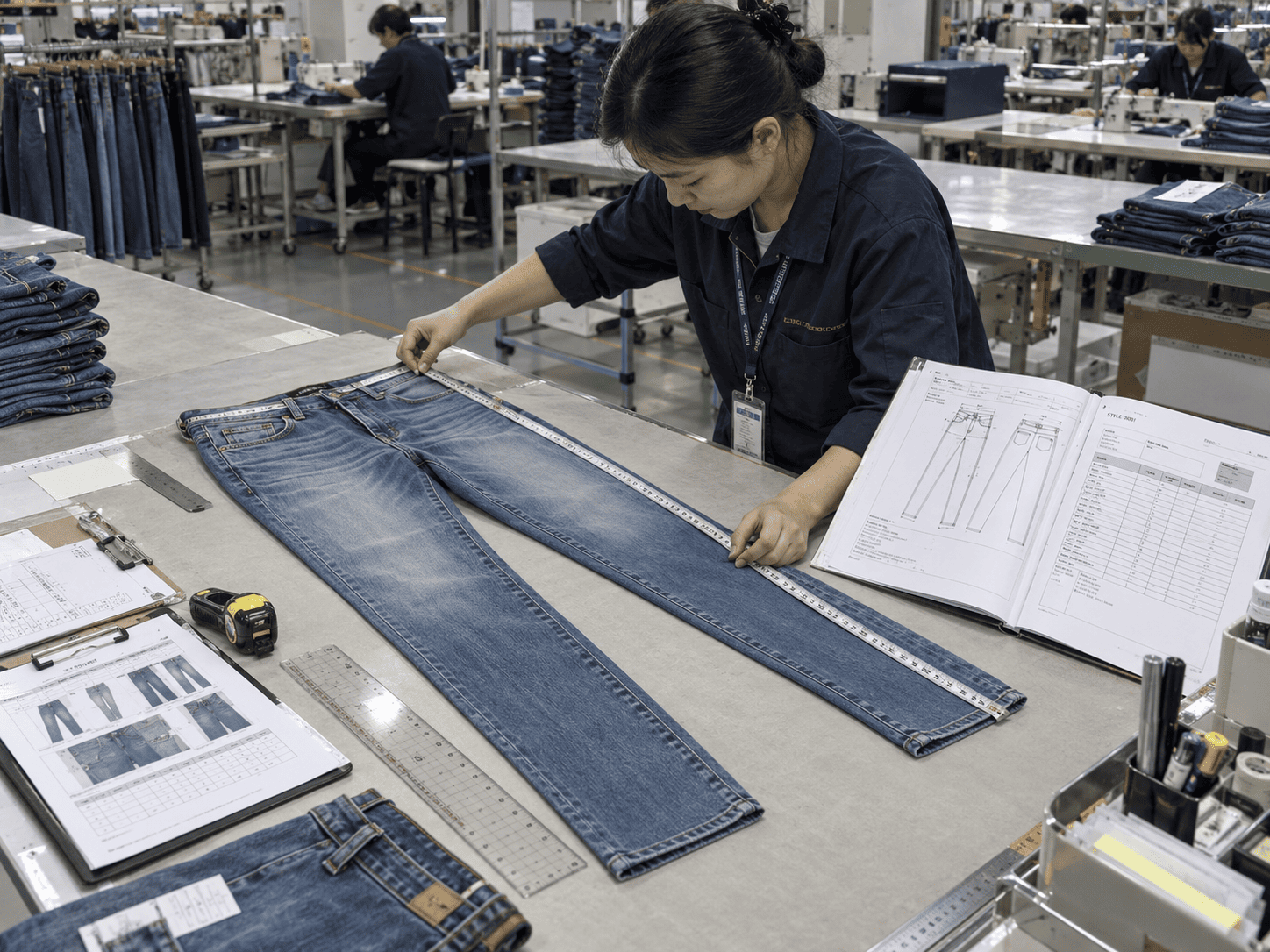
The biggest mistake is approving denim measurements before the final wash.
Denim fit should be judged after the garment has gone through the same wash and finishing process planned for bulk. Waist, rise, seat, thigh, knee, inseam, and leg opening all need to be checked in the finished state.
Key Denim Measurements
| Measurement | What it controls |
|---|---|
| Waist | Size and comfort |
| Front rise | Front fit and sitting position |
| Back rise | Seat coverage |
| Hip / seat | Overall fit |
| Thigh | Slim vs relaxed |
| Knee | Leg shape |
| Leg opening | Skinny, straight, wide or flare |
| Inseam | Final length |
| Outseam | Overall leg proportion |
Shrinkage Must Be Measured
The original article said denim usually shrinks more in length than width.
That may happen with some fabrics and washes.
It is not a universal rule.
The actual dimensional change depends on:
- Fabric
- Finishing
- Construction
- Wash recipe
- Temperature
- Drying
- Stretch content
ISO 5077[^4] provides a standardized method for determining dimensional change in textiles after washing and drying.
The useful workflow is:
- Measure before processing.
- Run the intended wash.
- Dry under the intended procedure.
- Measure again.
- Calculate directional dimensional change.
- Adjust the pattern if required.
Do not assume:
“Denim shrinks 5%, so enlarge everything 5%.”
Waist, inseam, thigh and rise may not move by the same percentage.
The Final Sample Must Go Through the Real Wash
Imagine the sewing sample measures:
Waist: 86 cm
Inseam: 80 cm
After wash:
Waist: 83.5 cm
Inseam: 77.5 cm
The buyer is not buying the first garment.
They are buying the second one.
So final fit approval should happen after the intended bulk-equivalent wash.
What Is Denim Leg Twist?
Leg twist happens when the leg panels rotate so the seam no longer hangs where intended.
You may notice:
- Side seam moving forward
- Inseam rotating
- Leg looking twisted after washing
ISO uses the term:
spirality / torque
for this type of movement.
ISO 16322-3:2021[^5] specifies procedures for measuring spirality or torque in woven and knitted garments after laundering.
The standard specifically notes that some constructions, including denim, can have spirality introduced during manufacturing.[^5]
That makes it particularly relevant to denim quality control.
What Causes Leg Twist?
Possible contributors include:
- Fabric skew
- Twill construction
- Residual fabric tension
- Cutting alignment
- Garment construction
- Wet processing
So it is too simple to say:
“All denim twists because it is twill.”
Some denim is very stable.
Some is not.
The right approach is:
test the actual fabric and actual wash.
Cutting Matters Too
Pattern pieces should be cut with correct orientation and grain control.
Poor cutting can make a fabric-stability problem worse.
That is why denim development needs communication between:
- Fabric supplier
- Pattern maker
- Cutting department
- Wash house
instead of treating each stage separately.
Which Trims and Construction Details Matter?
Customers recognize jeans partly through the details.
Buttons, rivets, zipper, thread, pocket bags, bartacks, patch, belt loops, topstitching and hem construction all affect durability and brand identity—and every trim used before washing must survive the chosen denim-finishing process.
Denim Trims
| Detail | Common options | What to check |
|---|---|---|
| Waist button | Shank button | Security and finish |
| Rivets | Copper, brass, matte | Wash durability |
| Fly | Zip or button | Function after washing |
| Thread | Tonal or contrast | Strength and wash appearance |
| Pocket bag | Cotton woven / printed | Strength |
| Back patch | Jacron, leather-style, woven | Shrinkage / wash behavior |
| Belt loops | Standard / wide | Bartack strength |
| Hem | Lockstitch / chain stitch | Appearance and durability |
Rivets and Bartacks
Rivets traditionally reinforce stress areas.
Modern jeans may also use bartacks at points such as:
- Pocket corners
- Belt loops
- Fly
- Stress seams
The design may choose one or both.
Thread Color
Classic denim often uses:
- Orange
- Gold
- Tobacco
contrast stitching.
Fashion denim may use:
- Black
- Navy
- Tonal
- White
- Custom brand colors
Thread needs to be tested against the wash.
A thread that looks perfect before washing may:
- Fade
- Stay too bright
- Change tone
after finishing.
Back Patch
Common options include:
- Jacron-style patch
- Faux leather
- Real leather where appropriate
- Woven patch
- Printed patch
The patch should be tested with the wash.
A beautiful patch is useless if it:
- Warps
- Cracks
- Shrinks badly
- Bleeds color
after processing.
Hem Construction
Some heritage jeans use chain stitching at the hem because repeated wear and washing can create the recognizable:
roping effect
around the hem edge.
But this is a style choice.
It is not required for every pair of jeans.
Custom Hardware
Branded:
- Shank buttons
- Rivets
- Zipper pulls
- Patches
can make a denim product much more recognizable.
But hardware suppliers may have:
- MOQ
- Mold fees
- Lead time
So custom trims should be planned early.
Do not approve the jean pattern first and think about all the hardware one week before bulk.
What MOQ, Cost, and Timing Should You Expect?
Denim MOQ is often shaped by two things:
fabric quantity + wash quantity
not just sewing.
Custom denim cost depends on the actual fabric, fabric consumption, wash complexity, fit, trims, decoration, quantity, and color split. Minimums may also be affected by fabric rolls and wash-house batch requirements.
What Drives Denim Cost?
| Cost factor | Why it matters |
|---|---|
| Denim weight | Changes material cost |
| Fabric quality | Premium denim costs more |
| Stretch | Changes yarn / fabric construction |
| Fit | Wide and baggy styles consume more |
| Wash | More steps mean more processing |
| Distressing | Extra labor / equipment |
| Hardware | Custom buttons and rivets |
| Patch | Custom development |
| Number of colors | Separate fabric / wash planning |
| Quantity | Affects production efficiency |
Fabric Roll Minimums
One roll does not always equal one fixed number of jeans.
Consumption depends on:
- Fabric width
- Garment size
- Fit
- Size ratio
- Marker efficiency
A wide baggy jean may use much more fabric than a slim jean.
So statements like:
“One denim roll makes 70 pants.”
should be treated as project-specific examples, not industry rules.
For one past striped-denim program, approximately one roll produced around 70 pieces for that particular pattern and size mix.
Another style may be very different.
Color Splits
Suppose you want:
100 jeans total.
Option A:
100 washed black
Option B:
25 black
25 blue
25 brown
25 grey
The second program requires much more complexity.
Different colors may mean:
- Different base fabric
- Different wash recipes
- Different test samples
- Different production batches
So MOQ should be discussed:
per style + per fabric + per color
rather than only total order quantity.
Wash Development Adds Cost
Heavy denim treatments may require multiple stages.
For example:
Base wash
→ Enzyme / abrasion
→ Bleach or discharge
→ Neutralization
→ Tint
→ Softening
→ Drying
More operations mean:
- More processing
- More handling
- More testing
- Higher cost
A simple dark rinse normally costs less than a heavily distressed multi-step vintage wash.
The Timeline Is Longer Than Sewing Alone
Denim development may involve:
- Fabric selection
- Pattern
- Sewing sample
- Wash development
- Post-wash measurement
- Pattern correction
- Second sample if required
- Bulk fabric
- Cutting
- Sewing
- Bulk washing
- Shade sorting
- Final QC
- Packing
So when a supplier says:
“Sewing takes 15 days.”
that does not mean your jeans will ship in 15 days.
Fiber Labeling
If denim is sold in the United States, the actual fiber composition should match the label.
The FTC Textile Fiber Rule[^6] requires covered textile products to disclose the generic names and percentages by weight of constituent fibers, together with the manufacturer or marketer identity and country of processing or manufacture.
So if your stretch denim is:
98% cotton / 2% elastane
do not simply label it:
100% cotton
because the fabric "feels like cotton."
The supplier's actual composition should be verified before bulk labels are produced.
How Do You Choose a Denim Jeans Manufacturer?
A good denim manufacturer should understand more than sewing.
Ask about the wash.
Green Flags and Red Flags
| Green flag | Red flag |
|---|---|
| Asks what wash you want | Only discusses sewing |
| Makes wash samples | Goes straight to bulk wash |
| Measures after washing | Approves final size before wash |
| Understands torque / leg twist | Says twisting is always normal |
| Tests trims through the wash | Adds hardware without wash testing |
| Keeps a physical wash standard | Matches from phone photos |
| Explains wash-house partners | Cannot say where wash is done |
| Shows real production documents | Uses vague certification claims |
Ask Where the Wash Is Done
Denim washing is specialized work.
A garment factory may sew the jeans while a specialist wash house performs the finishing.
That is not automatically a disadvantage.
What matters is whether the manufacturer actually manages the process.
We sew our woven garments through our own garment production setup and work with long-term specialist wash houses for denim washing.
We coordinate:
- Wash samples
- Shade approval
- Measurements
- Trims
- Bulk scheduling
- Final QC
so the wash is treated as part of the garment project.
Social Audit and Product QC Are Different
A supplier's social audit does not tell you whether the denim will twist.
And a perfect wash sample does not tell you whether the site meets your sourcing requirements.
These need separate checks.
SMETA, developed by Sedex[^7] is a social-audit methodology used to assess areas such as labour standards and health and safety, with a wider 4-Pillar format also covering environmental performance and business ethics.
SMETA is not a denim quality certification.
Product quality still depends on:
- Fabric
- Pattern
- Wash
- Fit
- Construction
- Inspection
Conclusion
Great jeans are not made at the sewing machine alone.
The wash can change:
- Size
- Shade
- Softness
- Surface
- Contrast
- Leg shape
So denim development needs to start with the finished product in mind.
Choose the fabric first.
Confirm:
What weight is it?
Is it rigid or stretch?
What is the actual fiber composition?
How does it behave in the wash?
Then develop the fit.
Measure:
- Waist
- Rise
- Seat
- Thigh
- Knee
- Inseam
- Leg opening
but approve those measurements after the intended finishing process.
Develop the wash.
Approve a physical wash standard.
Agree on the acceptable shade range.
Then test the trims.
Make sure:
- Buttons
- Rivets
- Thread
- Patch
- Zipper
all survive the same process.
Check for:
- Shrinkage
- Torque
- Leg twist
- Color variation
before bulk.
And if the wash is handled by a specialist partner, make sure the garment manufacturer manages that partner as part of one production chain.
A good pair of jeans should look effortless when the customer puts it on.
But behind that simple result is a lot of control.
Fabric → pattern → sewing → wash → measurement → QC.
Get those steps right, and the bulk looks like the sample.
Skip one, and the wash will expose it.
Footnotes & References
[^1]: Grand View Research — Denim Jeans Market Size, Share & Trends Analysis Report, 2026–2033. Grand View Research estimates the global denim jeans market at approximately USD 91.2 billion in 2025 and USD 96.1 billion in 2026, with the market projected to reach approximately USD 146.3 billion by 2033 at a CAGR of about 5.9%.
https://www.grandviewresearch.com/industry-analysis/denim-jeans-market
[^2]: CottonWorks / Cotton Incorporated — Denim Construction. Technical guidance explaining denim yarn preparation, indigo reduction and oxidation, rope dyeing, skying, sulfur topping, and other key parts of traditional denim construction and coloration.
https://cottonworks.com/learning-hub/denim/denim-construction/
[^3]: CottonWorks / Cotton Incorporated — Denim Finishing and Garment Finishing. CottonWorks explains denim rinse, enzyme and stonewashing processes, including how mechanical abrasion and finishing treatments change color, hand feel, surface appearance, and aged effects in denim garments.
https://cottonworks.com/learning-hub/denim/denim-finishing/
https://cottonworks.com/learning-hub/finishing/garment-finishing/
[^4]: International Organization for Standardization — ISO 5077:2007, Textiles — Determination of Dimensional Change in Washing and Drying. Specifies a method for determining dimensional change in textile fabrics, garments, and other textile articles after defined washing and drying procedures.
https://www.iso.org/standard/41877.html
[^5]: International Organization for Standardization — ISO 16322-3:2021, Textiles — Determination of Spirality After Laundering — Part 3: Woven and Knitted Garments. Specifies methods for measuring spirality or torque in garments after domestic laundering. ISO specifically notes that some fabric constructions such as denim can have spirality intentionally introduced during manufacturing and recognizes the phenomenon commonly referred to as denim jean leg twist.
https://www.iso.org/standard/78782.html
[^6]: U.S. Federal Trade Commission — Textile Fiber Rule. Requires covered textile products sold in the United States to disclose generic fiber names and percentages by weight, along with manufacturer or marketer identification and the country where the product was processed or manufactured.
https://www.ftc.gov/legal-library/browse/rules/textile-fiber-rule
[^7]: Sedex — SMETA Audit. SMETA is a social-audit methodology covering labour standards and health and safety, with 4-Pillar audits additionally addressing environmental performance and business ethics. It is a supplier social-audit methodology rather than a product-quality certification.
https://www.sedex.com/solutions/smeta-audit/