
Custom Workwear and Uniform Manufacturer: How Do You Make Uniforms That Last?
Your company orders a new uniform program.
The first delivery looks good.
Three months later:
The knees are wearing through.
Pocket corners are starting to tear.
The navy trousers have faded.
Some employees say the fit is too tight when they kneel.
And now procurement is preparing to buy the same uniforms again.
That is not a cheap uniform anymore.
It is an expensive uniform that had to be purchased twice.
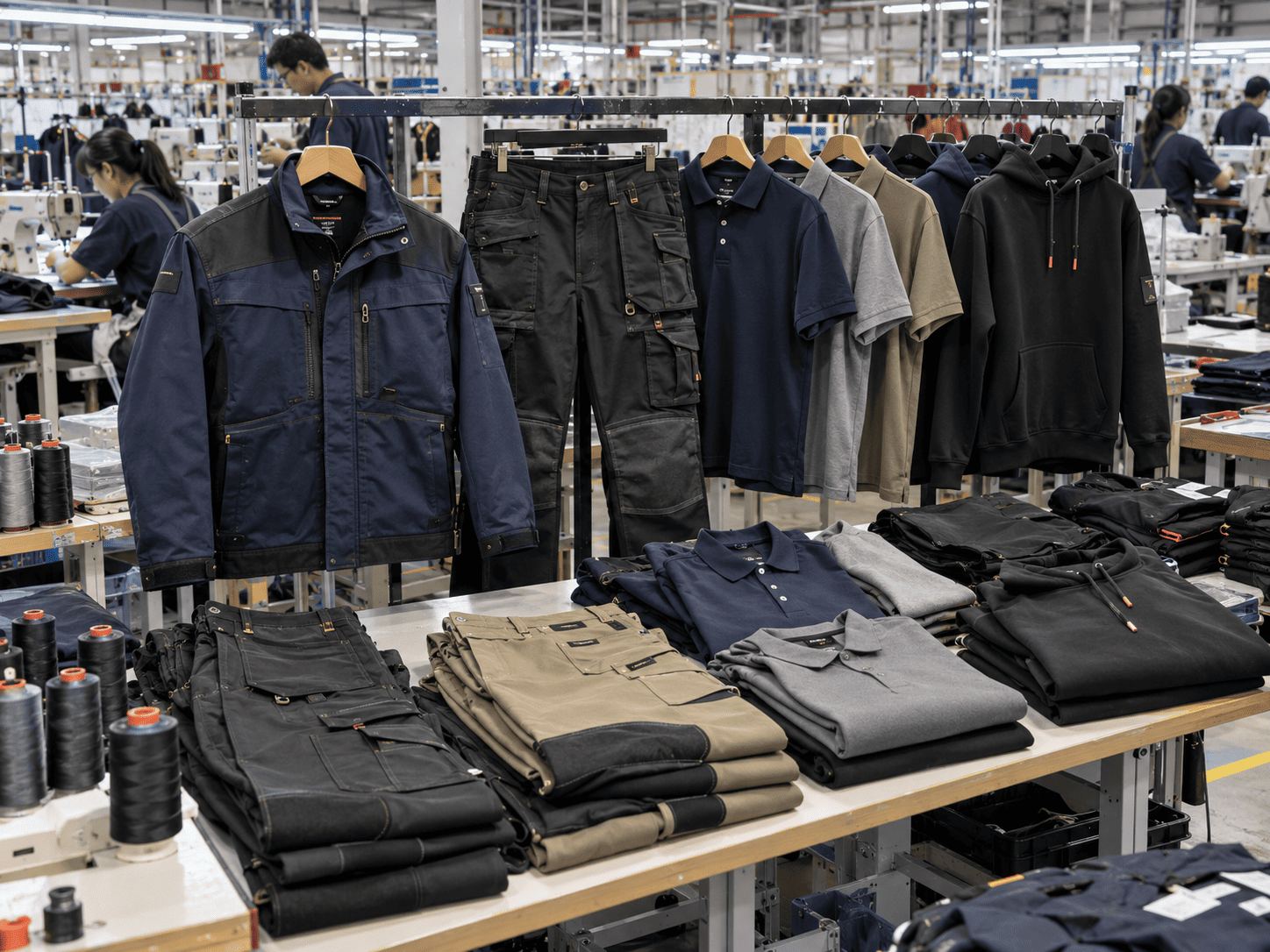
A custom workwear and uniform manufacturer makes durable clothing for staff, including work pants, cargo trousers, jackets, polos, shirts, hoodies, sweatshirts, and technical outerwear. Good workwear is designed around the job, wash conditions, movement, durability, sizing, and repeat orders—not appearance alone.
The uniform market is substantial and relatively stable because companies continually need clothing for:
- Staff
- New hires
- Replacements
- New locations
- Seasonal teams
- Corporate rebranding
According to Mordor Intelligence's Uniform Market report[^1], the global uniform market is estimated at approximately USD 63.48 billion in 2026 and projected to reach around USD 85.13 billion by 2031, representing a CAGR of about 6.05%.
Corporate uniforms represented the largest product segment in 2025, at approximately 28.74% of the market.[^1]
But workwear is not just corporate merchandise with more pockets.
If the garment is worn eight hours a day, five days a week, the fabric, seams, fit, and wash performance become much more important.
Table of Contents
- What Does a Workwear and Uniform Manufacturer Make?
- Which Fabrics Hold Up to Daily Work?
- Which Construction Details Make Workwear Last?
- How Do You Handle Sizing Across a Whole Team?
- What About Safety Standards and Compliance?
- What MOQ, Branding, and Reorders Should You Plan For?
- Conclusion
What Does a Workwear and Uniform Manufacturer Make?
"Uniform" covers a very wide range of products.
A hotel polo and a warehouse cargo trouser are both uniforms.
But they solve completely different problems.
A workwear and uniform manufacturer can produce work jackets, cargo trousers, utility pants, shirts, polos, hoodies, sweatshirts, vests, and technical outerwear. The right product depends on the employee's job, working environment, climate, movement, and laundering routine.
Common Workwear Products
| Product | Typical use | Main requirement |
|---|---|---|
| Work jacket | Field staff, logistics, trades | Durability and pockets |
| Work trousers | Warehouse, maintenance | Movement and abrasion resistance |
| Cargo pants | Operations and technical staff | Practical storage |
| Polo shirt | Retail, hospitality | Appearance and color retention |
| Woven shirt | Corporate / customer-facing roles | Easy care and clean fit |
| Hoodie | Casual teams / warehouse | Comfort and warmth |
| Sweatshirt | Indoor / cooler environments | Durability and easy layering |
| Vest | Logistics / outdoor layering | Mobility |
| Technical jacket | Outdoor staff / drivers | Weather protection |
Start With the Job
Before discussing fabric, ask:
What does the employee actually do?
A warehouse worker may:
- Kneel
- Lift boxes
- Carry a scanner
- Use a phone
- Bend repeatedly
A delivery driver may:
- Sit for long periods
- Move between warm and cold environments
- Work outdoors
- Need visibility
A hotel receptionist has completely different priorities.
That means one "uniform collection" may need several product categories rather than one fabric used everywhere.
Design Around Movement
Fashion clothing is often judged in front of a mirror.
Workwear should also be judged while the employee is:
- Sitting
- Kneeling
- Reaching
- Bending
- Lifting
- Walking
A trouser that looks clean while standing can become uncomfortable the moment someone crouches.
That is why we look at practical points such as:
- Rise
- Thigh
- Knee
- Crotch
- Waist
- Pocket placement
not just the overall silhouette.
One Uniform Program Can Mix Knit and Woven Products
For example:
Staff hoodie + polo + cargo pants + winter jacket
may all belong to the same program.
But they should not necessarily use the same manufacturing logic.
Knitted hoodies need:
- Rib control
- Shrinkage control
- Sweatshirt fabric selection
Work trousers need:
- Woven construction
- Stress reinforcement
- Pocket engineering
Outerwear may need:
- Shell fabrics
- Lining
- Insulation
- Water-repellent finishing
The goal is consistency in the brand, not forcing every product into one construction.
Which Fabrics Hold Up to Daily Work?
Workwear fabric should be chosen for actual use.
Not because it looks good in a sample book.
Useful workwear fabrics include polyester-cotton twill, cotton canvas, ripstop, stretch woven twill, polyester pique, heavyweight sweatshirt fabrics, and technical nylon or polyester shells. The correct fabric depends on abrasion, washing, climate, comfort, and the employee's job.
Common Workwear Fabrics
| Fabric | Character | Typical application |
|---|---|---|
| Poly-cotton twill | Stable, durable, easy-care | Pants, shirts, jackets |
| Cotton canvas / duck | Firm, rugged | Heavy work jackets and pants |
| Ripstop | Reinforced grid construction | Utility / outdoor pants |
| Stretch twill | Woven with movement | Active work trousers |
| Polyester pique | Stable and quick-drying | Polos |
| Heavy fleece / French terry | Warm and comfortable | Hoodies / sweatshirts |
| Nylon / polyester shell | Light outer layer | Jackets |
Poly-Cotton Is Not Automatically Better
Polyester-cotton blends are common in uniforms because they can offer a useful balance of:
- Comfort
- Strength
- Drying speed
- Shape retention
- Easy care
But there is no universal ratio that is best.
A:
65% polyester / 35% cotton
fabric may suit one project.
Another company may prefer:
60% cotton / 40% polyester
for a softer hand.
Choose based on the job and testing.
Abrasion Matters More Than GSM Alone
A common mistake is:
"Use heavier fabric so it lasts longer."
Weight matters.
But it is not the same as abrasion resistance.
A well-constructed medium-weight workwear fabric can outperform a heavier but poorly engineered fabric.
For woven fabrics, ISO 12947-2[^2] describes the Martindale method for determining fabric breakdown under abrasion.
It is one useful way to compare how textile materials tolerate repeated rubbing.[^2]
For work pants, abrasion testing can be especially relevant around:
- Knees
- Seat
- Thigh
- Pocket areas
Heavy Is Not Always Better
Imagine a maintenance worker in Saudi Arabia.
A very heavy canvas trouser may technically feel durable.
But if it is too hot to wear comfortably, it is not the right uniform.
The right fabric balances:
durability + climate + movement + comfort
rather than maximizing GSM.
Workwear Color Has to Survive Washing
Uniforms may be washed far more often than normal fashion products.
Navy trousers might be washed:
- Weekly
- Several times per week
- Commercially
So a navy fabric that looks perfect on day one can still be a poor workwear fabric if the color changes quickly.
ISO 105-C06:2010[^3] specifies methods for evaluating textile color fastness to domestic and commercial laundering.
The standard was reviewed and confirmed again in 2026, so it remains current.[^3]
It is useful because "the color looks stable" is subjective.
A test result is more meaningful.
Industrial Laundry Needs Separate Consideration
There is another important detail.
ISO 105-C06 addresses domestic and commercial laundering procedures for normal textile articles, but ISO itself notes that industrial and hospital textiles may experience more severe laundering procedures.[^3]
So if your customer's uniforms will go through a professional industrial laundry, tell the manufacturer at the beginning.
Do not develop the garment around:
30°C home washing
if the actual uniform will repeatedly go through a much harsher process.
Shrinkage Still Matters
Workwear sizing must remain usable after laundering.
ISO 5077[^4] provides a method for determining dimensional changes in fabrics and garments after specified washing and drying procedures.
This is especially important for:
- Cotton work pants
- Polos
- Staff hoodies
- Woven shirts
The useful question is not:
"Does this fabric shrink?"
Almost every textile can change under some condition.
The useful question is:
"How much does this actual fabric change under the laundering process we expect the customer to use?"
Which Construction Details Make Workwear Last?
Fabric is only half the product.
Two work trousers made from the same fabric can have completely different service lives.
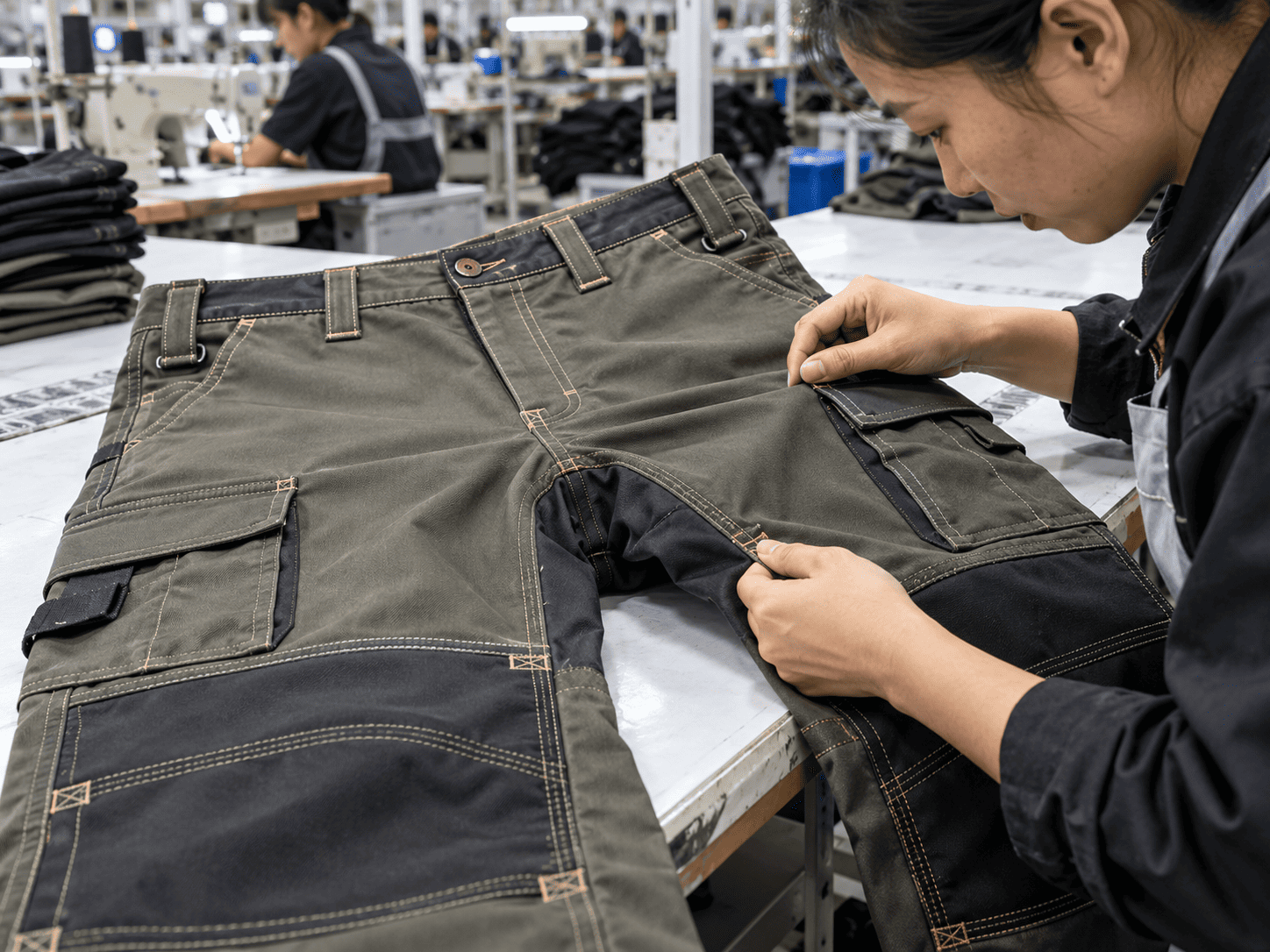
Durable workwear uses construction matched to stress areas: reinforced pockets, appropriate seams, bartacks, reinforced knees, strong waistbands, reliable zippers and snaps, and enough mobility through the crotch, knee, and thigh.
Workwear Usually Fails at Specific Points
The most common failure areas are often:
- Pocket corners
- Belt loops
- Crotch
- Knee
- Fly
- Waistband
- Tool pockets
- Zippers
These areas take repeated force.
So they should be designed intentionally.
Construction Details
| Detail | Purpose |
|---|---|
| Bartack | Reinforces localized stress points |
| Reinforced knee | Adds material where abrasion is high |
| Double-needle seam | Adds stability / visual workwear construction |
| Gusset | Improves movement in certain designs |
| Strong pocket bag | Handles phone, tools and keys |
| Reinforced belt loop | Reduces tearing |
| Quality zipper | Repeated daily use |
| Snap reinforcement | Prevents fabric tearing around hardware |
Bartacks
Bartacks are short, dense reinforcement stitches.
Common locations include:
- Pocket corners
- Belt loops
- Fly
- Stress points
But more bartacks do not automatically mean better workwear.
They should be used where the fabric and construction actually need reinforcement.
Reinforced Knees
For employees who kneel often, a second layer can make sense.
Options include:
- Double-layer knee
- Overlay panel
- Knee-pad pocket
The right choice depends on the occupation.
A warehouse employee may need something completely different from a construction worker using removable knee pads.
Pocket Design Should Start With Real Objects
Do not make a "phone pocket" from a drawing.
Put a phone in it.
Ask:
- Does it fit?
- Can the worker sit comfortably?
- Does it hit the knee?
- Can it fall out?
- Does the pocket opening stretch?
The same applies to:
- Scanner pockets
- Pen slots
- Radio loops
- Key loops
- Tool pockets
Useful workwear is often won or lost in these small details.
Wear-Test the Sample
A fitting room tells you whether the garment fits.
It does not tell you whether it works.
For a substantial uniform program, having a few actual employees wear prototypes can reveal issues such as:
- Pocket too shallow
- Waist uncomfortable when sitting
- Sleeve too restrictive
- Knee pulling when crouching
- Jacket riding up
That feedback is more valuable before 1,000 pieces are produced.
How Do You Handle Sizing Across a Whole Team?
Uniform sizing is harder than fashion sizing because the buyer is not targeting one consumer profile.
They may need to dress:
everyone.
A good uniform program uses a clearly defined size chart, checks grading across small and large sizes, collects actual employee size data before ordering, and plans replacement stock for new hires and future reorders.
Team Sizing Workflow
| Step | Why it matters |
|---|---|
| Build size chart | Defines garment measurements |
| Make base-size sample | Checks core fit |
| Check size set | Confirms grading |
| Staff fitting / survey | Establishes order breakdown |
| Add replacement stock | Supports new hires / losses |
| Keep same size standard | Makes reorders predictable |
Do Not Guess the Size Breakdown
For example, ordering:
10% S
30% M
30% L
20% XL
10% XXL
because "that seems normal" can create expensive inventory mistakes.
If possible, ask employees to:
- Measure themselves against the chart
- Try physical sizing samples
- Record preferred size
Then build the order around real demand.
Check the Ends of the Size Range
A base-size sample can look perfect.
But grading problems often appear at:
- XS
- 3XL
- 4XL
For example, simply adding the same amount to every point can create:
- Oversized neck
- Bad shoulder
- Too-wide cuff
- Incorrect pocket position
A size-set review helps confirm that the garment still looks intentional at the extremes.
Different Fits May Be Better Than One Universal Pattern
Some uniform programs work well with one unisex fit.
Others do not.
A buyer may need:
- Different trouser blocks
- Different body proportions
- Tall sizes
- Short inseams
depending on the workforce.
Do not force one fit merely because it is easier for production.
Keep the Size Chart Stable for Reorders
Uniform programs can continue for years.
If the Medium ordered next year suddenly fits like this year's Large, the client loses trust.
Keep:
- Approved sample
- Pattern
- Grading rules
- Measurement chart
on file.
What About Safety Standards and Compliance?
This section needs the clearest distinction.
Some uniforms are clothing.
Some workwear is PPE.
Those are not the same category.
A branded work jacket can be made for durability and visibility without being certified safety apparel. If a product is sold or relied upon as high-visibility, flame-resistant, chemical-protective, or another type of PPE, the applicable standard must be identified and the complete product needs the required testing and conformity evidence.
Reflective Tape Does Not Automatically Make a Hi-Vis Garment
You can put reflective tape on:
- Black jacket
- Navy vest
- Cargo pant
for visual effect or increased visibility.
That does not automatically make the garment:
certified high-visibility PPE.
United States: ANSI/ISEA 107
The current published U.S. standard listed by the International Safety Equipment Association is ANSI/ISEA 107-2020[^5].
ISEA explains that the standard establishes performance criteria for high-visibility materials and requirements relating to design, minimum material areas, color, retroreflective performance, and garment performance classes.[^5]
As of 2026, a revised edition is under development and went through public review, but ISEA explicitly identifies that version as an unapproved draft that should not yet be relied on as the final standard.[^5]
So for current production, do not advertise:
ANSI/ISEA 107-2026
unless and until an approved edition actually exists.
Europe / International: ISO 20471
ISO 20471:2013[^5] remains the currently published international high-visibility clothing standard.
It specifies requirements for clothing intended to visually signal the wearer's presence under daylight conditions and under vehicle headlights in darkness.[^5]
ISO notes that a replacement draft is currently under development.
Again:
current published standard ≠ future draft.
Different Markets Can Require Different Compliance
Do not tell a client:
"This is hi-vis certified."
without asking:
For which market and which standard?
A U.S. buyer and a European buyer may refer to different compliance frameworks.
Flame-Resistant Clothing Is Another Category Again
Flame-resistant workwear is not simply:
heavy cotton + FR label.
The required standard depends on:
- Hazard
- Occupation
- Market
- Garment use
The fabric and finished garment may both need specific testing.
The same principle applies to:
- Chemical protective clothing
- Arc-rated garments
- Rain PPE
- Other specialized protective apparel
So if a client requires PPE, the first question should be:
Which exact standard must the finished garment meet?
Our Scope
Our normal strength is:
- Branded staff uniforms
- Work trousers
- Jackets
- Hoodies
- Polos
- Outerwear
If a project requires a specific safety claim, that standard needs to be confirmed before:
- Fabric selection
- Pattern
- Reflective layout
- Sampling
Third-party laboratory testing can be arranged where required.
But testing is not a promise that a design will pass.
The result depends on the actual:
- Material
- Garment
- Construction
- Standard
- Test outcome
Social Compliance Is Different Again
Corporate procurement may also ask about factory social compliance.
SMETA, developed by Sedex[^6] assesses practices and conditions at individual supply-chain sites, including labour standards and health and safety, with the scope depending on whether the audit is 2-Pillar or 4-Pillar.[^6]
Sedex also states that audits are conducted by approved independent Affiliate Audit Companies.[^6]
But SMETA does not certify:
- Abrasion resistance
- Hi-vis performance
- Flame resistance
- Colorfastness
These are separate questions.
What MOQ, Branding, and Reorders Should You Plan For?
The first uniform order is only the beginning.
A good program is designed for the next order too.
For our standard programs, jackets, hoodies, and sweatshirts can typically start around 50 pieces per style, while tees, polos, and similar products may start around 100 pieces depending on the construction, fabric, colors, and trims.
Uniform Planning
| Item | What to decide |
|---|---|
| Style | Product and use |
| Fabric | Durability and wash |
| Color | Approved physical standard |
| Logo | Size, placement, method |
| Size range | Team requirements |
| Size breakdown | Real staff demand |
| Replacement stock | New hires / damage |
| Reorder reference | Approved sample and fabric |
| Delivery | Required arrival date |
Embroidery or Printing?
Embroidery is popular on uniforms because it can create a durable, professional appearance.
Common placements include:
- Left chest
- Sleeve
- Back neck
But embroidery is not automatically the correct decoration for every garment.
A lightweight performance polo with a very dense embroidery may:
- Pucker
- Feel heavy
- Distort
A large staff hoodie graphic may be more suitable for screen printing.
Choose the method based on:
- Fabric
- Logo
- Size
- Wash conditions
Test Decoration Through the Intended Wash
A logo should not only look good before laundering.
It needs to remain acceptable afterward.
That includes:
- Embroidery thread
- Patch
- Reflective detail
especially if the uniform is washed frequently.
Reorders Matter More Than First Orders
Imagine the company buys:
500 navy polos in January.
Then:
200 more in June.
Then:
80 for new hires in October.
Those garments may be worn side by side.
That is why reorders need records.
Keep:
- Approved color reference
- Fabric specification
- Logo file
- Thread color
- Measurement chart
- Label file
- Packaging
- Approved garment
Match to the Approved Standard, Not Memory
A new dye lot may not be physically identical to the previous roll.
So the correct goal is:
match the approved reference within the agreed tolerance
rather than:
"make the same navy from memory."
Watch Fabric Availability
Long-term uniform programs should consider whether the selected material is likely to remain available.
A very unusual stock fabric may look great on the first order but become difficult to source one year later.
For repeat programs, sometimes a stable core fabric is commercially smarter than a highly unusual one-off material.
MOQ and Replacement Orders
Small replacement orders can be more expensive than the first bulk run.
Why?
Because the factory may need to purchase:
- New fabric
- New dye lot
- Labels
- Embroidery setup
for a small quantity.
For long-term clients, planning a small spare inventory can sometimes be more economical.
Lead Time
A standard uniform order still needs:
- Sample
- Fit approval
- Fabric
- Logo approval
- Bulk production
- QC
- Packing
For our standard garment programs, bulk production is commonly around 20–30 days after approval and deposit, depending on materials and construction.
Special:
- Fabric
- Trims
- PPE testing
- Complex outerwear
can add time.
How Do You Choose a Workwear and Uniform Manufacturer?
Do not ask only:
"How much is one uniform?"
Ask how the supplier plans the product.
Green Flags and Red Flags
| Green flag | Red flag |
|---|---|
| Asks what the employee actually does | Starts from appearance only |
| Asks how the garments will be washed | Ignores laundry conditions |
| Discusses abrasion and shrinkage | Talks only about GSM |
| Reinforces actual stress points | Adds random decorative stitching |
| Checks size range and grading | Makes only one base sample |
| Distinguishes uniform from PPE | Calls any reflective garment certified |
| Requests the exact safety standard | Promises certification before testing |
| Keeps reorder references | Recreates colors from memory |
| Provides real social-audit information | Uses vague compliance logos |
Ask for Test Evidence Where It Matters
Do not demand every test ever written.
Test based on the product.
For example:
Work trousers may prioritize:
- Abrasion
- Shrinkage
- Seam strength
Dark polos may prioritize:
- Colorfastness
- Shrinkage
- Pilling
A certified hi-vis jacket needs the applicable PPE testing.
The testing plan should match the actual risk.
Conclusion
Good workwear starts with the job.
Not the catalog.
Ask:
What does this employee do all day?
Where does the garment experience abrasion?
What do they carry?
Do they kneel?
Do they work outside?
How often will the uniform be washed?
Then choose the fabric.
Do not judge durability by GSM alone.
Consider:
- Abrasion
- Colorfastness
- Shrinkage
- Comfort
- Climate
Then design the stress points.
Reinforce:
- Knees
- Pockets
- Belt loops
- Crotch
where the job requires it.
For sizing, fit the whole team rather than only the base size.
For safety claims, be precise.
A reflective strip does not automatically make a certified hi-vis garment.
ANSI/ISEA 107 and ISO 20471 have defined requirements.
And flame-resistant or other protective clothing may require completely different standards.
Finally, plan the reorder from day one.
Keep:
- Approved sample
- Size chart
- Fabric
- Color
- Logo
- Trim specification
on file.
Because the real test of a uniform supplier is not only whether the first 500 pieces look good.
It is whether the employees are still comfortable after months of wear—and whether the next 200 pieces still belong beside the first 500.
That is what makes a uniform program reliable.
Footnotes & References
[^1]: Mordor Intelligence — Uniform Market Size & Share Analysis. Mordor Intelligence estimates the global uniform market at approximately USD 60.05 billion in 2025 and USD 63.48 billion in 2026, projecting growth to approximately USD 85.13 billion by 2031 at a CAGR of about 6.05%. Corporate uniforms represented approximately 28.74% of the global market in 2025.
https://www.mordorintelligence.com/industry-reports/uniform-market
[^2]: International Organization for Standardization — ISO 12947-2:2016, Textiles — Determination of the Abrasion Resistance of Fabrics by the Martindale Method — Part 2. Specifies the Martindale procedure for determining specimen breakdown through repeated abrasion and is applicable to a wide range of textile fabrics. The standard was reviewed and confirmed in 2023 and remains current.
https://www.iso.org/standard/61058.html
[^3]: International Organization for Standardization — ISO 105-C06:2010, Textiles — Tests for Colour Fastness — Part C06: Colour Fastness to Domestic and Commercial Laundering. Specifies methods for assessing the resistance of textile color to domestic and commercial laundering. ISO notes that industrial and hospital articles may be subject to more severe laundering conditions. The standard was reviewed and confirmed in 2026 and remains current.
https://www.iso.org/standard/51276.html
[^4]: International Organization for Standardization — ISO 5077:2007, Textiles — Determination of Dimensional Change in Washing and Drying. Specifies a method for determining dimensional changes in fabrics, garments, and other textile articles after specified washing and drying procedures.
https://www.iso.org/standard/41877.html
[^5]: International Safety Equipment Association (ISEA) — ANSI/ISEA 107-2020; International Organization for Standardization — ISO 20471:2013. ANSI/ISEA 107-2020 is the current published U.S. standard listed by ISEA for high-visibility safety apparel. A proposed revision entered public review in 2026 but remains an unapproved draft. ISO 20471:2013 remains the currently published international standard for high-visibility clothing, while a replacement draft is under development.
https://safetyequipment.org/our-standards/
https://safetyequipment.org/high-visibility-products/
https://www.iso.org/standard/42816.html
[^6]: Sedex — SMETA Audit. SMETA is a social-audit methodology used to assess practices, workers, conditions, and risks at individual supply-chain sites. Sedex states that SMETA audits are carried out by auditors from approved independent Affiliate Audit Companies and may use either a 2-Pillar or 4-Pillar scope.
https://www.sedex.com/solutions/smeta-audit/