

Custom Underwear Manufacturer: How Do You Make Boxer Briefs With Your Own Waistband?
You want boxer briefs with your brand name woven into the waistband.
A factory says:
"No problem."
Then you learn the waistband has its own minimum quantity, its own setup cost, and its own lead time.
That small detail can change the whole order.
A custom underwear manufacturer makes briefs, trunks, boxer briefs, and boxers according to your fabric, fit, construction, and branding. For branded boxer briefs, the waistband is one of the most important parts of the product because it is manufactured separately from the garment itself.
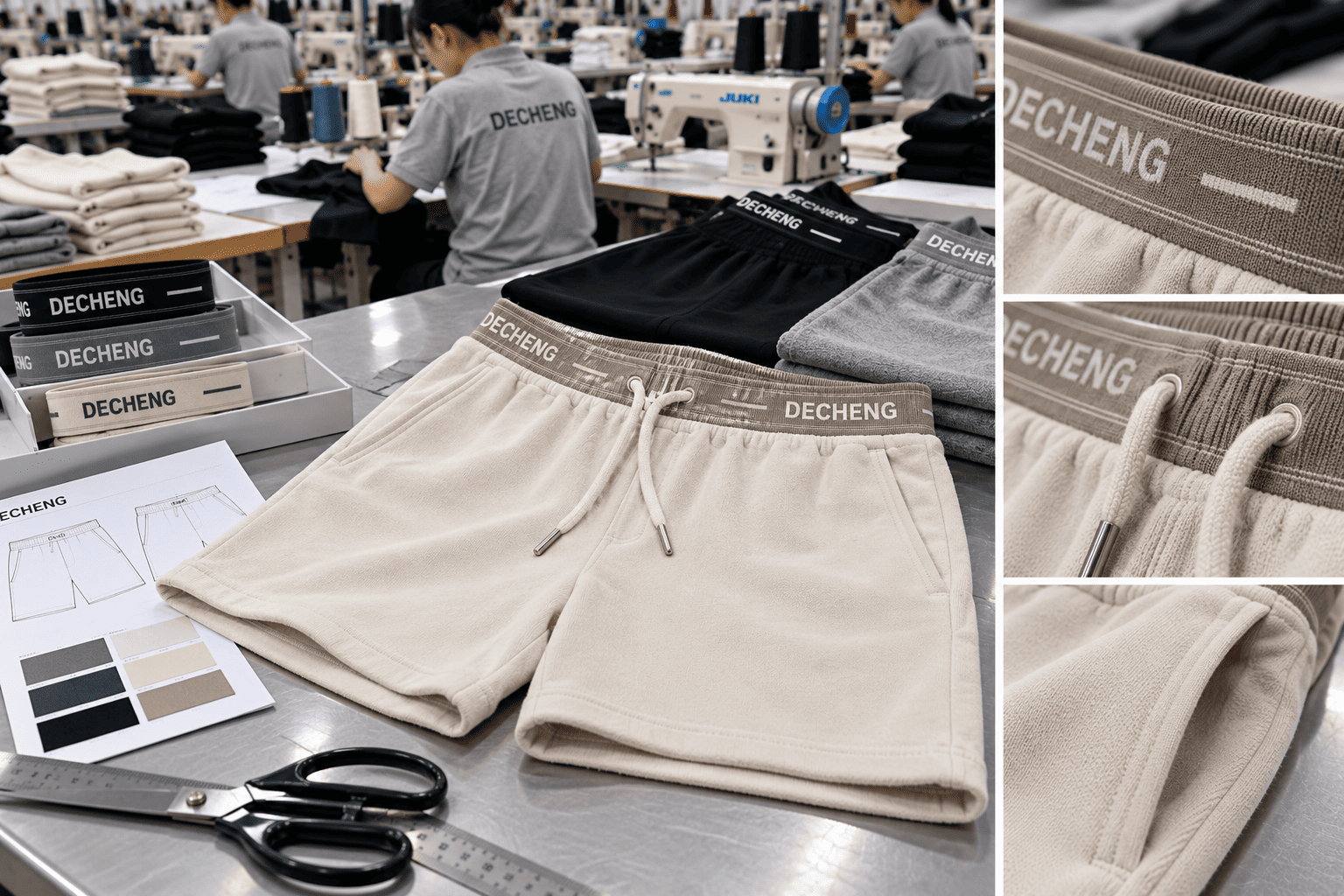
Men's underwear is a large and relatively stable apparel category.
According to Grand View Research[^1], the global men's underwear market was valued at approximately USD 42.9 billion in 2025 and is projected to reach around USD 68.9 billion by 2033.
Boxer briefs accounted for the largest product segment at about 33.7% of 2025 revenue, while cotton held approximately 68.4% of the fabric segment.[^1]
For a clothing brand already selling T-shirts, hoodies, or basics, underwear can be a natural extension.
But underwear has production rules of its own.
Let me explain them.
Table of Contents
- What Does a Custom Underwear Manufacturer Make?
- Which Fabric Should You Choose for Underwear?
- Why Does the Waistband Define the Product?
- Which Construction Details Matter Most?
- What MOQ, Cost, and Timing Should You Expect?
- How Do You Choose a Custom Underwear Manufacturer?
- Conclusion
What Does a Custom Underwear Manufacturer Make?
Underwear looks simple.
It uses less fabric than a hoodie or pair of sweatpants.
But because it stays directly against the body for many hours, small fit and construction problems become noticeable very quickly.
A custom underwear manufacturer can produce briefs, trunks, boxer briefs, long-leg boxer briefs, loose woven boxers, and lounge boxer shorts. Each style has a different leg length, support level, pattern, fabric requirement, and target customer.
The terminology confuses many first-time buyers.
A trunk and a boxer brief may look similar in a product photo, but their leg lengths and proportions are different.
A traditional boxer is usually loose rather than body-fitting.
So do not send a factory a picture and write only:
"I want men's boxers."
Be more specific.
For example:
"Fitted boxer brief, mid-thigh length, approximately 8 cm inseam."
That gives the pattern maker something measurable.
Common Underwear Styles
| Style | Leg length | Fit | Typical fabric |
|---|---|---|---|
| Brief | No leg | Close and supportive | Cotton-elastane knit |
| Trunk | Short leg | Close, square silhouette | Cotton-elastane, modal blend |
| Boxer brief | Mid-thigh | Close and supportive | Cotton-elastane, modal, microfiber |
| Long-leg boxer brief | Longer leg | Close, anti-chafe | Microfiber, cotton-elastane |
| Woven boxer | Mid-thigh | Loose | Cotton poplin |
| Lounge boxer short | Varies | Relaxed | Jersey or woven fabric |
Boxer briefs are a practical first product for many brands because the silhouette is familiar and commercially established.
Grand View Research reports that boxer briefs were the largest men's underwear category by revenue in 2025.[^1]
Underwear also works well as part of a wider basics collection.
A customer buying a T-shirt, hoodie, or lounge set may also buy branded boxer briefs at a lower entry price.
Our core manufacturing experience is in knit apparel, and many of the same skills involved in T-shirts and lightweight knitwear also matter here:
- Fabric sourcing
- Stretch control
- Pattern making
- Coverstitching
- Elastic application
- Shrinkage testing
- Labeling
- Bulk QC
If you are building a broader basics range, our heavyweight T-shirt guide covers the T-shirt side in more detail.
Which Fabric Should You Choose for Underwear?
Fabric is one of the first things the customer notices.
Underwear needs to feel comfortable when sitting, walking, sleeping, and moving throughout the day.
Cotton-elastane is a practical choice for classic everyday underwear. Modal blends can provide a softer, smoother hand. Nylon or polyester microfiber can work well for sports-oriented or quick-drying products. Whatever fabric you choose, stretch and recovery matter as much as softness.
Most fitted underwear needs elastane or another stretch component.
A common composition is around:
95% cotton / 5% elastane
but that is only one option.
The right ratio depends on:
- Knit construction
- Fabric weight
- Required stretch
- Recovery
- Fit
- Price
Underwear Fabrics Compared
| Fabric | Feel | Strengths | Watch out for |
|---|---|---|---|
| Cotton-elastane | Natural, soft | Familiar, comfortable, versatile | Shrinkage and recovery depend on fabric quality |
| Modal-elastane | Smooth, soft, fluid | Premium hand feel and drape | Higher fabric cost |
| Viscose made from bamboo + elastane | Soft, smooth | Popular soft-hand positioning | Labeling and environmental claims must be accurate |
| Nylon-spandex microfiber | Smooth, sleek | Strong stretch, quick drying | Different hand from cotton |
| Polyester-spandex | Sporty, smooth | Durable and easy to print | Odor management may matter |
| Cotton poplin | Crisp and lightweight | Traditional loose boxers | Little or no natural stretch |
Be Careful With "Bamboo" Fabric Claims
This is an important point for brands selling into the United States.
Many suppliers casually use terms such as:
"bamboo underwear"
or:
"bamboo fiber."
But if the textile is actually viscose or rayon manufactured using bamboo as the cellulose source, U.S. labeling rules do not allow the product to simply be described as bamboo.
The U.S. Federal Trade Commission's Bamboo Textiles guidance[^2] states that such products should be described appropriately as rayon made from bamboo or viscose made from bamboo, unless the textile actually contains mechanically processed bamboo fiber.
That distinction matters for:
- Product labels
- Website copy
- Amazon listings
- Packaging
- Advertising
So if a fabric supplier tells you:
"95% bamboo, 5% spandex"
ask for the official fiber composition.
Do not print packaging until you know what the fiber legally is.
What GSM Works for Underwear?
Fitted underwear fabrics are normally much lighter than hoodie fabrics.
As a practical sourcing range, many knit boxer-brief fabrics fall somewhere around:
150–190 GSM
depending on fiber, knit structure, stretch, and intended use.
But GSM should not be chosen alone.
A 160 GSM fabric with excellent recovery may perform better than a poorly knitted 190 GSM fabric.
Ask about:
- GSM
- Composition
- Stretch percentage
- Recovery
- Shrinkage
- Surface
- Colorfastness
before approving the fabric.
Material safety may also matter because underwear sits directly against the skin.
OEKO-TEX® STANDARD 100[^3] is an internationally recognized system for testing textile products and components for harmful substances, with requirements becoming stricter for products with more intensive skin contact.
If a supplier claims a fabric is OEKO-TEX certified, ask to see the certificate and confirm exactly which fabric or component it covers.
Why Does the Waistband Define the Product?
Ask someone to picture branded boxer briefs.
They will probably think about the waistband first.
It is one of the most visible branding areas on the product.
A custom jacquard underwear waistband has the brand name, logo, or pattern woven directly into the elastic construction. It is produced separately from the boxer brief by a specialized elastic supplier, so it has its own development process, minimum order, and lead time.
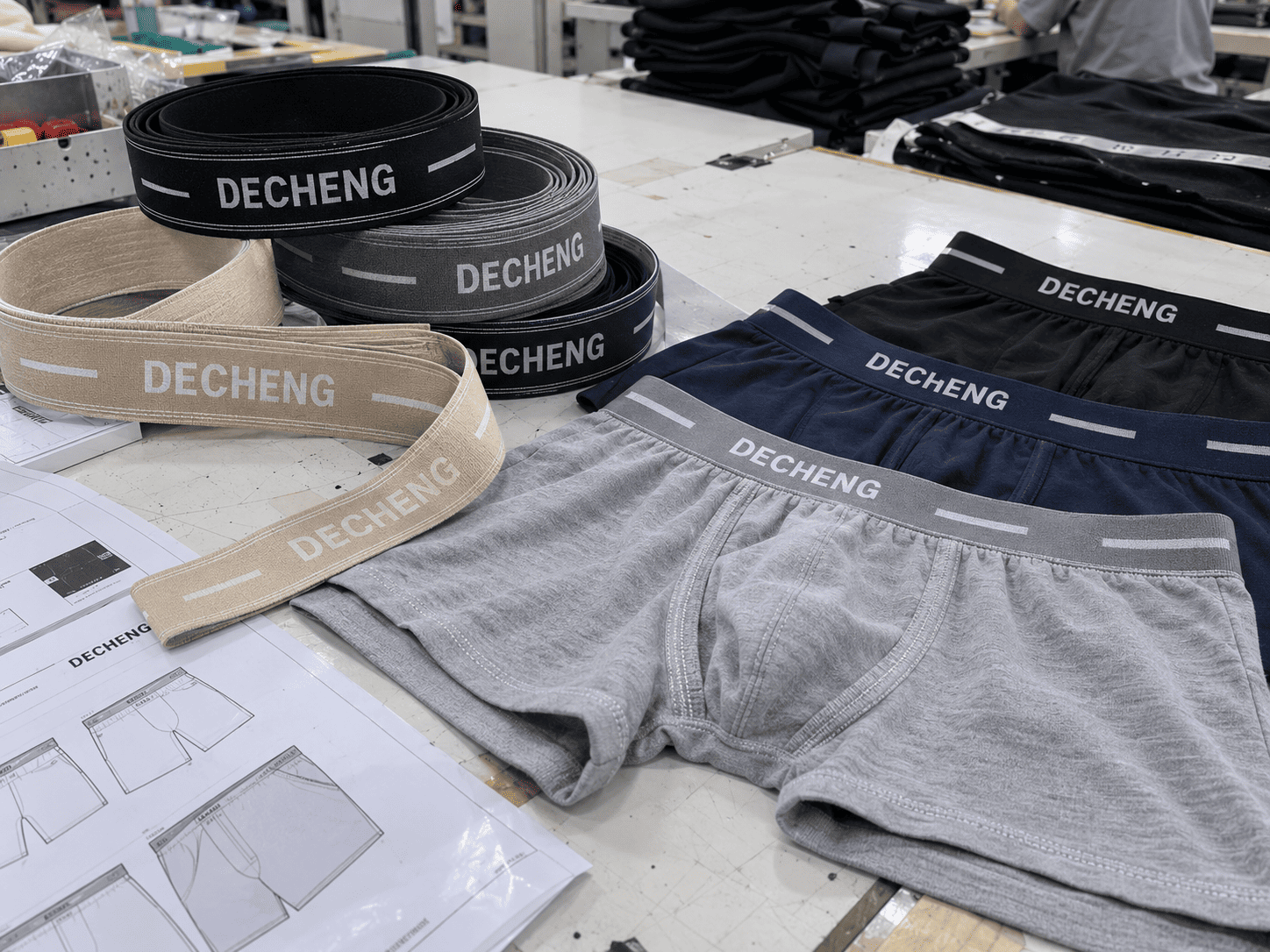
A jacquard waistband is different from a printed waistband.
With jacquard elastic, the design is created through the yarn structure itself.
The brand name becomes part of the elastic.
That means there is no surface logo layer that simply cracks like an ordinary print.
But it also means the elastic mill has to set up your design.
Waistband Options Compared
| Waistband type | Look | MOQ situation | Best for |
|---|---|---|---|
| Custom jacquard elastic | Logo woven into elastic | Separate elastic MOQ | Branded underwear collections |
| Printed elastic | Surface-printed logo | Often easier for smaller programs | Budget or test runs |
| Stock plain elastic | No custom branding | Lowest complexity | Samples and basics |
| Covered elastic | Elastic hidden by body fabric | Depends on garment | Minimal designs |
Our Typical Custom Waistband Minimum
For the custom jacquard waistband programs we normally work with, the supplier minimum is approximately:
200 meters
That can produce roughly 400 boxer briefs, depending on:
- Garment size
- Waistband width
- Waist measurement
- Size ratio
- Cutting allowance
- Production loss
So treat 400 pieces as an approximate planning figure, not an exact conversion.
The elastic supplier may also charge:
- Setup fee
- Artwork development
- Sampling fee
- Special yarn-color fee
That is why a garment factory may accept a relatively small underwear order but still tell you that the waistband has a larger minimum.
What Happens If You Order Less Than the Waistband MOQ?
Suppose you produce:
250 boxer briefs.
But your elastic supplier requires enough waistband for roughly 400 pieces.
You may have elastic left after the first production run.
That does not automatically mean it is wasted.
For repeat customers, we can normally keep usable leftover custom waistband material for future production.
That can make a second order easier because the approved waistband already exists.
But you should confirm storage and future-use arrangements with your manufacturer before the first order.
Approve the Waistband Before Bulk
Do not go directly from an Illustrator logo to 200 meters of elastic.
First approve:
- Logo size
- Logo repeat
- Waistband width
- Background color
- Logo yarn color
- Stretch appearance
- Inside surface
- Edge construction
Then use the approved elastic in a finished underwear sample.
A waistband may look perfect while lying flat but appear distorted when stretched around the body.
That is why you need to approve both conditions.
Which Construction Details Matter Most?
Underwear has very little visual complexity.
That makes construction mistakes easier to feel.
The most important details include pouch shape, seam construction, gusset design, leg opening, waistband comfort, and labeling. These features determine how the garment feels during actual wear.
The pouch is especially important.
A basic flat front panel is simple to produce.
A shaped or contoured pouch requires more pattern development but can create additional space and support.
Construction Details
| Detail | Options | Why it matters |
|---|---|---|
| Pouch | Flat, contoured, fly or no fly | Support and fit |
| Seams | Flatlock, coverstitch, overlock | Changes bulk and skin comfort |
| Gusset | Shaped crotch panel | Helps distribute seams and improve fit |
| Leg opening | Hemmed, bound, elasticated | Controls ride-up |
| Back construction | Center seam or alternative paneling | Seat fit |
| Waistband | Jacquard, printed, covered | Comfort and branding |
| Label | Heat transfer, printed, soft woven | Skin comfort and compliance |
Flat Seams Can Improve Comfort
Bulky seams can become noticeable during long wear.
Flatlock or other low-profile seam constructions can reduce seam bulk in high-friction areas.
But the best seam depends on the pattern and fabric.
Do not specify "flatlock everywhere" simply because it sounds premium.
Look at where the seam sits on the body.
Ask:
- Will it rub?
- Will it stretch?
- Does it need reinforcement?
- Will the stitch recover after stretching?
The construction should solve a fit problem, not just add production cost.
Fit Testing Matters More Than Table Measurements
An underwear sample can match every measurement in your tech pack and still be uncomfortable.
Why?
Because the body moves.
You need to test:
- Waist pressure
- Pouch space
- Leg opening
- Ride-up
- Seat coverage
- Stretch
- Recovery
Ideally, fit testing should include actual wear rather than only checking the garment flat on a table.
Then wash the sample and test it again.
Elastane-containing fabrics need to maintain usable recovery after repeated stretching and laundering.
Shrinkage also matters.
ISO 5077[^4] provides a standardized method for determining dimensional change in textile fabrics and garments after specified washing and drying procedures.
This is particularly useful for close-fitting products.
A small amount of unexpected shrinkage feels much more significant in underwear than in an oversized hoodie.
What About the Inside Label?
Comfort matters here too.
A thick woven label positioned at the center back waist may irritate the wearer.
Many underwear brands therefore use:
- Heat-transfer labels
- Printed labels
- Very soft woven labels
But removing a physical label does not remove your legal labeling obligations.
For products sold in the United States, the FTC Textile Fiber Rule[^5] requires covered textile products to disclose information including fiber content, responsible company identification, and country of processing or manufacture.
Care requirements also apply separately.
The FTC Care Labeling Rule[^5] requires manufacturers and importers of covered textile apparel to provide regular care instructions.
So when designing a "tagless" underwear product, plan where all required information will go before bulk production.
What MOQ, Cost, and Timing Should You Expect?
Underwear minimums work differently from T-shirts or hoodies.
Two things often control the quantity:
- The fabric
- The custom waistband
For the underwear programs we normally work with, a fabric roll may produce roughly 250 boxer briefs per color, while a custom jacquard waistband may have a separate minimum of around 200 meters.
These figures depend on the fabric supplier, fabric width, GSM, garment size ratio, pattern consumption, and elastic supplier.
They are practical production estimates, not universal industry standards.
How the Minimums Stack Up
| Item | Typical planning minimum | What it means |
|---|---|---|
| Fabric per color | One supplier roll | May produce roughly 250 boxer briefs |
| Custom jacquard waistband | Around 200 meters | May cover roughly 400 pieces |
| Custom main label | Supplier-specific MOQ | Can often be shared across products |
| Printed packaging | Separate supplier MOQ | Boxes usually require more setup than bags |
This is why two colors at approximately 250 pieces each can sometimes work naturally as a first production program.
You use:
- One fabric roll for Color A
- One fabric roll for Color B
- One custom waistband development
But every project needs its own consumption calculation.
Do not assume the same numbers apply to every fabric.
What Changes the Unit Price?
The main cost drivers include:
- Fabric type
- Fabric composition
- GSM
- Elastane percentage
- Custom waistband
- Pouch construction
- Flatlock seams
- All-over printing
- Number of colors
- Labels
- Packaging
- Order quantity
Modal or premium microfiber fabrics may cost more than standard cotton-elastane.
A contoured multi-panel pouch adds labor.
Flatlock seams can add sewing time.
Custom jacquard elastic requires separate development.
All-over printing adds another production process.
So a simple solid-color cotton boxer brief and a highly customized printed modal boxer brief should not be expected to have the same price.
Packaging Matters More in Underwear
Underwear is often sold as:
- Single pieces
- 2-packs
- 3-packs
- Gift boxes
- Branded paper bands
Printed retail boxes can dramatically improve presentation.
They also come with:
- Printing setup
- Packaging MOQ
- Added freight volume
- Higher unit cost
Decide the packaging format before final costing.
Otherwise your original garment quotation may look cheap and the finished retail product may not.
For new customers, our bulk terms commonly involve a 50% production deposit and 50% balance before shipment, depending on the project.
Our low MOQ clothing guide explains how fabric and accessory minimums affect total order quantity.
How Do You Choose a Custom Underwear Manufacturer?
Many clothing factories can sew a basic underwear sample.
Fewer understand how fabric, fit, waistband development, stretch, recovery, and labeling fit together.
Choose a manufacturer that explains the waistband MOQ before payment, develops the waistband separately, tests the finished fit, checks shrinkage and recovery, understands labeling requirements, and clearly tells you which specialist processes are handled by partners.
The waistband question is a very good filter.
Ask:
"What is the MOQ for my custom waistband?"
Then ask:
"What happens to any unused elastic?"
A factory that regularly produces branded underwear should understand both questions.
Green Flags and Red Flags
| Green flag | Red flag |
|---|---|
| Explains waistband MOQ and setup clearly | Claims any custom elastic is possible at any quantity |
| Develops waistband before bulk | Goes directly to bulk production |
| Keeps or accounts for usable leftover elastic | Cannot explain excess waistband |
| Discusses pouch and fit construction | Talks only about fabric |
| Tests shrinkage and recovery | No post-wash testing |
| Confirms legal fiber description | Uses vague fiber marketing claims |
| Refuses unauthorized logo copying | Offers to reproduce famous brand waistbands |
Do Not Copy Famous Underwear Waistbands
This category has a lot of imitation branding.
A customer may send a famous elastic waistband and say:
"Make exactly this, but change one letter."
That is not a good development strategy.
Your brand should have its own logo, repeat, font, spacing, and elastic design.
Trademark protection applies to branding used on apparel just as it does elsewhere.
The World Intellectual Property Organization[^6] explains that trademarks identify the goods or services of an enterprise and that registered trademarks generally give owners exclusive rights over the registered mark.
We do not reproduce another company's protected logo or brand name without appropriate authorization.
Compliance Is One Part of Supplier Verification
Factory social-compliance audits can also be useful when brands are evaluating long-term suppliers.
But they should not be confused with underwear quality testing.
A factory can have a social audit and still produce a bad waistband.
So evaluate both sides separately.
For production quality, check:
- Fabric
- Fit
- Waistband
- Seams
- Stretch
- Recovery
- Shrinkage
- Labels
- Packaging
For the wider supplier relationship, also check:
- Factory identity
- Compliance
- Communication
- Production capability
- Final inspection
Our custom clothing manufacturer guide explains how those steps fit together.
Conclusion
Custom boxer briefs may look simple.
They are not.
The fabric needs to feel good against the skin.
The elastane needs to stretch and recover.
The pouch needs to fit correctly.
The leg opening needs to stay in place.
The seams need to avoid unnecessary rubbing.
And the waistband needs to carry your brand without becoming uncomfortable.
For branded underwear, start with the waistband early.
Do not wait until the garment sample is already finished.
Confirm:
What is the waistband MOQ?
What is the width?
How is the logo woven?
What colors are used?
How does it look when stretched?
Then confirm the fabric.
Ask:
What is the official fiber composition?
What is the GSM?
How much does it stretch?
How well does it recover?
How much does it shrink after washing?
And if someone sells you "bamboo underwear," confirm whether the fiber is really bamboo or actually viscose/rayon made from bamboo before you print the label.
Finally, test the finished underwear on a body.
A measurement chart tells you whether the garment is the right size.
Actual wear tells you whether it is comfortable.
For underwear, both matter.
Footnotes & References
[^1]: Grand View Research — Men's Underwear Market Size, Share & Trends Analysis Report. The global men's underwear market was valued at approximately USD 42.9 billion in 2025 and is projected to reach USD 68.9 billion by 2033. Boxer briefs held approximately 33.7% of 2025 revenue, while cotton represented approximately 68.4% of the fabric segment.
https://www.grandviewresearch.com/industry-analysis/mens-underwear-market
[^2]: U.S. Federal Trade Commission — Bamboo Textiles. FTC guidance explains that textiles made from rayon or viscose using bamboo as the cellulose source generally cannot simply be labeled or advertised as "bamboo." Appropriate descriptions include "rayon made from bamboo" or "viscose made from bamboo."
https://www.ftc.gov/bamboo-textiles
[^3]: OEKO-TEX® — STANDARD 100. Official information about the STANDARD 100 certification system for textile products and components tested for harmful substances, with requirements based partly on intended skin contact and product use.
https://www.oeko-tex.com/en/our-standards/oeko-tex-standard-100/
[^4]: International Organization for Standardization — ISO 5077:2007, Textiles — Determination of Dimensional Change in Washing and Drying. Specifies a method for determining dimensional changes in fabrics, garments, and other textile articles after defined washing and drying procedures.
https://www.iso.org/standard/41877.html
[^5]: U.S. Federal Trade Commission — Textile Fiber Rule and Care Labeling Rule. The Textile Fiber Rule requires covered products to disclose generic fiber names and percentages by weight, responsible business identification, and country of manufacture or processing. The Care Labeling Rule separately requires covered apparel to carry appropriate regular-care instructions.
https://www.ftc.gov/legal-library/browse/rules/textile-fiber-rule
https://www.ftc.gov/legal-library/browse/rules/care-labeling-textile-wearing-apparel-certain-piece-goods
[^6]: World Intellectual Property Organization (WIPO) — Trademarks. Official overview of trademarks, their role in identifying goods and services, registration, protection, and rights associated with trademark ownership.
https://www.wipo.int/en/web/trademarks