
Custom Tank Top and Gym Stringer Manufacturer: How Do You Make Tanks That Fit and Hold Their Shape?
Your new gym stringer looks great in the first photoshoot.
The armhole is deep.
The shoulders look wide.
The logo sits perfectly across the back.
Then customers wash it a few times.
The armhole starts to wave.
The neckline no longer sits flat.
One side seam begins moving toward the front.
And the narrow shoulder straps look longer than they did when the garment was new.
A tank top looks simple because there is less fabric.
That is exactly why the problems are easier to see.
A good tank top or gym stringer depends on the relationship between the fabric, pattern, binding, edge tension, stretch and recovery, washing behavior, and fit. Armholes and necklines need to keep their intended shape without puckering, stretching out, or becoming uncomfortable during movement.
Training apparel also serves a large and active customer base.
The Health & Fitness Association's 2025 U.S. Health & Fitness Consumer Report[^1] reported that approximately 77 million Americans were members of fitness facilities in 2024, an industry record.
For a new gym brand, tanks and stringers can be attractive first products because they look relatively simple.
But simple construction does not mean automatic fit.
A sleeveless top leaves the:
- Neckline
- Shoulder
- Armhole
- Side seam
completely exposed.
Those details have nowhere to hide.
Table of Contents
- What Types of Tank Tops and Stringers Can You Make?
- Which Fabrics Work Best for Tanks and Stringers?
- Why Do Armholes and Necklines Decide the Look?
- How Should a Tank Top or Stringer Fit?
- How Should You Brand a Tank Top?
- What MOQ, Cost, and Timing Should You Expect?
- Conclusion
What Types of Tank Tops and Stringers Can You Make?
“Tank top” is a broad product name.
A classic tank, a bodybuilding stringer, and a women's ribbed racerback may all be sleeveless, but their patterns are very different.
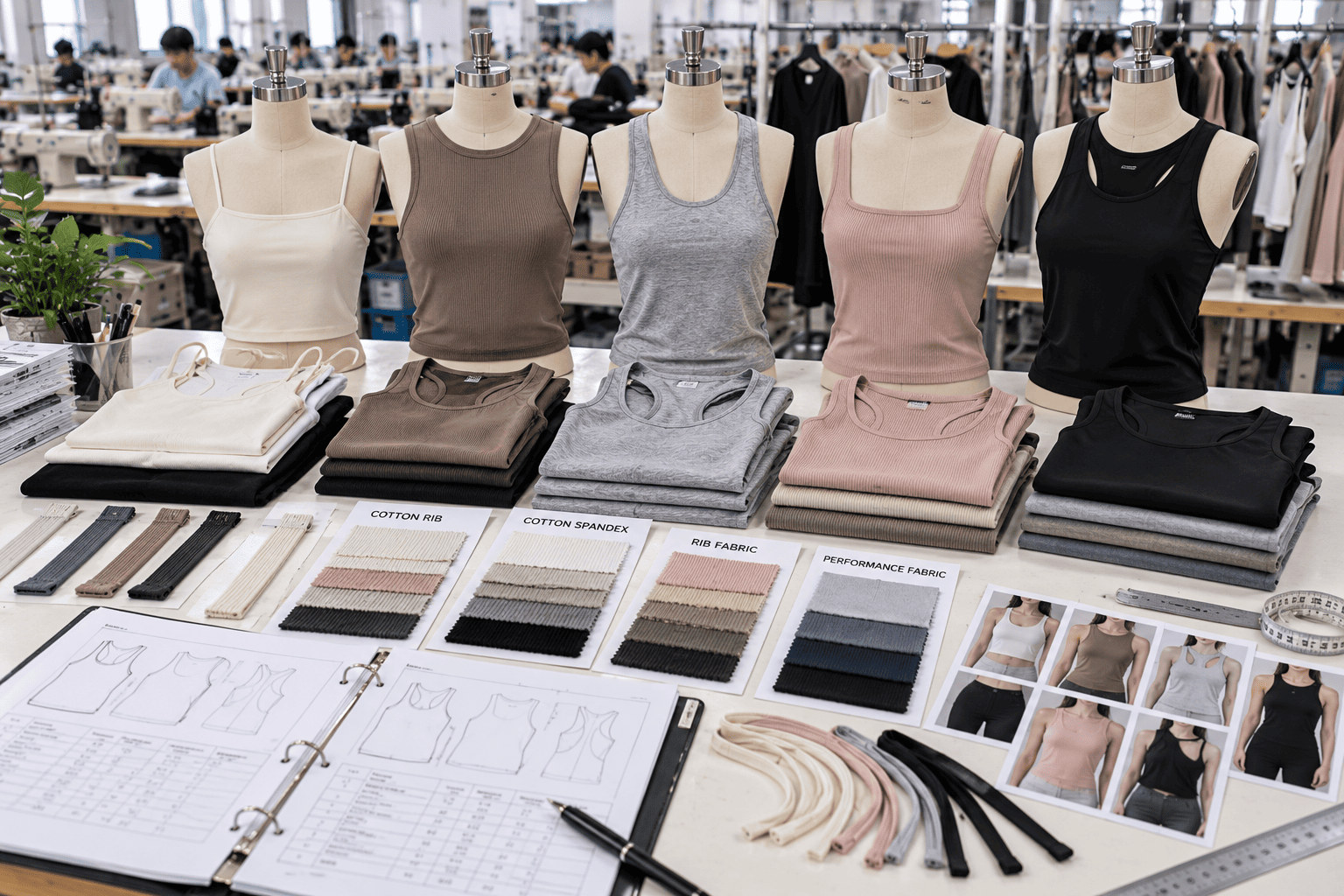
Common tank styles include classic tanks, muscle tanks, deep-armhole stringers, racerbacks, cropped tanks, fitted rib tanks, performance tanks, and oversized streetwear tanks. The biggest differences usually come from shoulder width, strap shape, armhole depth, neckline, body width, and fabric.
Classic Tank
A classic tank usually has:
- Moderate armhole
- Medium shoulder width
- Regular neckline
- Straight or slightly relaxed body
It can work for:
- Gym
- Lifestyle
- Casual basics
Muscle Tank
The muscle tank often looks like a T-shirt with the sleeves removed.
Typical details:
- Wider shoulder
- Deeper armhole
- Relaxed chest
- More casual shape
It can work for:
- Weight training
- Streetwear
- Vintage athletic styling
Gym Stringer
The stringer is more extreme.
Typical characteristics:
- Narrow shoulder straps
- Deep armholes
- More exposed upper back
- Relaxed or fitted body
The armhole is often one of the main design features.
A difference of even a few centimeters can completely change the look.
Racerback
Racerbacks are common in women's training tops.
The back shape may expose more of the:
- Shoulder blades
- Upper back
for both style and movement.
But the shoulder and neckline still need enough stability to remain in position during training.
Ribbed Fitted Tank
This category works well for:
- Women's basics
- Lounge sets
- Lifestyle collections
The fit is often created from:
- Stretch fabric
- Negative ease
- Narrower body pattern
rather than simply making a normal jersey tank smaller.
Cropped Tank
The cropped tank can be:
- Loose
- Fitted
- Ribbed
- Performance
The finished body length should always be specified.
“Crop it a little” is not enough information for a pattern maker.
Oversized Streetwear Tank
Possible features:
- Wide chest
- Deep armhole
- Wide shoulder
- Heavy jersey
- Boxy body
This is different from a bodybuilding stringer.
Both may have deep armholes, but the visual balance is completely different.
Common Tank Styles
| Style | Armhole | Shoulder / strap | Typical direction |
|---|---|---|---|
| Classic tank | Moderate | Medium | Gym / lifestyle |
| Muscle tank | Deeper | Wide | Lifting / streetwear |
| Stringer | Very deep | Narrow | Bodybuilding |
| Racerback | Shaped front and back | Narrower | Women's training |
| Cropped tank | Varies | Varies | Women's lifestyle |
| Rib fitted tank | Controlled | Narrow-medium | Basics / sets |
| Oversized tank | Deep | Wide | Streetwear |
Our core garment production includes knit products such as:
- T-shirts
- Tanks
- Hoodies
- Sweatshirts
- Activewear
so tanks and stringers can be developed within the same cut-and-sew workflow.
Which Fabrics Work Best for Tanks and Stringers?
A tank fabric needs to do more than feel comfortable.
It may be repeatedly:
- Pulled over the head
- Stretched around the armhole
- Sweated in
- Washed
- Dried
Choose tank-top fabric according to the intended silhouette and use. Cotton jersey works well for classic and streetwear tanks, elastane blends can add stretch and recovery, rib knits suit fitted styles, and performance knits can work for training when their actual stretch, recovery, moisture, and drying performance meet the product requirements.
Cotton Jersey
Cotton jersey works naturally for:
- Classic tanks
- Muscle tanks
- Stringers
- Streetwear
Possible weights vary widely.
A lighter jersey may create:
- More drape
- Cooler feel
- Softer appearance
A heavier jersey may create:
- More structure
- Boxier silhouette
- More substantial hand
But heavier does not automatically mean:
better recovery.
A 330 GSM cotton jersey can still stretch out if its:
- Yarn
- Knit construction
- Finishing
do not support good dimensional recovery.
Cotton + Elastane
A small elastane percentage may help create:
- Additional stretch
- Better recovery
for fitted garments.
But do not assume:
5% elastane = perfect recovery.
Performance still depends on:
- Fabric structure
- Elastane quality
- Finishing
- Amount of extension during wear
Rib Knit
Rib is common for:
- Women's tanks
- Fitted basics
- Lounge sets
Its structure naturally allows stretch.
But different ribs can behave very differently.
A:
1×1 rib
and a:
2×2 rib
may have different:
- Appearance
- Stretch
- Recovery
- Width stability
Performance Knits
Polyester- or nylon-based fabrics may be used for:
- Gym tanks
- Running tanks
- Racerbacks
Possible benefits can include:
- Lower weight
- Stretch
- Smooth hand
- Faster drying
depending on the actual textile.
But do not assume:
polyester = quick-dry
or:
nylon = premium recovery.
Those are fabric-specific performance claims.
Measure Elasticity Instead of Guessing
For stretch fabrics, ISO 20932-1:2018[^2] describes strip and loop methods that can be used to measure elasticity and related fabric properties.
ISO reviewed and confirmed the standard in 2024, so it remains current.[^2]
For a fitted tank or racerback, this helps us think about:
- How far the fabric stretches
- How it returns
rather than judging only from hand feel.
GSM Is Not Enough
Two fabrics can both be:
180 GSM polyester/elastane
and behave completely differently.
One may:
- Stretch smoothly
- Recover quickly
- Stay opaque
Another may:
- Grow during wear
- Become transparent
- Curl at the edge
So fabric approval should include actual physical evaluation.
Fabric Choice by Style
| Product | Possible fabric direction | Main checks |
|---|---|---|
| Classic tank | Cotton jersey | Hand, shrinkage |
| Muscle tank | Cotton jersey / heavy jersey | Structure, armhole |
| Stringer | Cotton or cotton-elastane | Recovery, binding |
| Racerback | Stretch knit | Stretch, recovery |
| Performance tank | Polyester / nylon blend | Movement, drying behavior |
| Rib tank | Cotton / modal rib blend | Recovery, dimensional stability |
| Streetwear tank | Heavy cotton jersey | Shape, shrinkage |
Why Do Armholes and Necklines Decide the Look?
On a T-shirt, sleeves cover much of the armhole construction.
On a tank:
the armhole itself becomes the design.
Armhole and neckline quality depends on the edge construction, binding ratio, fabric recovery, sewing tension, pattern shape, and wash behavior. A binding that is too loose can wave; one that is too tight can gather or pucker the body fabric.
Self-Fabric Binding
Self binding uses the garment fabric itself.
Advantages:
- Tonal appearance
- Simple material program
- Soft hand
But the strip width and stretch need to work with the opening.
Rib Binding
Rib binding can create:
- More athletic appearance
- Stronger visual edge
It may offer more recovery than some jersey constructions.
But again:
the actual fabric should be tested.
Folded / Coverstitched Edge
Some lightweight or performance tanks use a folded edge with coverstitch.
This can create a:
- Clean
- Flat
appearance.
But sewing tension needs to be controlled.
If the edge is stretched during sewing, it can become wavy.
Raw Edge
Raw armholes are common in:
- Distressed muscle tanks
- Cut-off streetwear designs
A raw edge may curl after washing and wear.
But how much it curls depends on:
- Knit construction
- Fabric
- Cut direction
- Finishing
So:
“raw edge always rolls naturally”
is too absolute.
Approve the actual washed sample.
Why Does Binding Wave?
Several factors may contribute:
- Binding ratio too long
- Binding stretched incorrectly
- Body opening stretched during sewing
- Stitch tension
- Fabric recovery
- Wash shrinkage
- Operator handling
So the answer is not simply:
use tighter binding.
Too much tension creates another problem.
Binding Ratio Is Fabric-Specific
You may hear rules such as:
binding should be 85% of the opening length.
That can be a useful starting experiment for some fabrics.
But it is not a universal standard.
A stable cotton jersey and a highly elastic rib may need different ratios.
The correct ratio is the one that makes the approved sample sit:
- Flat
- Smooth
- Comfortable
after washing.
Neckline Recovery
A stretched neckline immediately makes a tank look worn out.
Check it after:
- Dressing
- Washing
- Repeated handling
especially when the opening is wide.
Shrinkage Can Distort the Edge
The binding and body fabric may not behave exactly the same after laundering.
That is why wash testing the complete sample matters.
ISO 6330:2021[^3] defines standardized domestic washing and drying procedures for textile testing, including multiple machine and drying procedures.
It can be used together with dimensional-change evaluation when controlled laundering is needed.
Side Seam Twisting Is Not Just a Cutting Problem
The original draft said correct cutting and fabric relaxation help keep side seams straight.
That is true.
But twisting can also come from the actual fabric.
ISO 16322-3:2021[^4] provides procedures for measuring spirality or torque after laundering in woven and knitted garments.
ISO specifically notes that fabrics from circular knitting machines may have inherent nonvertical wale alignment.[^4]
So if a tank side seam twists after washing, possible causes include:
- Fabric torque
- Knitting
- Finishing
- Cutting
- Garment construction
not simply careless sewing.
How Should a Tank Top or Stringer Fit?
A tank does not have many pattern pieces.
That makes each dimension more important.
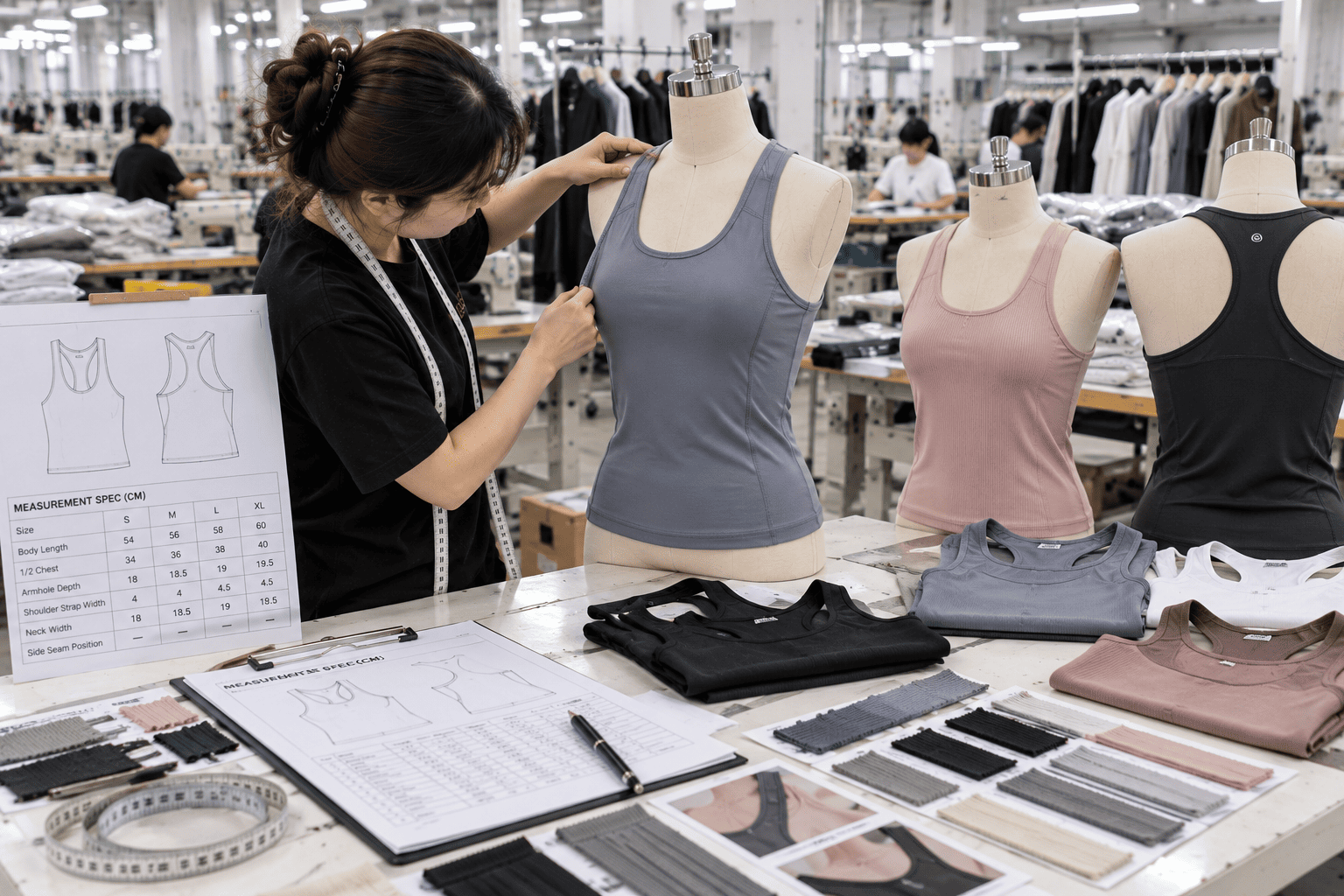
The main fit controls are strap or shoulder width, armhole shape and depth, neckline depth, chest width, body length, hem shape, and—in racerback styles—the shape and width of the back panel.
Armhole Depth
This can define the entire design.
Too shallow:
the stringer begins to look like a normal tank.
Too deep:
the product may expose much more of the torso than intended.
It can also reduce the effective side-seam length.
Do Not Grade the Armhole Blindly
Suppose every size adds:
2 cm armhole depth.
Across several sizes, the largest size may become dramatically more open.
That may not be what the brand wants.
So armhole grading should be reviewed separately from:
- Chest
- Body width
Strap Width
The same applies to shoulder straps.
Do not automatically make them much wider at every size.
For a stringer, the narrow-strap appearance is part of the design.
The goal is to preserve:
design proportion
across the range.
Chest
Decide whether the product is:
- Compression-like
- Fitted
- Regular
- Relaxed
- Oversized
before building the chart.
A stringer can be deep-cut but still have a relaxed chest.
Body Length
Tank length may be:
- Cropped
- Regular
- Longline
Longline does not have a universal measurement.
Put the finished dimension into the size chart.
Hem Shape
Options include:
- Straight
- Curved
- Dropped back
- Side split
For training styles, a curved or longer back can help maintain coverage during movement.
But that is a design choice.
Racerback Shape
For racerbacks, check:
- Strap placement
- Back neck width
- Shoulder-blade exposure
- Movement
The back should look intentional rather than simply cut away.
Fit-Test While Moving
Gym apparel should not be approved only with the model standing still.
Ask the wearer to:
- Raise arms
- Reach overhead
- Row
- Bend
- Rotate shoulders
Then check:
- Strap movement
- Armhole position
- Neckline
- Hem
- Side seam
A gym top has to work while the body moves.
Measure the Product Clearly
Important POMs may include:
- Half chest
- Body length
- Shoulder / strap width
- Front neck drop
- Back neck drop
- Armhole depth
- Bottom width
For unusual stringer shapes, include:
- Technical sketch
- Measurement arrows
rather than expecting the pattern maker to interpret a photo.
How Should You Brand a Tank Top?
A tank offers less surface area than a T-shirt.
But it still gives several strong branding positions.
Branding can include chest prints, upper-back graphics, heat-transfer logos, inside-neck prints, woven hem labels, or large streetwear artwork. Decoration should be selected according to fabric stretch, garment weight, and expected movement.
Chest Print
Works naturally for:
- Muscle tanks
- Classic tanks
- Streetwear tanks
Possible techniques include:
- Screen print
- DTF
- Heat transfer
depending on:
- Artwork
- Fabric
- Quantity
Upper Back Print
This is particularly common on stringers because the back is a major visual area.
But check how the artwork looks when the garment is:
- Flat
- Worn
- Stretched across the back
Neck Print
A printed inside label can reduce the need for a physical neck label.
That may improve comfort for training products.
But the print still needs to survive the intended laundering.
Woven Label
A small woven label can be placed at:
- Side seam
- Hem
for more subtle branding.
Performance-Fabric Decoration
Highly stretchable fabrics need decoration that can work with the actual extension.
A rigid print on a highly elastic panel may:
- Crack
- Limit stretch
- Distort the garment
So test the print on the real fabric.
Do Not Assume Every Heat Transfer Is Stretch-Compatible
“Heat transfer” describes a broad category.
Different materials have different:
- Stretch
- Adhesion
- Heat requirements
The exact transfer needs to be matched to the textile.
Water-Based Printing
Water-based inks may provide a softer hand on suitable fabrics.
But avoid saying:
“water-based always works best on cotton.”
Actual performance depends on:
- Fabric color
- Fiber content
- Pretreatment
- Artwork
- Ink system
Discharge Printing
Discharge printing can create a softer print effect on certain dyed cotton garments.
But it does not work equally well on:
- Every dye
- Every cotton fabric
- Blends
A test is necessary.
Print Size Across the Size Range
If the brand wants the graphic to remain visually proportional from:
S → 4XL
it may choose:
- One physical print size
- Two print sizes
For traditional screen printing, different artwork dimensions generally require additional screens or setup.
But this is a visual and cost decision.
It is not mandatory.
Specialist Decoration
Printing and embroidery can be handled through long-term partner workshops that we coordinate directly.
Before bulk, we confirm:
- Artwork
- Size
- Placement
- Color
- Technique
on the actual fabric or garment.
How Do You Control Washing, Pilling, and Shape?
For tanks, repeated washing often exposes problems quickly because the garment has so many open edges.
Dimensional Change
Check:
- Body length
- Width
- Armhole
- Neckline
before and after the agreed laundering procedure.
Do not assume a fabric is stable because the first sample looks correct.
Spirality
As explained earlier, ISO 16322-3:2021[^4] can be used to evaluate garment spirality or torque after laundering.
This is especially relevant for:
- Cotton jersey tanks
- Longline tanks
because a twisted side seam is easy to see.
Pilling
Gym tops can experience repeated friction from:
- Arms
- Gym equipment
- Backpacks
- Washing
ISO 12945-2:2020[^5] provides the modified Martindale method for evaluating fabric propensity to:
- Pill
- Fuzz
- Matt
under controlled rubbing.
Pilling is not determined by fiber name alone.
It depends on the actual fabric.
Shape Recovery
For fitted tanks, check whether:
- Armholes
- Neck
- Body
return toward the intended dimensions after extension.
That is where elasticity and recovery testing can be useful.
What MOQ, Cost, and Timing Should You Expect?
Tanks normally use less fabric than T-shirts.
But the product still requires:
- Pattern
- Binding
- Sewing
- Decoration
- QC
For our standard tank-top and stringer programs, a practical starting MOQ is usually around 100 pieces per style, depending on fabric, colors, size range, binding, wash, and decoration requirements.
Typical Starting Point
| Product | Typical starting MOQ |
|---|---|
| Tank top | Around 100 pcs |
| Gym stringer | Around 100 pcs |
| Muscle tank | Around 100 pcs |
| Performance tank | Depends on fabric program |
Fabric Minimum Still Matters
Imagine you order:
100 tanks
in:
10 colors.
That is only:
10 garments per color.
Sewing may be possible.
Fabric purchasing may not be.
The actual minimum depends on:
- Stock colors
- Full-roll requirements
- Custom dyeing
- Supplier MOQ
Do Not Assume Small Fabric Quantities Always Cost Double
Sometimes they cost much more per unit.
Sometimes stock fabric can be bought economically.
Quote the real supplier situation rather than publishing a universal multiplier.
Cost Drivers
| Cost factor | Effect |
|---|---|
| Fabric | Main material cost |
| GSM | Changes consumption |
| Elastane | May change fabric price |
| Binding | Adds cutting and sewing |
| Contrast binding | Adds material / handling |
| Flatlock | More specialized construction |
| Longline body | More consumption |
| Curved hem | More sewing |
| Decoration | Print / transfer / embroidery |
| Wash | Adds processing |
Heavyweight Streetwear Tanks
We can develop heavier cotton styles for:
- Streetwear
- Oversized fits
including heavyweight fabric directions.
But custom-knitted fabrics may require:
- Higher fabric MOQ
- Longer lead time
than readily available materials.
Sample Timing
For a standard style using available fabric:
approximately 5–14 days
is a practical sampling range.
Complex:
- Custom fabric
- Garment wash
- Special binding
- Decoration
may require more time.
Bulk Timing
For standard programs:
approximately 20–30 days after final sample approval and deposit
is a practical bulk-production range.
Actual schedule depends on:
- Fabric
- Quantity
- Decoration
- Production capacity
Payment
For new bulk orders, our standard structure is:
50% before production + 50% before shipment.
What Labels Do U.S. Tank Tops Need?
For covered textile products sold in the United States, the FTC Textile Fiber Rule[^6] requires information including:
- Generic fiber names
- Percentages by weight
- Manufacturer or marketer identity
- Country where the product was processed or manufactured
So if your gym stringer is:
95% cotton / 5% elastane
the supported fiber composition should be reflected accurately on the product labeling.
The FTC Care Labeling Rule[^6] also requires covered apparel to carry care instructions supported by a reasonable basis.
That means care instructions should be based on:
- Actual fabric
- Wash testing
rather than simply copying the same wash label onto every tank.
How Do You Choose a Tank Top or Stringer Manufacturer?
Do not ask only:
“Can you make gym tanks?”
Ask how the factory controls the parts most likely to fail.
Ask About the Armhole
Questions:
- What finish do you recommend?
- How will you control binding tension?
- Does the sample stay flat after washing?
Ask About Fabric Recovery
Especially for:
- Racerback
- Fitted tank
- Stringer
ask how the actual material behaves after repeated extension.
Ask About Spirality
For cotton jersey:
Does the side seam move after washing?
If yes, investigate the fabric and garment—not just sewing.
Ask About Grading
The armhole and strap are design features.
Ask:
How does the armhole change from S to XL?
How does the strap width change?
A factory should not blindly add the same amount to every POM.
Ask About Printing
If it is stretch fabric:
- Has this print been tested on the actual textile?
- Does it stretch?
- Does it crack?
- Does the application temperature affect the fabric?
Green Flags and Red Flags
| Green flag | Red flag |
|---|---|
| Checks fabric stretch and recovery | Judges only by GSM |
| Tests binding on actual fabric | Uses one binding rule for everything |
| Wash-tests neckline / armhole | Approves only before wash |
| Reviews spirality | Blames every twisted seam on sewing |
| Controls armhole grading | Armhole gets dramatically deeper each size |
| Fit-tests movement | Checks only hanger fit |
| Tests printing on actual textile | Assumes any transfer works |
| Defines POMs | Copies a generic tank chart |
| Uses actual fabric composition | Uses vague “performance fabric” descriptions |
Conclusion
A tank top has fewer components than a hoodie.
That does not make it easier to get right.
In fact, fewer components mean the details become more visible.
Start with the fabric.
Decide whether the product should be:
- Structured
- Soft
- Fitted
- Oversized
- Stretchy
- Lightweight
Then evaluate:
- GSM
- Stretch
- Recovery
- Dimensional change
- Pilling
not just the fiber content.
Next, develop the armhole and neckline.
The binding needs to work with the body fabric.
Too loose:
the edge waves.
Too tight:
the edge puckers.
There is no universal binding ratio for every jersey.
Test it.
Wash it.
Then approve it.
For cotton jersey, watch the side seam after laundering.
Spirality may come from:
- Fabric torque
- Knitting
- Finishing
- Cutting
- Construction
so do not treat every twisted seam as a simple sewing mistake.
Then fit-test the garment.
A gym stringer should be checked while the wearer:
- Raises the arms
- Bends
- Pulls
- Rotates the shoulders
not only while standing for a product photo.
Control the armhole grade.
Control the strap width.
Keep the intended design proportion across sizes.
Finally, test the decoration.
A print that looks perfect on flat fabric may crack or distort when a training top stretches across the body.
Because a good stringer is not simply a T-shirt with the sleeves removed.
It is a product where:
fabric, binding, pattern, armhole, recovery, movement, washing, and branding
all have to work together.
That is what makes it hold its shape after the photoshoot is over.
Footnotes & References
[^1]: Health & Fitness Association — 2025 U.S. Health & Fitness Consumer Report: Expanded Insights. HFA reported that approximately 77 million Americans were members of U.S. fitness facilities in 2024, a record level for the industry.
https://www.healthandfitness.org/2025-u-s-health-fitness-consumer-report/
[^2]: International Organization for Standardization — ISO 20932-1:2018, Textiles — Determination of the Elasticity of Fabrics — Part 1: Strip Tests. Describes strip and loop test methods that can be used to measure elasticity and related fabric properties. The standard was reviewed and confirmed in 2024 and remains current.
https://www.iso.org/standard/69489.html
[^3]: International Organization for Standardization — ISO 6330:2021, Textiles — Domestic Washing and Drying Procedures for Textile Testing. Specifies standardized domestic washing and drying procedures for textile fabrics, garments, and other textile articles used in textile testing.
https://www.iso.org/standard/75934.html
[^4]: International Organization for Standardization — ISO 16322-3:2021, Textiles — Determination of Spirality After Laundering — Part 3: Woven and Knitted Garments. Specifies procedures for measuring garment spirality or torque after domestic laundering and notes that some circular-knitted fabrics can have inherent nonvertical wale alignment.
https://www.iso.org/standard/78782.html
[^5]: International Organization for Standardization — ISO 12945-2:2020, Textiles — Determination of Fabric Propensity to Surface Pilling, Fuzzing or Matting — Part 2: Modified Martindale Method. Specifies a controlled method for evaluating a textile fabric's tendency to pill, fuzz, or matt under repeated rubbing.
https://www.iso.org/standard/75375.html
[^6]: U.S. Federal Trade Commission — Textile Fiber Rule and Care Labeling Rule. The Textile Fiber Rule requires covered U.S. textile products to disclose generic fiber names and percentages by weight, manufacturer or marketer identity, and country of processing or manufacture. The Care Labeling Rule separately requires covered apparel to carry care instructions supported by an appropriate basis.
https://www.ftc.gov/legal-library/browse/rules/textile-fiber-rule
https://www.ftc.gov/legal-library/browse/rules/care-labeling-textile-wearing-apparel-certain-piece-goods