
Custom Sweatshirt Manufacturer: How Do You Make a Crewneck That Looks Premium?
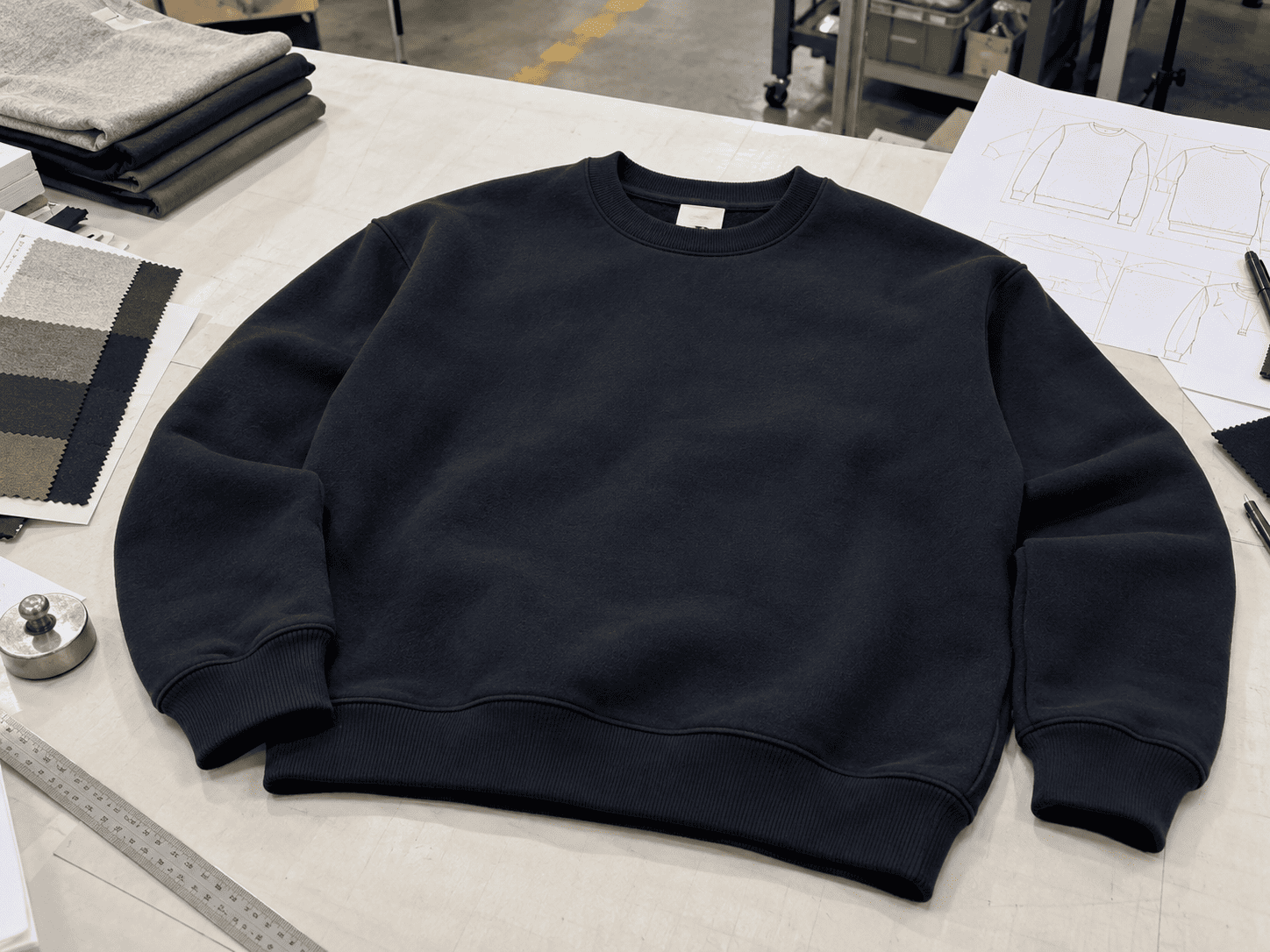
A crewneck sweatshirt has no hood.
No zipper.
Usually no front pocket.
That means there is nowhere for bad construction to hide.
If the collar stretches after two washes, you see it immediately.
If the hem flares outward, the whole silhouette changes.
If the rib and body are two slightly different shades, the customer notices.
A custom sweatshirt manufacturer makes crewnecks and other hoodless sweatshirts according to your fabric, fit, construction, and branding. Because the garment is visually simple, premium quality depends heavily on the rib, fabric, proportions, and how well the sweatshirt keeps its shape after washing.
The category itself is large.
According to Fortune Business Insights[^1], the global hoodies and sweatshirts market was valued at approximately USD 241.11 billion in 2025, is expected to reach about USD 256.08 billion in 2026, and is projected to reach approximately USD 442.64 billion by 2034.
For many clothing brands, the crewneck is one of the simplest products in the range.
It is also one of the products where small quality problems are easiest to see.
Table of Contents
- What Does a Custom Sweatshirt Manufacturer Make?
- Which Construction Details Define a Premium Crewneck?
- Which Fabric and Weight Should You Choose?
- How Do You Control Shrinkage and Shape?
- How Should You Decorate a Crewneck Sweatshirt?
- What MOQ and Cost Should You Expect?
- Conclusion
What Does a Custom Sweatshirt Manufacturer Make?
When most buyers say "sweatshirt," they mean a crewneck.
But the sweatshirt family is wider than that.
A custom sweatshirt manufacturer may produce crewnecks, quarter-zips, half-zips, mock-neck sweatshirts, raglan sweatshirts, cropped crewnecks, and oversized heavyweight styles.
They often share the same basic sweatshirt fabrics.
What changes is:
- Neck construction
- Shoulder construction
- Zipper
- Body proportion
- Sleeve shape
- Rib
- Decoration
Common Sweatshirt Styles
| Style | Main feature | Typical use |
|---|---|---|
| Crewneck | Round ribbed neckline | Streetwear, basics, merch |
| Quarter-zip | Short zipper at neck | Lifestyle, golf, corporate |
| Half-zip | Longer zipper | Outdoor and sport-inspired collections |
| Mock neck | Short stand collar | Minimal and contemporary brands |
| Raglan sweatshirt | Sleeve seam runs toward neckline | Vintage and athletic styling |
| Cropped crewneck | Short body | Fashion and women's collections |
| Oversized crewneck | Wide body, dropped shoulder | Modern streetwear |
A crewneck is often the natural partner to a hoodie collection.
If the two products use the same:
- Fabric
- Dye lot
- Rib
- Wash
- Decoration
the brand can create a matching product family without developing everything from zero.
Is a Crewneck Just a Hoodie Without the Hood?
Not really.
Removing the hood changes the visual balance.
On a hoodie, the customer sees:
- Hood
- Drawcord
- Kangaroo pocket
- Body
- Decoration
On a crewneck, the eye goes almost immediately to:
- Collar
- Shoulder
- Chest
- Cuffs
- Hem
The construction looks simpler.
But that simplicity makes mistakes more obvious.
Quarter-zips and half-zips introduce another variable because a zipper is being attached to a knit garment.
Our zip-up hoodie guide explains the principles of zipper balance, fabric stability, and wash testing in more detail.
Our core production is heavyweight knitwear, so crewnecks normally sit alongside hoodies, sweatpants, T-shirts, and matching sets in the same development program.
Which Construction Details Define a Premium Crewneck?
Two sweatshirts can use the same 380 GSM fabric and still look like completely different products.
The difference is often in the details around the openings.
A premium crewneck normally needs a stable neckline, rib with good recovery, clean cuffs and hem, balanced shoulder construction, and sewing that allows the garment to keep its intended silhouette after wear and washing.
Important Crewneck Construction Details
| Detail | What it is | Why it matters |
|---|---|---|
| Collar rib | Stretch knit around neckline | Keeps neck shape |
| V-insert | Triangular insert below collar | Heritage / athletic styling |
| Cuff rib | Stretch knit at sleeve opening | Controls sleeve shape |
| Hem rib | Rib at body bottom | Controls silhouette |
| Side rib panel | Ribbed side construction | Movement and vintage look |
| Shoulder | Set-in, dropped or raglan | Defines silhouette |
| Neck tape | Covers back-neck seam | Comfort and cleaner finish |
| Flatlock | Flat seam construction | Athletic / vintage appearance |
Why Rib Matters So Much
Rib is usually used at:
- Neck
- Cuffs
- Hem
It needs enough stretch to go over the body comfortably.
But it also needs enough recovery to return to shape afterward.
A weak collar rib may look perfect when the sample first comes off the sewing line.
After wear and washing, it may:
- Stretch
- Ripple
- Curl
- Become too wide
The same thing can happen at the cuffs.
Rib Is Not Always the Same Fabric as the Body
The sweatshirt body may use French terry or brushed fleece.
The neck, cuffs, and hem normally use a separate rib construction.
That means you need to control:
- Color
- Composition
- Stretch
- Recovery
- Weight
- Shrinkage
separately.
A black body with a slightly warmer or lighter black rib can look cheap under daylight.
Always compare the actual rib and body fabric together before approving bulk.
What Is the V-Insert on a Crewneck?
The small triangle below the front collar is usually called a:
V-insert
or sometimes a V-gusset.
It is associated with heritage athletic sweatshirts.
Historically, sweatshirt details like this had practical roots in athletic garments.
Today, brands mostly use the V-insert because it creates a vintage, constructed appearance.
It works especially well on:
- Heavyweight crewnecks
- College-inspired styles
- Vintage washes
- Raglan sweatshirts
- Heritage sportswear
It is a small detail, but on a very simple garment, small details carry a lot of visual weight.
Shoulder Construction Changes the Whole Product
A set-in sleeve gives a cleaner classic shape.
A drop shoulder gives a loose, boxy streetwear silhouette.
A raglan sleeve runs diagonally from the underarm toward the neckline and creates a more athletic or vintage appearance.
Do not ask a factory only for:
"oversized sweatshirt."
Tell them whether you want:
- Set-in
- Drop shoulder
- Raglan
because those are different patterns.
Which Fabric and Weight Should You Choose?
Crewneck fabric follows much of the same logic as hoodie fabric.
But without a hood, the body fabric itself becomes even more visually important.
French terry is a strong choice for a clean, versatile crewneck, while brushed sweatshirt fleece gives a softer, warmer interior. GSM then determines how light, substantial, or structured the finished garment feels.
CottonWorks explains that French terry is technically an un-napped fleece construction, while brushing or napping the interior yarn differentiates fleece from French terry.[^2]
You can see the technical explanation in CottonWorks' Single & Double Knits guide.[^2]
French Terry vs Fleece
| Feature | French terry | Brushed fleece |
|---|---|---|
| Inside | Visible loops / floats | Brushed soft pile |
| Hand feel | Cleaner, drier | Soft, plush |
| Warmth | Moderate | Higher |
| Bulk | Lower | Higher |
| Best use | Year-round / mild climates | Autumn and winter |
| Look | Clean, structured | Cozy, substantial |
CottonWorks specifically notes that French terry works well for sweatshirts and layering products and performs well across seasons because its back is not napped.[^2]
Practical Crewneck GSM Ranges
There is no official rule saying a premium sweatshirt must be a specific GSM.
But practical sourcing ranges often look like this:
| Weight | Character |
|---|---|
| 280–320 GSM | Lighter sweatshirt |
| 320–350 GSM | Substantial everyday crewneck |
| 360–400 GSM | Heavyweight streetwear |
| 400–450 GSM | Very heavy / structured |
| 450 GSM+ | Ultra-heavy statement garment |
For many streetwear customers, the 360–400 GSM range creates the kind of structured look they expect.
But GSM alone does not determine quality.
A poor 400 GSM fabric is still a poor fabric.
You also need to check:
- Yarn
- Knit density
- Composition
- Surface
- Finishing
- Shrinkage
- Pilling
- Hand feel
100% Cotton or Cotton-Polyester?
Both can work.
100% cotton can provide:
- Natural hand feel
- Strong cotton story
- Good garment-wash potential
A cotton/polyester blend may provide:
- Better dimensional stability
- Lower shrinkage in some constructions
- Different hand feel
- Lower cost depending on specification
Neither composition is automatically premium.
The correct choice depends on:
- Target market
- Climate
- Retail position
- Wash treatment
- Fit
- Price
If you are developing a sweatshirt for the U.S. market, the actual fiber composition also needs to match the finished label. The FTC Textile Fiber Rule[^5] requires covered textile products to disclose generic fiber names and percentages by weight.
So if your crewneck is:
85% cotton / 15% polyester
it should not be marketed as 100% cotton.
How Do You Control Shrinkage and Shape?
A crewneck has to look good after washing, not only when it leaves the sample room.
Shrinkage control starts with understanding the fabric before bulk cutting, then testing the finished sample under a defined wash process and comparing its dimensions and appearance before and after laundering.
This is more accurate than saying:
"Pre-shrink the fabric and the problem is solved."
No factory process can magically make every knit garment dimensionally unchanged.
The goal is to understand the movement and control it within an agreed tolerance.
Common Shape Problems
| Problem | Possible cause | What to check |
|---|---|---|
| Body becomes too short | Fabric shrinkage | Pre/post-wash length |
| Hem flares | Rib ratio or recovery problem | Hem rib length and stretch |
| Collar waves | Rib or sewing imbalance | Neck rib recovery |
| Side seams twist | Fabric torque / cutting | Post-wash side seam position |
| Cuffs become loose | Poor rib recovery | Stretch and wash test |
| Body and rib react differently | Different shrinkage | Test complete garment |
| Color changes unevenly | Dye / wash / care issue | Wash and color testing |
Measure Before and After Washing
ISO 5077[^3] specifies a method for determining dimensional change in fabrics, garments, and textile articles after washing and drying.
The current ISO 5077:2007 edition was reviewed and confirmed in 2022 and remains current.[^3]
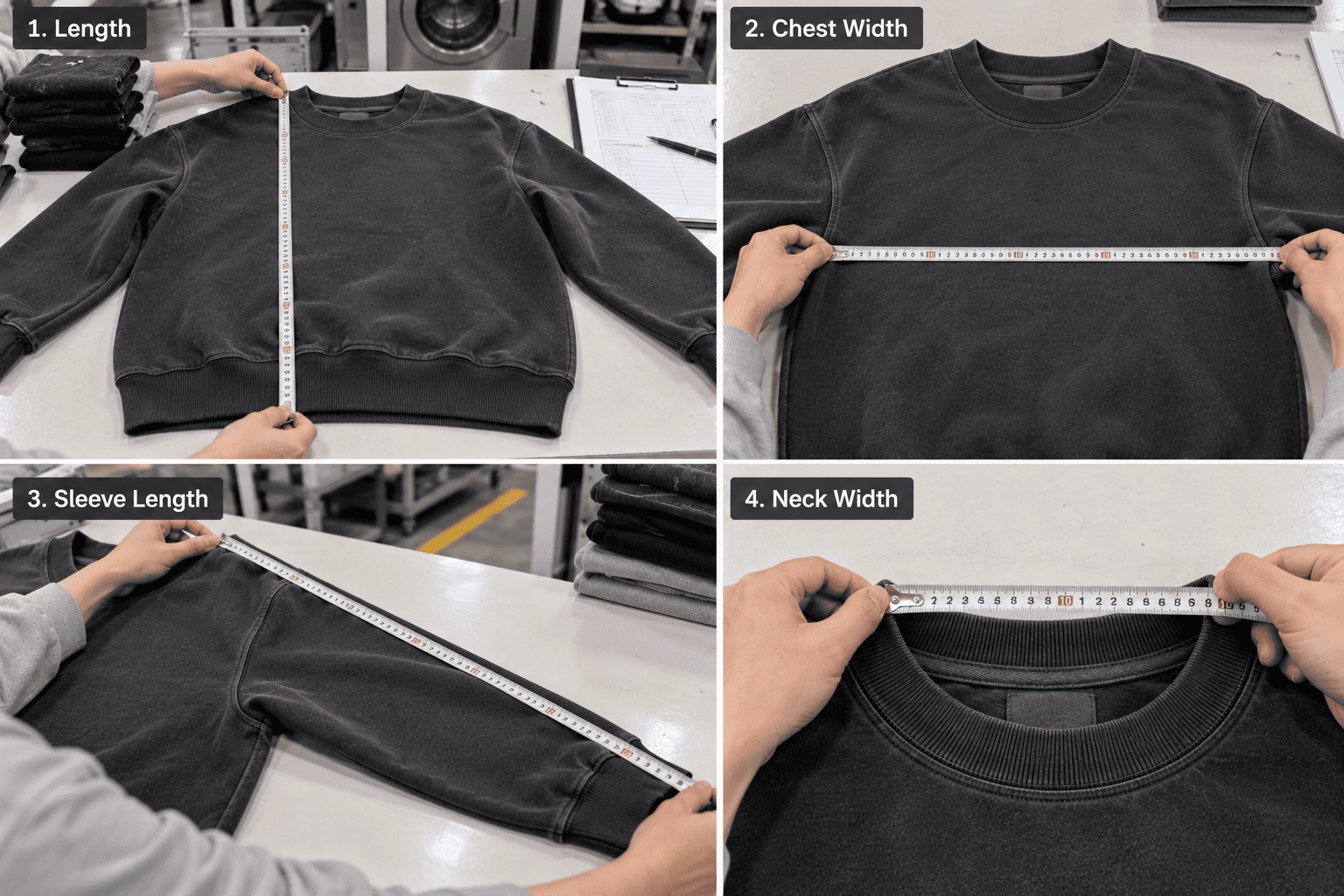
A simple crewneck evaluation might include:
Before washing:
- Body length
- Chest
- Shoulder
- Sleeve length
- Cuff opening
- Hem width
Then wash and dry the garment according to the intended test procedure.
Then measure it again.
Standardize the Wash Test
If one person washes a sample in cold water and air dries it while another washes in hot water and tumble dries it, their shrinkage results cannot be compared fairly.
ISO 6330:2021[^4] defines standardized domestic washing and drying procedures for textile testing.[^4]
It includes different washing procedures and drying methods such as:
- Line dry
- Flat dry
- Tumble dry
This is useful because a meaningful shrinkage number needs a defined test condition.
The Complete Garment Matters
Do not test only the sweatshirt body fabric.
The finished crewneck contains:
- Main fabric
- Collar rib
- Cuffs
- Hem rib
- Embroidery or print
- Labels
- Thread
If the body shrinks 4% and the hem rib behaves differently, the bottom of the garment may flare or pull.
So the final sample should be wash tested as a complete product.
Watch the Hem
The hem rib is one of the quickest places to judge a crewneck.
A good hem should support the intended silhouette.
For a classic sweatshirt, it may pull the body in slightly.
For an oversized boxy style, the designer may want a straighter hem.
The important thing is intention.
If the rib is too long relative to the body opening, the bottom can flare outward.
If it is too short, it may pull the body in too aggressively.
That ratio is part of pattern and construction development.
How Should You Decorate a Crewneck Sweatshirt?
The crewneck gives you one of the cleanest decoration areas in apparel.
There is no zipper splitting the front.
There is usually no kangaroo pocket competing with the artwork.
Crewnecks work well with embroidery, screen printing, puff printing, appliqué, chenille, rhinestones, and other decoration methods depending on fabric and artwork.
Common Crewneck Decoration Options
| Method | Look | Good placement |
|---|---|---|
| Embroidery | Premium, dimensional | Left chest / center chest |
| Screen print | Clean, graphic | Front / back |
| Puff print | Raised texture | Lettering and graphics |
| Chenille | Soft varsity texture | Large chest letters |
| Appliqué | Layered fabric look | College-style graphics |
| Rhinestones | Decorative sparkle | Statement graphics |
| Chain stitch | Vintage / crafted | Logos and lettering |
Heavyweight sweatshirt fabric can be a very good base for decoration because it has more structure.
But every decoration should still be tested on the actual fabric.
Embroidery
Dense embroidery needs:
- Correct backing
- Thread tension
- Stitch density
- Placement control
A thick 400 GSM fleece may support embroidery well.
But too many stitches in a small area can still distort the garment.
Chenille and Appliqué
Crewnecks are especially suited to the varsity look.
Large:
- Letters
- Numbers
- College-style names
can work well with:
- Chenille
- Appliqué
- Embroidery combinations
These decorations usually perform best when the shapes are bold enough to construct cleanly.
Tiny complicated lettering is not ideal.
Screen Printing and Size Scaling
Another issue is graphic size across garment sizes.
If you approve one screen-print size, for example:
30 cm wide
that same physical graphic can normally be used on:
- S
- M
- L
- XL
But visually, it will occupy more of the size S and less of the XL.
If you want the artwork scaled proportionally for every garment size, additional print setups may be required.
For many low-MOQ brands, using one print size is the practical choice.
We Manage Specialist Decoration Separately
We manufacture the garment itself in our factory.
Specialist processes such as:
- Printing
- Embroidery
- Chenille
- Appliqué
- Garment washing
may be handled by long-term specialist partner workshops that we manage directly.
The important point is that the decoration is tested against the actual garment fabric, not just a random swatch.
That way we can evaluate:
- Placement
- Size
- Color
- Distortion
- Wash result
before bulk.
What MOQ and Cost Should You Expect?
A crewneck normally uses fewer materials and sewing operations than a comparable hoodie.
So it can cost less.
Our standard MOQ for custom crewneck sweatshirts can start from 50 pieces per style, depending on the fabric, colors, decoration, wash, and custom trims.
Why a Crewneck Can Cost Less Than a Hoodie
A hoodie normally adds:
- Hood fabric
- Sometimes double-layer hood fabric
- Hood sewing
- Drawcord
- Eyelets
- Kangaroo pocket
A crewneck removes most of those.
That reduces:
- Fabric consumption
- Trims
- Sewing time
But the difference depends on the design.
A complex crewneck with:
- Side rib panels
- Flatlock seams
- Chenille
- Garment wash
- Custom rib
can easily cost more than a basic hoodie.
Main Cost Drivers
| Cost factor | Effect |
|---|---|
| Fabric GSM | Heavier fabric increases cost |
| Fabric composition | Premium cotton may cost more |
| Fit | Oversized patterns use more fabric |
| Rib construction | Custom rib can add development |
| V-insert / side panels | Additional pattern and sewing |
| Quarter-zip | Adds zipper and construction |
| Embroidery / print | Decoration cost |
| Chenille / appliqué | More material and labor |
| Garment wash | Adds processing |
| Color quantity | Affects fabric sourcing |
Why We Need More Than a Logo to Quote
A logo does not tell us:
- Body width
- Body length
- Fabric consumption
- Sleeve construction
- GSM
- Decoration size
- Rib
- Wash
So for a more accurate quotation, send:
- Front mockup
- Back mockup
- Size chart or reference garment
- Fabric preference
- GSM
- Composition
- Decoration size
- Decoration placement
- Quantity
- Color split
The more accurate the specification, the more accurate the quotation.
Colors Affect Low-MOQ Pricing
A 50-piece order in one stock color is very different from:
10 black
10 cream
10 navy
10 brown
10 grey
Fabric suppliers work with:
- Full rolls
- Stock availability
- Dye quantities
- Small-cut pricing
So low MOQ does not always mean unlimited color splits at the same price.
Care Labels Should Be Based on the Finished Product
A sweatshirt with:
- Heavy cotton fleece
- Puff print
- Embroidery
- Garment wash
may require different care from a plain French terry crewneck.
For U.S. apparel, the FTC Care Labeling Rule[^5] requires covered manufacturers and importers to provide regular-care instructions and have a reasonable basis for those instructions.
That is another reason the finished garment should be tested.
Do not simply copy the wash label from another sweatshirt.
How Do You Choose a Custom Sweatshirt Manufacturer?
A crewneck looks simple.
That makes it a good product for judging a factory.
Look at the details.
Green Flags and Red Flags
| Green flag | Red flag |
|---|---|
| Discusses rib stretch and recovery | "Collar no problem" |
| Shows real sweatshirt samples | Only stock photos |
| Checks rib color against body | Ignores shade difference |
| Wash tests finished sample | Checks only unwashed garment |
| Measures shrinkage | No dimensional records |
| Asks for mockups before final quote | Quotes from logo alone |
| Explains which processes are outsourced | Claims everything is in-house without detail |
| Provides relevant audit information | Cannot explain compliance evidence |
Factory Compliance Is Not the Same as Product Quality
Social compliance is one part of supplier evaluation.
Product quality is another.
For example, Sedex's SMETA methodology[^6] is used to assess supplier sites across areas including:
- Labour standards
- Health and safety
and, under a 4-Pillar audit:
- Environment
- Business ethics
Sedex explains that SMETA audits are performed by approved independent Affiliate Audit Companies.[^6]
That can help brands assess working conditions and responsible sourcing.
But it does not tell you whether:
- The collar will stretch
- The rib matches the body
- The hem will flare
- The sweatshirt will shrink 5 cm
Those are product-quality questions.
So evaluate both separately:
Factory / compliance verification
and
Product / quality verification
A strong manufacturer should be comfortable with both.
Conclusion
A premium crewneck sweatshirt looks simple because the construction is controlled.
Not because the product is easy.
There is no hood to distract from a bad neckline.
No zipper to distract from a weak shoulder.
No pocket to hide a poorly balanced body.
So start with the basics.
Choose the fabric.
Choose the GSM.
Choose French terry or fleece.
Define the shoulder.
Define the body shape.
Then pay close attention to the rib.
Check:
- Collar recovery
- Cuffs
- Hem
- Rib color
- Shrinkage
Wash the sample.
Measure it again.
Check whether the hem still sits correctly.
Check whether the collar is still round.
Then approve bulk.
For decoration, take advantage of the clean front.
Embroidery, screen printing, puff print, chenille, and appliqué can all work very well on a heavyweight crewneck when the method matches the fabric and artwork.
A crewneck has fewer components than a hoodie.
That does not make quality less important.
It makes quality easier to see.
Footnotes & References
[^1]: Fortune Business Insights — Hoodies & Sweatshirts Market Size, Share & Industry Analysis. The global hoodies and sweatshirts market was valued at approximately USD 241.11 billion in 2025, is estimated at USD 256.08 billion in 2026, and is projected to reach approximately USD 442.64 billion by 2034, representing a CAGR of around 7.08%.
https://www.fortunebusinessinsights.com/hoodies-and-sweatshirt-market-106230
[^2]: CottonWorks / Cotton Incorporated — Single & Double Knits. Technical textile guidance explaining French terry, 2-end fleece, and 3-end fleece. CottonWorks describes French terry as an un-napped fleece construction and explains how brushing or napping differentiates fleece from French terry.
https://cottonworks.com/learning-hub/knitting/single-and-double-knits/
[^3]: International Organization for Standardization — ISO 5077:2007, Textiles — Determination of Dimensional Change in Washing and Drying. Specifies a method for determining dimensional change in fabrics, garments, and textile articles after defined washing and drying procedures. The standard was reviewed and confirmed in 2022 and remains current.
https://www.iso.org/standard/41877.html
[^4]: International Organization for Standardization — ISO 6330:2021, Textiles — Domestic Washing and Drying Procedures for Textile Testing. Specifies standardized domestic washing and drying procedures for testing textile fabrics, garments, and other textile articles.
https://www.iso.org/standard/75934.html
[^5]: U.S. Federal Trade Commission — Textile Fiber Rule and Care Labeling Rule. The Textile Fiber Rule requires covered textile products to disclose generic fiber names and percentages by weight, business identity, and country of manufacture or processing. The Care Labeling Rule requires covered textile apparel to carry appropriate regular-care instructions supported by a reasonable basis.
https://www.ftc.gov/legal-library/browse/rules/textile-fiber-rule
https://www.ftc.gov/legal-library/browse/rules/care-labeling-textile-wearing-apparel-certain-piece-goods
[^6]: Sedex — SMETA Audit. Official Sedex information on the SMETA social-audit methodology. SMETA assesses labour standards and health and safety, while 4-Pillar audits also cover environmental performance and business ethics. Audits are conducted by Sedex-approved independent Affiliate Audit Companies.
https://www.sedex.com/solutions/smeta-audit/