
Custom Long Sleeve T-Shirt Manufacturer: How Do You Make Long Sleeves That Fit and Feel Premium?
Your short-sleeve T-shirt becomes a bestseller.
So the next step feels obvious:
make a long-sleeve version for autumn.
The first sample arrives.
The body looks right.
But the sleeves cover half the hands.
After washing, the cuffs feel looser.
And the large sleeve print that looked centered on the flat sample twists slightly toward the front when the garment is worn.
That is when you realize:
a long sleeve is not simply a T-shirt with extra fabric added to the arms.
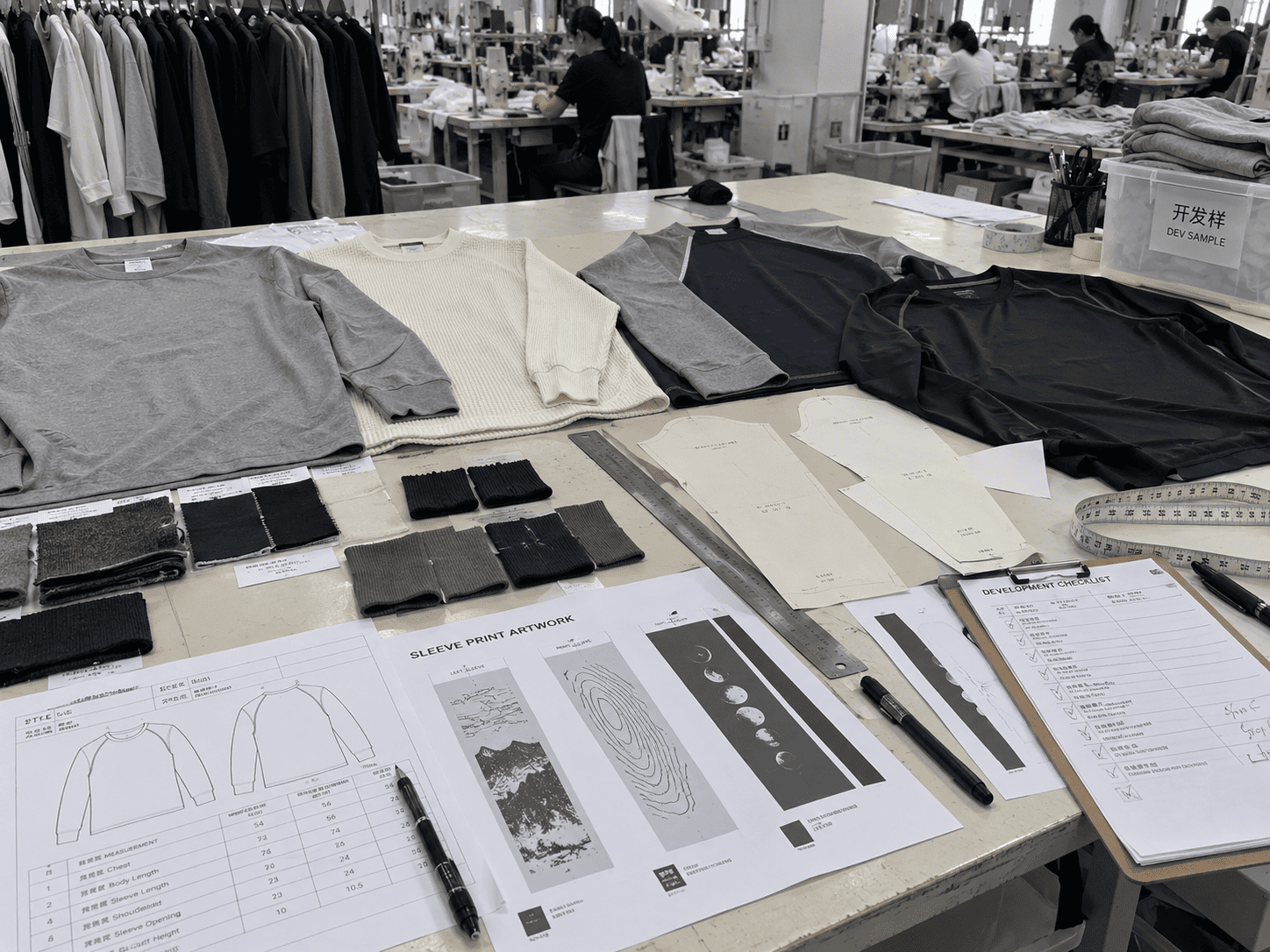
A good custom long sleeve T-shirt depends on the relationship between the body fit, shoulder position, sleeve pattern, cuff construction, fabric behavior, grading, and decoration. Sleeve length must match the shoulder shape, cuffs need suitable recovery, and sleeve graphics should be positioned and tested on the actual garment rather than judged only while flat.
Long sleeves are also a natural extension for brands already selling printed apparel.
According to Future Market Insights' Custom T-Shirt Printing Market report[^1], the global custom T-shirt printing market is estimated at approximately USD 5.1 billion in 2026 and projected to reach around USD 12.4 billion by 2036.
For a brand, the long sleeve creates something the short sleeve cannot:
an entirely new branding area down the arm.
But before adding the artwork, the garment itself needs to fit correctly.
Table of Contents
- What Types of Long Sleeve T-Shirts Can You Make?
- Which Fabrics Work Best for Long Sleeve Tees?
- Why Do Sleeves and Cuffs Make or Break a Long Sleeve?
- How Should a Long Sleeve T-Shirt Fit?
- How Should You Brand a Long Sleeve Tee?
- What MOQ, Cost, and Timing Should You Expect?
- Conclusion
What Types of Long Sleeve T-Shirts Can You Make?
“Long sleeve T-shirt” describes a category, not one pattern.
A heavyweight streetwear long sleeve and a fitted women's rib top may both have long sleeves, but almost every important measurement can be different.
Common long sleeve styles include classic crewneck tees, heavyweight boxy streetwear long sleeves, waffle or thermal tops, raglan baseball tees, mock-neck styles, fitted women's tops, cropped long sleeves, and performance training layers.
Classic Crewneck Long Sleeve
This is the closest relative of a regular T-shirt.
Typical characteristics:
- Set-in sleeve
- Crewneck
- Regular body
- Hemmed or rib cuff
It works for:
- Everyday basics
- Printed merchandise
- Layering
Heavyweight Streetwear Long Sleeve
Typical features may include:
- Heavy cotton jersey
- Dropped shoulder
- Boxy chest
- Wider sleeve
- Rib cuff
- Large sleeve graphics
This style needs careful sleeve development because the shoulder seam sits farther down the arm.
Waffle / Thermal Long Sleeve
Waffle knit adds:
- Texture
- Visual depth
- Different thermal feel
It can work for:
- Lifestyle
- Autumn layering
- Loungewear
But waffle structures can behave differently in:
- Stretch
- Shrinkage
- Recovery
so the actual fabric needs testing.
Raglan Long Sleeve
Instead of a conventional shoulder seam, the sleeve extends toward the neckline.
This is common for:
- Baseball tees
- Retro sportswear
- Training tops
The sleeve measurement method therefore needs to be defined differently from a normal set-in sleeve.
Mock-Neck Long Sleeve
A mock neck changes:
- Neck opening
- Collar height
- Stretch requirements
The collar should stay comfortable while maintaining its intended shape.
Fitted Women's Long Sleeve
Possible materials include:
- Rib
- Cotton/elastane
- Modal blends
The fit may use:
- Stretch
- Negative ease
so recovery becomes especially important.
Performance Long Sleeve
Used for:
- Running
- Gym
- Training
- Layering
Possible features:
- Raglan sleeves
- Thumbholes
- Flat seams
- Stretch knit
But performance should be defined by actual textile properties.
Do not assume that:
polyester/elastane automatically means quick-dry.
Common Styles
| Style | Typical fabric direction | Main development issue |
|---|---|---|
| Classic crewneck | Cotton jersey | Sleeve balance |
| Heavy streetwear | Heavy cotton jersey | Drop shoulder + sleeve length |
| Waffle / thermal | Textured knit | Dimensional behavior |
| Raglan baseball tee | Cotton jersey | Sleeve measurement |
| Mock neck | Jersey / rib | Neck stability |
| Fitted women's | Rib / stretch jersey | Recovery |
| Performance | Stretch knit | Movement / elasticity |
Our garment production is focused strongly on cut-and-sew knitwear, so long sleeve products can be developed alongside:
- T-shirts
- Hoodies
- Sweatshirts
- Activewear
using the same pattern, sampling, cutting, sewing, and QC workflow.
Which Fabrics Work Best for Long Sleeve Tees?
The fabric affects much more than warmth.
It changes:
- Sleeve drape
- Cuff behavior
- Body silhouette
- Print appearance
- Shrinkage
- Stretch
- Recovery
Mid-weight cotton jersey works well for everyday long sleeves, heavier cotton suits structured streetwear, waffle knit adds texture, rib and elastane blends suit fitted styles, and performance knits can work for training when the actual material provides the stretch, recovery, moisture, and drying behavior required by the design.
Mid-Weight Cotton Jersey
A standard cotton jersey works naturally for:
- Classic long sleeves
- Merchandise
- Casual basics
It may have:
- Softer drape
- Easier layering
than a heavyweight streetwear jersey.
Heavyweight Cotton Jersey
For streetwear, heavier cotton can create:
- More structure
- Wider silhouette
- Stronger visual presence
especially with:
- Large chest graphics
- Sleeve printing
Our available heavyweight directions can include fabrics around 330 GSM and other weights depending on the current fabric program.
Heavier weights can also be custom developed where the order volume supports it.
But GSM should not be confused with quality.
A higher number does not automatically mean:
- Better yarn
- Better recovery
- Better durability
Waffle Knit
Waffle fabric can create:
- More texture
- Different drape
- More dimensional surface
But different waffle constructions can behave differently after laundering.
So fit should be approved on the actual fabric.
Rib Knit
Rib can work very well for:
- Fitted women's tops
- Soft basics
- Matching sets
Its natural extension makes the fit more forgiving.
But recovery still depends on:
- Yarn
- Structure
- Elastane where used
- Finishing
Cotton + Elastane
Adding elastane can help create:
- Additional stretch
- Recovery
for close-fitting styles.
But do not write:
5% elastane = good recovery.
The complete fabric construction determines the result.
Performance Knits
Polyester/elastane or nylon/elastane can be useful for:
- Running
- Gym
- Training
Potential characteristics may include:
- Lightweight hand
- Stretch
- Smooth surface
But terms such as:
quick-dry
should be supported by the actual textile performance rather than assumed from fiber composition.
Stretch and Recovery Can Be Measured
For stretch fabrics, ISO 20932-1:2018[^2] provides methods using fabric strips or loops to measure elasticity and related properties.
ISO reviewed and confirmed this standard in 2024, so it remains current.[^2]
For fitted long sleeves, this matters because:
- Sleeve
- Elbow
- Cuff
- Body
are repeatedly extended during wear.
Bamboo / Modal Directions
Regenerated-cellulose fabrics can work for:
- Lounge tops
- Soft fitted styles
- Sleepwear
because they can create a very fluid hand.
But their wash behavior and labeling need to be handled correctly.
Do not describe viscose made from bamboo simply as:
100% bamboo
unless the actual fiber supports that terminology.
Fabric Comparison
| Fabric | Typical character | Good for | Main check |
|---|---|---|---|
| Cotton jersey | Soft / familiar | Everyday long sleeve | Shrinkage |
| Heavy cotton | Structured | Streetwear | Weight + dimensional change |
| Waffle knit | Textured | Lifestyle | Wash behavior |
| Rib | Stretchy | Fitted tops | Recovery |
| Cotton/elastane | Close fitting | Basics | Elastic recovery |
| Performance knit | Light / stretch | Training | Actual performance |
| Modal / viscose blends | Drapey | Lounge | Stability / care |
Why Do Sleeves and Cuffs Make or Break a Long Sleeve?
On a short-sleeve T-shirt, the sleeve is a relatively small part of the garment.
On a long sleeve, it becomes one of the biggest visual areas.
Sleeve quality depends on sleeve length, shoulder position, bicep and forearm width, cuff construction, fabric behavior, and grading. The cuff must work with the fabric rather than simply being added as a standard component.
Sleeve Length Is Not One Universal Measurement
For a set-in sleeve, a brand may measure from:
shoulder seam → cuff edge.
For a raglan sleeve, the measurement may instead begin from:
center back neck
or another agreed reference point.
That is why the method should be defined in the tech pack.
ISO 18890:2018[^3] defines major garment measurement points and standardized methods for garment measurement and allows additional POMs to be agreed between the interested parties.
Dropped Shoulder Changes the Whole Sleeve
This is one of the most common mistakes in oversized development.
Suppose a normal tee has:
Shoulder: 52 cm
Sleeve: 62 cm
Then the brand creates a dropped shoulder:
Shoulder: 62 cm
but keeps the sleeve:
62 cm.
Now the effective arm reach becomes much longer.
The sleeve may cover the hand.
But “Shorten the Sleeve” Is Too Simple
The correct solution depends on the target silhouette.
You need to evaluate:
- Shoulder drop
- Sleeve length
- Bicep width
- Forearm width
- Cuff
- Arm length
together.
For some streetwear designs, slightly stacked sleeves are intentional.
For others, they are a fit mistake.
Rib Cuffs
Rib cuffs are common because they can:
- Gather the sleeve
- Hold the wrist
- Give a sweatshirt-inspired finish
But a rib cuff does not automatically have:
very good recovery.
Actual performance depends on:
- Rib construction
- Yarn
- Elastane
- Length
- Cuff tension
Hemmed Cuffs
A simple folded sleeve hem creates a cleaner T-shirt appearance.
This works well for:
- Classic long sleeves
- Lightweight tees
But the sleeve opening needs to be correctly sized.
Long Rib Cuffs
Long cuffs can create:
- Stacked appearance
- Athletic or streetwear look
They also change total sleeve proportion.
So cuff height should be included as a POM.
Thumbhole Cuffs
Thumbholes are often used in:
- Running
- Training
- Layering tops
Check:
- Opening size
- Thumb comfort
- Wrist tension
- Sleeve length
because a thumbhole effectively controls where the sleeve sits.
Raw Edge
Raw cuffs may suit:
- Distressed
- Vintage
- Washed styles
But edge rolling or fraying depends on the actual fabric and finish.
It should be approved after the intended wash process.
Why Do Cuffs Stretch Out?
Possible causes include:
- Rib with poor recovery
- Incorrect cuff ratio
- Cuff opening too small
- Repeated pushing up the forearm
- Wash behavior
- Fabric growth
So the solution is not automatically:
use tighter rib.
Too much tension can make the cuff uncomfortable.
Wash-Test the Sleeve and Cuff Together
A cotton body and rib cuff may not change by exactly the same percentage after laundering.
That can affect:
- Sleeve length
- Cuff opening
- Seam appearance
ISO 5077:2007[^4] specifies a method for determining dimensional change in fabrics and garments after specified washing and drying procedures.
The standard was reviewed and confirmed in 2022 and remains current.[^4]
How Should a Long Sleeve T-Shirt Fit?
Long sleeves can be:
- Regular
- Boxy
- Oversized
- Fitted
- Raglan
- Athletic
- Cropped
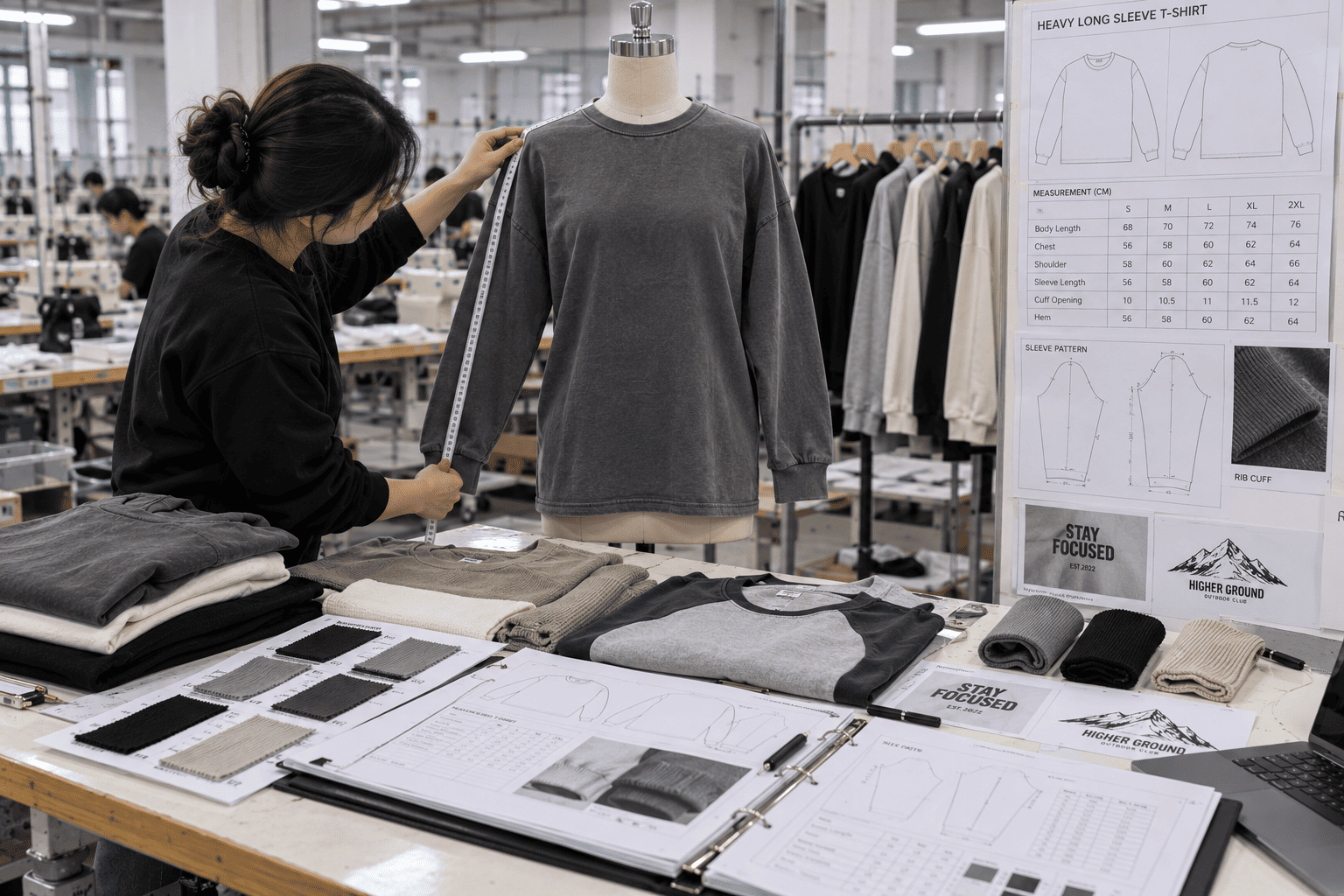
The body and sleeve should be developed together. Shoulder width, chest width, sleeve length, bicep width, cuff opening, body length, and fabric drape should all support the same intended silhouette.
Regular Fit
Typical characteristics:
- Set-in shoulder
- Regular chest
- Straight sleeve
- Hemmed or rib cuff
This works well for:
- Basics
- Merchandise
- Layering
Boxy / Oversized Fit
Possible characteristics:
- Dropped shoulder
- Wide chest
- Wider sleeve
- Shorter or controlled body length
- Rib cuff
The key word is:
controlled.
Oversized should not mean:
“make every measurement bigger.”
Fitted Long Sleeve
Usually depends more on:
- Body shape
- Stretch
- Recovery
- Negative ease
Check movement at:
- Elbow
- Shoulder
- Chest
rather than evaluating only the standing photo.
Raglan
Raglan patterns can give:
- Different shoulder appearance
- Different sleeve movement
They also require a different measurement system.
Athletic Fit
Possible features:
- Closer torso
- Raglan or set-in sleeve
- Thumbholes
- Stretch knit
For training wear, test:
- Arm raise
- Forward reach
- Elbow flexion
Important POMs
Typical points include:
- Half chest
- Body length
- Shoulder
- Sleeve length
- Bicep
- Elbow
- Cuff opening
- Neck width
- Neck rib height
- Bottom width
For raglan styles, define:
- Exact sleeve measurement method
Sleeve Grading
Sleeve length should not automatically increase at the same rate as:
- Chest
- Body width
Different POMs need different grade rules.
For example, chest might grow:
+3 cm half measurement per size
while sleeve grows:
+1 cm.
Those are only examples.
The correct grade depends on:
- Fit
- Customer
- Size system
Extended Sizes Need Review
For wider size ranges:
S–4XL
do not simply continue one mechanical grade forever.
Check:
- Bicep
- Sleeve length
- Cuff
- Shoulder
on strategic larger sizes.
A larger body does not mean every dimension grows at the same rate.
How Should You Brand a Long Sleeve Tee?
This is one of the strongest reasons brands add a long sleeve.
The sleeves become an additional branding surface.
Common branding positions include the chest, back, one or both sleeves, cuff, inside neck, and side hem. Sleeve graphics should be developed around the actual sleeve shape and smallest relevant garment size rather than treated as a flat rectangular print area.
Sleeve Prints
This is the signature look for many streetwear long sleeves.
Possible layouts:
- Logo down one sleeve
- Text down both sleeves
- Repeating graphics
- Small forearm print
- Wrist graphic
Placement Must Be Checked While Worn
A sleeve is cylindrical.
A flat garment is not showing you the final visual orientation.
The print should be checked on-body to make sure it does not rotate:
- Too far forward
- Too far backward
Where Does “Outer Arm” Actually Sit?
The correct position depends on:
- Sleeve pattern
- Shoulder type
- Arm rotation
So rather than writing:
“print on outer sleeve”
include:
- Distance from shoulder / sleeve seam
- Distance from cuff
- Artwork centerline
where practical.
Print Size Across Sizes
Suppose the artwork is:
8 × 45 cm.
It fits XL easily.
But does it fit the S sleeve without moving into:
- Seam allowance
- Cuff area
?
Always check the smallest relevant size.
Does Every Size Need a Different Screen?
No.
That depends on whether the physical artwork dimension changes.
If S–XL all use:
8 × 45 cm
the same screen can generally support that artwork dimension.
If larger sizes use:
10 × 50 cm
that becomes a different print setup.
So avoid the statement:
“every garment size needs its own screen.”
Chest and Back Prints
These work just like on short sleeve tees, but the long sleeves change the overall visual balance.
A very large:
- Chest
- Back
- Both sleeves
graphic can become visually heavy.
That may be intentional for streetwear.
Screen Printing
Screen printing can work very well for:
- Cotton jersey
- Heavy streetwear long sleeves
especially at volume.
But ink system should match:
- Fabric
- Color
- Artwork
- Desired hand
Water-Based Printing
Water-based systems can create a soft hand on suitable fabrics.
But results depend on:
- Fabric
- Color
- Ink system
- Cure process
So do not treat:
water-based = always best for cotton
as a universal rule.
Discharge Printing
Discharge can create a soft result on some dyed cotton garments by altering the garment dye in the printed area.
But it depends heavily on:
- Dye chemistry
- Fabric composition
- Color
Some dyes do not discharge cleanly.
Blends may react differently.
Always test.
Stretch Performance Fabric
For stretch textiles, the decoration should move with the garment.
Options may include:
- Stretch-compatible transfer
- Silicone
- Suitable print systems
depending on the design.
A rigid decoration may:
- Crack
- Restrict extension
- Cause puckering
Embroidery
Small embroidery can work well on:
- Heavy cotton
- Structured fabrics
But dense embroidery on a lightweight tee can cause:
- Puckering
- Stiffness
Again, test the actual garment.
Specialist Processes
Our core garment cutting and sewing is handled through our garment production.
Specialist printing and embroidery can be handled by long-term partner workshops that we manage directly.
Before bulk, we confirm:
- Artwork
- Technique
- Size
- Placement
- Color
on the actual material or sample.
How Do You Keep Long Sleeves Looking Good After Washing?
Long sleeves expose several wash-related issues:
- Body shrinkage
- Sleeve shrinkage
- Cuff behavior
- Pilling
- Twisting
Dimensional Change
Measure:
- Body length
- Sleeve length
- Chest
- Cuff
before and after the agreed laundering process.
The sleeve is particularly important because even a modest length change can be noticeable.
Pattern Compensation
If the fabric changes after washing, pattern compensation should follow the actual test result.
Do not use:
“all cotton shrinks 5%.”
Different fabrics behave differently.
Pilling
Long sleeves experience friction at:
- Underarm
- Elbow
- Side body
- Desk surfaces
ISO 12945-2:2020[^5] specifies a modified Martindale method for evaluating a fabric's propensity to:
- Pill
- Fuzz
- Matt
under controlled rubbing.
Pilling depends on more than fiber name.
It can be influenced by:
- Yarn
- Knit
- Finish
- Friction
- Fiber blend
Care Instructions
For U.S. sales, the FTC Care Labeling Rule[^6] requires manufacturers and importers of covered textile apparel to provide regular care instructions and possess a reasonable basis for them.
So do not copy the same:
machine wash cold / tumble dry low
instruction onto every long sleeve by default.
The care method should work with:
- Fabric
- Rib cuff
- Garment wash
as a finished product.
What MOQ, Cost, and Timing Should You Expect?
A long sleeve generally uses more fabric than the equivalent short-sleeve tee.
It may also add:
- Rib cuffs
- Sleeve printing
- Thumbholes
- More sewing
For our standard custom long sleeve T-shirt programs, a practical starting MOQ is typically around 100 pieces per style, depending on fabric, colors, size range, decoration, and trim requirements.
Typical Starting Point
| Product | Typical starting MOQ |
|---|---|
| Standard long sleeve tee | Around 100 pcs |
| Heavy streetwear long sleeve | Around 100 pcs |
| Waffle long sleeve | Depends on fabric |
| Performance long sleeve | Depends on fabric program |
What Drives Cost?
| Cost factor | Why it matters |
|---|---|
| Fabric | Main raw material |
| GSM | Changes consumption |
| Sleeve length | More material than short sleeve |
| Oversized fit | Higher consumption |
| Rib cuffs | Additional material / sewing |
| Thumbholes | More construction |
| Sleeve print | Additional decoration |
| Wash | Extra processing |
| Colors | Material sourcing complexity |
| Quantity | Production efficiency |
Fabric Weight
A 330 GSM oversized long sleeve uses substantially more material than a lightweight standard tee.
But:
heavy = expensive
is still only part of the story.
Composition and fabric supplier also matter.
Sleeve Prints
A garment with:
- Front print
- Back print
- Left sleeve
- Right sleeve
has more setup and production work than one front logo.
Artwork dimensions and number of colors also matter.
Colors
100 pcs black
and:
25 black
25 cream
25 brown
25 green
do not necessarily cost the same.
Small per-color fabric requirements can change material purchasing.
Do Not Publish “Small Fabric Quantity Costs Double”
Sometimes it may.
Sometimes stock fabric is available at a reasonable cut price.
Use the current supplier quotation.
Sample Timing
For standard programs using available fabrics, sampling commonly falls around:
5–14 days
depending on:
- Fabric
- Fit
- Decoration
- Wash
Bulk Timing
For standard programs, bulk commonly falls around:
20–30 days after final sample approval and deposit.
Custom-knitted fabric, special washes, and complicated decoration can add lead time.
Payment
For new bulk orders, our normal structure is:
50% before production + 50% before shipment.
What Labels Do Long Sleeve T-Shirts Need in the U.S.?
For covered textile garments sold in the United States, the FTC Textile Fiber Rule[^7] requires information including:
- Generic fiber names
- Percentages by weight
- Manufacturer or marketer identity
- Country where the product was processed or manufactured
For example:
100% Cotton
or:
95% Cotton / 5% Spandex
should reflect the actual supported fiber composition.
Fiber labeling and care labeling are separate requirements.
How Do You Choose a Long Sleeve T-Shirt Manufacturer?
Do not ask only:
“Can you make long sleeve T-shirts?”
Ask whether the supplier understands the details that make long sleeves different.
Ask About Sleeve Length
If the shoulder is dropped:
How is sleeve length adjusted?
If the answer is simply:
“same as normal tee”
look more closely.
Ask About Cuffs
Questions:
- What rib do you recommend?
- How is cuff opening controlled?
- How does it behave after washing?
Ask About Grading
Ask:
- How does sleeve length change by size?
- How does bicep width change?
- Does cuff width change?
Ask About Sleeve Printing
Ask:
- How is artwork positioned?
- Will it fit the smallest size?
- Is the same artwork size used across the range?
- Will you approve placement on an actual sample?
Ask About Washing
For cotton long sleeves:
- What happens to sleeve length after wash?
- What happens to the cuff?
- Does the body change differently from the sleeve?
Green Flags and Red Flags
| Green flag | Red flag |
|---|---|
| Adjusts sleeve to shoulder design | Adds a standard sleeve to every body |
| Defines sleeve POM | Gives one vague sleeve number |
| Checks cuff recovery | Assumes all rib is stable |
| Wash-tests actual fabric | Uses one cotton shrinkage assumption |
| Grades sleeve separately from chest | Same increment everywhere |
| Tests sleeve graphics while worn | Approves only on flat garment |
| Confirms print compatibility | Says every cotton takes discharge |
| Checks smallest-size print fit | Artwork runs into seams |
| Separates cut-and-sew from decoration partners | Claims every specialist process is in-house |
Conclusion
A long sleeve T-shirt looks simple because the body can resemble a regular tee.
But the sleeve changes the entire garment.
Start with the fabric.
Choose whether the product should be:
- Soft
- Structured
- Fitted
- Oversized
- Textured
- Performance-oriented
Then test the actual fabric for the properties that matter.
For stretch garments:
check elasticity and recovery.
For cotton:
check dimensional change.
For everyday wear:
consider pilling performance.
Then develop the sleeve together with the shoulder.
If the shoulder drops farther down the arm, the sleeve cannot simply keep the same dimensions as a regular T-shirt.
Control:
- Shoulder
- Sleeve length
- Bicep
- Forearm
- Cuff
as one system.
Then develop the cuff.
Rib does not automatically mean good recovery.
The actual rib needs to match:
- Sleeve opening
- Fabric
- Fit
Then grade carefully.
Chest width and sleeve length do not need to grow by the same amount.
For wider size ranges, review strategic larger sizes instead of relying only on mechanical grading.
Finally, use the sleeve as a branding area—but treat it as part of a three-dimensional garment.
A sleeve print should be checked:
- Flat
- Worn
- On the smallest relevant size
before bulk.
And select the decoration according to the actual material.
Water-based ink.
Discharge.
Screen print.
Heat transfer.
Embroidery.
None of them is automatically the best solution for every long sleeve.
Because a premium long sleeve is not simply:
a T-shirt with longer arms.
It is a garment where:
fabric, shoulder, sleeve, cuff, grading, washing, and decoration
all need to remain balanced.
That is what makes it look intentional rather than stretched from a short-sleeve pattern.
Footnotes & References
[^1]: Future Market Insights — Custom T-Shirt Printing Market. FMI estimates the global custom T-shirt printing market at approximately USD 5.1 billion in 2026 and projects it to reach approximately USD 12.4 billion by 2036, representing an estimated CAGR of 9.3% over the forecast period.
https://www.futuremarketinsights.com/reports/custom-t-shirt-printing-market
[^2]: International Organization for Standardization — ISO 20932-1:2018, Textiles — Determination of the Elasticity of Fabrics — Part 1: Strip Tests. Describes test methods using straight fabric strips or loops to measure elasticity and related properties. ISO reviewed and confirmed the standard in 2024, so it remains current.
https://www.iso.org/standard/69489.html
[^3]: International Organization for Standardization — ISO 18890:2018, Clothing — Standard Method of Garment Measurement. Defines major garment measurement points and standardized methods for garment measurement, while allowing additional measurement points to be agreed between interested parties. The standard was reviewed and confirmed in 2024 and remains current.
https://www.iso.org/standard/63693.html
[^4]: International Organization for Standardization — ISO 5077:2007, Textiles — Determination of Dimensional Change in Washing and Drying. Specifies a method for determining dimensional change in fabrics, garments, and other textile articles after specified washing and drying procedures. The standard was reviewed and confirmed in 2022 and remains current.
https://www.iso.org/standard/41877.html
[^5]: International Organization for Standardization — ISO 12945-2:2020, Textiles — Determination of Fabric Propensity to Surface Pilling, Fuzzing or Matting — Part 2: Modified Martindale Method. Specifies a method for evaluating resistance to pilling, fuzzing, and matting under controlled rubbing.
https://www.iso.org/standard/75375.html
[^6]: U.S. Federal Trade Commission — Care Labeling Rule, 16 CFR Part 423. Requires manufacturers and importers of covered textile apparel to provide regular-care instructions and to have a reasonable basis for those instructions before sale.
https://www.ftc.gov/legal-library/browse/rules/care-labeling-textile-wearing-apparel-certain-piece-goods
[^7]: U.S. Federal Trade Commission — Textile Fiber Rule, 16 CFR Part 303. Requires covered textile products sold in the United States to disclose generic fiber names and percentages by weight, manufacturer or marketer identity, and the country where the product was processed or manufactured.
https://www.ftc.gov/legal-library/browse/rules/textile-fiber-rule