Many startup brands want custom hoodies but do not want to order 500 or 1,000 pieces before testing the market. I understand that concern. Inventory ties up cash, and a new design may not sell as expected. The good news is that small-batch hoodie production is possible if the product specifications stay realistic.
Yes, you can order small batch custom hoodies from some China clothing factories. A practical starting MOQ is often around 50–100 pieces per style, depending on fabric, colors, size range, printing, embroidery, trims, and packaging. Stock fabrics and standard accessories usually make small orders easier, while custom-dyed fabrics and special hardware can increase the minimum.
In my own work, I often see buyers assume the sewing quantity is the only limit. In reality, fabric suppliers, printing factories, embroidery suppliers, label makers, and trim suppliers all have their own minimums. A 50-piece hoodie order can work well, but the whole supply chain needs to support it.
Table of Contents
- Is 50 Pieces a Realistic MOQ for Custom Hoodies?
- Why Do Some China Clothing Factories Accept Small Orders?
- What Affects the MOQ for Custom Hoodies?
- How Does Fabric Choice Affect Small Batch Production?
- Can I Order Several Colors in a Small Hoodie Order?
- How Many Sizes Can I Include in a Small Batch?
- Can Small Batch Hoodies Include Printing and Embroidery?
- Can I Customize Labels, Tags, and Packaging?
- Why Are Small Batch Hoodies More Expensive Per Piece?
- How Much Does a Custom Hoodie Sample Usually Cost?
- How Long Does Small Batch Hoodie Production Take?
- What Hoodie Specifications Work Best for Small Orders?
- Should Startup Brands Begin with 50 or 100 Hoodies?
- How Can Buyers Reduce MOQ and Cost?
- What Should I Send to a Hoodie Manufacturer Before Ordering?
- Conclusion
- Footnotes & References
Is 50 Pieces a Realistic MOQ for Custom Hoodies?
For some factories, yes. For others, 50 pieces is too small. The answer depends on the type of manufacturer and how the hoodie is made.
A 50-piece MOQ can be realistic for custom hoodies when the factory specializes in flexible small-batch production and can use available fabrics, standard ribs, standard zippers, and common decoration methods. If the hoodie requires custom fabric, several colors, special washing, custom hardware, or many sizes, the factory may require 100 pieces or more.
MOQ simply means the minimum quantity a supplier is willing or economically able to produce under a particular set of conditions. Shopify's explanation of minimum order quantity and inventory management[^1] also points out that suppliers use MOQs because very small orders may not justify the resources and costs required to fulfill them.
For a relatively simple hoodie, 50 pieces can work.
For example:
- One fabric
- One color
- Four sizes
- One chest embroidery
- One back print
- Standard labels
- Standard polybag
That is much easier than 50 pieces divided across many variations.
A Small Order Is Easier When It Stays Simple
Compare these two projects:
| Order | Details | Difficulty |
|---|---|---|
| Order A | 50 black hoodies, 4 sizes, one logo | Low |
| Order B | 50 hoodies, 5 colors, 7 sizes, custom dye, special zipper | High |
Both orders contain 50 garments.
But the production structure is completely different.
This is why I always ask for the full product details before confirming MOQ.
Why Do Some China Clothing Factories Accept Small Orders?
Not every factory is built for the same customer.
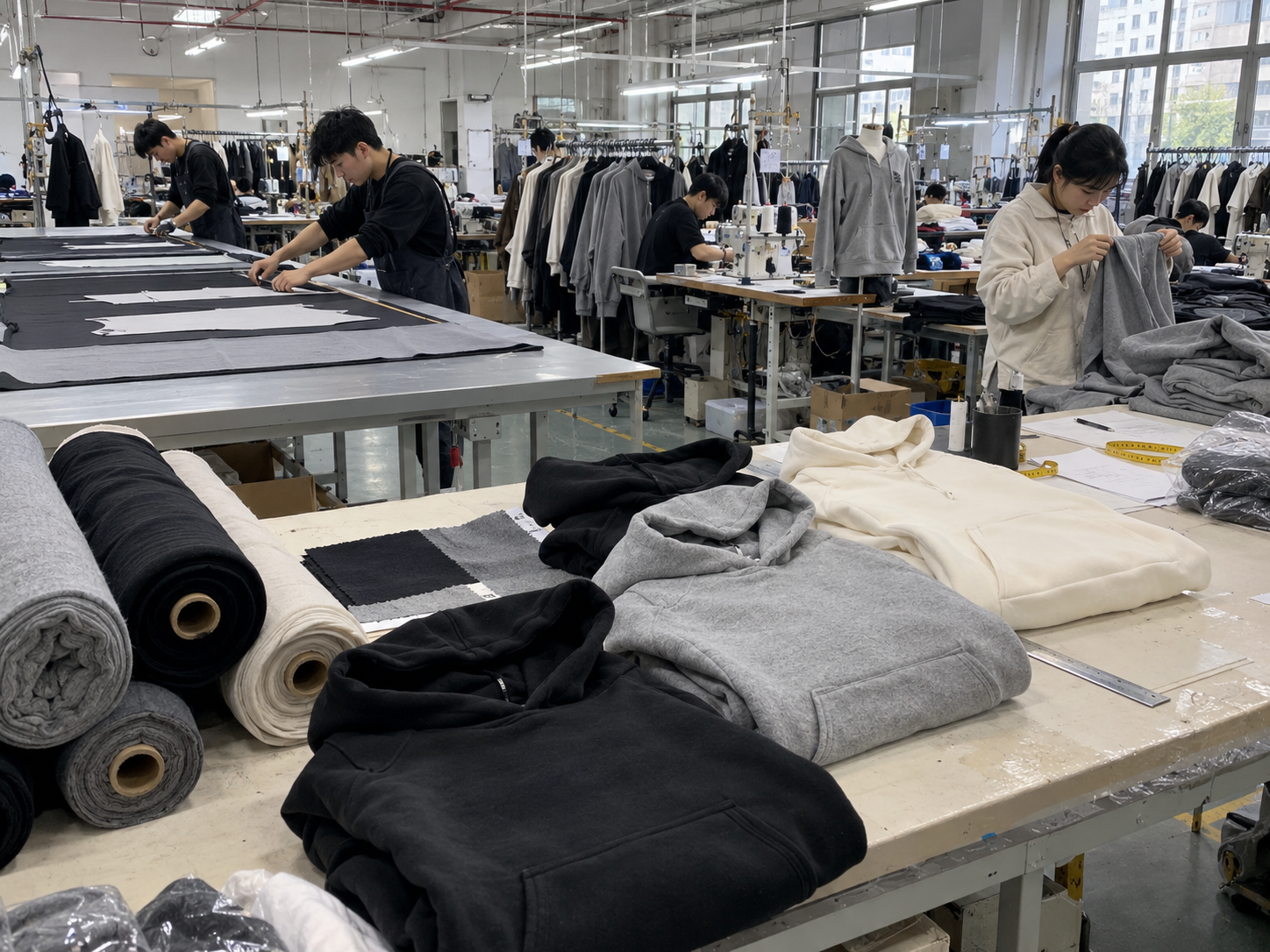
Some China clothing factories accept small batch orders because their production system is designed for flexible OEM and ODM work. They may have smaller production lines, strong local fabric sourcing, experienced sample rooms, and suppliers that support short runs. Larger mass-production factories usually prefer higher MOQs because frequent style changes reduce efficiency.
A factory producing 100,000 basic T-shirts per month may not want a 50-piece custom hoodie project.
A flexible custom garment factory may be much more comfortable with it.
Small Batch Manufacturing Needs a Different Production System
Small orders usually require:
- Flexible cutting
- Flexible sewing lines
- Fast style changes
- Small fabric purchases
- Close production tracking
- More communication per garment
The factory needs to be organized for this kind of work.
That is why buyers should not only ask:
Are you a factory?
They should also ask:
Do you regularly produce small custom orders?
That question tells me much more.
What Affects the MOQ for Custom Hoodies?
Hoodie MOQ is not decided by one factor.
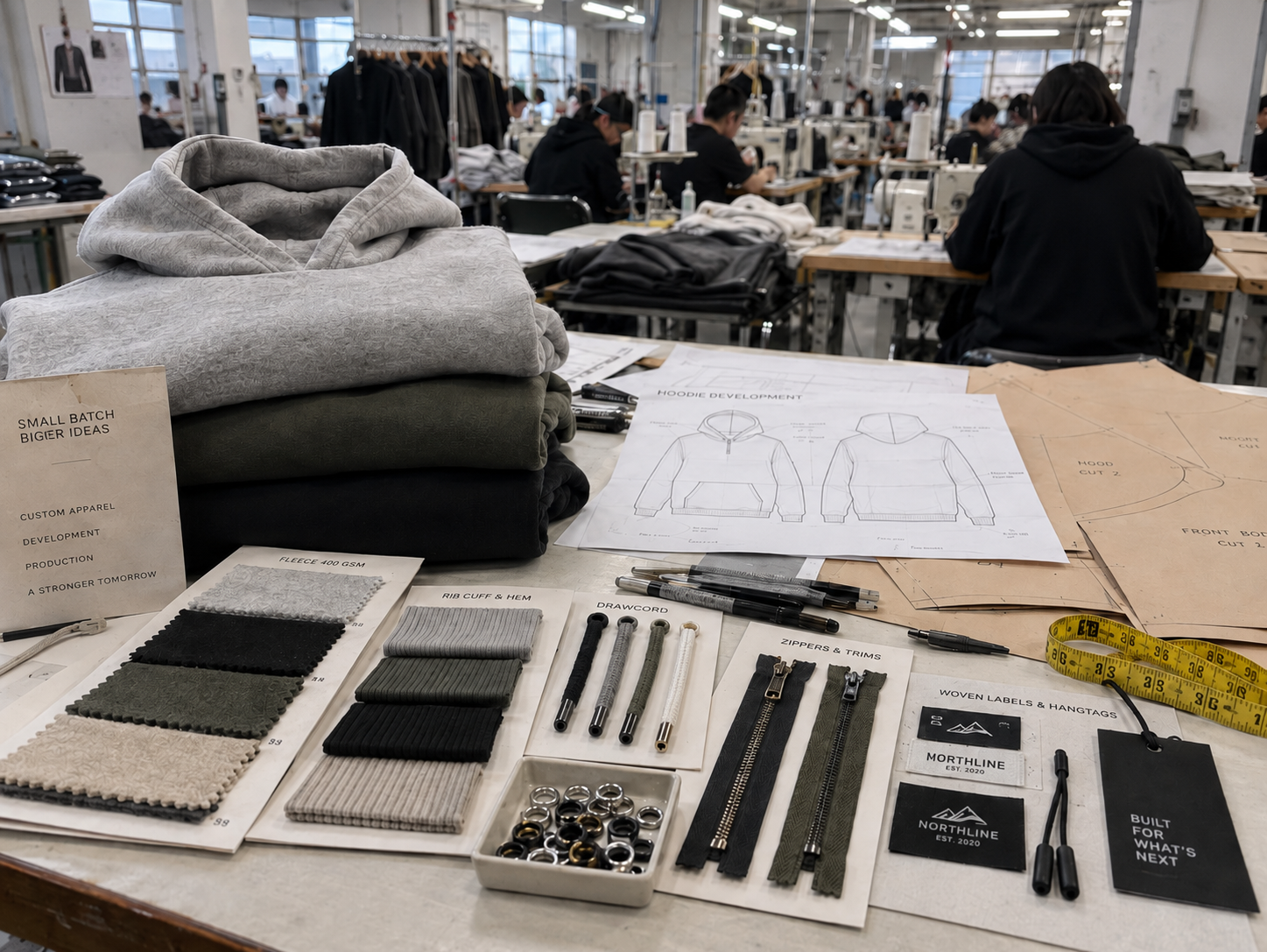
The main factors that affect custom hoodie MOQ are fabric availability, fabric color, GSM, size range, decoration method, washing process, zipper or hardware requirements, labels, packaging, and total order complexity. Stock materials usually support lower MOQs, while custom-developed components normally increase the minimum quantity.
The biggest factors are usually:
| Factor | MOQ Impact |
|---|---|
| Stock fabric | Low |
| Standard black/grey color | Low |
| Custom Pantone dye | Medium to high |
| 4-size range | Low |
| 7–8 sizes | Medium |
| Standard embroidery | Low |
| Screen print | Low to medium |
| Custom zipper pull | Medium to high |
| Special garment wash | Medium |
| Custom packaging | Separate MOQ |
The final MOQ comes from the combination.
How Does Fabric Choice Affect Small Batch Production?
Fabric is often the first thing I check when a buyer asks for 50 hoodies.
Stock fabric makes small-batch hoodie production much easier because the factory can buy only the amount needed. Custom-knitted or custom-dyed fabric usually requires a larger minimum because fabric mills have their own production quantities. Buyers who want a low MOQ should consider existing colors and available GSM options first.
Stock Fabric Is the Best Friend of Low MOQ
If a supplier already has:
- 320 GSM French terry
- 400 GSM fleece
- 500 GSM heavyweight fleece
- Black
- Grey
- Navy
- Brown
I may only need to purchase enough fabric for the order.
That is much easier.
Custom Fabric Changes Everything
Now imagine the buyer wants:
470 GSM, 100% cotton, custom loop structure, custom Pantone olive green.
The mill may need to:
- Source yarn
- Knit the fabric
- Dye it
- Finish it
- Test shrinkage
- Deliver it to the factory
A fabric mill normally will not do this for enough material to make only a few hoodies.
That is why small garment MOQ and custom fabric do not always work well together.
Can I Order Several Colors in a Small Hoodie Order?
Yes, but more colors usually make the order harder.
Small batch hoodie orders can include multiple colors, but each color reduces the quantity per fabric lot. A 100-piece order in two colors is usually easier than a 50-piece order in five colors. If custom dyeing is required, each color may also have its own minimum fabric quantity.
For example:
100 hoodies can be divided:
- 50 black
- 50 grey
This is usually manageable.
But 50 hoodies divided into:
- 10 black
- 10 grey
- 10 brown
- 10 green
- 10 navy
creates much more production work.
Color Changes Affect More Than Fabric
Each color may require separate:
- Fabric preparation
- Cutting
- Thread matching
- Rib matching
- Print colors
- Labels
- Production tracking
That is why I normally recommend fewer colors for the first small order.
If a buyer needs a specific custom shade, I prefer receiving an actual textile color reference rather than a screenshot from a phone. Pantone's official Fashion, Home + Interiors system[^2] specifies TCX references for soft surfaces such as textiles and apparel.
That gives the fabric supplier a much clearer target.
How Many Sizes Can I Include in a Small Batch?
Most small batch orders can include several sizes, but the size range should make sense for the total quantity.
A small custom hoodie order can usually include around four common sizes without creating too much production difficulty. If buyers want five, six, or more sizes, increasing the total order quantity is often more practical because each size needs enough units for efficient cutting and production.
For example, 50 hoodies might be divided like this:
| Size | Quantity |
|---|---|
| S | 8 |
| M | 14 |
| L | 16 |
| XL | 12 |
| Total | 50 |
This is manageable.
Now imagine 50 pieces across eight sizes.
Some sizes may have only two or three pieces.
At that point, production becomes much closer to sample-room work.
Size Distribution Matters More Than Equal Quantity
You do not always need the same number in every size.
A brand can use expected sales data.
For example, if M and L sell best, order more of those sizes.
That is usually smarter than forcing an equal split.
Can Small Batch Hoodies Include Printing and Embroidery?
Yes. Small orders can still include strong branding.
Small batch custom hoodies can include screen printing, DTG, DTF, embroidery, puff print, appliqué, and other decoration methods. Simple embroidery and digital methods are usually easier for low quantities, while multi-color screen printing, appliqué, chenille, silicone, and special effects may create additional setup charges.
Simple Decoration Is Easier
For a first order, these can work well:
- Small chest embroidery
- One-color screen print
- DTF back graphic
- DTG artwork
- Simple puff print
Complex Decoration Is Still Possible
A small order can also include:
- Large appliqué
- Chenille embroidery
- Sleeve embroidery
- Puff print
- Multiple logo positions
But the sample and unit cost will increase.
Setup Cost Does Not Disappear Because Quantity Is Small
If a print screen costs money to prepare, that setup still exists whether I make 50 pieces or 500.
The difference is how many garments share the cost.
This is one reason small runs have higher unit prices.
Can I Customize Labels, Tags, and Packaging?
Yes, but these items often have their own supplier minimums.
Small batch hoodies can include custom woven labels, size labels, care labels, hangtags, polybags, zipper bags, and other private label packaging. However, accessory suppliers may require quantities larger than the hoodie order, so buyers may need to purchase extra labels or tags and keep them for future production.
For example:
You order 50 hoodies.
The woven label supplier may require 100 labels.
The hangtag supplier may require 500 pieces.
This does not mean you need to order 500 hoodies.
The extra accessories can often be stored.
Custom Boxes Need More Care
Custom rigid boxes can become expensive at low quantities.
For a startup, I often prefer:
- Branded polybags
- Matte zipper bags
- Stickers
- Hangtags
These create branding without making packaging cost too high.
Labels Also Depend on the Target Market
If the hoodies will be sold in the United States, some label information is not only a branding choice.
The U.S. Federal Trade Commission's Textile Fiber Rule[^3] requires covered textile products to disclose information including fiber content, the responsible manufacturer or marketer, and country of origin.
The FTC's Care Labeling Rule[^4] also requires manufacturers and importers of covered apparel to provide appropriate care instructions.
For this reason, I prefer knowing the target market before final care labels are produced.
Why Are Small Batch Hoodies More Expensive Per Piece?
This is one of the first things startup brands notice.
Small batch hoodies cost more per piece because fixed costs such as pattern making, cutting setup, print setup, embroidery programming, quality control, and production-line preparation are divided across fewer garments. Small fabric and trim purchases also receive less favorable pricing than larger bulk orders.
Imagine a setup cost of $100.
At 50 pieces:
$100 ÷ 50 = $2 per garment
At 500 pieces:
$100 ÷ 500 = $0.20 per garment
The setup work did not change.
The volume did.
Small Quantity, High Customization, and Low Price Rarely Come Together
Buyers often want:
- Low MOQ
- Full customization
- Low unit price
Usually, they can optimize two of those more easily than all three.
If the quantity is low and customization is high, the unit price will normally rise.
That is not unusual.
It is simply how the cost structure works.
How Much Does a Custom Hoodie Sample Usually Cost?
Before bulk production, I strongly recommend making a sample.
A custom hoodie sample from China often costs around $80–$180, depending on fabric, GSM, decoration, washing, zippers, trims, and construction. Simple styles can be lower, while heavyweight streetwear hoodies with appliqué, embroidery, custom wash, or special hardware can cost $150–$300 or more.
Sample cost is not the same as bulk price.
The sample may include:
- Pattern development
- Fabric sourcing
- Print setup
- Embroidery setup
- Sewing
- Quality control
All of those costs are concentrated into one garment.
Do Not Skip the Sample to Save Money
I understand why startup brands want to save money.
But skipping the sample can create much bigger problems.
A photo cannot confirm:
- Fit
- Fabric hand feel
- Hood shape
- Embroidery quality
- Print size
- Rib tension
A sample gives the buyer a physical approval standard before bulk production.
For buyers working with a new supplier, the sampling stage is also useful for confirming communication, development ability, quality expectations, and whether the factory can actually reproduce the design before money is committed to a larger order.
How Long Does Small Batch Hoodie Production Take?
Small quantity does not always mean instant production.
Small batch custom hoodie production often takes around 20–30 days after sample approval and material confirmation. Simpler orders using stock fabrics may be faster, while custom-dyed fabric, washing, embroidery, complex printing, or special trims can increase the production timeline.
The order normally goes through:
- Fabric preparation
- Fabric inspection
- Cutting
- Printing or embroidery
- Sewing
- Finishing
- Quality control
- Packing
Even 50 pieces need these steps.
Peak Season Can Affect Lead Time
A small order may still enter a busy production schedule.
If a brand has a fixed launch date, I recommend discussing it before placing the order.
Do not assume that 50 pieces automatically means production can start tomorrow.
What Hoodie Specifications Work Best for Small Orders?
Some specifications are much easier to produce in small quantities.
The easiest small-batch hoodie projects normally use available fleece or French terry, one or two colors, four common sizes, standard rib, simple drawcords or zippers, and one or two decoration techniques. Keeping the first production run focused allows a startup to test fit, quality, pricing, and customer demand with less inventory risk.
A startup-friendly hoodie might use:
- 400 GSM stock fleece
- Black
- S–XL
- Oversized fit
- Double-layer hood
- Small front embroidery
- Large back screen print
- Woven neck label
- Standard polybag
This can still look like a strong branded product.
Not every detail needs to be custom-developed.
Should Startup Brands Begin with 50 or 100 Hoodies?
There is no perfect number for every brand.
Fifty pieces can be a good starting point for a new brand testing one hoodie design, especially when cash flow and inventory risk are important. One hundred pieces can offer better size distribution, more flexibility with colors, and a lower unit cost. The right quantity depends on demand, budget, retail price, and customization level.
When I Think 50 Pieces Makes Sense
I would consider 50 pieces when:
- This is the first collection
- The brand is testing demand
- There is one main color
- The size range is controlled
- The design is relatively simple
- Cash flow matters more than unit cost
When 100 Pieces May Be Smarter
I would consider 100 pieces when:
- The buyer wants two colors
- The buyer needs five sizes
- Sales demand already exists
- Custom decoration setup is expensive
- The buyer wants better unit pricing
The lowest quantity is not always the lowest business risk.
Sometimes ordering slightly more reduces unit cost enough to make the economics better.
At the same time, I would not recommend increasing quantity only because the price per hoodie becomes more attractive.
A lower unit cost does not help if the brand ends up holding inventory it cannot sell.
How Can Buyers Reduce MOQ and Cost?
Buyers have several ways to make a small production run easier.
To reduce MOQ and cost, use stock fabric, choose one or two colors, limit the size range, avoid unnecessary custom hardware, use standard trims, keep decoration simple, combine labels across future styles, and communicate all product details before sampling begins. These changes reduce the number of special processes the factory must manage.
Use Existing Fabric
This is usually the biggest opportunity.
Instead of requiring a new 430 GSM fabric, consider whether an available 420 GSM or 450 GSM fabric can achieve the same product goal.
Keep the First Drop Focused
I would rather see:
One strong hoodie in black.
than:
Five colors with ten pieces each.
A focused first drop is easier to produce and easier to evaluate.
Avoid Custom Molds Too Early
Custom zipper pulls and metal hardware can look great.
But they often require:
- Mold fees
- Minimum quantities
- Extra development time
A standard high-quality zipper may make more sense for the first order.
Even when a buyer specifies a branded zipper, the exact zipper still matters. YKK's official fastening product search[^5] includes metal, coil, VISLON®, sliders, plastic hardware, snaps, buttons, and many other options.
Writing only “YKK zipper” may therefore not be enough.
I prefer specifications such as:
YKK #5 metal zipper
Gunmetal finish
Black tape
Standard puller
That gives purchasing and production a much clearer target.
What Should I Send to a Hoodie Manufacturer Before Ordering?
A clear inquiry helps the factory confirm MOQ and pricing much faster.
Buyers should send the hoodie design, sample size, size chart, fabric composition, GSM, color, logo artwork, logo dimensions, printing or embroidery method, labels, packaging needs, expected quantity, size breakdown, and shipping destination. Reference garments or clear photos can also help when the desired fit or hand feel is difficult to describe.
A good request might look like this:
| Item | Requirement |
|---|---|
| Product | Oversized pullover hoodie |
| Quantity | 50 pcs |
| Fabric | 100% cotton fleece |
| GSM | 450–500 GSM |
| Color | Black |
| Sizes | S–XL |
| Sample size | L |
| Front logo | 8 cm embroidery |
| Back logo | 32 cm screen print |
| Neck label | Custom woven label |
| Packaging | Individual polybag |
| Market | United States |
Now I can quickly check:
- Fabric availability
- MOQ
- Sample cost
- Bulk price
- Production time
Send Proper Artwork Files
For printing and embroidery development, I also prefer receiving the original logo or artwork files instead of only screenshots.
Useful formats include:
- AI
- EPS
- SVG
- Vector PDF
Adobe's official Illustrator supported file formats documentation[^6] confirms support for commonly used formats including AI, PDF, EPS, and SVG.
For embroidery, the artwork still needs to be digitized for the embroidery machine, but starting with a clean vector file normally makes development easier.
One Lesson I Have Learned From Small Orders
I have seen startup brands spend too much energy trying to make their first 50 pieces look like a 10,000-piece program.
They want custom fabric, custom metal hardware, custom boxes, five colors, complicated embroidery, and many sizes.
The product may look impressive on paper.
But the supply chain becomes expensive and difficult before the brand has tested demand.
I prefer another approach.
I focus first on:
- Good fabric
- Good fit
- Strong construction
- Clear branding
- Reliable quality
Then the brand can add more custom details as sales grow.
A small batch should help the brand learn.
It should not create unnecessary complexity.
Conclusion
Yes, small batch custom hoodies can be ordered from the right China clothing factory, and around 50–100 pieces is often a practical starting range for flexible custom production.
But MOQ is not only about how many hoodies a sewing factory is willing to make.
The real minimum can be affected by:
- Fabric availability
- Custom dyeing
- Number of colors
- Size range
- Printing
- Embroidery
- Garment washing
- Zippers and hardware
- Labels
- Packaging
For a startup brand, I normally prefer keeping the first order focused.
A strong first run might be one hoodie style, one or two colors, around four sizes, available fabric, good construction, and one or two clear decoration techniques.
That gives the brand a chance to test:
- Fit
- Fabric
- Product quality
- Customer response
- Retail pricing
- Size distribution
- Supplier reliability
before adding more expensive customization.
If 50 pieces works with the supply chain, it can be a very useful way to test the market.
If increasing to 100 pieces makes the fabric, colors, size distribution, and unit economics significantly better, then 100 may be the smarter business decision.
The goal should not simply be to find the factory advertising the lowest MOQ.
The goal is to find a production structure that lets you order a manageable quantity without sacrificing the fabric, fit, branding, and quality that make the hoodie worth selling.
Footnotes & References
[^1]: Shopify — Inventory Management and Minimum Order Quantities. Overview of MOQ as the smallest quantity a buyer can purchase from a supplier and how minimum quantities relate to supplier costs and inventory management.
https://www.shopify.com/blog/inventory-management
[^2]: Pantone — Fashion, Home + Interiors (FHI). Official Pantone color system explaining the use of TCX references for soft surfaces including textiles and apparel.
https://www.pantone.com/na/en-us/fashion-home-interiors
[^3]: U.S. Federal Trade Commission — Textile Fiber Rule. Official U.S. requirements covering textile fiber-content disclosure, responsible business identification, and country-of-origin information for covered textile products.
https://www.ftc.gov/legal-library/browse/rules/textile-fiber-rule
[^4]: U.S. Federal Trade Commission — Care Labeling Rule. Official U.S. requirements concerning care instructions for covered textile wearing apparel and certain textile goods.
https://www.ftc.gov/legal-library/browse/rules/care-labeling-textile-wearing-apparel-certain-piece-goods
[^5]: YKK Fastening Products Group — Product Search. Official YKK database covering metal, coil and VISLON® zippers, sliders, plastic hardware, snaps, buttons, and other fastening products.
https://www.ykkfastening.com/products/search/?cl=on
[^6]: Adobe — Supported File Formats in Illustrator. Official Adobe documentation covering AI, PDF, EPS, SVG, and other artwork formats used in design and production workflows.
https://helpx.adobe.com/illustrator/desktop/get-started/learn-the-basics/supported-file-formats.html