
All-Over Print Clothing Manufacturer: How Do You Make Custom All-Over Print Apparel?
You designed a bold pattern that covers the whole shirt.
You want it on soft cotton.
Three factories say:
"No problem."
The shirts arrive, and after a few washes the bright print already looks tired.
That is the problem with choosing the visual effect before choosing the right printing system.
All-over print clothing uses artwork that covers most or all of the garment surface. For small and medium custom runs, one of the most common production methods is cut-and-sew dye sublimation on polyester or polyester-rich fabric, where the fabric or garment panels are printed before final sewing.
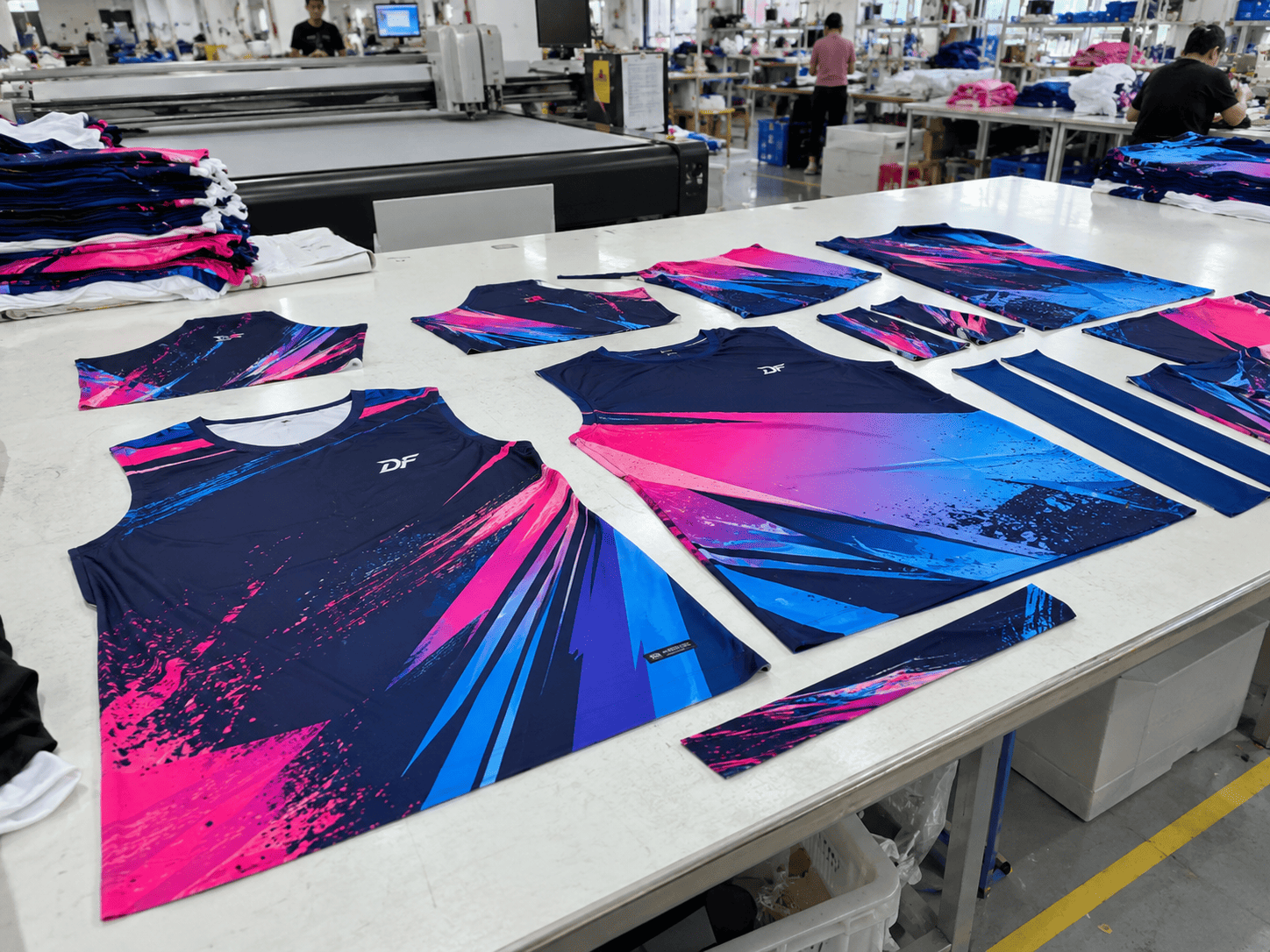
Digital textile printing has made complex full-coverage designs much easier to produce.
According to Mordor Intelligence[^1], the global digital textile printing market is estimated at approximately USD 3.09 billion in 2026 and is projected to reach about USD 4.28 billion by 2031.
Sublimation inks accounted for about 53.47% of the market in 2025, while garment and apparel applications represented approximately 56.89% of revenue.[^1]
But all-over print has technical limits.
And the biggest one is fabric.
Table of Contents
- What Is All-Over Print Clothing?
- Can You Do All-Over Print on Cotton?
- Which All-Over Print Method Should You Choose?
- How Should You Prepare Artwork for All-Over Print?
- What MOQ, Cost, and Timing Should You Expect?
- How Do You Choose an All-Over Print Manufacturer?
- Conclusion
What Is All-Over Print Clothing?
Most printed clothing uses a placement print.
The artwork may sit:
- On the chest
- On the back
- On one sleeve
- On one leg
All-over print works differently.
All-over print means the design extends across most or all of the garment, often including the front, back, sleeves, sides, and individual pattern panels. For higher-quality results, the print is usually planned before the garment is fully assembled.
That difference changes everything.
Placement Print vs All-Over Print
| Factor | Placement print | All-over print |
|---|---|---|
| Coverage | One defined area | Most or all garment panels |
| Printing stage | Usually after sewing | Often before final sewing |
| Typical methods | Screen print, DTG, heat transfer | Sublimation, roll digital print, rotary print |
| Typical fabric | Cotton, blends, polyester | Often polyester for sublimation |
| Artwork | One graphic at fixed size | Repeat pattern or panel-based artwork |
| Setup | Simpler | More artwork and panel preparation |
| Cost | Usually lower | Usually higher |
A placement print is applied to a garment.
An all-over print becomes part of the garment design itself.
That is why the artwork may need to follow:
- Front panel
- Back panel
- Sleeve
- Collar
- Hood
- Side panel
- Short leg
- Waist panel
rather than simply sitting inside one rectangular print area.
All-over print works especially well for:
- Sports jerseys
- Teamwear
- Cycling apparel
- Swimwear
- Leggings
- Resort wear
- Event shirts
- Bold fashion pieces
- Pattern-driven streetwear
It is less natural for some heavyweight cotton basics.
If your product is a 350 GSM cotton streetwear T-shirt with one bold back graphic, a screen print or other placement decoration may make more sense.
Our embroidery and screen-printing guide explains those alternatives.
Can You Do All-Over Print on Cotton?
This is one of the most common questions I get.
The short answer is:
Yes, cotton can be printed all over, but traditional dye sublimation is designed for polyester. If you want the classic vivid, durable sublimation result for a small or medium production run, polyester or polyester-rich fabric is still the most straightforward choice.
Traditional dye-sublimation works because the dye converts into a gas under heat and enters polyester-based material.
Epson's current dye-sublimation guidance states that, for standard dye-sub workflows, the best results come from white or light-colored polyester fabrics, and that cotton and dark fabrics should generally be avoided.[^2]
That is why polyester has dominated this process.
Fabric Options for All-Over Print
| Fabric | Typical result | Feel | Practical use |
|---|---|---|---|
| 100% polyester | Very vivid | Smooth, light | Best fit for traditional sublimation |
| Polyester-spandex | Vivid, stretchy | Soft, sporty | Activewear, leggings, fitted garments |
| Cotton-poly blend | Depends on fiber ratio and method | More cotton-like | May produce softer or less saturated effects |
| 100% cotton | Requires different ink system or special treatment | Natural | Possible, but not the default sublimation choice |
| Nylon-spandex | Requires suitable dye/print process | Smooth, technical | Swimwear, activewear |
Why Polyester Works So Well
Sublimation is different from laying a thick layer of ink on top of the surface.
The color becomes associated with the polyester substrate itself.
That gives the finished fabric several advantages:
- No thick ink hand
- Good stretch compatibility
- Strong color
- Lightweight feel
- Good suitability for activewear
- Good repeatability
That is why polyester-spandex is one of our usual recommendations for all-over printed apparel.
Modern performance polyester can also feel very different from the shiny, stiff polyester people sometimes remember from older uniforms.
It can be:
- Matte
- Soft
- Lightweight
- Stretchy
- Moisture-managing
- Smooth
depending on the knit and finishing.
Does This Mean Cotton Can Never Be Sublimated?
No.
This is where the technology is changing.
In September 2026, Epson announced a new Sublimation Primer for Cotton[^2] designed to make dye-sublimation possible on certain white and light-colored cotton garments.
That is an important development.
But it does not mean standard polyester sublimation and cotton sublimation are suddenly identical production systems.
For bulk apparel sourcing, you still need to ask:
- What cotton treatment is being used?
- Is it a primer or coating?
- What wash durability has been tested?
- What hand feel does it create?
- What quantities are practical?
- What printer and ink system is being used?
So for a first custom production run where you want predictable color and established production efficiency, polyester remains the safer mainstream answer for traditional sublimation.
Other Ways to Print Cotton
Cotton can also be printed using other textile-printing systems, including:
- Pigment printing
- Reactive printing
- Certain digital roll-printing systems
- Screen-based textile printing
Mordor Intelligence notes that pigment inks are growing partly because of their ability to print natural fibers, synthetic fibers, and blends, while reactive inks remain important for premium cotton applications.[^1]
Those systems have different:
- Pretreatment
- Washing
- Steaming
- Colorfastness
- MOQ
- Cost
requirements.
So when a supplier says:
"Yes, we can all-over print cotton."
the next question should be:
"Which printing process?"
Which All-Over Print Method Should You Choose?
"All-over print" describes the visual effect.
It does not describe one single printing method.
For many small and medium custom apparel orders, cut-and-sew sublimation offers the cleanest balance of full coverage, color consistency, low minimums, and design flexibility. Roll printing works well for larger production, while printing finished garments carries more risk of white gaps and missed areas.
Common All-Over Print Methods
| Method | How it works | Best for | Main limitation |
|---|---|---|---|
| Cut-and-sew sublimation | Fabric or panels printed, then garment sewn | Custom apparel, sportswear, small-mid runs | Best suited to polyester |
| Finished-garment sublimation | Completed blank pressed with transfer | Promo products | White gaps around folds and seams |
| Digital roll printing | Whole fabric roll digitally printed | Medium-large runs | Fabric MOQ / roll planning |
| Rotary screen printing | Pattern printed continuously using screens | Large-scale production | Higher setup and color limitations |
| Pigment digital printing | Pigment-based print on compatible fabric | Cotton, blends, varied fibers | Hand feel and wash performance depend on system |
| Reactive digital printing | Dye chemically bonds with suitable fibers | Premium cotton and cellulose fibers | More processing and washing required |
Why Cut-and-Sew Usually Looks Better
Imagine printing a finished T-shirt.
The fabric around:
- Underarms
- Side seams
- Sleeve joins
- Collars
- Folds
does not sit perfectly flat.
The transfer cannot reach every hidden area.
That creates white or unprinted creases.
For low-cost promotional products, that may be acceptable.
For a retail garment, it usually is not.
With cut-and-sew production, each garment panel is printed while flat.
Then it is cut and assembled.
That gives the printer much better control over edge coverage.
White and Light Base Fabrics
Traditional sublimation also needs a white or light polyester base.
Epson explains that dye sublimation does not use white ink, which is why standard sublimation blanks are normally white or light colored.[^2]
So if your final garment looks black, that does not necessarily mean the mill started with black fabric.
The black may be part of the printed artwork.
That is an important detail for buyers to understand.
Our Production Setup
We sew the garments in our own factory.
Specialized all-over printing is handled by long-term printing workshops that we manage directly.
Before bulk production, we coordinate:
- Fabric
- Print method
- Artwork
- Color
- Strike-off
- Panel placement
- Cutting
- Sewing
- Final inspection
The printing workshop handles its specialist process.
We remain responsible for integrating that process into the finished garment.
How Should You Prepare Artwork for All-Over Print?
Artwork is one of the biggest reasons an AOP project slows down.
A file that works perfectly for a chest print may be completely unsuitable for all-over printing.
For all-over print, provide high-resolution raster artwork or vector artwork, define whether the design is a seamless repeat or engineered print, give the desired physical motif size, and approve a strike-off on the actual fabric before bulk printing.
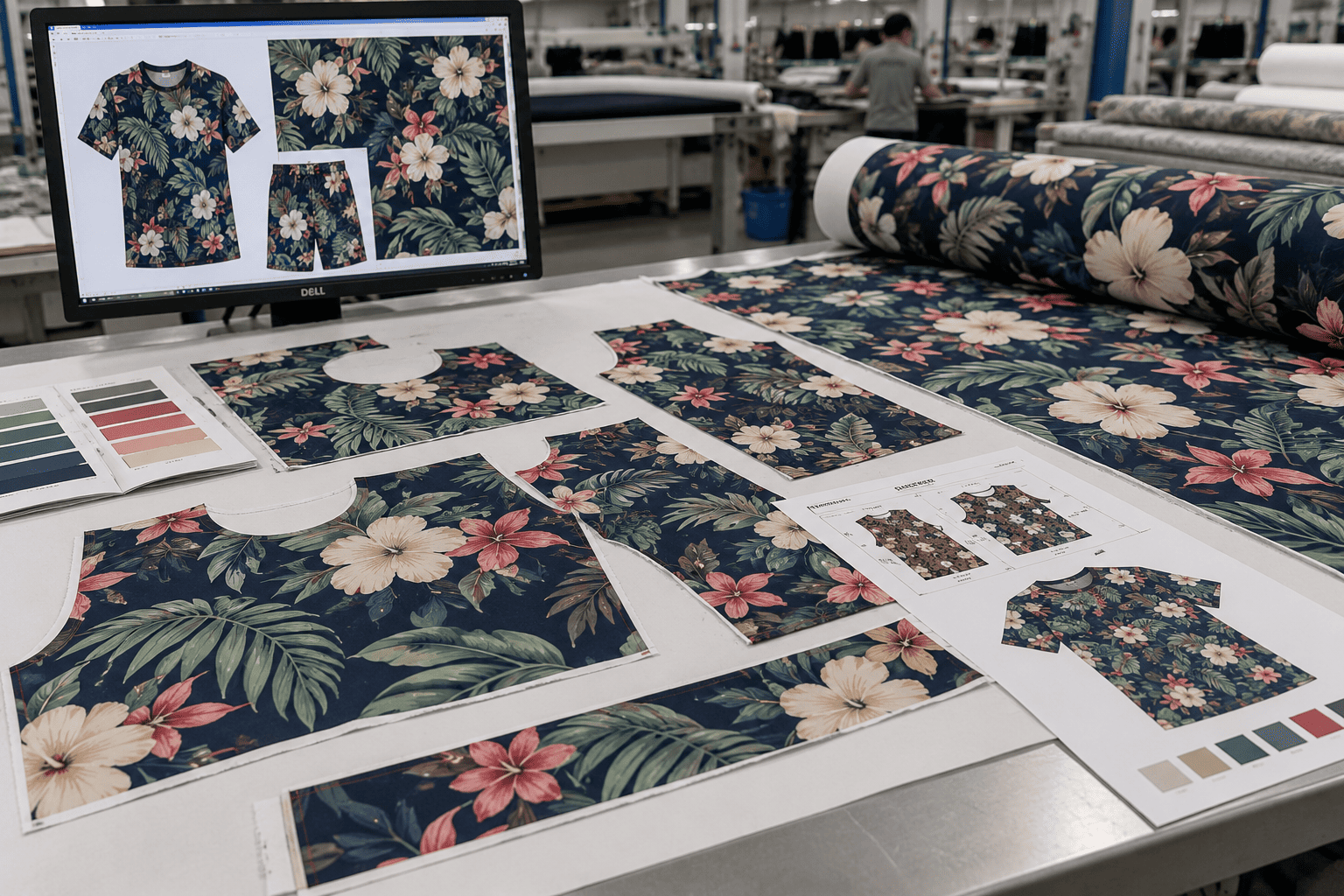
There are two main artwork approaches.
1. Seamless Repeat
A repeat pattern tiles continuously.
Think of:
- Camouflage
- Floral prints
- Geometric patterns
- Repeating logos
- Abstract designs
This type of artwork is easier to scale across different garment sizes.
2. Engineered Print
An engineered print is positioned intentionally.
For example:
- One large face centered on the front
- A stripe aligned down the sleeve
- A gradient moving from body to sleeve
- Artwork that crosses the side seam
- A logo positioned at the thigh
This type requires much more panel planning.
Artwork Checklist
| Item | What to provide | Why it matters |
|---|---|---|
| File format | Vector or high-resolution raster | Prevents low-resolution printing |
| Pattern style | Repeat or engineered | Determines panel setup |
| Final motif size | Physical dimensions | Controls pattern scale |
| Color reference | Pantone or approved physical reference | Helps communicate target color |
| Size range | XS–XXL, etc. | Important for engineered artwork |
| Placement | Panel or garment location | Controls layout |
| Bleed | Extra artwork beyond cut edge | Prevents white edges |
| Background | Full color coverage if required | Helps hide seam variation |
Why Pantone Helps but Does Not Guarantee an Exact Digital Print Match
Color is one of the hardest parts of textile printing.
What you see on your laptop is emitted light.
What you see on fabric depends on:
- Ink
- Fabric
- Printhead
- Heat
- Finishing
- Surface texture
- Lighting
Pantone's Fashion, Home + Interiors system[^3] is designed for fashion, apparel, and textile color communication, and Pantone specifically identifies TCX for textiles and soft surfaces.
That gives the brand and factory a shared target.
But Pantone itself also explains that color appearance varies with material and production process.[^3]
So the correct process is not:
Send Pantone → assume bulk is perfect.
It is:
Send Pantone → print strike-off → review → adjust → approve.
What Is a Strike-Off?
A strike-off is a small test printing of the actual design on the intended production fabric.
It allows you to check:
- Color
- Scale
- Sharpness
- Detail
- Background
- Contrast
- Fabric interaction
before the factory prints the full run.
Always approve the strike-off before bulk when color matters.
Engineered Prints and Size Grading
A repeat pattern can normally continue across multiple sizes.
An engineered print is more complicated.
A graphic that fills a size M front panel may look too small on XXL.
The artwork may therefore need to be adjusted for each size.
This creates additional artwork-preparation time.
Tell the manufacturer the full size range before the print file is finalized.
We do not operate as a graphic-design studio, so customers normally provide their own artwork.
We can then advise on:
- Scale
- Bleed
- Panel placement
- Production feasibility
before sampling.
What MOQ, Cost, and Timing Should You Expect?
All-over printing normally costs more than a standard placement print.
That is because far more surface area is printed.
For our lighter custom garments such as T-shirts, the garment MOQ generally starts from around 100 pieces per style. All-over printing then adds its own cost depending on fabric, print method, number of designs, panel complexity, and total quantity.
What Drives All-Over Print Cost?
| Cost driver | Effect |
|---|---|
| Print coverage | More printed area uses more ink and processing |
| Fabric | Performance polyester-spandex generally costs more than basic polyester |
| Quantity | Production becomes more efficient at higher volume |
| Number of designs | Each artwork requires preparation |
| Repeat vs engineered | Engineered layouts require more work |
| Number of panels | More panels increase print and matching complexity |
| Size range | Engineered artwork may need adjustment |
| Color testing | Strike-offs add development time |
One Design vs Multiple Designs
This matters more than buyers expect.
Suppose you order:
210 pieces total.
That could mean:
- 210 pieces of one design
or:
- 70 pieces × 3 designs
Those are not the same production program.
Each design may require:
- File preparation
- Strike-off
- Color approval
- Production setup
- Sorting
- Cutting management
So always ask whether the MOQ is calculated:
- Per style
- Per print design
- Per colorway
- Or as total order quantity
What If Your Budget Is Tight?
If you want a lower-risk first order, you do not need to make the whole collection all-over print.
A common strategy is:
- Several solid styles
- Placement embroidery or screen print
- One hero all-over print design
That gives the collection visual impact without putting all your production budget into expensive print coverage.
Timing
All-over print sampling usually includes an additional approval step:
- Artwork check
- Fabric confirmation
- Strike-off
- Color adjustment if needed
- Sample printing
- Sewing
- Sample approval
- Bulk print
- Cutting
- Sewing
- QC
That is why color approval should happen before full bulk printing.
For new customers, our bulk payment terms typically involve a production deposit followed by the balance before shipment, depending on the project.
Our low MOQ clothing guide explains how garment minimums are structured, while our clothing sample guide explains the development process.
How Do You Choose an All-Over Print Manufacturer?
The biggest risk with all-over print is a supplier that says yes to everything.
A good manufacturer understands the limits of the process.
Choose a supplier that explains which fabrics fit the printing method, uses appropriate cut-and-sew production when needed, provides strike-offs, asks for proper artwork and size information, checks seams and white gaps, and respects intellectual-property rights.
Green Flags and Red Flags
| Green flag | Red flag |
|---|---|
| Explains fabric limitations | "Any fabric, no problem" |
| States the actual printing method | Uses vague term "digital printing" only |
| Sends a strike-off | Prints bulk immediately |
| Requests full-size artwork | Accepts a tiny JPG |
| Discusses panel bleed | Ignores edges and seam coverage |
| Checks size range for engineered print | Uses same artwork blindly for every size |
| Explains cotton limitations honestly | Promises standard polyester sublimation on untreated cotton |
| Refuses unauthorized IP | Offers to print any character or logo |
Inspect the Seams
When the sample arrives, check:
- Underarms
- Side seams
- Sleeve seams
- Neck
- Hem
- Panel joins
Look for:
- White gaps
- Misaligned patterns
- Broken artwork
- Color changes
- Poor panel matching
Then stretch the fabric.
Some sublimated polyester fabric may reveal more of the white base when heavily stretched.
Whether that is acceptable depends on the product.
For leggings or highly elastic sportswear, this should be tested carefully before approval.
Wash Test the Print
Color durability also matters.
Do not approve all-over print only based on a fresh sample.
Wash the garment and compare it with the original approved sample.
For U.S. apparel, the Federal Trade Commission Care Labeling Rule[^4] requires covered textile apparel to carry appropriate regular care instructions.
That means your care label should match the actual fabric and print system you tested.
Copyrighted Artwork and Brand Logos
All-over printing makes it easy to reproduce:
- Famous characters
- Designer patterns
- Brand logos
- Licensed artwork
- Sports graphics
That does not mean a factory should print them without authorization.
The World Intellectual Property Organization[^5] explains that registered trademarks generally give their owners exclusive rights to use the registered mark or license others to use it.
WIPO's guidance on character merchandising also explains that fictional-character use is commonly handled through licensing agreements covering specific products and rights.[^5]
We do not reproduce protected logos, licensed characters, or copyrighted commercial artwork without appropriate authorization.
For licensed collaborations, we may request written confirmation.
Factory Compliance Is Separate From Print Quality
Supplier social compliance is useful, but it is not the same thing as print quality.
SMETA, created and stewarded by Sedex[^6], evaluates areas including labour standards, health and safety, environmental performance, and business ethics.
That helps buyers understand supplier-site practices.
But a SMETA audit does not tell you whether:
- Your Pantone color is correct
- The print aligns across a seam
- The garment has white underarm gaps
- The artwork is sharp
Those still require product sampling and QC.
We use factory compliance and product-quality control as separate parts of supplier verification.
Conclusion
All-over print is not just a bigger version of a chest print.
It is a different production system.
The fabric, print chemistry, artwork, panel layout, cutting, sewing, and color approval all need to work together.
For traditional small-to-medium dye-sublimation apparel production, polyester and polyester-spandex remain the most practical starting points.
Cotton can be all-over printed too, but it normally requires:
- A different ink system
- A different production method
- Or a special treatment or primer
So do not ask only:
"Can you all-over print this?"
Ask:
"Which print method are you using?"
"Which fabric does that method require?"
"Will you send a strike-off?"
"How do you control panel placement?"
"How do you prevent white gaps?"
"How will the print look after washing?"
Then check the real sample.
All-over print can create some of the strongest visual products in a collection.
But only when the printing method and fabric are designed together from the beginning.
Footnotes & References
[^1]: Mordor Intelligence — Digital Textile Printing Market Size & Share Analysis. The global digital textile printing market is estimated at approximately USD 3.09 billion in 2026 and projected to reach about USD 4.28 billion by 2031. Sublimation inks accounted for approximately 53.47% of market share in 2025, while garments and apparel represented around 56.89% of application revenue.
https://www.mordorintelligence.com/industry-reports/global-digital-textile-printing-market
[^2]: Epson — Dye-Sublimation Printing Guidance / Sublimation Primer for Cotton. Epson's standard dye-sublimation guidance recommends white or light-colored polyester fabrics and explains that traditional dye-sub does not work directly on untreated cotton. In September 2026, Epson also announced a cotton primer designed to extend sublimation to certain white and light-colored cotton garments.
https://epson.com/sublimation-printers-for-makers
https://news.epson.com/news/surecolor-f370-cotton-primer-dye-sublimation
[^3]: Pantone — Fashion, Home + Interiors. Pantone's official color system for fashion, textiles, apparel, and soft goods. Pantone identifies TCX for textile applications and explains that material and production process influence how a color appears.
https://www.pantone.com/na/en-us/fashion-home-interiors
[^4]: U.S. Federal Trade Commission — Care Labeling of Textile Wearing Apparel & Certain Piece Goods. Official U.S. rule requiring covered textile apparel manufacturers and importers to provide appropriate regular-care instructions.
https://www.ftc.gov/legal-library/browse/rules/care-labeling-textile-wearing-apparel-certain-piece-goods
[^5]: World Intellectual Property Organization — Trademarks / Character Merchandising. WIPO explains trademark ownership and licensing rights and provides guidance on licensing fictional characters for merchandising on products such as apparel.
https://www.wipo.int/en/web/trademarks/
https://www.wipo.int/documents/d/copyright/docs-en-wo_inf_108.pdf
[^6]: Sedex — SMETA Audit. Official Sedex information on SMETA, a social-audit methodology covering labour standards, health and safety, environmental performance, and business ethics.
https://www.sedex.com/solutions/smeta-audit/