


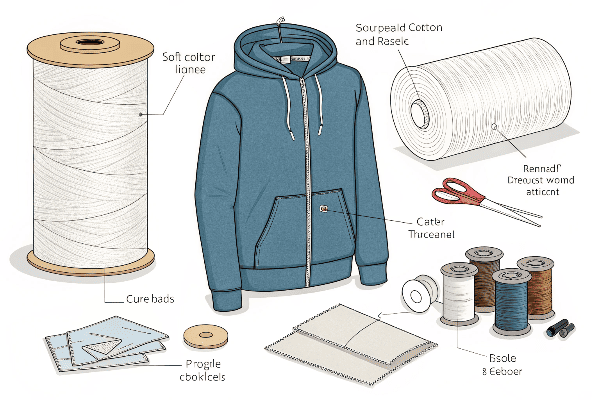
When I explain hoodie production to new buyers, one of the first questions I hear is: What raw materials do you use to make hoodies?
This question matters because the choice of fabric decides comfort, durability, and cost.
The main raw materials for hoodies are cotton, polyester, and blended fabrics. Premium hoodies often use 100% cotton fleece or French terry (400–500 GSM), while basic hoodies use cotton-poly blends. Some luxury brands add organic cotton, bamboo fibers, or merino wool for extra softness.
I remember a client who changed from a 60% cotton/40% polyester blend to 100% heavy cotton French terry. The look and feel of the hoodie completely changed and their retail price doubled.
Table of Contents
- Why is cotton the most common raw material?
- Why is polyester often blended with cotton?
- What is French terry and fleece?
- What other raw materials are used in premium hoodies?
- Why does GSM depend on raw material choice?
- Other components besides fabric
- Conclusion
Why is cotton the most common raw material?
Cotton is the main base for most hoodies.
Cotton is natural, breathable, and soft, which makes it ideal for daily wear.
- Comfortable and absorbs moisture
- Soft feel on skin
- Can be brushed into fleece for a warm inside
- Takes dye well for rich colors
For high-quality hoodies, factories often use combed cotton or ring-spun cotton to achieve smoother and stronger fabric.
Learn more about sustainable cotton from Textile Exchange.
Why is polyester often blended with cotton?
Polyester is a synthetic fiber that helps control costs.
Polyester is added to hoodie fabric to reduce price, reduce shrinkage, and make hoodies lighter.
- 100% cotton: heavier, softer, higher cost
- Cotton/poly blend: cheaper, dries faster, less shrinkage
- Typical blends: 60/40 or 65/35 cotton to polyester
Most basic retail hoodies use blends because they are easier to maintain.
What is French terry and fleece?
These are not raw materials but fabric structures.
French terry and fleece are the two main fabric constructions for hoodies.
- French terry: Smooth surface outside, looped back inside. Light, breathable, and structured.
- Fleece: Smooth outside, brushed soft inside. Warmer and thicker.
Factories choose one of these based on the type of hoodie: lightweight fashion vs. cozy winter wear.
What other raw materials are used in premium hoodies?
Premium hoodies sometimes use natural or specialty fibers.
Organic cotton, bamboo fiber, and merino wool are common in high-end or eco-conscious hoodies.
- Organic cotton: Chemical-free farming, softer feel
- Bamboo fiber: Silky soft, moisture-wicking
- Merino wool: Warm, breathable, premium price
- Recycled fibers: Used in sustainable collections
These raw materials increase the cost but create a distinct texture. For eco-conscious collections, refer to guides from Common Objective.
Why does GSM depend on raw material choice?
Fabric weight is affected by the raw material.
High-quality hoodies often use 400–500 GSM cotton-based fabrics, while basic hoodies use 280–320 GSM cotton/poly blends.
| GSM (grams per square meter) | Raw material type | Typical use |
|---|---|---|
| 280–320 GSM | Cotton-poly blend | Basic hoodies |
| 350–400 GSM | 100% cotton or cotton blend | Midweight hoodies |
| 400–500 GSM | 100% cotton French terry | Premium hoodies |
Other components besides fabric
A hoodie also needs trims and accessories.
Drawstrings, rib knit cuffs, eyelets, zippers, labels, and lining are all made from additional raw materials like cotton ribbing, polyester thread, and metal or plastic hardware.
These parts are small but important for both function and appearance.
Conclusion
The main raw materials for hoodies are cotton and polyester. High-end hoodies use 100% cotton fabrics like fleece or French terry, while basic hoodies often use cotton-poly blends. For eco or luxury models, organic cotton, bamboo, or merino wool are used to create a premium feel.