


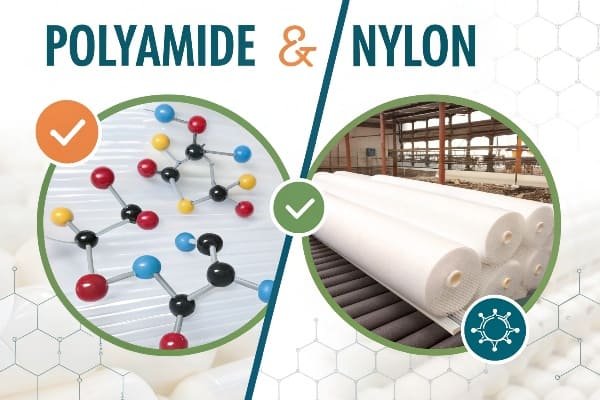
You’ve probably seen “polyamide” and “nylon” listed on fabric tags—and wondered if they’re the same thing. They’re often used interchangeably, but technically, they’re not identical.
Nylon is a specific type of polyamide. Polyamide is the broader chemical category, while nylon refers to a particular synthetic fiber within that category—like Nylon 6 or Nylon 6,6. In fashion, both terms usually mean the same material.
I’ve worked with fabric mills and technical spec sheets that use both terms. In most apparel contexts, polyamide is nylon—but understanding the nuance helps when sourcing or comparing materials[^1].
Table of Contents
- What exactly is polyamide?
- What is nylon and how is it different?
- Why do some labels say polyamide and others say nylon?
- Are there performance differences between polyamide and nylon?
- Conclusion
What exactly is polyamide?
Let’s start from the top—what is this material made of?
Polyamide is a type of polymer made from repeating units linked by amide bonds. It can be either synthetic (like nylon) or natural (like proteins in wool or silk). In textiles, polyamide typically refers to man-made fibers like nylon.
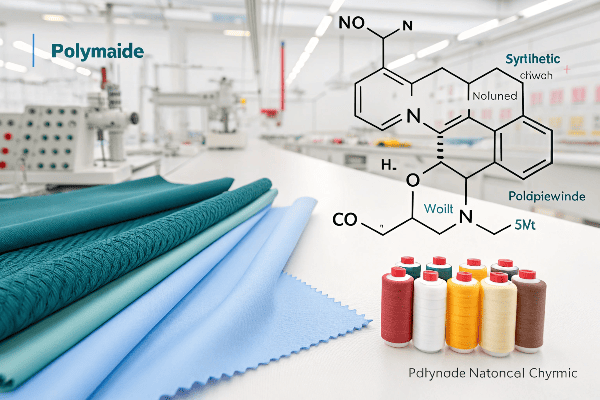
Types of polyamides
| Polyamide Type | Examples |
|---|---|
| Synthetic Polyamide | Nylon 6, Nylon 6,6 |
| Natural Polyamide | Wool (keratin), Silk (fibroin) |
| Aromatic Polyamide | Kevlar, Nomex |
So yes—nylon is one of several kinds of synthetic polyamide. In fashion, it’s by far the most common.
What is nylon and how is it different?
Nylon was the first synthetic polyamide made for textiles.
Nylon is a branded form of synthetic polyamide first introduced by DuPont in 1935. Today, “nylon” often refers to Nylon 6 or Nylon 6,6—strong, elastic, quick-drying materials widely used in clothing, swimwear, and gear.
Nylon types in clothing
| Nylon Variant | Features |
|---|---|
| Nylon 6 | Softer, more elastic |
| Nylon 6,6 | Stronger, more heat- and abrasion-resistant |
| Recycled Nylon | Eco-friendly, made from industrial or ocean waste |
Brands like Patagonia and Girlfriend Collective often specify which type of nylon is used in their recycled or performance gear.
Why do some labels say polyamide and others say nylon?
It’s mostly about terminology preferences and international labeling standards.
In the U.S., “nylon” is the common term. In Europe and Asia, “polyamide” is more frequently used on fabric content labels—even though they refer to the same fiber.
Regional naming tendencies
| Region | Common Label Term |
|---|---|
| United States | Nylon |
| Europe | Polyamide |
| China/Japan | Polyamide or Nylon |
| Technical Specs | Polyamide (always) |
In EU-compliant labeling systems like those used on Farfetch, “polyamide” is required even if the item is made of nylon 6,6.
Are there performance differences between polyamide and nylon?
In clothing? Almost none. In industrial use? Maybe.
For fashion and sportswear, there’s no difference in performance—both nylon and polyamide offer high stretch, durability, and moisture-wicking. In technical fabrics like Kevlar, “polyamide” includes more specialized materials.
Fiber property comparison
| Property | Nylon / Polyamide Performance |
|---|---|
| Strength | Excellent |
| Abrasion Resistance | High |
| Moisture Wicking | Fast-drying |
| Elasticity | Great (esp. with spandex) |
| Breathability | Moderate |
Most performance garments, from Nike leggings to Arc'teryx shells, use nylon blends under the “polyamide” label depending on the region of sale.
Conclusion
Polyamide is the chemical family, and nylon is a specific type within it. In clothing, “polyamide” and “nylon” usually mean the same thing—strong, stretchy, moisture-wicking synthetic fabric that performs well in activewear, swimwear, and outerwear.
[^1]: “Polyamide” refers to any polymer linked by amide bonds, while “nylon” typically refers to textile-grade synthetic types like Nylon 6 or 6,6.